Contract clause
Bonus clause: discretionary, formula or both
A bonus clause sets out whether an employee can earn a payment on top of salary, what it is measured against, when it is assessed and paid, and what happens if the employee leaves. The key question it answers is whether the bonus stays discretionary or becomes an entitlement once targets are met.
A bonus promised in an offer and described loosely in a contract is one of the most argued payments at the end of a job. The clause decides whether a departing employee walks away with a pro rata share or with nothing, so the leaver rule matters as much as the target.
Indunil Asanka · Co-founder
4 min read · Published
Sample clause
an employment contract between Northwind Solar Installations, a fictional residential solar installer in Perth, and its regional sales manager
6. Short Term Incentive 6.1 The Employee is eligible for a Short Term Incentive with a target of 10 percent of the Base Salary paid during each Financial Year. 6.2 The incentive is assessed against three Measures set in writing by 31 July each year: team sales revenue (50 percent), installations completed by the quoted date (30 percent) and safety audit results (20 percent). Each Measure is assessed separately and may pay between 0 and 150 percent of its share of the target. 6.3 Northwind Solar will assess the Measures by 31 August and pay any incentive in the next pay cycle. 6.4 If the Employee starts part way through a Financial Year, the incentive is calculated on the Base Salary actually paid in that year. 6.5 If the employment ends before 30 June for any reason other than serious misconduct, the Employee receives a pro rata incentive assessed on the Measures at the end of that Financial Year. 6.6 An incentive paid because of a calculation error may be recovered by agreement, or by a deduction the Employee authorises in writing.
Sample wording, not legal advice.
Variants
Fully discretionary bonus
An employer that wants to reward performance without creating a contractual entitlement.
The Employer may, in its absolute discretion, pay the Employee a bonus for any Financial Year. In deciding whether to pay a bonus and its amount, the Employer may consider the Employee's performance, the performance of the business and any other matter it considers relevant. No bonus is payable unless the Employer confirms it in writing, and a payment in one year creates no expectation of a payment in any other year.
Formula based entitlement
Sales roles where the employee needs certainty that meeting the number produces the money.
The Employee will be paid a bonus equal to 5 percent of the Gross Margin above $1,200,000 generated by the Employee's accounts in each Financial Year, calculated from the Employer's finalised management accounts. The bonus is paid within 30 days after those accounts are finalised. The Employer may not reduce a bonus calculated under this clause except to correct an error in the figures, which it must explain to the Employee in writing.
Company pool with individual allocation
Larger teams where the company result sets the pool and managers divide it.
Each Financial Year the Employer will fund a bonus pool equal to 8 percent of net profit before tax above the approved budget. The Employer will allocate the pool among eligible employees having regard to individual ratings under the performance review process, acting honestly and on reasonable grounds. An employee rated as meeting expectations will receive at least 50 percent of their target share of the pool.
What to negotiate
The leaver rule
Employers often write that a bonus is payable only if the employee is employed and not under notice on the payment date. That rule can wipe out a year of work because of a resignation in August. Employees ask for a pro rata payment for good leavers, such as redundancy or illness, with forfeiture kept for serious misconduct.
Who sets the measures, and when
Measures fixed after the year starts, or changed during it, turn a target into a moving line. Employees ask for written measures within a month of the year starting and a rule that changes need agreement. Employers want room to adjust for an acquisition or a major market change, which can be allowed with a written explanation.
The risk of leaving it out
Without a written bonus clause, an incentive promised at interview may still be enforceable as a term of the contract, but its measures, timing and leaver treatment are left to recollection. The employer risks a claim for a full bonus from an employee who has left, and the employee risks receiving nothing because nothing was written down.
Discretionary or contractual
The label matters less than the wording underneath it. A clause saying the employee will be paid a stated amount when measures are met creates an entitlement, and the employer cannot withhold it simply by calling the bonus discretionary somewhere else. A clause that leaves both the decision and the amount to the employer is much harder to claim under, although an employer that sets up a review process and then ignores it invites a dispute about how the discretion was used. Hybrid clauses are common because they give each side part of what it wants: a pool the business can afford and a floor the employee can rely on.
Superannuation and termination pay
Many bonuses count as ordinary time earnings, which makes them qualifying earnings for superannuation guarantee purposes, so the guarantee is paid on them within the same payday timeframe as salary. Redundancy pay under the National Employment Standards is calculated at the base rate for ordinary hours and does not include incentive based payments or bonuses, so a target bonus does not lift that figure. A clause that deals with redundancy in its leaver rule fills that gap by agreement.
Where it sits in a generated document
A generated employment contract numbers the incentive as its own clause beside remuneration, with the target, the measures, the payment date and the leaver rule as separate sub clauses. Because generated drafts do not cite sources, the superannuation treatment and any award interaction are checked before the document goes to the employee.
Documents that carry this clause
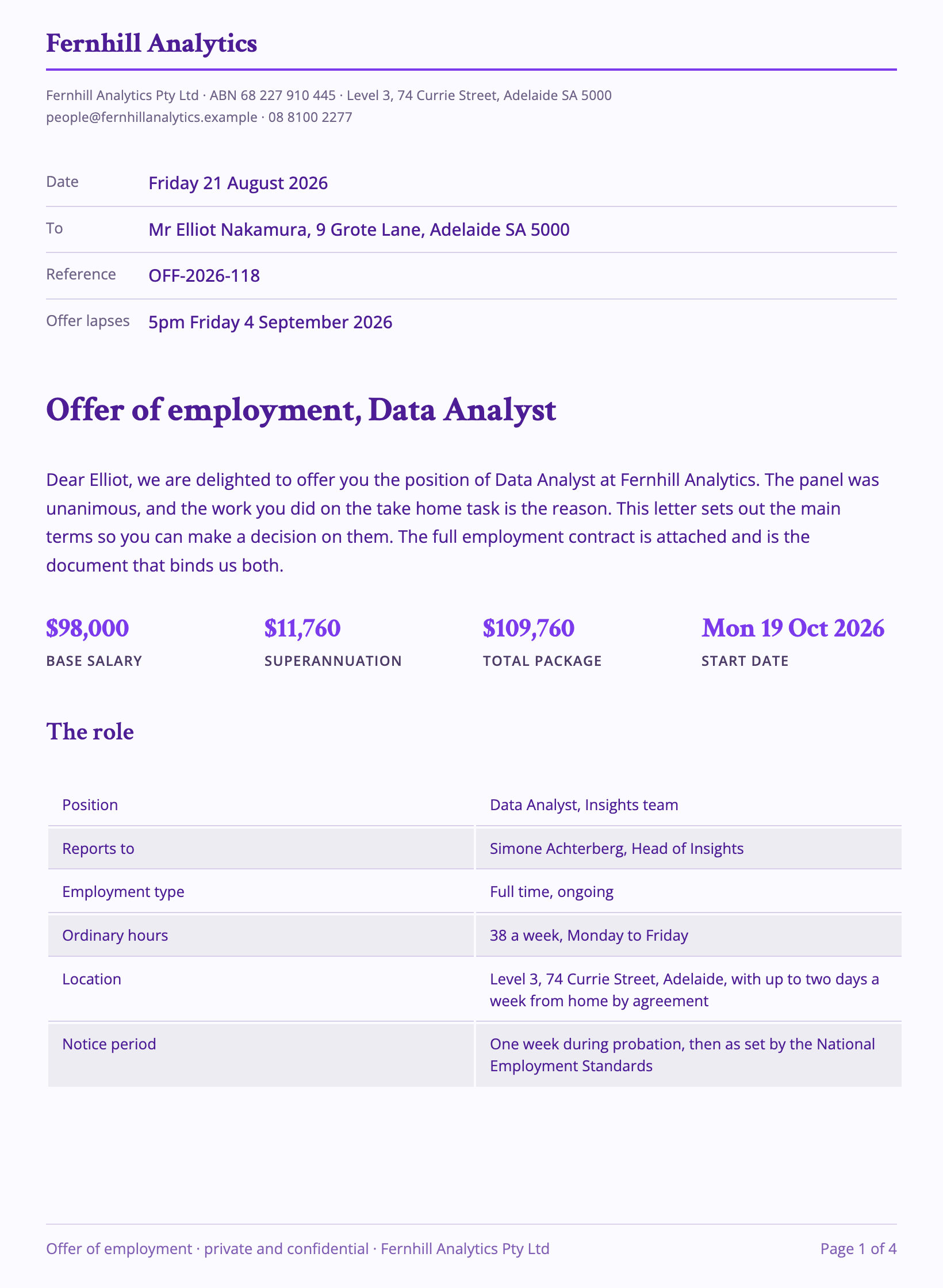 Job offer letterAn offer of $98,000 plus $11,760 of superannuation, with the three checks it depends on and a clear instruction not to resign until they clear. The letter also names what is not in the offer, which is the part candidates most often assume.
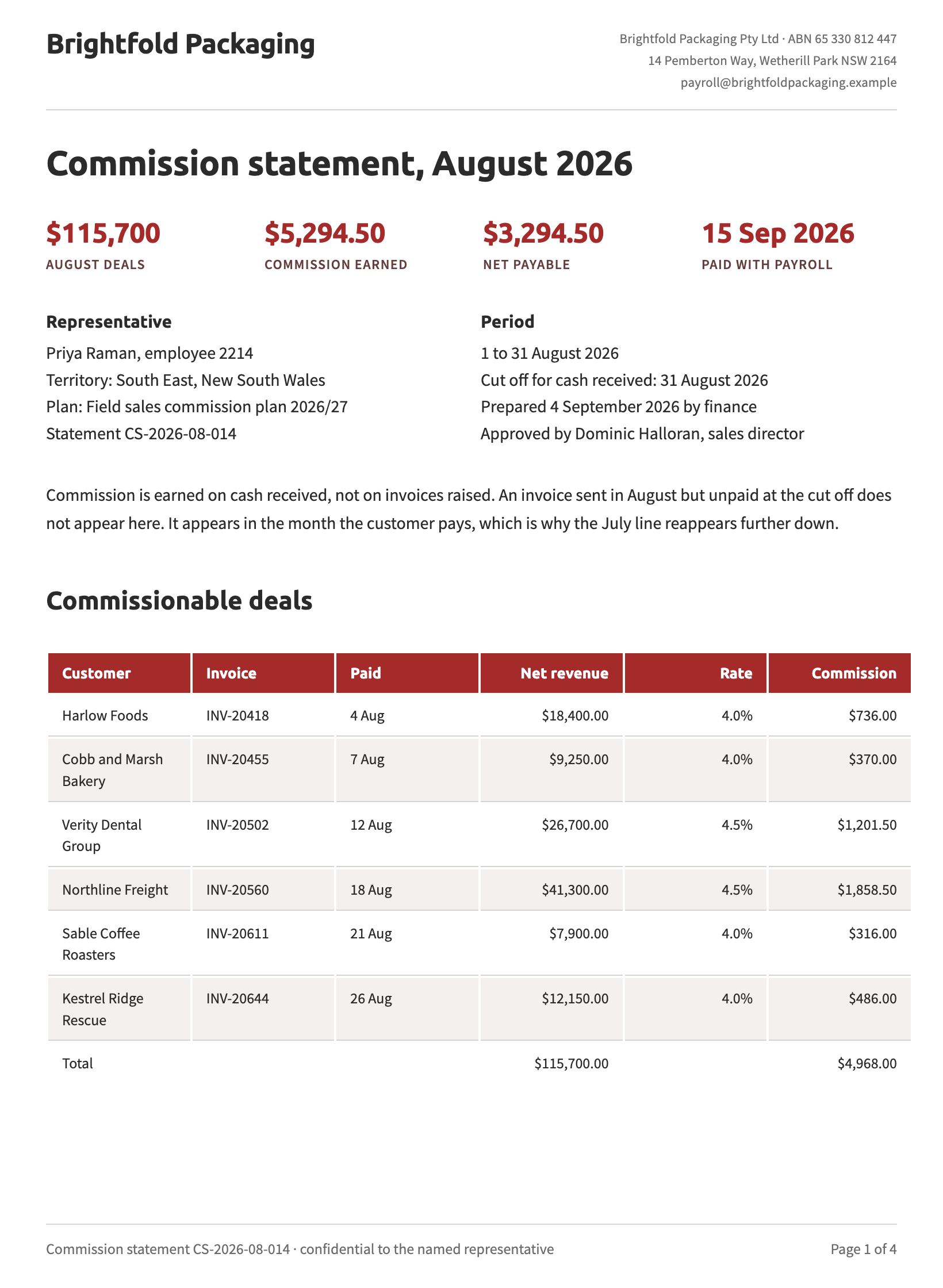 Commission statementA representative earns $5,294.50 in August and banks $3,294.50. The gap is a $2,000 draw being recovered, and the statement is built so that difference is explained on the page rather than in an email.
Questions people ask
Is a discretionary bonus enforceable?
A genuinely discretionary bonus is hard to enforce, because the employer has not promised to pay anything. The position changes if the contract or the offer letter promised a specific amount for meeting specific targets, or if the employer created a process and then failed to follow it. The wording and the surrounding documents decide which side of that line a bonus falls.
Do employees get a bonus if they resign?
Only if the clause provides for it. Many clauses require the employee to be employed on the payment date, which excludes anyone who has resigned. Others pay a pro rata amount to good leavers and nothing to those dismissed for serious misconduct. Without a rule, the answer depends on how the clause and the offer were worded.
Is superannuation paid on a bonus?
Often yes. The Australian Taxation Office treats many bonuses as ordinary time earnings, and ordinary time earnings are qualifying earnings on which the superannuation guarantee is calculated. A payment made only for overtime can be treated differently, so the ATO lists of ordinary time earnings are the place to check a particular bonus.
Can an employer recover a bonus paid by mistake?
An overpayment caused by a calculation error can usually be recovered, but a deduction from wages needs the employee's written authorisation or another lawful basis. A clause that sets out how errors are corrected and requires written consent to a deduction stops an employer simply withholding the amount from the next pay.
What is the difference between a bonus and a commission?
A commission is usually a fixed percentage of each sale, calculated and paid regularly as sales are made. A bonus is usually assessed at the end of a period against several measures, some of them not financial. From 1 July 2026 all commissions paid to employees are qualifying earnings for superannuation, which makes the distinction matter for payroll.
Should bonus measures be written into the contract?
The mechanism belongs in the contract, while each year's measures usually sit in a separate written plan. That lets targets change every year without a contract variation. The contract should require the plan to be issued in writing by a set date, so an employee is never assessed against measures nobody wrote down.
Put the clause in a finished document
The button opens the document generator with a starting description already filled in. Change it to match your own agreement before you run it.
Create a document with OneCraftRelated clauses
- Remuneration clause: the pay terms in an employment contractA remuneration clause sets what an employee is paid, how often and what the figure includes. Australian sample wording, package and hourly variants.
- Superannuation clause in an Australian employment contractA superannuation clause sets super contributions, the fund and the timing. Australian sample wording for 2026 with the 12 percent rate and Payday Super.
- Redundancy clause in an Australian employment contractA redundancy clause sets what happens when a role is no longer needed. Australian sample wording, the NES redundancy pay scale and enhanced variants.
For everything the document generator can do, see the document maker.
Step by step in the builder: Create a document with AI, then Document builder components.
Written and checked by the OneCraft team. Last checked .