Contract clause
Remuneration clause: the pay terms in an employment contract
A remuneration clause states what an employee is paid, how often and by what method, and what the amount includes. It usually fixes a base salary or hourly rate, says whether superannuation is on top, and sets out how and when pay is reviewed during the employment.
Most pay disputes start with one ambiguous word, usually package, inclusive or review. A remuneration clause that states the base figure, what sits on top of it and what a review does and does not promise leaves nothing to interpret on the first pay slip.
Nuwan Madhusanka · Co-founder
4 min read · Published
Sample clause
an employment contract between Bellbird Freight Pty Ltd, a fictional logistics company in Geelong, and a transport operations coordinator
5. Remuneration 5.1 Bellbird Freight will pay the Employee a Base Salary of $92,000 a year, calculated on 38 ordinary hours a week. 5.2 Bellbird Freight will make superannuation contributions for the Employee in addition to the Base Salary, at the rate required by superannuation guarantee law. 5.3 The Base Salary is paid in equal fortnightly instalments by electronic funds transfer into the account the Employee nominates, and a pay slip is issued within 1 working day of each pay day. 5.4 The Base Salary is paid in satisfaction of the minimum wages, overtime, allowances and loadings under any modern award that applies to the Employee's role, for the hours the Employee works. If the award entitlement for a pay period is higher, Bellbird Freight will pay the difference. 5.5 The Base Salary is reviewed each July. A review does not oblige Bellbird Freight to increase it.
Sample wording, not legal advice.
Variants
Total package including superannuation
Senior roles where the offer is quoted as one figure and the employee accepts that superannuation comes out of it.
The Employee's Total Remuneration Package is $103,000 a year and includes the superannuation contributions the Employer is required to make. The Base Salary is the package less those contributions, calculated at the superannuation guarantee rate on qualifying earnings. If that rate increases, the Base Salary reduces by the same amount so that the package stays the same, unless the parties agree otherwise in writing.
Hourly rate under an award
Shift based roles where hours vary from week to week and every hour is paid.
The Employee is paid $36.50 for each ordinary hour worked, which the parties confirm is not less than the minimum rate for the Employee's classification under the applicable modern award. Overtime, penalty rates and allowances are paid as that award requires. Wages are paid weekly in arrears by electronic funds transfer, and superannuation is paid in addition at the rate required by law.
Salary with allowances
Roles with travel or on call duties, where part of the pay is tied to a cost or a duty rather than to time.
In addition to the Base Salary, the Employee receives a vehicle allowance of $9,000 a year and an on call allowance of $120 for each week rostered on call, both paid fortnightly. Each allowance is paid for the purpose stated, may be withdrawn on 4 weeks written notice if the Employee no longer has that duty, and is not part of the Base Salary when any payment on termination is calculated.
What to negotiate
On top of the package or inside it
Quoting a package that includes superannuation makes an offer look larger than the same salary plus super. Candidates comparing offers should convert each one to base salary. Employers who use packages should say what happens when the guarantee rate changes, because otherwise the employee expects the base to stay fixed while the employer expects the total to stay fixed.
What a review promises
An annual review clause is often read as a promise of a rise. Employers want to state that a review does not require an increase. Employees can ask for the month, the criteria and a written outcome, which makes the review real without fixing a number in advance.
The risk of leaving it out
Without a remuneration clause the employee is still owed at least the award or national minimum wage, paid at least monthly. What is lost is certainty about the agreed figure, whether superannuation sits inside or outside it, and whether a salary was meant to cover overtime and allowances, and each of those points tends to surface only when the employment ends.
Rules that apply whatever the clause says
Employers must pay employees at least monthly, by cash, cheque or electronic funds transfer, and give a pay slip within 1 working day of pay day. Pay secrecy terms that stop an employee sharing information about their own pay generally cannot be enforced. Superannuation guarantee contributions are 12 percent of qualifying earnings in the 2026 to 27 year, and since 1 July 2026 they must reach the fund within 7 business days after each pay day, so a clause that still promises quarterly super is out of date.
Salaries that absorb award entitlements
Many salaried employees are covered by a modern award, and a salary can be set to cover the award's overtime, penalty rates and allowances. That only works if the salary actually covers them for the hours worked. A clause that names the entitlements the salary absorbs and promises to pay any shortfall gives the employer a defensible position and the employee a clear remedy. Some awards set their own conditions for annual salaries, so the award is checked before the clause is finalised.
Where it sits in a generated document
In a generated employment contract the remuneration clause is numbered content placed after the duties and hours clauses, with the base figure, the pay cycle and superannuation as separate sub clauses that the leave and termination clauses can refer to by number. The draft never cites its sources, so the superannuation timing and any award reference are confirmed before the contract is signed.
Documents that carry this clause
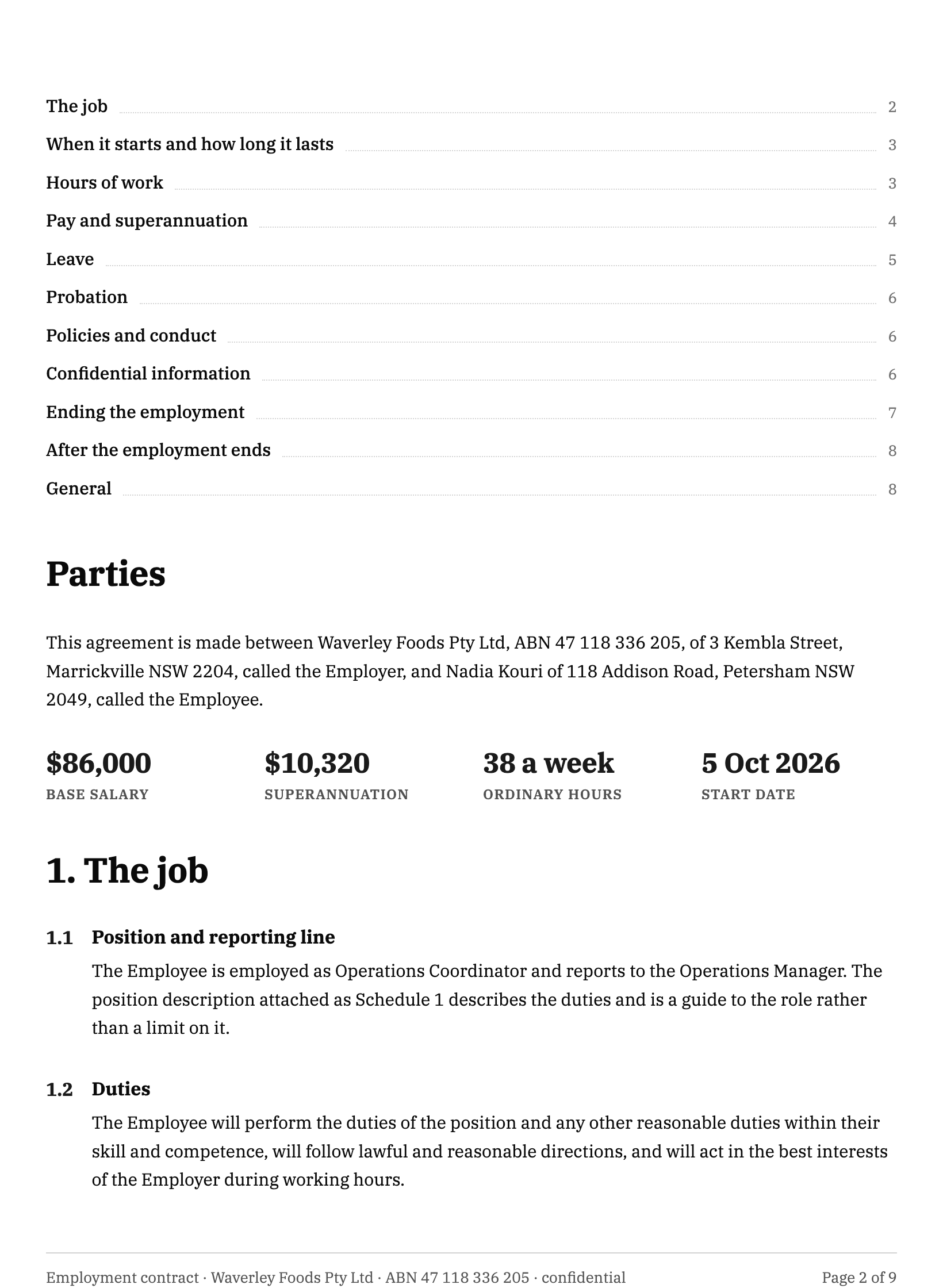 Employment contractA full time ongoing contract for an operations coordinator on $86,000 plus $10,320 of superannuation. Eleven numbered clauses, a leave table drawn from the National Employment Standards, and a notice table that scales with service.
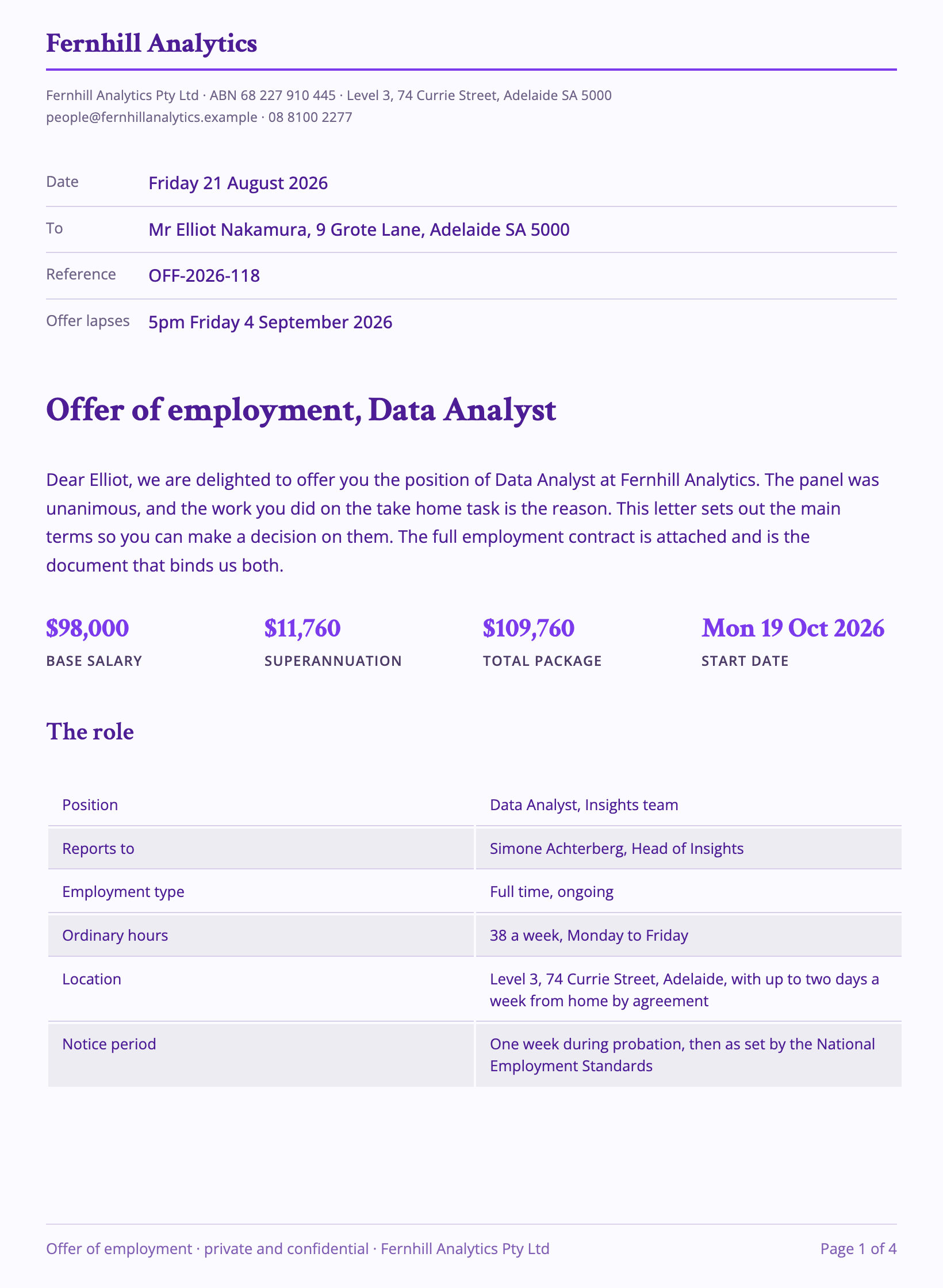 Job offer letterAn offer of $98,000 plus $11,760 of superannuation, with the three checks it depends on and a clear instruction not to resign until they clear. The letter also names what is not in the offer, which is the part candidates most often assume.
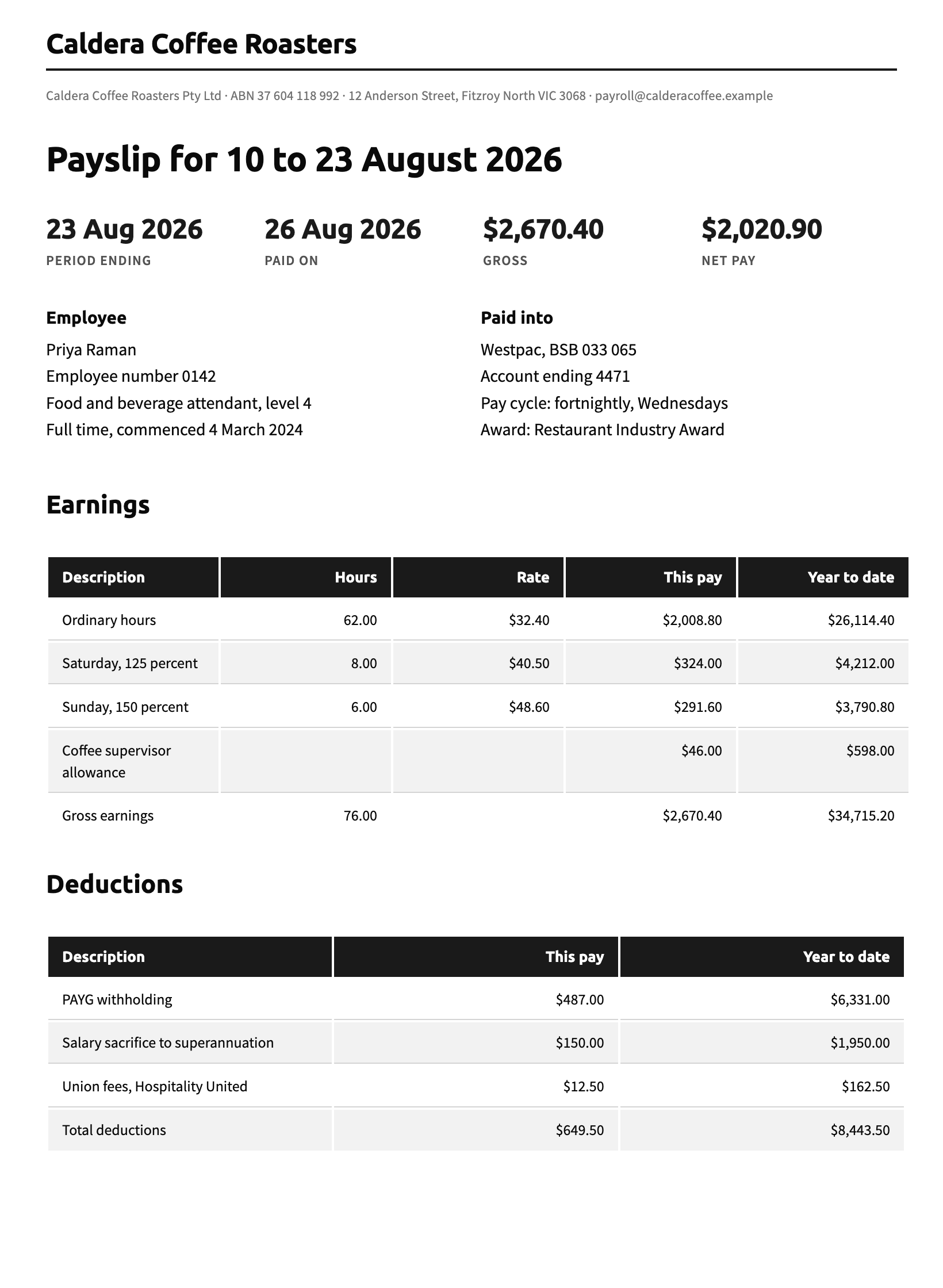 PayslipOne fortnight for a cafe supervisor paid by the hour, with weekend rates, a union deduction and a salary sacrifice. Half of a payslip is legally required; the other half is what stops the questions.
Questions people ask
Is superannuation included in a salary?
Only if the contract says so. A salary stated as plus superannuation means contributions are paid on top. A total package means superannuation comes out of the figure. Either way the employer must still contribute at least the guarantee rate on qualifying earnings, so the wording changes the base pay, not the minimum contribution.
How often must employees be paid in Australia?
At least monthly. Many employers pay weekly or fortnightly, and an award may require a particular frequency. A pay slip must be given within 1 working day of pay day, including when the employee is on leave. The remuneration clause should state the pay cycle so that everyone plans around the same dates.
Can a contract stop employees discussing their pay?
Generally no. Employees have a workplace right to share or not share information about their own pay and employment conditions, and pay secrecy terms inconsistent with that right cannot be enforced in most circumstances. A confidentiality clause can still protect business information, but it should not be drafted to cover an employee's own salary.
Does a salary cover overtime?
It can, if the contract says the salary is paid in satisfaction of overtime and the salary is high enough to cover what the award would require for the hours actually worked. Where the hours grow, the salary may stop covering them, and a shortfall promise in the clause protects both sides if that happens.
Must a salary be reviewed every year?
No law requires an annual increase to a contract salary, although award minimum rates change after the Fair Work Commission's annual wage review and a salary must stay above the new minimum. A review clause is a promise to consider pay at a set time, and it should say plainly whether an increase is guaranteed.
What happens if a salaried employee turns out to be underpaid?
The employer must make up the difference, and back pay can reach across many pay periods. A shortfall promise in the remuneration clause does not remove that liability, but it shows the parties intended the award to be met. A regular check of salary against the hours actually worked is the practical way to catch a gap early.
Put the clause in a finished document
The button opens the document generator with a starting description already filled in. Change it to match your own agreement before you run it.
Create a document with OneCraftRelated clauses
- Bonus clause: discretionary, formula or bothA bonus clause sets how an employee earns an incentive, when it is paid and what happens on leaving. Sample wording plus discretionary and formula variants.
- Superannuation clause in an Australian employment contractA superannuation clause sets super contributions, the fund and the timing. Australian sample wording for 2026 with the 12 percent rate and Payday Super.
- Overtime clause: paid, time off or built into salaryAn overtime clause says whether extra hours are paid, given as time off or absorbed in salary. Australian sample wording with an annual reconciliation.
For everything the document generator can do, see the document maker.
Step by step in the builder: Create a document with AI, then Document builder components.
Written and checked by the OneCraft team. Last checked .