Contract clause
Redundancy clause in an Australian employment contract
A redundancy clause sets out what happens when an employer no longer needs a job to be done by anyone. It describes the consultation and redeployment steps, the notice owed and the redundancy pay, and it may add an enhanced payment above the National Employment Standards, which remain the minimum for most employers.
Redundancy is the one ending where both sides agree nobody did anything wrong, which is why the payment and the process carry all the weight. A clause that commits to consultation, redeployment and a clear calculation makes a hard conversation shorter and the result easier to defend.
Nuwan Madhusanka · Co-founder
4 min read · Published
Sample clause
an employment contract between Ironbark Engineering Services, a fictional structural design firm in Newcastle with 40 staff, and a senior design drafter
12. Redundancy 12.1 Redundancy occurs when Ironbark Engineering Services decides it no longer requires the Employee's job to be done by anyone, for a reason other than the Employee's conduct or performance. 12.2 Before making a final decision, Ironbark Engineering Services will consult the Employee as required by any applicable award or enterprise agreement, give the Employee written information about the proposed change and its likely effects, and consider any alternatives the Employee raises. 12.3 Ironbark Engineering Services will consider whether the Employee can reasonably be redeployed to another role in its business or an associated entity. 12.4 If the employment ends because of redundancy, the Employee will receive notice or payment instead of notice under clause 11, and redundancy pay under the National Employment Standards calculated at the Employee's base rate of pay for ordinary hours. 12.5 Accrued but untaken annual leave and long service leave are paid in the final pay.
Sample wording, not legal advice.
Variants
National Employment Standards only
Employers with 15 or more employees who want the contract to match the statutory scale and nothing more.
If the Employee's position becomes redundant, the Employee is entitled to notice and redundancy pay in accordance with the National Employment Standards and any applicable award or enterprise agreement, and no additional payment is made under this agreement. The Employer will comply with any consultation obligations that apply before it makes a decision to terminate the employment.
Enhanced redundancy payment
Senior or long serving staff, or businesses that use a generous formula to support restructures.
If the Employee's position becomes redundant, the Employer will pay the greater of the redundancy pay under the National Employment Standards and 3 weeks of Base Salary for each completed year of continuous service, with a minimum of 8 weeks and a maximum of 52 weeks. The payment includes, and is not in addition to, the statutory redundancy pay. Any amount above the statutory redundancy pay is conditional on the Employee returning all Employer property.
Small business employer
An employer with fewer than 15 employees, which is generally not required to pay redundancy pay under the National Employment Standards.
At the date of this agreement the Employer is a small business employer for the purposes of the Fair Work Act 2009. If the Employee's position becomes redundant while the Employer remains a small business employer, the Employee is entitled to notice under clause 11 but not to redundancy pay under the National Employment Standards, unless an applicable award or enterprise agreement provides it. The Employer will consult the Employee before a final decision is made.
What to negotiate
The multiplier and the cap
Enhanced formulas are usually expressed as weeks per year of service with a cap. Employees with long service care most about the cap, while newer staff care about the minimum. Employers should model the cost across the whole team before agreeing, because a formula written for one senior hire tends to be copied into later contracts.
What pay the calculation uses
Statutory redundancy pay uses the base rate for ordinary hours and excludes bonuses, loadings, allowances, overtime and penalty rates. An employee whose income relies on regular overtime or commission may ask for an enhanced payment calculated on average earnings. Stating the calculation base avoids a dispute when the final pay is prepared.
The risk of leaving it out
Without a redundancy clause the National Employment Standards still set the minimum redundancy pay for employers with 15 or more employees, and any award consultation duties still apply. The contract simply offers nothing more, and the employer loses the chance to record redeployment and consultation steps that make a later redundancy easier to show as genuine.
The National Employment Standards redundancy pay scale
An employee of an employer with at least 15 employees who has at least 1 year of continuous service is entitled to redundancy pay on this scale: at least 1 but less than 2 years, 4 weeks; 2 to less than 3 years, 6 weeks; 3 to less than 4 years, 7 weeks; 4 to less than 5 years, 8 weeks; 5 to less than 6 years, 10 weeks; 6 to less than 7 years, 11 weeks; 7 to less than 8 years, 13 weeks; 8 to less than 9 years, 14 weeks; 9 to less than 10 years, 16 weeks; and at least 10 years, 12 weeks. Notice of termination is owed in addition.
What makes a redundancy genuine
A redundancy is genuine when the job no longer needs to be done by anyone because of changes in the business and the employer has followed the consultation requirements in the relevant award or enterprise agreement. It is not genuine if the employee could reasonably have been given another job within the business or an associated entity. An employee made genuinely redundant cannot obtain an unfair dismissal remedy. An employer considering 15 or more redundancies must also notify Services Australia in writing before the dismissals happen.
Where it sits in a generated document
In a generated employment contract redundancy is a numbered clause placed after notice of termination, so the payment sub clause can refer back to the notice clause by number. The generated text does not print sources, so the pay scale and any small business exemption in a draft are checked against the Fair Work Ombudsman's current guidance before the contract is signed.
Documents that carry this clause
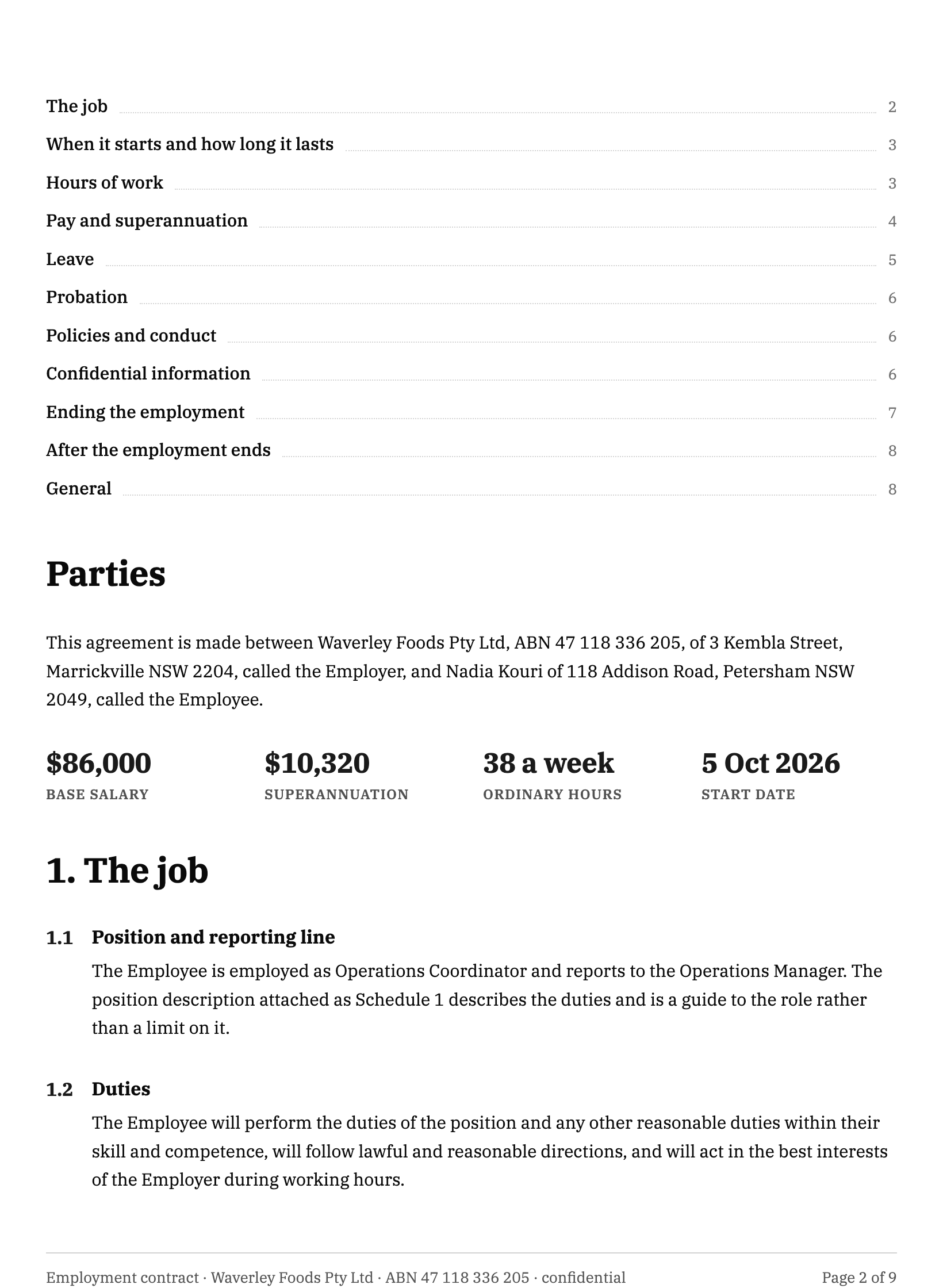 Employment contractA full time ongoing contract for an operations coordinator on $86,000 plus $10,320 of superannuation. Eleven numbered clauses, a leave table drawn from the National Employment Standards, and a notice table that scales with service.
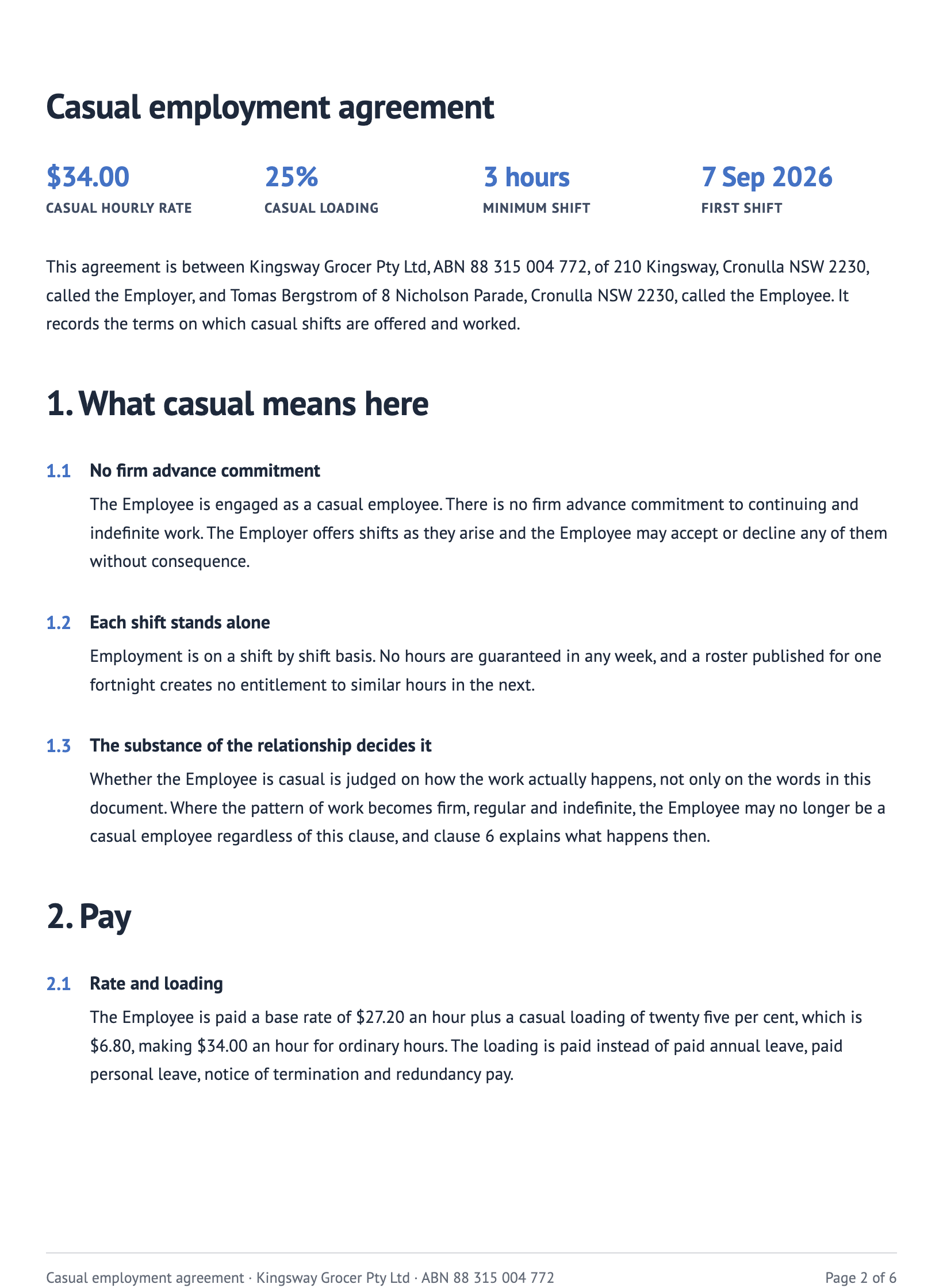 Casual employment agreementA retail assistant is paid $34.00 an hour, which is a base of $27.20 plus a twenty five per cent loading. The agreement shows how every other rate is built from that base, and what the loading is paid instead of.
Questions people ask
Who is not entitled to redundancy pay?
Under the National Employment Standards, redundancy pay generally does not apply to employees with less than 1 year of continuous service, casual employees, apprentices, trainees employed only for the training arrangement, or employees of a small business employer with fewer than 15 employees. An award or enterprise agreement can provide different entitlements, so it is checked first.
How is a small business counted for redundancy?
The count is taken at the time of the redundancy and includes the employees being made redundant, other full time and part time staff, regular and systematic casuals, and employees of associated entities. An employer that falls under 15 employees because it is downsizing may still have to pay redundancy pay under the National Employment Standards.
Can an employer reduce redundancy pay?
An employer can apply to the Fair Work Commission to reduce redundancy pay under the National Employment Standards if it has found the employee other acceptable employment or cannot afford the full amount. That option is not available where the entitlement comes from an award or an enterprise agreement, and a contract cannot reduce the statutory amount.
Does redundancy pay include bonuses or allowances?
No. Redundancy pay under the National Employment Standards is calculated at the base pay rate for ordinary hours and excludes incentive payments, bonuses, loadings, monetary allowances, overtime and penalty rates. An enhanced contractual payment can use a wider base if the parties agree, and the clause should describe that base in plain terms.
Is notice paid as well as redundancy pay?
Yes. An employer making a job redundant must still give notice of termination or pay instead of notice, in addition to redundancy pay. Outstanding entitlements such as unused annual leave and long service leave are also paid out in the final pay, so the redundancy payment is only one part of the final amount.
Does a redundancy clause stop an unfair dismissal claim?
Not by itself. What prevents an unfair dismissal remedy is a genuine redundancy: the job is no longer needed, the consultation obligations were followed and redeployment was not reasonably available. A clause that commits to consultation and redeployment helps the employer follow that process, but the process still has to actually happen.
Put the clause in a finished document
The button opens the document generator with a starting description already filled in. Change it to match your own agreement before you run it.
Create a document with OneCraftRelated clauses
- Notice period clause in an employment contractA notice period clause sets how much notice ends employment. Australian sample wording, the National Employment Standards minimums and three variants.
- Leave entitlements clause in an employment contractA leave entitlements clause lists annual, personal and other leave in an employment contract. Australian sample wording, NES minimums and three variants.
- Bonus clause: discretionary, formula or bothA bonus clause sets how an employee earns an incentive, when it is paid and what happens on leaving. Sample wording plus discretionary and formula variants.
- Remote work clause: hybrid, fully remote or by requestA remote work clause sets where an employee works, on which days and on what conditions. Sample hybrid wording, fully remote and UK variants, and what to agree.
For everything the document generator can do, see the document maker.
Step by step in the builder: Create a document with AI, then Send a document for signature.
Written and checked by the OneCraft team. Last checked .