Contract clause
Remote work clause: hybrid, fully remote or by request
A remote work clause records where an employee may work, how many days are spent at the office, and the conditions attached to working from home, such as a safe workspace, equipment and availability. It turns an informal arrangement into a term that says who can change it and how.
Hybrid arrangements agreed over a coffee tend to unravel when a manager changes or the lease on the office does. A clause that names the days, the workspace rules and the notice needed to change them protects the arrangement for both sides.
Nuwan Madhusanka · Co-founder
4 min read · Published
Sample clause
an employment contract between Lyrebird Accounting Group, a fictional accounting practice in Brisbane, and a client services manager moving to a hybrid pattern
9. Place of Work 9.1 The Employee's Primary Workplace is Lyrebird Accounting Group's office at the address in the Schedule. The Employee may work from the Home Workplace on up to 2 days in each week, and attends the Primary Workplace on the Team Days published each quarter. 9.2 Before working from the Home Workplace, the Employee completes the workspace checklist and tells the Employer promptly of any hazard or change in the space. 9.3 The Employer provides a laptop, monitor and headset, which remain its property, and pays a home office allowance of $40 a month. 9.4 On remote days the Employee is available by phone and video between 9.30 am and 3 pm. 9.5 Either party may end or change the hybrid pattern on 4 weeks written notice, or sooner where the Employer reasonably needs the Employee on site for a particular client matter. 9.6 This clause does not affect the Employee's right to request a flexible working arrangement under the Fair Work Act 2009.
Sample wording, not legal advice.
Variants
Fully remote
Roles recruited from outside the office's city, where no regular attendance is expected.
The Employee works from a Home Workplace in Australia that the Employer has approved in writing and is not required to attend an office except for up to 4 planned team days a year, for which the Employer pays reasonable travel costs. The Employee must not change the location of the Home Workplace to another state or territory, or work from overseas, without the Employer's written consent.
Hybrid at the employer's discretion
Businesses that want to allow home working without promising it as a contractual right.
The Employer may permit the Employee to work from home on some days under the Employer's hybrid work policy as in force from time to time. Permission is not a term of this agreement, may be varied or withdrawn by the Employer on reasonable notice having regard to the Employee's circumstances, and does not limit any right the Employee has to request a flexible working arrangement under the Fair Work Act 2009.
United Kingdom wording
An employer in England, Scotland or Wales, where the statutory request process looks different.
The Employee's place of work is the Employer's Leeds office, with home working on up to 2 days a week in accordance with the Employer's hybrid working policy. Any request to change this arrangement is handled under the Employer's flexible working procedure, which follows the statutory scheme and the Acas Code of Practice, and the Employer will notify the Employee of its decision within 2 months of receiving a request unless a longer period is agreed.
What to negotiate
Who pays for the home office
Employees working from home pick up electricity, internet and furniture costs. Employers can provide equipment, pay an allowance, or reimburse set items against receipts. An allowance is simplest to administer, while reimbursement matches actual cost. Whatever is chosen should be written into the clause, because informal promises about home office costs are the first thing forgotten.
The notice to bring someone back
A clause that lets the employer end home working immediately makes the arrangement fragile for an employee who has moved or organised care around it. Employees ask for several weeks notice and a stated reason. Employers want an exception for genuine short term needs, which can sit alongside a longer notice period for permanent changes.
The risk of leaving it out
Without a remote work clause the place of work is whatever the contract names, usually the office, and any home working rests on an informal permission that can be withdrawn at short notice. Disputes follow about equipment, costs, availability and safety at home, and an employee who relied on the arrangement may pursue a formal flexible work request instead.
The right to request flexible work in Australia
Full time and part time employees with at least 12 months of service can request flexible working arrangements, including working from home, if they are a parent or carer of a child who is school aged or younger, a carer, a person with disability, aged 55 or older, pregnant, or experiencing or supporting a family member through family and domestic violence. Long term regular casuals can also ask. The request must be in writing, and the employer must reply in writing within 21 days and can refuse only on reasonable business grounds after genuinely discussing alternatives. The Fair Work Commission can deal with disputes, including by arbitration.
Clause, policy or both
The contract clause records the individual arrangement: the days, the workspace, the equipment and how the arrangement can change. The remote work policy records the rules that apply to everyone, such as security, health and safety checks and approval levels. Keeping the two apart means the policy can be updated without a contract variation, while the employee's own pattern cannot be changed without the notice the clause requires. A United Kingdom employee can make a statutory flexible working request from the first day of a job.
Where it sits in a generated document
A generated employment contract places the remote work terms inside the numbered place of work clause, with each condition as its own sub clause. The draft does not cite the Fair Work Act or any other source, so the statutory request rules mentioned in the clause are confirmed against the regulator's guidance before the contract is signed.
Documents that carry this clause
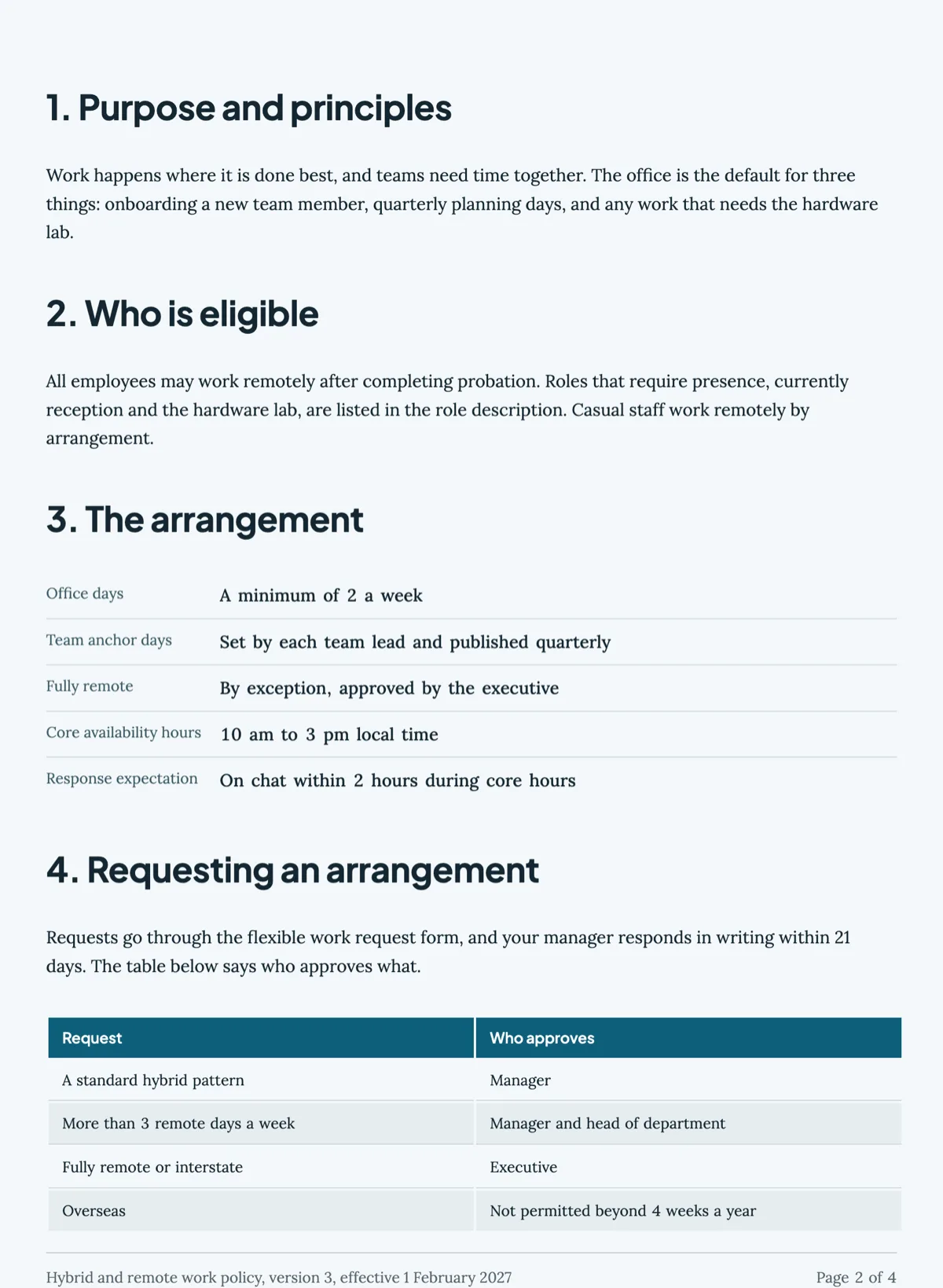 Remote work policy template with the days, the money and the checklistHybrid policies fail on the three questions nobody wants to answer: how many days, who pays for the chair, and what happens if it is not working. This policy answers all three with numbers, adds the workspace checklist the safety duty requires, and keeps the security rules to the six that matter.
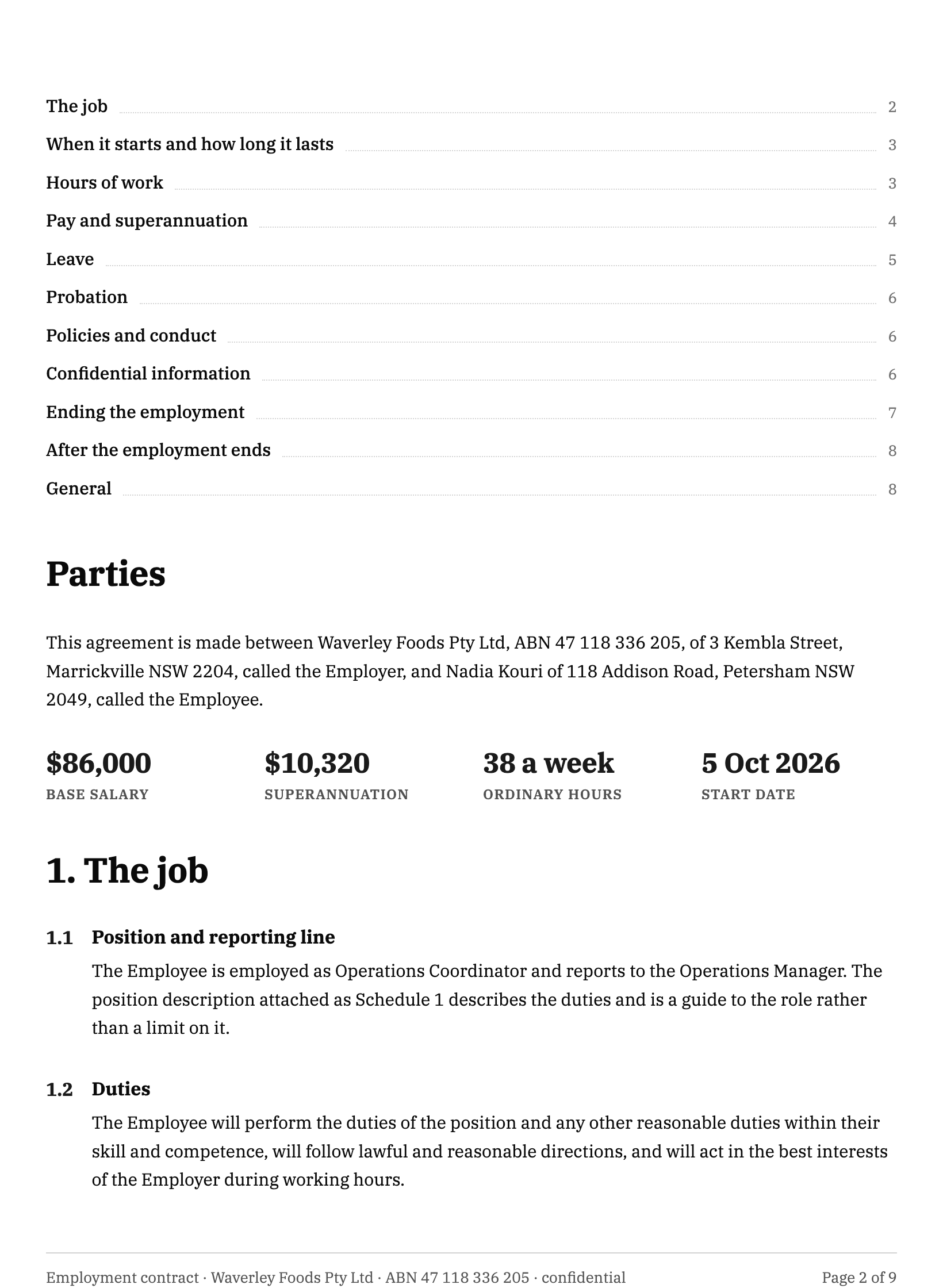 Employment contractA full time ongoing contract for an operations coordinator on $86,000 plus $10,320 of superannuation. Eleven numbered clauses, a leave table drawn from the National Employment Standards, and a notice table that scales with service.
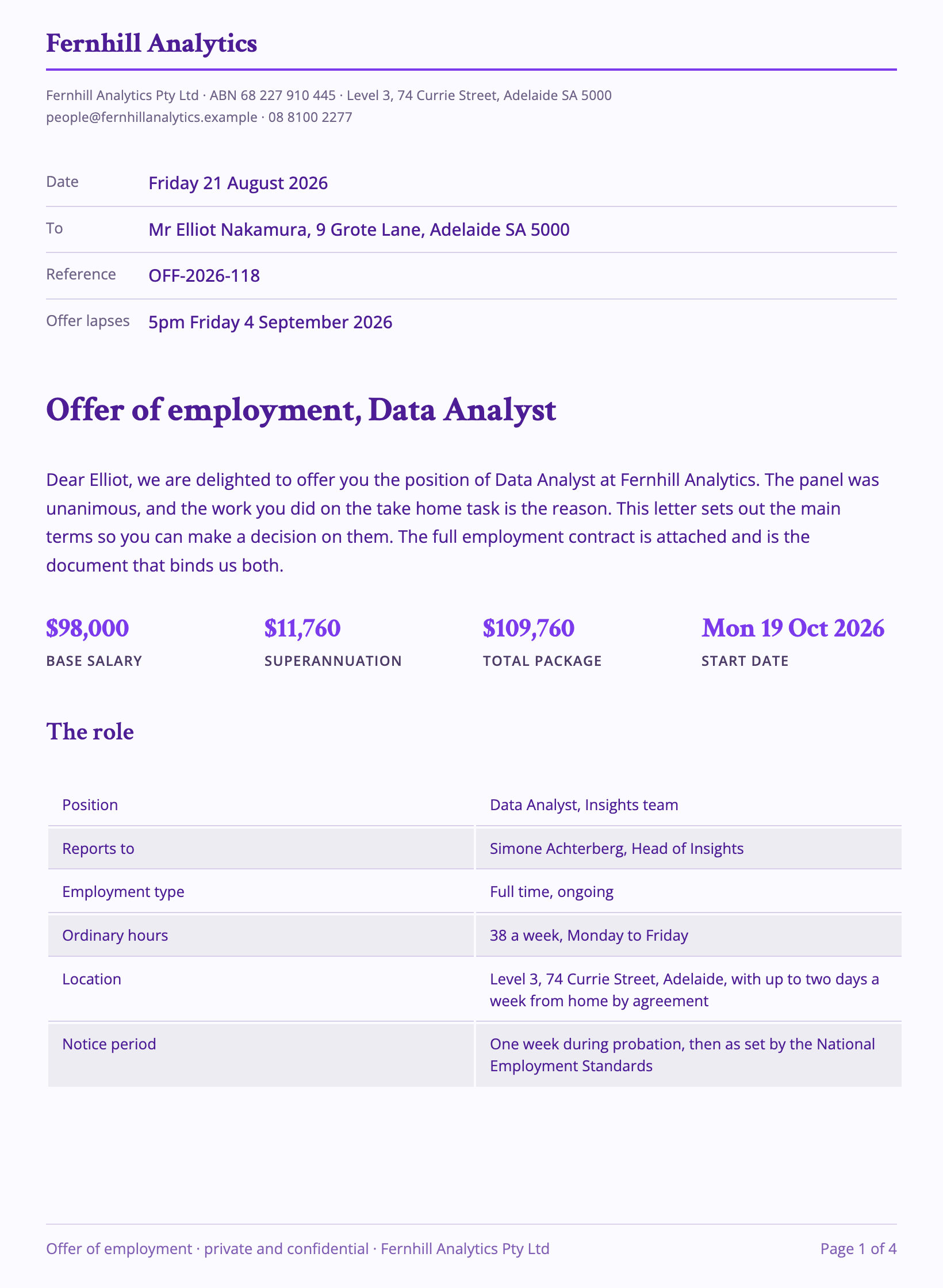 Job offer letterAn offer of $98,000 plus $11,760 of superannuation, with the three checks it depends on and a clear instruction not to resign until they clear. The letter also names what is not in the offer, which is the part candidates most often assume.
Questions people ask
Can an employer require staff to return to the office?
It depends on the contract. If the contract names the office as the workplace and home working was only permitted informally, the employer can usually withdraw that permission on reasonable notice. If home days are a term of the contract, changing them needs agreement or the process the clause sets out. An eligible employee can also make a formal flexible work request.
Who is responsible for safety when an employee works from home?
The employer's duty of care does not stop at the office door, although its practical control over a home is limited. That is why remote work clauses ask the employee to complete a workspace checklist, report hazards and keep the space suitable. The employee also has a duty to take reasonable care of their own health and safety.
How long does an employer have to answer a flexible work request?
In Australia the employer must respond in writing within 21 days, saying whether the request is approved or refused. A refusal needs reasonable business grounds and a genuine attempt to agree an alternative. In the United Kingdom the employer must make its decision within 2 months unless a longer period is agreed with the employee.
Can a remote employee move interstate or overseas?
Only if the contract allows it. A move can change which state laws apply, how payroll is handled and whether the employee can attend when needed. Working from overseas raises tax and visa questions for both sides. Most remote work clauses therefore require written consent before the home workplace changes location.
Is a home office allowance the same as a reimbursement?
No. An allowance is a fixed amount paid regardless of actual spending, and it is generally paid through payroll. A reimbursement repays a specific cost the employee has incurred and can prove. The clause should say which one applies, because the payroll and record keeping treatment of the two is different.
Does a remote work clause replace the right to request flexible work?
No. The statutory right to request flexible working arrangements exists regardless of the contract, and a clause cannot remove it. Good drafting says so expressly, which avoids an argument that an employee on an agreed hybrid pattern has given up the right to ask for something different when their circumstances change.
Put the clause in a finished document
The button opens the document generator with a starting description already filled in. Change it to match your own agreement before you run it.
Create a document with OneCraftRelated clauses
- Leave entitlements clause in an employment contractA leave entitlements clause lists annual, personal and other leave in an employment contract. Australian sample wording, NES minimums and three variants.
- Remuneration clause: the pay terms in an employment contractA remuneration clause sets what an employee is paid, how often and what the figure includes. Australian sample wording, package and hourly variants.
- Probation period clause in an employment contractA probation period clause sets a trial period, a review and the notice during it. Australian sample wording, extension rules and the minimum employment period.
For everything the document generator can do, see the document maker.
Step by step in the builder: Create a document with AI, then Send a document for signature.
Sources
Written and checked by the OneCraft team. Last checked .