Contract clause
Leave entitlements clause in an employment contract
A leave entitlements clause lists the types of leave an employee can take, how each one accrues, and how it is requested and paid. In Australia it sits on top of the National Employment Standards, so it can repeat or improve those minimums but can never reduce them.
Leave is where a contract most often promises something the law already gives, or quietly offers less. A clause that names each entitlement, points to the statutory floor and says what is extra settles most leave disputes before a request is ever refused.
Indunil Asanka · Co-founder
4 min read · Published
Sample clause
a full time employment contract between Kurrajong Analytics, a fictional data consultancy in Hobart, and a senior analyst on a salary
8. Leave 8.1 The Employee is entitled to the leave provided by the National Employment Standards, as supplemented by any applicable award, and to the additional leave set out in this clause. 8.2 Annual Leave. The Employee accrues 4 weeks of paid annual leave for each year of service, progressively according to ordinary hours worked. Kurrajong Analytics also grants 3 paid Wellbeing Days in each calendar year, which do not carry over and are not paid out on termination. 8.3 Personal and Carer's Leave. The Employee accrues 10 days of paid personal and carer's leave for each year of service. 8.4 Other Leave. The Employee may take compassionate leave, paid family and domestic violence leave, community service leave, parental leave and long service leave in accordance with the National Employment Standards and the applicable state law. 8.5 Requests. Annual leave is requested in writing at least 4 weeks in advance and is not unreasonably refused. Personal leave is notified as soon as practicable, with evidence if Kurrajong Analytics reasonably asks for it.
Sample wording, not legal advice.
Variants
National Employment Standards by reference only
A small employer that wants the contract to follow the statutory minimums automatically whenever they change.
The Employee is entitled to annual leave, personal and carer's leave, compassionate leave, family and domestic violence leave, community service leave, parental leave, long service leave and public holidays in accordance with the National Employment Standards, any applicable award or enterprise agreement, and the long service leave law of the state or territory in which the Employee works. Nothing in this agreement reduces any of those entitlements.
Above the minimums
An employer competing for scarce staff that offers a fifth week of annual leave as part of the package.
The Employee accrues 5 weeks of paid annual leave for each year of service. Four weeks are the entitlement under the National Employment Standards and 1 week is additional contractual leave, which accrues and is taken on the same basis. Any unused additional leave is paid out on termination at the rate that applies to annual leave. The Employer may review the additional week on 12 months written notice, but not the statutory 4 weeks.
Casual employee
A casual engagement, where paid annual leave and paid personal leave are replaced by a casual loading.
As a casual employee, the Employee is paid a casual loading instead of paid annual leave and paid personal and carer's leave. The Employee is entitled to 10 days of paid family and domestic violence leave in each year, 2 days of unpaid carer's leave and 2 days of unpaid compassionate leave on each occasion, unpaid community service leave, and long service leave where the relevant state or territory law provides it.
What to negotiate
Extra leave or extra salary
Employers often offer an additional week of leave instead of a pay rise, because it costs less in cash this year. Employees should check whether the extra week is paid out when the job ends and whether it attracts any award leave loading. If the clause is silent, the answer depends on how the extra week is described, so it is worth naming it.
Notice for a leave request
A long notice period for annual leave suits rostering but makes short breaks hard to plan. A common settlement is 4 weeks notice for leave of more than a week and 5 business days for shorter absences, with a promise that requests are not unreasonably refused, which mirrors the statutory position anyway.
The risk of leaving it out
Without a leave clause the employee still receives every National Employment Standards entitlement, so the real loss falls on the employer. There is no agreed notice period for requests, no evidence rule for personal leave and no record of any extra leave promised at interview, which leaves each of those to be argued when the first request arrives.
The minimum entitlements in one place
Under the National Employment Standards a full time or part time employee receives 4 weeks of paid annual leave a year based on ordinary hours, with more for shiftworkers defined that way in their award or agreement. Paid personal and carer's leave is 10 days a year for a full time employee and pro rata for part time. Compassionate leave is 2 days each time a qualifying event happens. Every employee, casuals included, can access 10 days of paid family and domestic violence leave each year. Long service leave mostly comes from state and territory laws rather than the national standards.
What a contract can and cannot change
A contract can add leave, shorten the notice needed to take it, or pay it at a higher rate. It cannot lower an entitlement, remove paid family and domestic violence leave, or attach a condition to personal leave that the law does not impose. Where an award covers the role, it may add rules about leave loading, shutdowns and cashing out, so the clause is read together with the award rather than on its own. A separate leave policy then deals with the booking process, which keeps the contract short.
Where it sits in a generated document
A generated employment contract writes leave as numbered content, usually one sub clause per leave type after the pay clause, so a later variation can change one entitlement without rewriting the others. The generated text never prints citations, so every figure in a draft, from the annual leave weeks to the family and domestic violence days, has to be checked against the Fair Work Ombudsman pages before the contract is sent for signature.
Documents that carry this clause
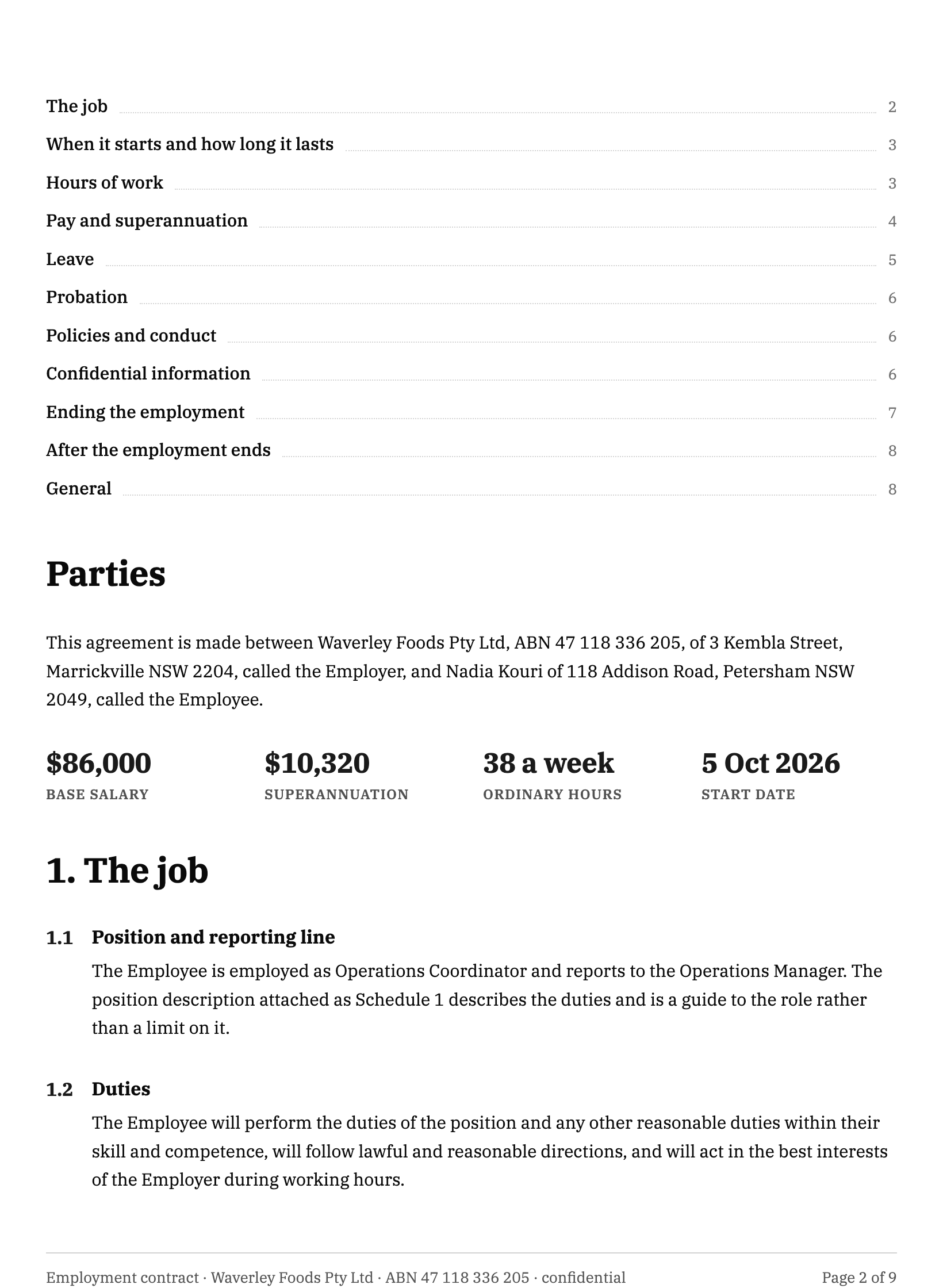 Employment contractA full time ongoing contract for an operations coordinator on $86,000 plus $10,320 of superannuation. Eleven numbered clauses, a leave table drawn from the National Employment Standards, and a notice table that scales with service.
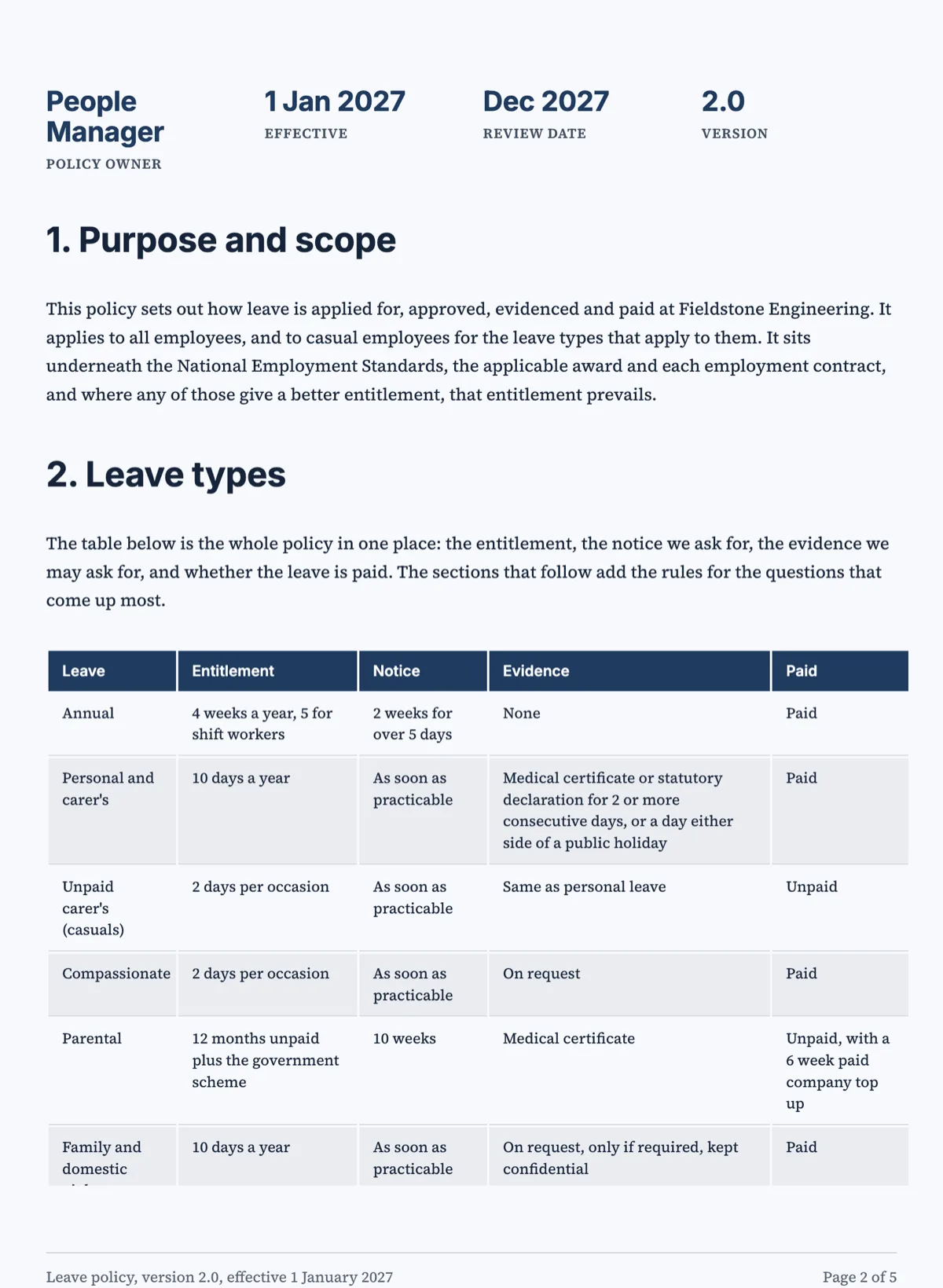 Leave policy template with the entitlements and rules in one tableA leave policy is not the law restated; it is the business's rules for applying, approving and evidencing leave on top of the law. This one puts every leave type in one table with the entitlement, the notice and the evidence, then spends its pages on the questions managers actually get: shutdowns, excessive balances, cashing out and who approves.
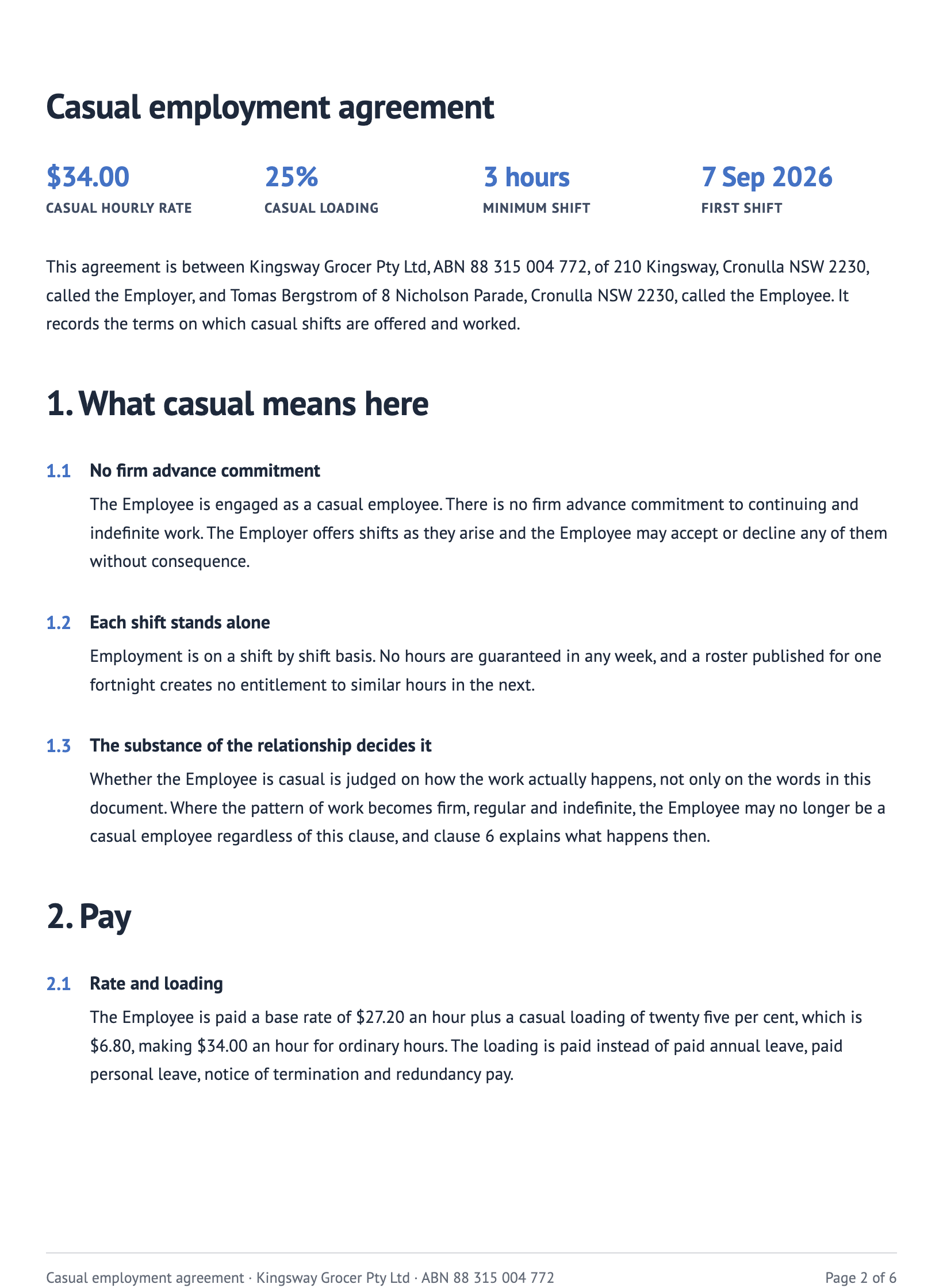 Casual employment agreementA retail assistant is paid $34.00 an hour, which is a base of $27.20 plus a twenty five per cent loading. The agreement shows how every other rate is built from that base, and what the loading is paid instead of.
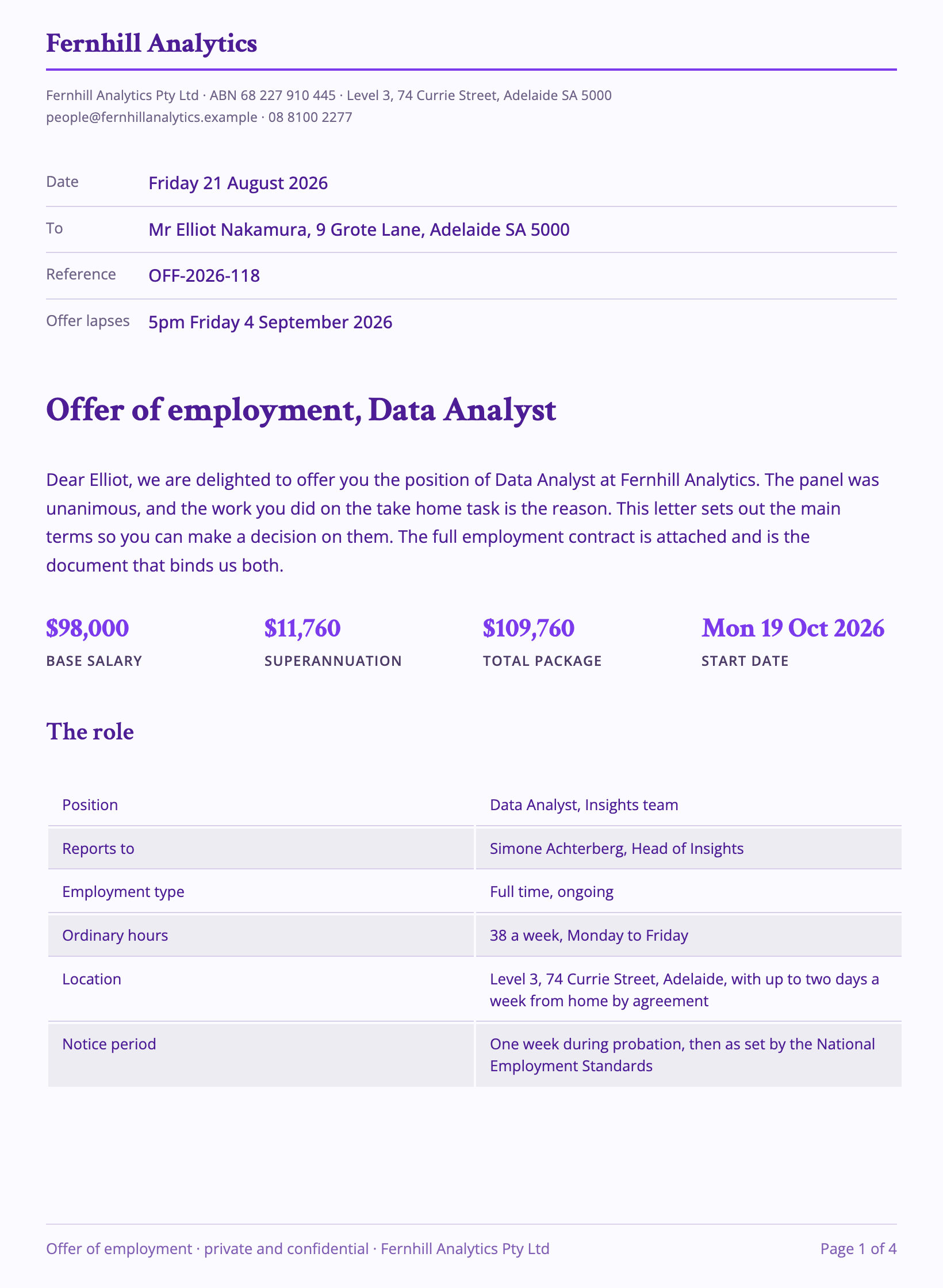 Job offer letterAn offer of $98,000 plus $11,760 of superannuation, with the three checks it depends on and a clear instruction not to resign until they clear. The letter also names what is not in the offer, which is the part candidates most often assume.
Questions people ask
Can an employment contract give less leave than the National Employment Standards?
No. The National Employment Standards are minimums that an award, an enterprise agreement or a contract cannot reduce. A clause offering 3 weeks of annual leave to a full time employee is ineffective to that extent, and the employee still accrues 4 weeks. The contract can offer more, and many do to attract staff.
Does leave accrue during probation?
Yes. Annual leave and personal and carer's leave accrue from the first day of employment, including any probation period, because accrual depends on service and ordinary hours rather than on passing a review. A probation clause can shorten the notice period for ending the employment, but it cannot pause the accrual of leave.
Do casual employees get any paid leave?
Casual employees receive a loading instead of paid annual leave and paid personal leave. They are still entitled to 10 days of paid family and domestic violence leave each year, to unpaid carer's leave and unpaid compassionate leave of 2 days on each occasion, and in some states to long service leave after long regular service.
Where does long service leave come from?
For most employees it comes from the long service leave law of the state or territory where they work, not from the National Employment Standards. Qualifying periods and the amount of leave differ between states, so a contract usually refers to the applicable state law instead of naming a number that may be wrong elsewhere.
Should the contract repeat the leave policy?
It is usually better to keep the entitlements in the contract and the process in a policy. Entitlements are binding promises that should change only by agreement. Booking rules, approval steps and calendars change often, and a policy can be updated without asking every employee to sign a variation to the contract.
Can an employer require evidence for personal leave?
An employer can ask for evidence that would satisfy a reasonable person that the leave was taken for a permitted reason, such as a medical certificate or a statutory declaration. A clause that demands a certificate for every single day can overreach, so many contracts set a threshold, such as absences longer than one day.
Put the clause in a finished document
The button opens the document generator with a starting description already filled in. Change it to match your own agreement before you run it.
Create a document with OneCraftRelated clauses
- Remuneration clause: the pay terms in an employment contractA remuneration clause sets what an employee is paid, how often and what the figure includes. Australian sample wording, package and hourly variants.
- Remote work clause: hybrid, fully remote or by requestA remote work clause sets where an employee works, on which days and on what conditions. Sample hybrid wording, fully remote and UK variants, and what to agree.
- Redundancy clause in an Australian employment contractA redundancy clause sets what happens when a role is no longer needed. Australian sample wording, the NES redundancy pay scale and enhanced variants.
For everything the document generator can do, see the document maker.
Step by step in the builder: Create a document with AI, then Send a document for signature.
Written and checked by the OneCraft team. Last checked .