Classic form
Competition entry form
A creative competition lives or dies on whether entries can be judged fairly, so the form has to collect two things at once: the work, and the truth about how it was made. This photography entry does both, and puts every rule where the entrant is standing when it matters. It is a classic form, because an upload and a set of declarations belong on one page where both can be checked before sending.
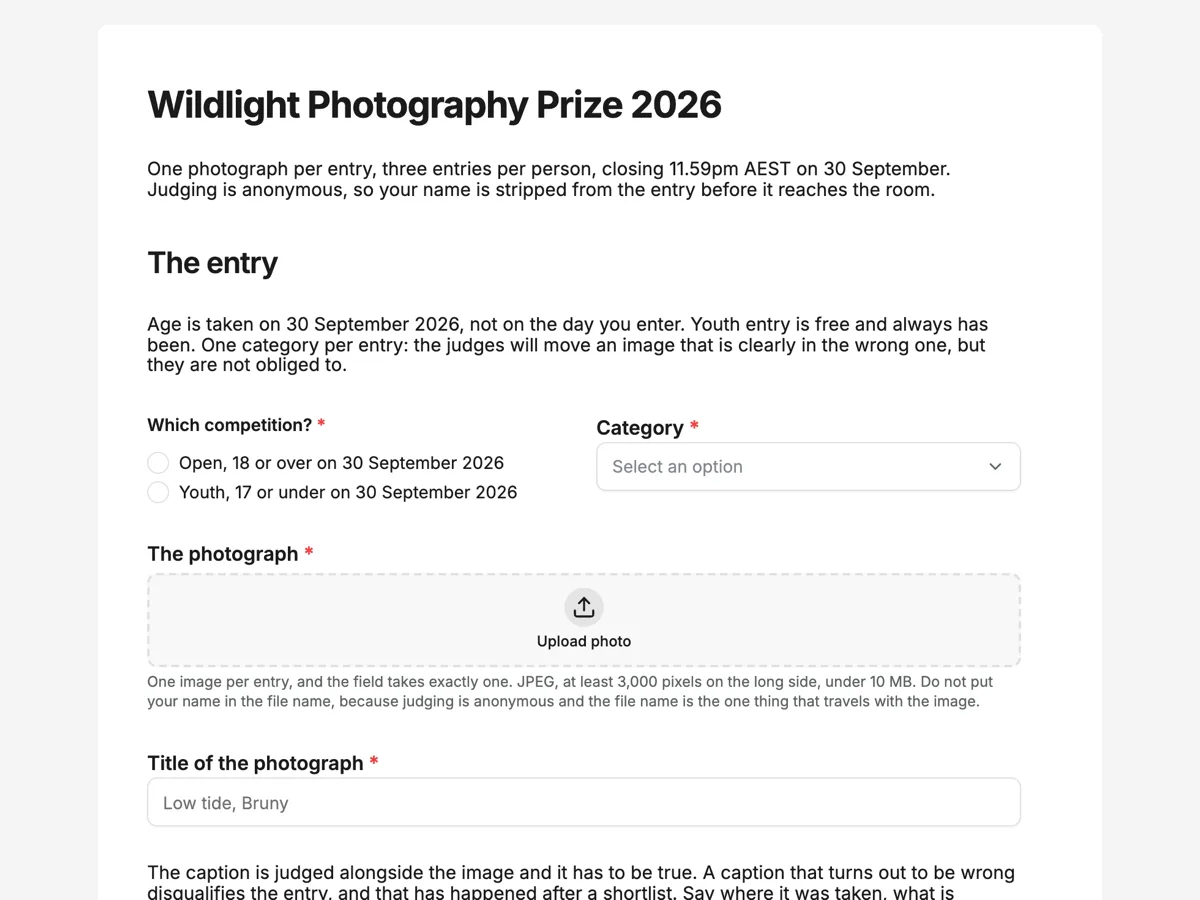
The form itself
A static copy of the finished form, exactly as it renders. Nothing here can be filled in or submitted, so read it as a reference and build your own from the button above.
Every field, and what it collects
The complete field list, in the order respondents meet it.
- Which competition?Single choiceRequired
- Options: Open, 18 or over on 30 September 2026 · Youth, 17 or under on 30 September 2026
- CategoryDropdownRequired
- Options: Animal behaviour · Animal portraits · Coast and marine · Habitat and landscape · Hidden world, macro and microscopy · Urban wildlife · Black and white · Botanical
- The photographPhoto uploadRequired
- One image per entry, and the field takes exactly one. JPEG, at least 3,000 pixels on the long side, under 10 MB. Do not put your name in the file name, because judging is anonymous and the file name is the one thing that travels with the image.
- Title of the photographShort textRequired
- Caption for the judgesLong textRequired
- Camera, lens and settingsShort text
- Was any bait, call, scent or captive animal involved?Single choiceRequired
- Options: No · Yes, and I have described it in the caption above
- How was the image processed?Single choiceRequired
- Options: Global adjustments only: exposure, contrast, colour, crop, dust spotting · Also a stitched panorama, a focus stack, or an in camera multiple exposure · Something else, and I have described it in the caption
- PhotographerNameRequired
- Email for the confirmationShort textRequired
- Your date of birthDateRequired
- Tick all fourMultiple choiceRequired
- Options: This photograph is mine, I own the copyright, and it does not infringe anybody else's rights · I grant the prize a non exclusive licence to show it in the exhibition, the catalogue and prize publicity, with my name on it · If I am shortlisted I will supply the raw file or the original untouched JPEG within a week of being asked · The entry fee is not refundable and unused entry credits do not carry over to next year
The entry
How the picture was made
You
The rules, in four lines
What makes this form work
The declarations are asked as questions, not agreements
Was bait used, and how was it processed. Both have a legitimate answer that is not "no", and the form says so. An entrant told that baiting is allowed in some categories declares it. One who reads a prohibition simply answers no and hopes nobody looks.
The caption carries its own warning
Captions are judged alongside the image, and a false one ends the entry even after a shortlist. Saying that immediately above the box produces careful writing about species, place and circumstance rather than a line of atmosphere.
The raw file promise is made at entry
Agreeing on the way in to supply the original within a week of being asked is what makes a challenge enforceable in October. Asking afterwards turns a rule into a negotiation with somebody who has just been told they are a finalist.
Questions people ask
What does a competition entry form have to collect?
The work, an identifier that is not the entrant's name, and the declarations the judging depends on. For photography that is the image, a caption that has to be true, whether anything was used to attract the subject, and what was done to the file afterwards. Everything else is administration.
How does anonymous judging work if the form asks for a name?
The name is collected late, after the work, and detached before judging. The thing that most often leaks it is the file name, which is why the upload says not to put a name in it. Explaining why, rather than issuing a rule, is what gets it followed.
Can the form take one image or several?
One. The photo field is a single image by design, which suits a competition where each entry is judged on its own. Three entries from the same photographer means three submissions, which is also how the entry fee and the entry numbers work.
Where should the manipulation rules go?
Immediately above the processing question, not in a rules page. Listing what is allowed and what is not at the moment somebody chooses an answer is the difference between an honest declaration and one made from memory, and it removes most disqualifications before they can happen.
Why ask for camera, lens and settings on a photo competition form?
Because the settings are how a judge separates skill from luck, and they are the first thing a shortlisted entrant gets asked anyway. This form collects them in one field beside the bait and processing questions. Collecting them at entry means the organiser is not chasing eight finalists for exposure data the week before judging.
Does a competition entry form need a date of birth?
It does when the rules have an age condition, which most do. This form asks for the entrant date of birth in the personal section, not the age, because an age typed in March is wrong by July. It also lets the organiser run a junior category without a separate form.
Build your own in about a minute
The button below opens the generator with this use case already described. Change the wording to match your own, generate, then edit anything you like.
Make one like thisOther form examples
Artist residency application form with a portfolio and work list
A residency panel looks at the images first and reads afterwards, so the portfolio instructions matter more than anything else on the form. This twelve field application caps the upload at ten images with a minimum resolution, pairs it with a numbered work list, and asks for a proposal that could only happen at this studio.
Hackathon registration form that handles solo and teams
Half the people who register for a hackathon do not have a team yet, and a form that assumes otherwise loses them on the second question. This one asks solo or team first, then keeps the teammate table optional, and turns the skills tick list into the data the Friday night matching actually runs on.
Award nomination form
Most award nominations fail because the person writing one has no idea what the judges score. This form fixes that by printing the criteria immediately above the boxes, capping each answer, and asking the three questions a panel is going to ask anyway. It is a classic form, so the criteria stay on screen while the three answers are written.
Want the steps in the builder? Read Every form field and when to use it, then View, export and manage your responses. For everything this generator can do, see the form maker.
Written and checked by the OneCraft team. Last checked .