Classic form
Award nomination form
Most award nominations fail because the person writing one has no idea what the judges score. This form fixes that by printing the criteria immediately above the boxes, capping each answer, and asking the three questions a panel is going to ask anyway. It is a classic form, so the criteria stay on screen while the three answers are written.
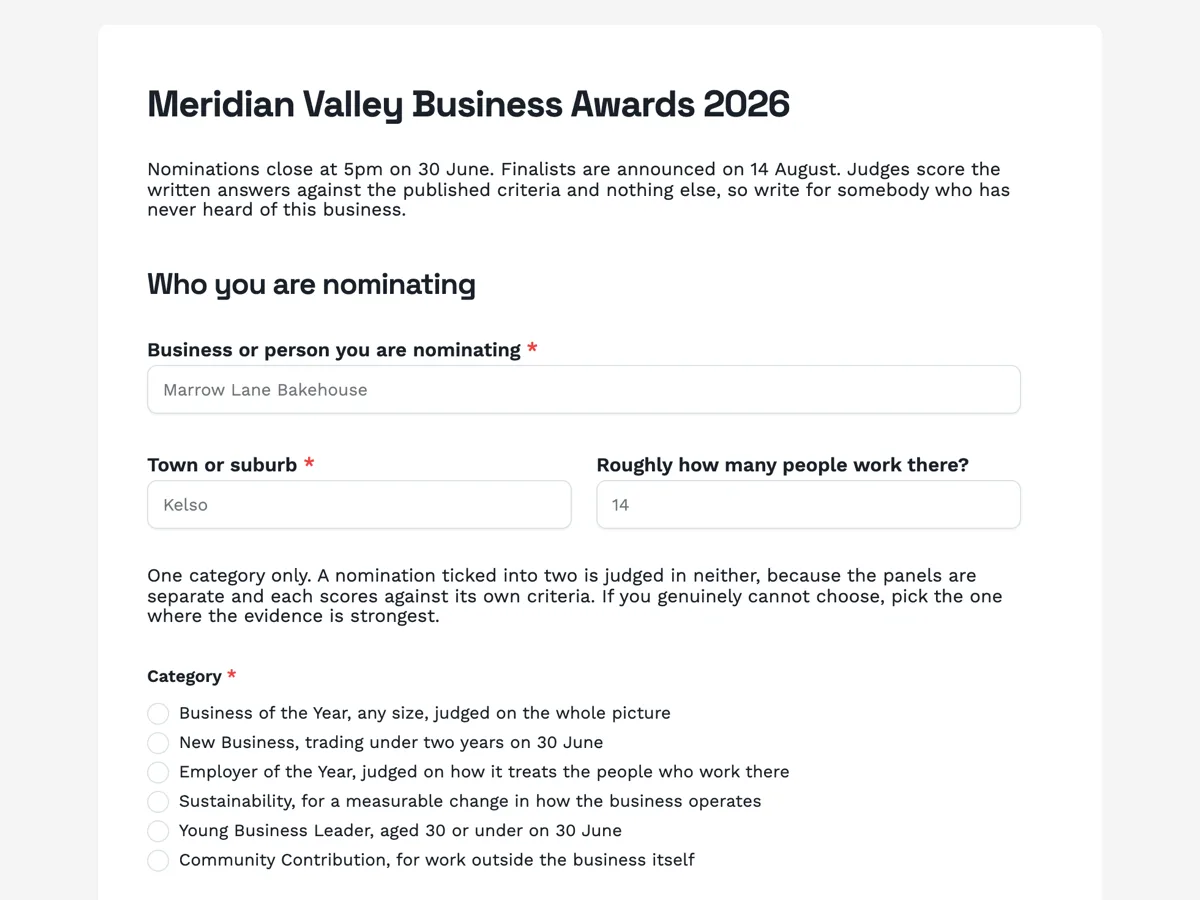
The form itself
A static copy of the finished form, exactly as it renders. Nothing here can be filled in or submitted, so read it as a reference and build your own from the button above.
Every field, and what it collects
The complete field list, in the order respondents meet it.
- Business or person you are nominatingShort textRequired
- Town or suburbShort textRequired
- Roughly how many people work there?Number
- CategorySingle choiceRequired
- Options: Business of the Year, any size, judged on the whole picture · New Business, trading under two years on 30 June · Employer of the Year, judged on how it treats the people who work there · Sustainability, for a measurable change in how the business operates · Young Business Leader, aged 30 or under on 30 June · Community Contribution, for work outside the business itself
- Do you have contact details for them?Single choiceRequired
- Options: Yes, they are below · No, and I would rather you found them
- Their email, if you have itShort text
- Their phone, if you have itShort text
- Your nameNameRequired
- Your emailShort textRequired
- Your phoneShort text
- Are you nominating your own business?Single choiceRequired
- Options: No, somebody else's · Yes, my own
- Should the nominee know it came from you?Single choiceRequired
- Options: Yes, tell them it was me · No, keep my name out of it
- What has this business done, and over what period? Up to 300 wordsLong textRequired
- What difference did it make? Up to 300 wordsLong textRequired
- Why this year, and not last year or next? Up to 150 wordsLong text
- Anything that backs it upFile upload
- Optional. Images and PDF only, up to five files, 5 MB each. A page from a report, a letter, a press clipping, photographs of the work.
- First referee, name or roleShort textRequired
- How to reach themShort textRequired
- Second referee, name or roleShort text
- How to reach themShort text
- Before you submitMultiple choiceRequired
- Options: I have asked both referees and they are happy to be contacted · Everything I have written here is true as far as I know · I understand the nominee will be told they have been nominated and asked to confirm
- Anything else the judges should see?Long text
Who you are nominating
You
The nomination
Referees
Question banks built on this form
What makes this form work
The criteria are printed above the boxes
What was done, what changed, how hard it was, in that order, immediately before the three questions that ask for exactly those things. A nominator reading it writes to the scoring sheet without ever seeing the scoring sheet, which is the whole job of a nomination form.
One category, and the reason is given
The panels are separate and each scores against its own criteria, so a nomination ticked into two categories is judged in neither. Saying that on the form is more effective than a rule in the guidelines, and the advice to pick where the evidence is strongest is what people actually need.
Word caps are set where the judge feels them
Three hundred words, three hundred, then a hundred and fifty. The caps are in the field labels, so a nominator sees the length before writing rather than after producing a thousand words for a panel that reads the first screen. Every nomination arrives the same length, which is what makes them comparable.
Questions people ask
What makes a nomination win?
A situation, an action and a result a judge could check. Panels score what was done, what changed because of it, and how hard it was, so a nomination that spends three hundred words on how lovely somebody is scores badly against one that names a month, a decision and a number.
Should nominations be anonymous?
Offer the choice. Some nominators are customers who would rather stay out of it and some are peers whose name adds weight. Asking explicitly, right after the note that the nominee is always told they were nominated, means nobody is surprised by an awkward phone call in July.
Do more nominations help?
No, and saying so on the form saves everybody a campaign. Panels read one nomination per nominee, so twenty identical submissions count as one. Printing that line stops the rally-the-customers approach that clogs an inbox and improves nothing.
How many referees should be asked for?
Two is plenty at nomination stage, and accepting a role rather than a name lets somebody nominate without knowing the chamber president personally. Say plainly that referees are only contacted if the nomination is shortlisted, and remind the nominator to ask them first.
Should the form let people nominate their own business?
Let them, but make them say so. This form asks it directly, so judges can weigh a self nomination against one from a customer without guessing. Banning self nomination outright loses good entries from sole traders who have nobody else to write for them. Declaring it costs one question and keeps the judging honest.
How long should the written answers be?
Short enough that a judge reads every entry. This form caps the achievement at 300 words, the difference it made at 300 words, and why this year at 150. Those caps are in the field labels, so a nominator knows the shape before they start writing rather than after they have written a thousand words.
Build your own in about a minute
The button below opens the generator with this use case already described. Change the wording to match your own, generate, then edit anything you like.
Make one like thisOther form examples
Grant application form with a budget the assessor can compare
Small grants rounds fail assessors, not applicants: forty applications in forty formats and no way to compare a budget. This form fixes the format, five short sections with word limits and a six line budget table with the same columns for everyone, so a panel can score in an afternoon.
Competition entry form
A creative competition lives or dies on whether entries can be judged fairly, so the form has to collect two things at once: the work, and the truth about how it was made. This photography entry does both, and puts every rule where the entrant is standing when it matters. It is a classic form, because an upload and a set of declarations belong on one page where both can be checked before sending.
Media release form for an interview, recording and attribution
A media release form is the written permission an organisation needs before it records someone and publishes their words or image. This one lets a person interviewed by a foodbank choose what is recorded, how they are named, where the story appears and whether they see it first.
Want the steps in the builder? Read Design your welcome and thank-you screens, then Every form field and when to use it. For everything this generator can do, see the form maker.
Written and checked by the OneCraft team. Last checked .