Classic form
Grant application form with a budget the assessor can compare
Small grants rounds fail assessors, not applicants: forty applications in forty formats and no way to compare a budget. This form fixes the format, five short sections with word limits and a six line budget table with the same columns for everyone, so a panel can score in an afternoon.
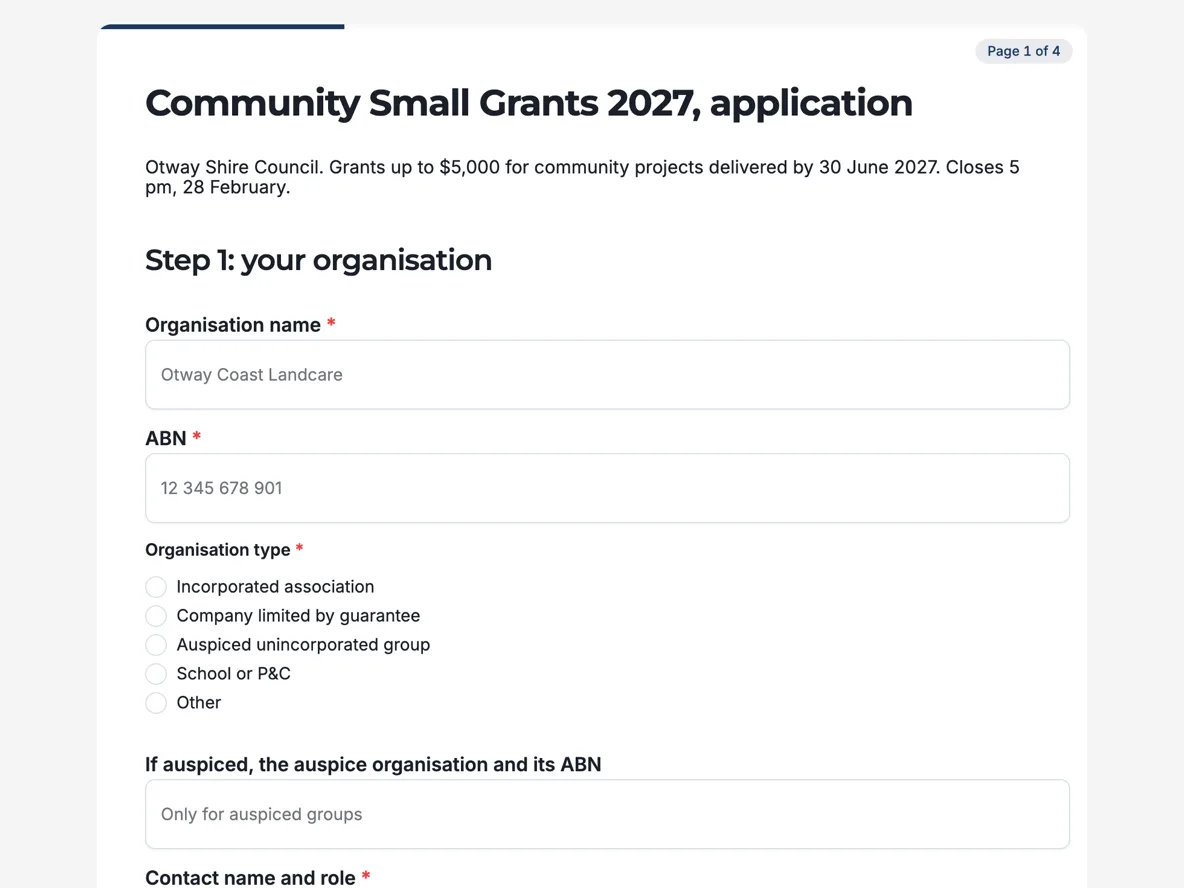
The form itself
A static copy of the finished form, exactly as it renders. Nothing here can be filled in or submitted, so read it as a reference and build your own from the button above.
Every field, and what it collects
The complete field list, in the order respondents meet it.
- Organisation nameShort textRequired
- ABNShort textRequired
- Organisation typeSingle choiceRequired
- Options: Incorporated association · Company limited by guarantee · Auspiced unincorporated group · School or P&C · Other
- If auspiced, the auspice organisation and its ABNShort text
- Contact name and roleShort textRequired
- Email and phoneShort textRequired
- Postal addressAddressRequired
- Project titleShort textRequired
- Project summary (100 words)Long textRequired
- Who benefits and how (200 words)Long textRequired
- How it will be delivered, by whom and when (200 words)Long textRequired
- Partners and their contribution (100 words)Long text
- How the project includes people who are often left out (100 words)Long textRequired
- BudgetTableRequired
- Columns: Item · Amount requested ($) · Other funding ($) · Total ($)
- Amount requested from council ($)NumberRequired
- Expected outcomes and how you will measure themLong textRequired
- Supporting documentsFile upload
- Up to 5 files, PDF or images: quotes, letters of support, the insurance certificate.
- I declare the organisation is eligible, the information is true, and the project will be acquitted by 31 July 2027Multiple choiceRequired
- Options: I declare
- Authorised signatory name and positionShort textRequired
- SignatureSignatureRequired
Step 1: your organisation
Step 2: the project
Step 3: budget
Step 4: documents and declaration
Question banks built on this form
Why a fixed format helps applicants too
The volunteer secretary writing this at a kitchen table benefits from every constraint on it. The printed criteria and their weights say exactly what earns marks, so nobody writes 800 words about history when partnerships carry 20 percent. The word limits mean the application is finishable in an evening. The budget table's four columns ask for the same arithmetic every funder eventually wants anyway. Grant writing skill stops being the thing assessed, which is the point: the panel is trying to fund the best project, not the best grant writer, and a fixed format is the only known way to tell them apart.
How to adapt this form
An arts round swaps the supporting documents for a portfolio upload and adds an artform question, keeping the weighted criteria pattern. A sports club equipment round can shrink step two to a summary and a who-benefits question, make quotes compulsory in the upload field, and let the budget table carry the application. A foundation running a two stage process uses this form's step two alone as the expression of interest, then invites full applications with the budget and documents. In every case, print the criteria and weights above the questions they score; hiding the rubric only rewards applicants who guess well.
What makes this form work
The rubric is printed where the writing happens
Community benefit 30 percent, feasibility 30, partnerships 20, inclusion 20: the weights sit in a paragraph above the five questions they score, and each question's placeholder names its criterion. Applicants write to the rubric, which is precisely what a fair round wants them doing.
One budget shape for all forty applications
Six rows, four columns, totals written by the applicant, and the requested amount repeated as a number the form caps between $500 and $5,000. The panel compares like with like down a single column instead of decoding forty homemade spreadsheets.
Every word limit is enforced, not suggested
The five written sections carry character maximums matched to their stated word counts, 650 characters for the 100 word sections, 1,300 for the 200s, and the paragraph in step two says the fields stop there. Nobody wins by ignoring the limit, because the form makes ignoring it impossible.
Questions people ask
Should a grant form show the assessment criteria?
Yes, with their weights, directly above the questions they score, exactly as this form's step two does. Hidden criteria reward guesswork and grant writing experience, neither of which is community benefit. The Australian grants frameworks push the same way: published, weighted criteria applied consistently.
How do you take a budget on a form?
A fixed table with the same columns for everyone, item, amount requested, other funding, total, and the applicant writing the totals row because table cells hold text rather than formulas. The requested amount is then repeated in a number field capped at $5,000, which is the figure the panel sorts and sanity-checks against the table.
What is an auspice?
An incorporated organisation that receives and holds the grant on behalf of an unincorporated community group, taking on the legal and reporting obligations. The organisation type question includes auspiced groups, and the next field asks for the auspice body and its ABN, since that is who the council actually pays.
How long should the written sections be?
One hundred to two hundred words each, five sections, and the character limits enforce it. That is deliberately shorter than most rounds ask, because assessors read forty of these in a sitting and length rewards stamina over substance. A project that cannot be explained in 700 words is usually not a $5,000 project.
What happens after submission?
The panel scores from the exported responses against the printed weights, the outcome email goes out by 31 March, and successful groups receive a funding agreement for electronic signature. The declaration on the form already commits the group to acquitting the grant by the stated date, so the agreement holds no surprises.
Can applicants save a draft and come back?
No, a submission is one sitting, and the welcome screen says so while pointing at the 25 minute estimate. The practical workaround is honest and low tech: draft the five written sections against the visible word limits elsewhere, then paste and submit in ten minutes.
Build your own in about a minute
The button below opens the generator with this use case already described. Change the wording to match your own, generate, then edit anything you like.
Make my grant application form with a budget the assessor can compareOther form examples
Award nomination form
Most award nominations fail because the person writing one has no idea what the judges score. This form fixes that by printing the criteria immediately above the boxes, capping each answer, and asking the three questions a panel is going to ask anyway. It is a classic form, so the criteria stay on screen while the three answers are written.
Scholarship application form that asks everyone the same three questions
A scholarship committee reads a hundred applications against one rubric, and the only fair form is the one that asks everyone the same questions at the same length. This form checks eligibility first, then asks three questions with 250 word limits, takes the evidence as uploads, and ends with a declaration two people sign.
Volunteer signup form
A conversational volunteer signup that asks ten questions one at a time and takes about four minutes. After a name, email and optional mobile, it asks which days of the week you can help and what time of day suits, what you would like to help with from seven areas, any certificates or skills, previous volunteering, an emergency contact, and whether you consent to a background check.
Want the steps in the builder? Read Paginate a classic form into steps, then View, export and manage your responses. For everything this generator can do, see the form maker.
Sources
Written and checked by the OneCraft team. Last checked .