Classic form
Scholarship application form that asks everyone the same three questions
A scholarship committee reads a hundred applications against one rubric, and the only fair form is the one that asks everyone the same questions at the same length. This form checks eligibility first, then asks three questions with 250 word limits, takes the evidence as uploads, and ends with a declaration two people sign.
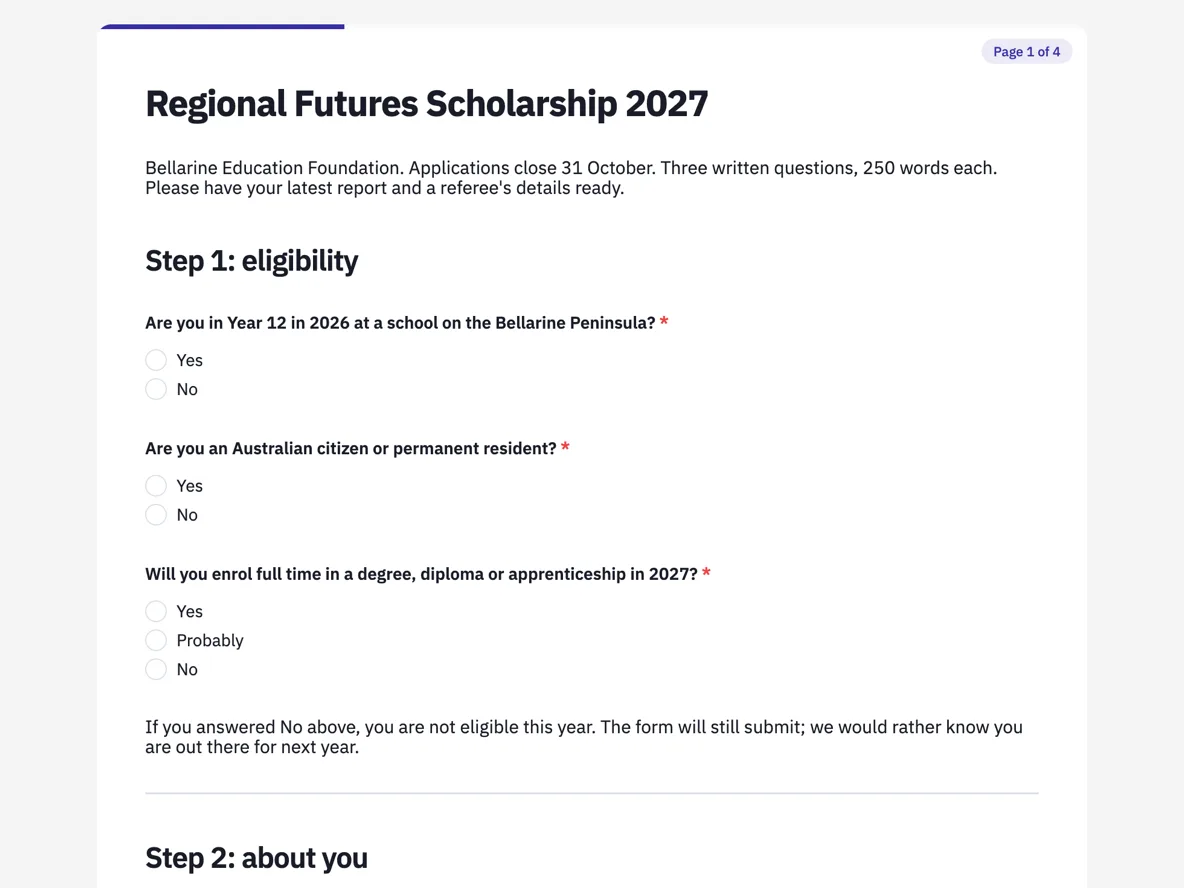
The form itself
A static copy of the finished form, exactly as it renders. Nothing here can be filled in or submitted, so read it as a reference and build your own from the button above.
Every field, and what it collects
The complete field list, in the order respondents meet it.
- Are you in Year 12 in 2026 at a school on the Bellarine Peninsula?Single choiceRequired
- Options: Yes · No
- Are you an Australian citizen or permanent resident?Single choiceRequired
- Options: Yes · No
- Will you enrol full time in a degree, diploma or apprenticeship in 2027?Single choiceRequired
- Options: Yes · Probably · No
- NameNameRequired
- Date of birthDateRequired
- Email and mobileShort textRequired
- Home addressAddressRequired
- SchoolDropdownRequired
- Options: Bellarine Secondary · Saint Ignatius Geelong · Christian College Bellarine · Ocean Grove Secondary · Other
- Intended course and institutionShort textRequired
- What do you want to study, and why?Long textRequired
- Describe a time you kept going when something was hard.Long textRequired
- How would this scholarship change what is possible for you?Long textRequired
- Financial circumstancesSingle choiceRequired
- Options: Household holds a Health Care Card or receives Youth Allowance · Household income under $90,000 · Neither · Prefer not to say
- Anything about your circumstances the committee should knowLong text
- Latest school report or transcriptFile uploadRequired
- One file, PDF or a clear photo.
- Referee: name, role and emailShort textRequired
- I declare the information is true and I consent to the foundation contacting my school and refereeMultiple choiceRequired
- Options: I declare
- Applicant signatureSignatureRequired
- Parent or guardian signatureSignatureRequired
Step 1: eligibility
Step 2: about you
Step 3: your application
Step 4: evidence and declaration
Question banks built on this form
What makes a scholarship application fair
Sameness. Every applicant answers the same three questions inside the same 250 word fence, so the committee compares writing against writing rather than formatting against formatting. The rubric behind those questions, motivation, resilience, impact of the money, is visible in the questions themselves. Financial need is asked as bands built on public benchmarks, the Health Care Card and Youth Allowance among them, so no sixteen year old uploads a parent's payslip just to be considered. And the blind read is built in: export the responses, hide the name column, and the three answers stand alone in front of each committee member.
How to adapt this form
A university faculty scholarship adds a student number and swaps the school dropdown for the enrolled program, keeping the word-limited questions untouched. A trade apprenticeship bursary replaces the transcript upload with an employer or TAFE letter and rewrites question one around the trade. An arts grant makes the upload a portfolio, raises the file count, and holds the line on written length everywhere else. What should not change: eligibility asked first and honestly, one written length for all, and the referee named rather than uploaded, because a letter the applicant carries is a letter the applicant has read.
What makes this form work
The character caps hold the 250 word line
Each of the three written questions has a 1,600 character maximum, which is where 250 words actually lands, and the paragraph above them says over-length answers are read to the limit and no further. Every applicant writes inside the same fence, which is the fairness.
Eligibility is asked before effort is spent
Three questions open the form: the school region, residency, and full time enrolment next year. An ineligible applicant finds out in under a minute, before writing 750 words, and the paragraph explains the form will still accept their submission and why the foundation wants it.
Need is a band with a dignified exit
The financial circumstances question offers two concrete bands, neither, and prefer not to say. Equity gets assessed without a single uploaded payslip, and the applicant who would rather not answer keeps a real option instead of being forced into fiction.
Questions people ask
How do you enforce a word limit on a form?
With a character maximum on each written field: 1,600 characters is about 250 words of ordinary English, and the fields here stop accepting input at that point. The paragraph above the questions states the reading rule too, so the limit is a fence everyone can see, not a trap discovered after drafting in a document.
Should applicants upload a reference letter or name a referee?
Name one. The form takes the referee's name, role and email, and the foundation writes to them directly. A letter that travels through the applicant's hands is coached by definition, and busy referees give more honest answers to two specific emailed questions than to a blank page.
Can the form reject ineligible applicants automatically?
No, and it says so on the page: there is no branching, so an ineligible answer in step one cannot stop the submission. The eligibility step works as a declaration instead, and the paragraph under it is honest about the consequence, along with why the foundation still wants the submission.
How is financial need assessed without documents?
As bands: a Health Care Card or Youth Allowance in the household, income under $90,000, neither, or prefer not to say. The bands lean on existing public means tests instead of duplicating them, and documentary proof is requested from the shortlist only, when the ask is proportionate to the odds.
Why do two people sign?
Because the applicants are Year 12 students, mostly seventeen. The applicant signs the declaration; a parent or guardian countersigns beneath it. Both signature fields are drawn or typed on the page and print into the response PDF that becomes the application of record.
How does a committee read a hundred of these?
From the CSV export, one column per question. Hide the name and school columns and the three written answers become a blind read; sort by the financial band when the equity criterion applies. The 250 word fence is what makes a hundred applications a weekend of reading instead of a month.
Build your own in about a minute
The button below opens the generator with this use case already described. Change the wording to match your own, generate, then edit anything you like.
Make my scholarship application form that asks everyone the same three questionsOther form examples
Teaching job application form with registration and referees
A teaching application is checked against two registers before anybody reads the cover letter, which is why the numbers come before the prose. This eighteen field form asks for a teacher registration number and the state that issued it, a working with children check with its expiry, the subjects and year levels somebody will actually take, and three referees including a current line manager.
Apprenticeship application form for a trade employer
An apprenticeship application is filled in by somebody who has never written one, so every question has to be answerable without a careers adviser in the room. This fifteen field form asks the year level, the maths, the licence and the way somebody would actually get to a job each morning, and gives the one written answer the space it deserves.
Internship application form
An internship application has to do two things a job application does not: work for somebody with almost no employment history, and sort a large field quickly on things that are actually disqualifying. This one asks about study, availability and field readiness before it asks anybody to write 300 words. It is a classic form, because two PDF uploads and a referee table need one page where everything can be checked before sending.
Want the steps in the builder? Read Paginate a classic form into steps, then View, export and manage your responses. For everything this generator can do, see the form maker.
Written and checked by the OneCraft team. Last checked .