Classic form
Abstract submission form
A scientific committee reads three hundred abstracts in a fortnight, without author names, scoring each on the same four parts. This form makes that possible: four boxes with their own character limits, a co-author table that prints in order, and the declarations a committee has to take on trust. It is a classic form, because the four boxes have to be visible together for an author to balance them.
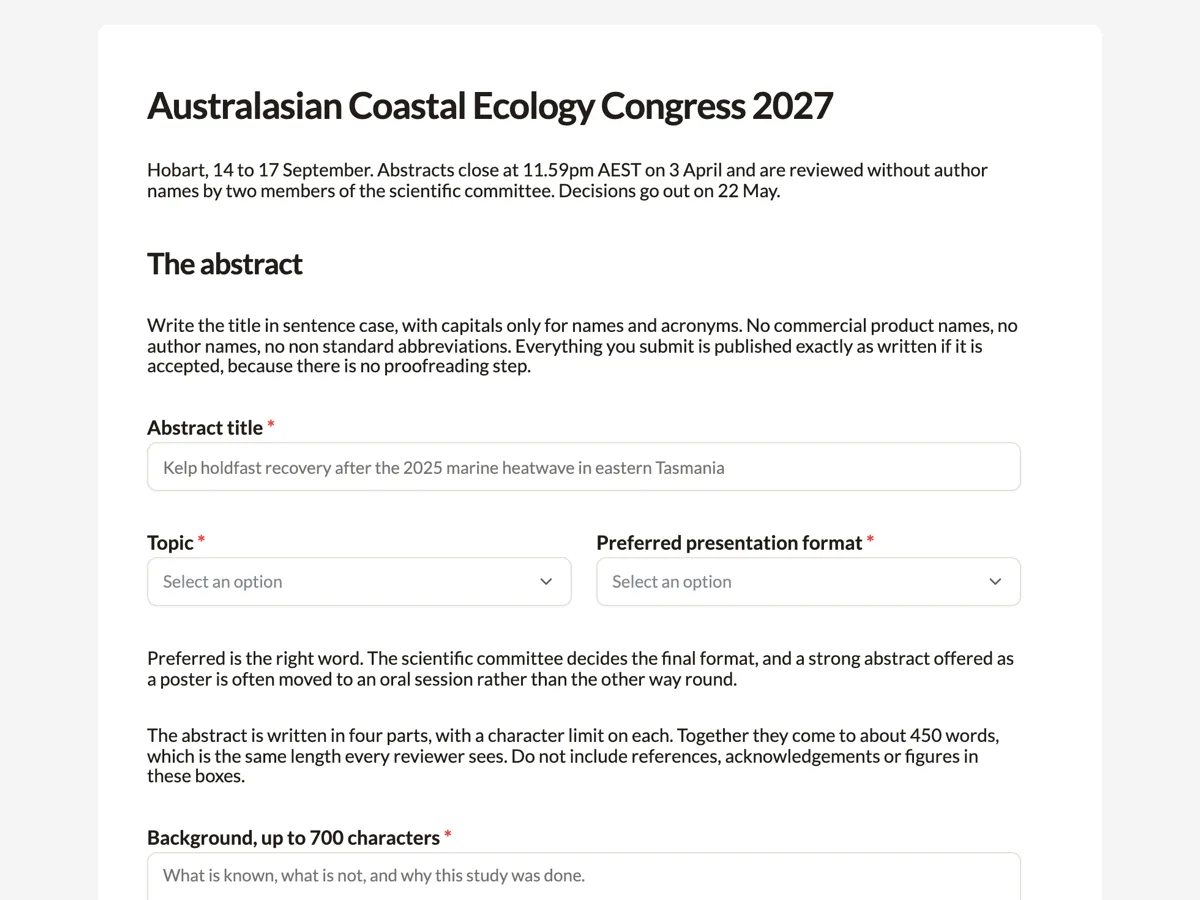
The form itself
A static copy of the finished form, exactly as it renders. Nothing here can be filled in or submitted, so read it as a reference and build your own from the button above.
Every field, and what it collects
The complete field list, in the order respondents meet it.
- Abstract titleShort textRequired
- TopicDropdownRequired
- Options: Reef and kelp ecology · Estuaries and catchments · Fisheries and aquaculture · Climate and heatwaves · Restoration and management · Monitoring methods and sensing · People, policy and coastal communities
- Preferred presentation formatDropdownRequired
- Options: Oral, 12 minutes plus 3 for questions · Rapid fire oral, 5 minutes · Poster with a 2 minute pitch · Poster only
- Background, up to 700 charactersLong textRequired
- Methods, up to 700 charactersLong textRequired
- Results, up to 900 charactersLong textRequired
- Conclusion, up to 450 charactersLong textRequired
- Up to five keywords, separated by commasShort textRequired
- One or two figures, only if the abstract genuinely needs themFile upload
- Images and PDF only, up to two files, 2 MB each, at least 800 pixels on the short side. A table must be supplied as an image, not as text.
- Presenting authorNameRequired
- Their emailShort textRequired
- Their institution and departmentShort textRequired
- Co-authors, in the order they should be printedTable
- Columns: Name · Institution · City and country
- Conflicts of interest, for every authorLong textRequired
- DeclarationsMultiple choiceRequired
- Options: This work is original and has not been published or presented at another international meeting · It is not one part of a larger study split across several abstracts to increase our count · Every co-author, and the institution where the work was done, has agreed to this submission · No participant or landholder can be identified, and written consent was obtained where identification is possible · We hold the rights to any third party material included · Conflicts of interest are declared above for every author · The presenting author will register for the congress and present in person if this is accepted
- Did you use an AI tool in preparing this abstract?Single choiceRequired
- Options: No · Yes, for language editing only · Yes, in generating or analysing results, and it is described in the methods
The abstract
Authors
Declarations
What makes this form work
Preferred format is labelled as preferred
The committee decides the final format, and saying so on the form stops the disappointment that follows an abstract offered as an oral and programmed as a poster. It also tells people the truth, which is that strong posters get moved up more often than talks get moved down.
The declarations name the specific failures
Salami slicing, co-author consent, identifiable participants, third party rights. Generic honesty statements are ticked without reading. Naming the four things committees actually get burned by makes a submitter stop on at least one of them.
Co-authors go in a table, in printing order
Name, institution, city and country in five numbered rows, which is exactly what the programme needs and exactly what a free text box never produces cleanly. The row count is fixed, so the form says in order and leaves the spare rows for whoever has fewer.
Questions people ask
Why split the abstract into four boxes?
Because reviewers score the parts, not the paragraph. Separate boxes for background, methods, results and conclusion force the structure that a blind review needs, and they make a missing results section obvious at submission rather than at scoring. Each box also carries its own character limit in the label, so an author can see where the length is going.
Character limit or word limit?
Character limits, set on each field, because they are the ones the software can actually enforce while somebody is typing. Roughly a thousand characters is two hundred and fifty words. Four limits totalling about 2,750 characters give every reviewer the same length to read.
Who should receive the decision email?
The presenting author, and only them, which is why they are named separately from whoever fills in the form. A submitting supervisor who keeps the correspondence is how an accepted abstract ends up with nobody registered to present it in September.
How should AI use be declared?
As its own question with three real answers, separating language editing from generating or analysing results. Bundling it into a general declaration tells you nothing. Asking directly, with a note that analysis by AI belongs in the methods, gets an honest answer and a usable record.
How many figures should an abstract form accept?
One or two, and this form says so in the field label. A file upload can be capped at any number between one and ten, so the limit is a setting rather than a request. Keeping it low protects the reviewer, because an abstract that needs three figures is usually a paper that has not been cut down yet.
How should co-author order be captured?
As a table with one numbered row per co-author, filled in the order the names should be printed, which is what this form does. Five rows take the name, institution, and city and country, the three things a programme prints. The row numbers make the order explicit, and spare rows stay empty for smaller teams, so nobody has to guess who is second.
Build your own in about a minute
The button below opens the generator with this use case already described. Change the wording to match your own, generate, then edit anything you like.
Make one like thisOther form examples
Call for speakers form
A conference programme committee is choosing between two hundred proposals in a fortnight. This form is built for the reading, not the writing: everything the committee scores on is asked in the same shape every time, and the things that get a talk declined are printed where a speaker sees them first. It is a classic form, so a speaker can see the whole proposal at once and balance the outline against the description.
Course evaluation form that separates teaching from materials
When one grid mixes the trainer, the slides and the assessment, a bad textbook sinks a good teacher. This evaluation splits the three, asks the workload question numerically, and keeps free text to the two questions a coordinator can act on before the next intake.
Excursion permission form
Consent only counts if the parent had enough information to give it, which is why half of this form is the school telling you about the day before it asks you for anything. The rest is the health picture for one Thursday and the four things parents most often say nobody told them. It is a classic form, because a page of information reads better as a page than as a series of questions.
Want the steps in the builder? Read Every form field and when to use it, then View, export and manage your responses. For everything this generator can do, see the form maker.
Sources
Written and checked by the OneCraft team. Last checked .