Classic form
Call for speakers form
A conference programme committee is choosing between two hundred proposals in a fortnight. This form is built for the reading, not the writing: everything the committee scores on is asked in the same shape every time, and the things that get a talk declined are printed where a speaker sees them first. It is a classic form, so a speaker can see the whole proposal at once and balance the outline against the description.
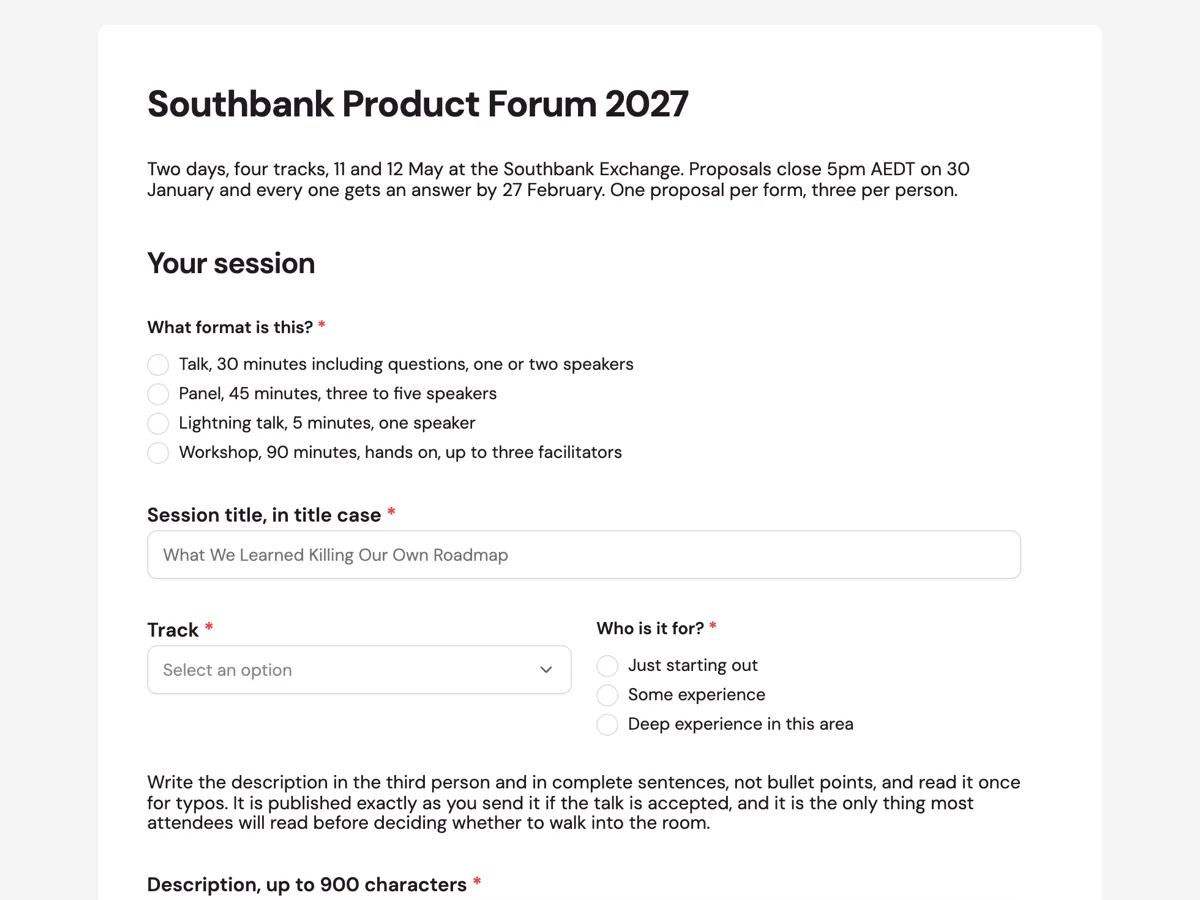
The form itself
A static copy of the finished form, exactly as it renders. Nothing here can be filled in or submitted, so read it as a reference and build your own from the button above.
Every field, and what it collects
The complete field list, in the order respondents meet it.
- What format is this?Single choiceRequired
- Options: Talk, 30 minutes including questions, one or two speakers · Panel, 45 minutes, three to five speakers · Lightning talk, 5 minutes, one speaker · Workshop, 90 minutes, hands on, up to three facilitators
- Session title, in title caseShort textRequired
- TrackDropdownRequired
- Options: Discovery and research · Design systems and craft · Platform and delivery · Leading product teams
- Who is it for?Single choiceRequired
- Options: Just starting out · Some experience · Deep experience in this area
- Description, up to 900 charactersLong textRequired
- What does somebody take away, up to 1,500 charactersLong textRequired
- Outline, with rough timingsLong textRequired
- Is this a case study of work you did yourself?Single choiceRequired
- Options: Yes · No, it is a broader argument
- A link to you speaking, if there is oneShort text
- Have you given a version of this talk in the past year? Where, and what is different this time?Long text
- Slides, a recording, or anything else that helpsFile upload
- Optional. Images and PDF only, up to three files, 10 MB each.
- Speaker nameNameRequired
- Job titleShort textRequired
- OrganisationShort textRequired
- EmailShort textRequired
- Bio, up to 500 characters, in the third personLong textRequired
- HeadshotPhoto upload
- One photograph, at least 800 pixels wide. It is printed in the programme and used on the session page if the talk is accepted.
- Co-speakers, one per line, with job title and organisationLong text
- Do you need travel support to be able to attend?Single choice
- Asked separately from review. The committee never sees this answer.
- Options: No · Yes, a contribution towards travel · Yes, travel and one night of accommodation
- Before you submitMultiple choiceRequired
- Options: This is not a product pitch, and I understand a sales talk is declined without review · I have read and accept the Forum code of conduct · I can attend on 11 and 12 May if this is accepted
- Anything the programme committee should know?Long text
Your session
You
Practical
Question banks built on this form
What makes this form work
The description rules sit above the description
Third person, complete sentences, no bullets, read once for typos, published exactly as sent. Five instructions in a paragraph the speaker cannot scroll past, at the exact moment they start typing. It raises the quality of two hundred submissions for the cost of two lines.
The outline asks for timings, not headings
A five line outline with minute markers tells a committee whether a talk fits in its slot, which is the most common reason a good idea becomes a bad session. It also shows the speaker their own pacing problem before anybody else has to.
Travel support is asked, and separated from review
A speaker who needs help getting there will not ask unless the form asks first. The question sits in the Practical section, apart from the proposal, and the organiser keeps that column out of the committee's copy of the responses. That removes the fear that needing support counts against the proposal, which is the whole reason the question usually goes unanswered.
Questions people ask
What should a call for speakers form ask?
Format and track, because they decide which committee member reads it. The description as it will be published. A separate answer on what the audience takes away, written to the committee rather than to the room. A timed outline, which is the single best predictor of a talk that finishes on time.
Why put a character limit on the description?
Because it is published as written, and a programme page has a fixed shape. Nine hundred characters is about a hundred and fifty words, which is enough for an argument and not enough for a preamble. The limit is set on the field, so nobody writes twice as much and has it cut by an editor.
Should the headshot be collected at proposal time?
It costs a speaker ten seconds and saves the programme team a week of chasing in March. The photo field takes exactly one image, which is what a programme page needs, and the note about the minimum width prevents the thumbnail that has to be asked for again.
How do you keep sales pitches out?
Say it on the form, in the tick box, where somebody has to actively agree. "This is not a product pitch, and I understand a sales talk is declined without review" turns a vendor submission into a decision rather than an accident, and it removes the awkward email later.
Should a call for speakers ask for an outline with timings?
Yes, and this form asks for one. A description says what the talk is about, an outline says whether it fits the slot. Most rejected proposals are good ideas with sixty minutes of material in a thirty minute session, and the timings are where a committee sees that before the speaker discovers it on stage.
Why ask whether the talk has been given before?
Because a repeat is not disqualifying, it is a question of what is new. This form asks where it was given in the past year and what is different this time. A talk that has been road tested is often the safer booking, and the answer tells the committee whether a recording already exists.
Build your own in about a minute
The button below opens the generator with this use case already described. Change the wording to match your own, generate, then edit anything you like.
Make one like thisOther form examples
Abstract submission form
A scientific committee reads three hundred abstracts in a fortnight, without author names, scoring each on the same four parts. This form makes that possible: four boxes with their own character limits, a co-author table that prints in order, and the declarations a committee has to take on trust. It is a classic form, because the four boxes have to be visible together for an author to balance them.
Party RSVP form
A party RSVP form tells the host who is coming, how many chairs to put out and what the food depends on, in a reply short enough to finish on a phone. This one is for a fortieth birthday where the food is shared and the hall is booked, and it also stops nine people arriving with dessert. It is conversational, nine questions one at a time, because an RSVP arrives as a link in a group chat and gets answered standing up.
Webinar registration form
A webinar registration form needs a name and an email to send the joining link to, plus the few questions that change what the speakers prepare. This one asks eight questions for a free 45 minute session, one screen at a time, and only three of them are required. It can be this short because the deliverable is an email, and it is conversational because that is where webinar links actually get opened: on a phone, halfway through something else.
Want the steps in the builder? Read Every form field and when to use it, then View, export and manage your responses. For everything this generator can do, see the form maker.
Written and checked by the OneCraft team. Last checked .