Coastal Removals safe lifting workshop
Workshop title slide with the date, duration, trainer and room
A workshop title slide is the one screen everybody sees before the session starts, so it should answer the questions people ask at the door. This one opens a fictional safe lifting workshop run for Coastal Removals at its own depot.
What is on the slide
- Photograph
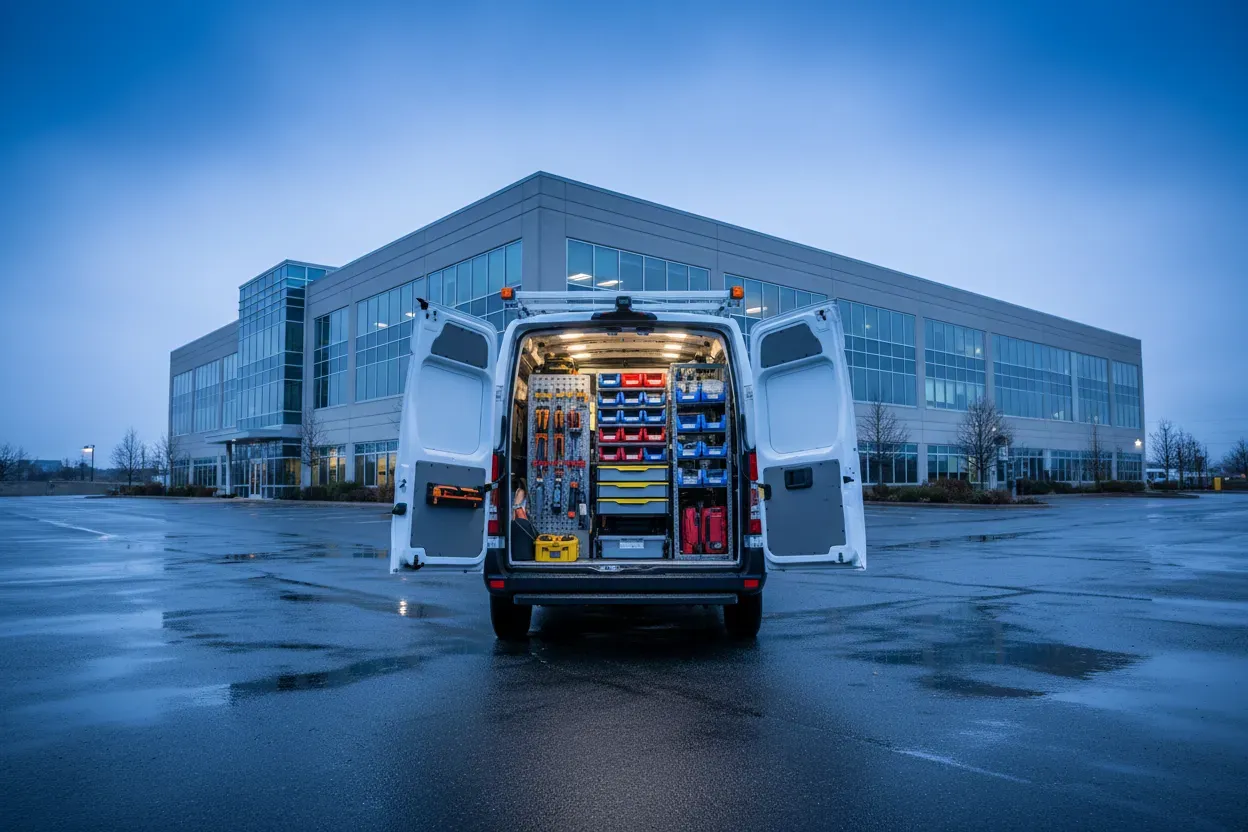
- A vertical image of a work van outside the depot at dusk, rear doors open, its fitted interior racking stocked and lit, held in a rounded frame at the left.
- Brand pill
- COASTAL, set in a small filled pill over the top of the photograph.
- Title
- Safe Lifting. On Every Job. broken across two emphatic lines, with an accent rule and the triad PRACTICAL, ASSESSED, 3 HOURS underneath.
- Metadata rail
- DATE Tuesday 16 March 2027, DURATION 3 hours one break, TRAINER Priya Raman WHS lead, ROOM Depot 2 training room.
When this is the right slide
A photo cover with a four item metadata rail suits a workshop where the audience arrives with logistics questions and the room needs the date, the length, the trainer and the venue confirmed before anyone sits down.
What to swap it for
Cover: Photo Left, Pill Title Right. Swap to the photo left cover with a pill title when there is no rail data to carry, such as a recurring internal session where everyone already knows the time and the room.
What this slide shows
A tall photograph fills the left third of the slide in a rounded frame: a work van outside the depot at dusk, rear doors open, its interior racking stocked and lit. A small filled pill reading COASTAL sits over the upper part of the image. The centre of the slide carries the title in two emphatic lines, each ending in a full stop: Safe Lifting. On Every Job. Under it, a short accent rule and an uppercase triad reading PRACTICAL, ASSESSED, 3 HOURS separated by middle dots. A thin vertical rail runs down the right edge with four labelled entries: DATE, Tuesday 16 March 2027; DURATION, 3 hours, one break; TRAINER, Priya Raman, WHS lead; ROOM, Depot 2 training room. Each rail label is small uppercase with its value in normal case beneath, and a small marker sits on the rail beside each pair, so the four items read as a list rather than as a paragraph.
When this is the right slide
Use it for any session people have to turn up to: a safety workshop, an induction, a practical training course, a client onboarding session or a facilitated planning day. All of them share the same problem, which is that attendees arrive carrying logistics questions that have nothing to do with the content, and a cover that answers those questions clears the room's mind before the first exercise. It is the right choice when the four rail items are genuinely known and specific. It is the wrong slide when they are not: a rail with TBC in two of four slots undermines the session before it starts, and a cover with no rail at all is better. It is also wrong for a talk rather than a workshop, where the audience is not going to do anything and the duration is set by the programme.
How to adapt it
First, write the rail from the questions the trainer actually gets. Date, duration, trainer and room is the common set, but a session with prerequisites should carry BRING or PREREQUISITE instead of one of them, and an online session should carry the joining method rather than a room. Four slots is all there is, so each one has to earn its place. Second, put the qualifier in the duration line. Three hours reads as a block; three hours, one break reads as a plan, and people who need to arrange cover for a shift can act on the second. Third, make the triad describe the session's demands rather than its subject. Practical, assessed and three hours are three different kinds of fact about what the attendee is in for, which is more useful than three synonyms for safety. If there is no rail data worth printing, a simpler photo cover keeps the image and the title without leaving four labels looking for values.
What makes this slide work
The rail answers the four questions asked at the door
When, how long, who is running it and where. Those are the questions a trainer fields in the five minutes before a session starts, and putting them on the opening slide means they are answered once for everybody. The duration line adds one break, which is the follow up question and costs three words to pre empt.
The triad sets expectations about the session
PRACTICAL, ASSESSED, 3 HOURS tells a room that they will be doing something, that it will be marked and roughly what it will cost them in time. Assessed in particular changes how people arrive; a group that expects a lecture and finds an assessment at the end will say so on the feedback form, and the word on the cover is the cheapest way to avoid that.
The photograph shows the actual working context
A work van outside the depot with its racking loaded is where the lifting in question happens. Training images that show a generic office or a studio pose leave a practical audience unconvinced before the first slide, while a picture of their own kind of vehicle signals that the session was written for this work rather than bought off a shelf.
Questions people ask
What should a workshop title slide carry that a talk cover does not?
Logistics. A workshop asks people to do something for a set period in a particular place, so the date, the duration, the facilitator and the room belong on the opening screen. A talk cover carries an argument instead, because the audience has nothing to organise beyond sitting still for the session.
How long should a workshop title stay on screen?
From the moment the room opens until the session starts, which is usually ten to fifteen minutes. That is why the rail matters: it is doing its work while nobody is presenting. A cover designed only for the first thirty seconds wastes the most valuable screen time a workshop has.
Should the trainer's qualifications go on the cover?
A role is enough. Priya Raman, WHS lead tells attendees who is accountable for the content without turning the cover into a biography. Certifications belong on an introduction slide or in the course outline, where a participant who cares can read them and the rest of the room is not held up.
What if the session runs in several rooms or online?
Replace the room line with the joining method, and keep it to one line. Depot 2 training room works for one place; for a hybrid session, name the physical room and say that the link is in the invitation. Two separate lines for in person and online exhaust the rail, which only holds four items.
Does a workshop cover need a photograph at all?
It helps when the image shows the work being trained. A van with its racking, a ward, a kitchen or a site office all tell a practical audience that the session was written for their conditions. If the only available image is generic, a typographic cover with the same rail is a better use of the space.
How should this slide be used while people arrive?
Leave it up and say nothing. Point at the rail if someone asks about timing, and start the session by reading the triad rather than the title, because practical, assessed and three hours is what the room wants confirmed. Covering the same ground again in the first content slide is the usual way a workshop loses its first ten minutes.
Build your own in about a minute
The button below opens the generator with this use case already described. Change the wording to match your own, generate, then edit anything you like.
Make one like thisOther slide examples
Board meeting cover slide with the meeting number and papers version
A board cover stays plain because the pack it opens is a record, and a record is judged on whether it can be identified later. This one opens board meeting 118 at Aurora Aged Care, a fictional provider running three homes.
Annual report cover slide with the period, author and version
An annual report cover has to date itself, because the same deck is read months later by people who were not in the room. This one belongs to Southern Rivers Landcare, a fictional catchment group reporting on the year to 30 June 2025.
Keynote title slide example built on a single word
A keynote title slide is read by a room that has just sat down, so one word holds better than a full sentence. This one opens a fictional conference talk called Slower, given by a logistics planner at a freight industry week.
Want the steps in the builder? Read Add and generate images in slides, then Add, reorder and restructure slides. For everything this generator can do, see the slide maker.
Written and checked by the OneCraft team. Last checked .