fil-PH · Filipino
Filipino AI voiceover
Filipino is one of three mapped languages without a premium voice tier, alongside Malay and Traditional Chinese: fil-PH offers fil-PH-Wavenet-C, male, and fil-PH-Wavenet-A, female. The script generation is full strength; only the voices are a generation older, and this page says what that means.
The Filipino voices, with samples
Each sample reads the same line so you can compare them fairly.
fil-PH-Wavenet-C
wavenet · maleGanito ang boses ko kapag binabasa ko ang iyong script sa karaniwang bilis, walang musika sa likod.
fil-PH-Wavenet-A
wavenet · femaleGanito ang boses ko kapag binabasa ko ang iyong script sa karaniwang bilis, walang musika sa likod.
Two voices, and why
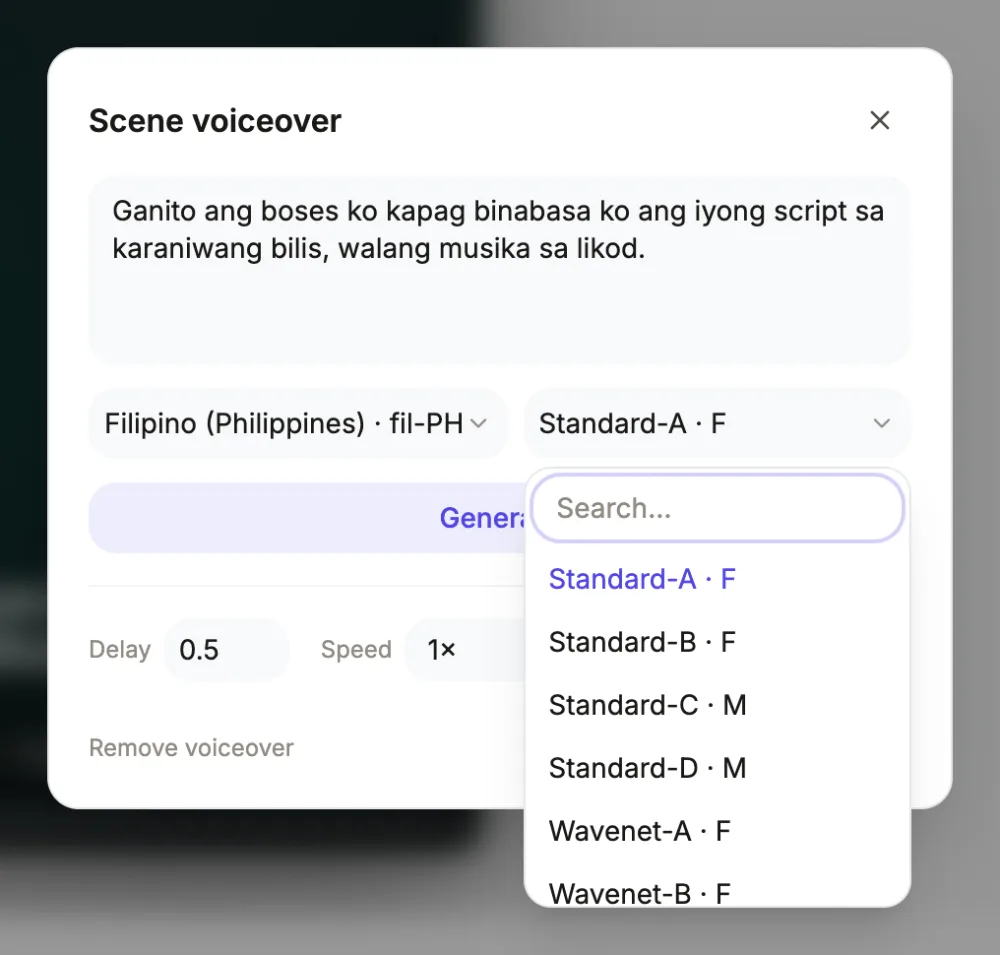
The live catalogue holds no premium characters for fil-PH, so the product falls back to the locale's best tier, Wavenet, choosing C for male reads and A for female. That verification is baked into the casting code, not guessed per request, so generation never fails on Filipino; it just has less texture to offer. Compared with the eight-character languages, delivery is flatter across long passages, though clarity is excellent. The per-scene voice dialog can search the full catalogue, which for fil-PH surfaces Standard-tier voices, older still, plus whatever Google adds over time.
Style requests and where they go
Ask for energetic, warm, instructional or neutral and Filipino returns the same two voices; only the gender preference changes the outcome. The register then lives in the writing, and the director uses it: a promo script gets short exclamations and a sale rhythm, a tutorial gets even, numbered steps, and the tutorial rule still applies in the sense that the script is written instructionally. Taglish is available on request; describe your brand voice in the brief and the mix of Tagalog and English follows it, which is often the most natural register for Metro Manila retail.
Full pipeline, older instrument
Everything around the voice runs at full capability. The Language field set to Filipino makes the director write narration and on-screen copy natively from any brief. Scenes stretch to fit clips, dynamic pace flows overruns across cuts, each scene has its delay in seconds and speed steps from 0.85x to 1.25x, and music ducks itself to 22 percent under speech. A typical clip uses about half a credit, billed by length, and an export bills only its render time once clips are complete. The word-timed captions are actually at their most precise here, since Wavenet supplies timing marks natively.
Getting the best from Wavenet
A flatter voice rewards livelier text. Keep sentences short and rhythmic; the evenness that drones through a fifty word sentence sounds crisp across ten word ones. Spell out numbers whose reading matters, isang daang piso over P100, and respell foreign or English names phonetically in the narration when the read is off, about half a credit per regeneration. Sentence punctuation cuts the caption cues, so punchy sentences also caption cleanly. The em dash is banned in generated narration by prompt rule; commas suit Filipino cadence better anyway.
Captions in this script
Filipino captions are among the simplest cases: spaced Latin words every catalogue font renders natively, so all 21 looks keep their own typography. There is also a timing bonus specific to Wavenet voices: they honour timing marks directly, so the word highlight is measured on the exact clip you hear instead of scaled from a sibling read, and Filipino caption sync is correspondingly tight. Long Taglish sentences past 48 characters split into a second cue, so shortish sentences read best in the pill.
Questions people ask
Which Filipino voices can I use?
Two: fil-PH-Wavenet-C, the male voice, and fil-PH-Wavenet-A, the female one. The fil-PH locale ships no premium characters, so these are automatically selected as the locale's best tier. The scene-level catalogue search lists the locale's remaining, older options, so a single scene can be recast if one of them suits a line better.
How noticeable is the quality gap?
On short promo lines, mild; across a minute of continuous narration, clear. Wavenet articulates cleanly but with flatter intonation than the premium characters other languages get. Short sentences, a slightly slowed speed for tutorials, and letting captions carry detail all narrow the gap.
Can the video be in Taglish?
Yes. Describe the mixed register in your brief, or quote exact Taglish lines, and the director writes it; the voice reads Tagalog and English words in one sentence acceptably. For heavy English passages you can also re-voice individual scenes with an English voice from the catalogue search.
Are captions still word-timed?
Precisely so. Wavenet voices support timing marks natively, so the highlight is measured on the very clip you hear, making Filipino caption sync tighter than most languages. The Latin script renders in every look's own font, and captions toggle per scene in the voice dialog.
Is pricing affected by the voice tier?
No. Synthesis is billed by length whatever the tier, about half a credit for a typical clip, and the export rule is standard: it bills its render time and needs at least 1 credit left past 30 seconds or when narration is still owed. All editing between generations is free.
Narrate a video in Filipino
The button opens the video generator with the language already set in the brief. Pick a voice after the scenes are planned.
Make a videoRelated pages
Malay AI voiceover
Malay is one of three mapped languages with no premium tier at all, alongside Filipino and Traditional Chinese: the ms-MY locale offers two Wavenet voices, ms-MY-Wavenet-B male and ms-MY-Wavenet-A female. They are older-generation voices, serviceable and clear, and this page sets out the difference.
Vietnamese AI voiceover
Vietnamese narration has the full eight vi-VN voices behind it, with the director writing every line in Vietnamese. The caption question is tone marks: most look fonts ship the Vietnamese subset, but three families do not, and this page names them.
Romanian AI voiceover
Selecting Romanian assigns one of eight ro-RO voices and has the director write every spoken and on-screen line in Romanian. The ș and ț render correctly in captions across all looks, and each clip is billed by how long its line is.
Every locale is listed onthe voiceover languages page.