Videos
Testimonial video scene
A quote lands harder with a face attached, and there is a scene role for exactly that. What it will not do is invent the person. The instruction is explicit: only claim a named person when the brief actually names one, so a testimonial from nobody in particular is a quote scene instead.
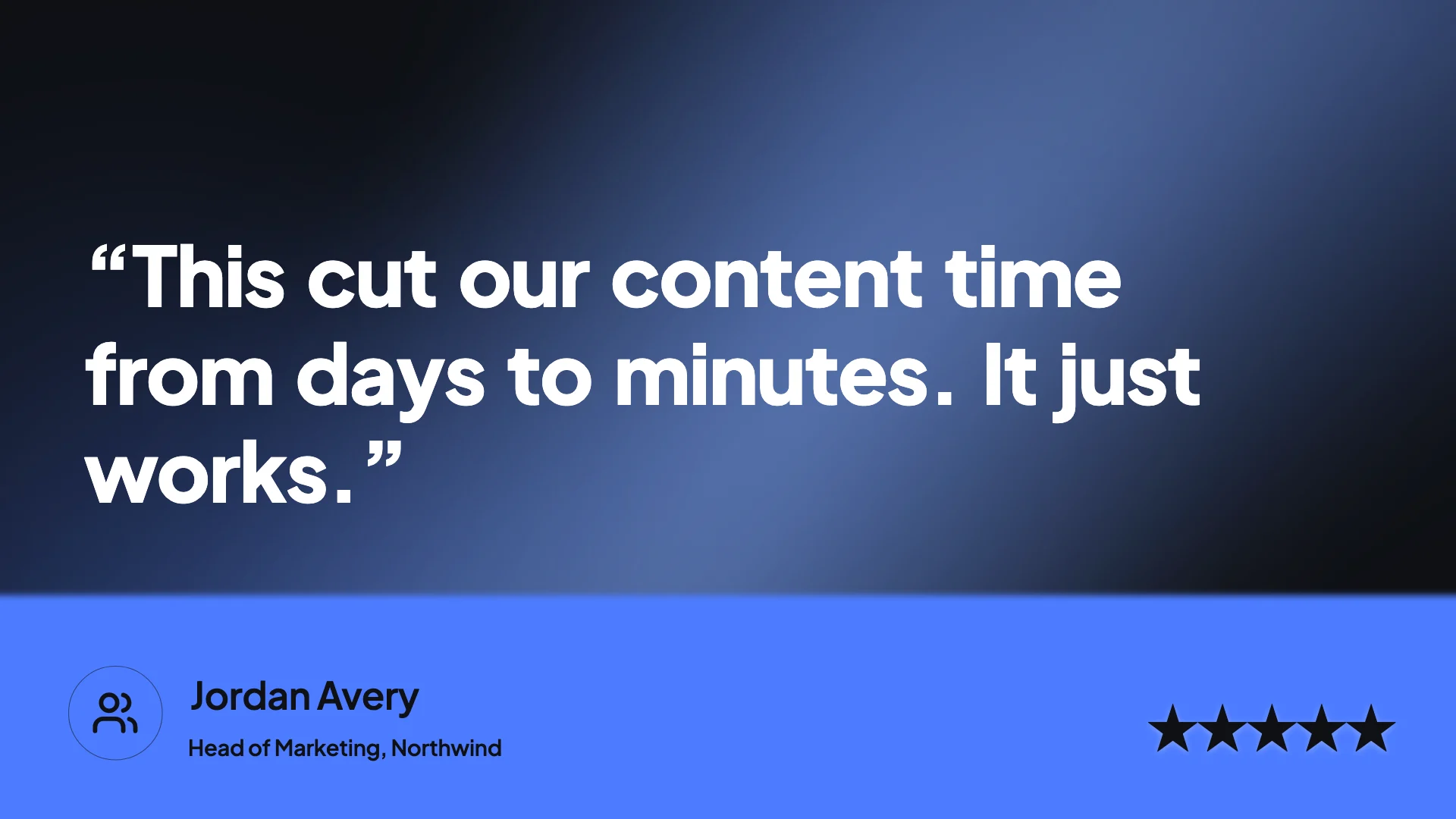
Five layouts, two of them portrait free
A full height portrait bleeding off the edge beside the quote. A tall portrait against a glow with one huge word pulled out of it. A named customer with their company logo and a count-up proof figure. A quote over a brand colour band with a drawn avatar. And three short testimonials stacked as cards. The first three need one uploaded portrait each. The last two draw an avatar instead, which is the honest option when you have permission to use the words but not a photograph.
The strongest version pairs a name with a number
One layout puts the customer's name, their logo and a counting proof statistic together, and that combination is worth building toward. A quote alone is an opinion. A quote from a named person at a named company, next to a figure that quantifies what changed, is evidence. Both the name and the number have to come from your brief, since neither will be fabricated.
Related roles, and when to use them instead
Quote is for a sentence that carries the message without needing a face, and has eight layouts including a written note on paper and a portrait variant. Social proof is for informal buzz, with a social post card, floating emoji reactions and scrolling ticker rows. Case study is for a customer result told as a story rather than a sentence. Rating is for a score. Choose by how formal the endorsement is and what you actually have permission to show.
A testimonial is a claim you have to stand behind
Under the FTC's endorsement guides, revised in 2023, an endorsement about a key attribute implies the endorser's experience is what customers generally get, and a disclaimer no longer rescues an atypical result. Any material connection between you and the person, payment, free product, a discount for the case study, must be disclosed in the same medium as the endorsement, which for a video means both what is seen and what is heard. Get the words signed off and the person's permission in writing before you build the scene.
How it works, in three steps
Step 1
Put the exact quote in the brief
Their words, their name, their company. Approximating a testimonial is both a legal problem and the reason most of them read as invented.
Step 2
Upload the portrait if you have one
Three of the five layouts want a real photograph. A tall crop suits the portrait layouts, and the picture is matched to slot shape automatically.
Step 3
Add the number that proves it
One layout counts a figure up beside the name and logo. That figure has to come from you, and it is what turns an opinion into evidence.
The full walkthrough with screenshots is in the guide Make a promo video with AI voiceover.
Limits worth knowing
- It will not name a person your brief did not name, and it will not invent a company or a figure.
- Portraits are uploaded images. There is no stock face library and generated illustration is never used to fake a real person.
- Logos are entered as an image or via the brand kit's logo URL. There is no logo search.
- Two of the five layouts draw a generic avatar. That is a placeholder graphic, not a depiction of your customer.
Questions people ask
Can I use a review from a public site?
Attribute it as it appears and keep the wording exact. The scene will print what you write, so an edited quote is your edit. A social post card layout in the social proof role suits a public review better than a formal testimonial layout does.
What if I do not have a photo?
Use one of the two layouts that draw an avatar, or drop to a quote scene, which has eight layouts and only one of them wants a portrait. A generic stock face attached to a real customer's name is the thing to avoid.
How long should a testimonial scene be?
Long enough to read the quote, which usually means giving it more than the 2.5 to 4 seconds a promo scene defaults to. Lengthen it in the timeline, or write a shorter quote.
Do I need a release from the person?
Yes, in writing, covering their name, words and image and the places the video will run. This is a business decision rather than a product feature, but it is the step most often skipped.
Make your own video
The button opens the generator with this use case already described. Change the wording to match yours, generate, then edit anything you like.
Create a video with OneCraftRelated pages
Faceless video maker
A faceless video maker builds a finished video with nobody on camera: moving type, drawn graphics, your screenshots or stock clips, a synthesised voice and captions burned into the picture. Faceless is a constraint you accept for a reason. Nobody has to be available, nothing has to be filmed twice when a price changes, and the same video can be reissued in another language without anybody appearing to speak it. The trade is that every second has to be carried by type, motion and voice.
Agency video maker
The recurring failure in agency reels is that a viewer cannot tell what the agency actually did. Every shot is somebody else's brand, no role is credited, the strongest piece sits at fifty seconds behind a logo animation, and it ends fading to black. It proves you have good taste in other people's work.
Restaurant video maker
There are two restaurant videos and they run in opposite directions. The venue film follows a guest's arrival: sign, room, bar, then the food. The social cut inverts it entirely, opening on the pour, the cheese pull or the sauce hitting the plate, and only orienting the viewer afterwards.
More finished work of this kind is on the video examples hub.
Written and checked by the OneCraft team. Last checked .