Contract clause
Inspection of goods clause: checking and rejecting a delivery
An inspection of goods clause gives a buyer a fixed period after delivery to check goods against the contract and reject any that do not conform, usually by written notice. It also says what happens when that period ends without a notice, which is normally that the goods are treated as accepted.
Goods left unopened on a loading dock for a month are hard to send back, because the longer a buyer keeps them the more the law reads silence as acceptance. A clause with a clear window, a notice method and a rule for hidden defects turns that uncertainty into a date on the calendar.
Indunil Asanka · Co-founder
4 min read · Published
Sample clause
a supply agreement under which Saltbush Fasteners, a fictional wholesaler in Wollongong, delivers cartons of stainless steel bolts to a boat builder that checks each delivery against its purchase order
10. Inspection and Rejection 10.1 The Buyer must inspect the Goods within 5 Business Days after Delivery (the Inspection Period). 10.2 The Buyer may reject any Goods that are damaged, short delivered or not in accordance with the Order by giving the Supplier a Rejection Notice within the Inspection Period. A Rejection Notice must identify the Goods by carton number, describe how they do not conform and attach photographs. 10.3 Within 10 Business Days after receiving a Rejection Notice, the Supplier must collect the rejected Goods at its own cost and, at the Buyer's election, replace them or credit their price. 10.4 Goods not rejected within the Inspection Period are treated as accepted, except for a defect that could not reasonably have been found by a count and visual check. 10.5 Until collection, the Buyer must store rejected Goods with reasonable care and must not use them.
Sample wording, not legal advice.
Variants
Short window for perishable goods
Fresh produce or flowers, where condition changes within hours of delivery.
The Customer must inspect each delivery of Produce on arrival. The Customer may reject Produce that is spoiled, below the grade in the Specification or delivered above 5 degrees Celsius by noting the reason on the delivery docket and telephoning Mulga Fresh within 4 hours after Delivery. Produce not rejected in that way is accepted, but acceptance does not affect a claim for damages for Produce that did not meet the Specification.
Deemed acceptance
A supplier that wants certainty before invoicing, for goods whose faults show on a quick check.
The Buyer is deemed to have accepted the Goods at the earliest of the end of 3 Business Days after Delivery, the Buyer using any of the Goods in production, or the Buyer reselling any of them, unless the Buyer has already given the Seller written notice rejecting the Goods and stating its reasons. Acceptance does not affect the Seller's warranty in clause 14 or any right that cannot lawfully be excluded.
Latent defects preserved
Equipment or components with faults that may only appear once in use, where the buyer needs protection after the window closes.
Acceptance of the Goods, whether by notice, by the end of the Inspection Period or by payment, does not prevent the Buyer from rejecting Goods, or claiming damages, for a Latent Defect notified to the Supplier within 30 days after the Buyer discovers it and in any event within 12 months after Delivery. A Latent Defect is a defect that was not apparent on a reasonable inspection at Delivery.
United States sale
A contract governed by the law of a US state that has adopted Article 2 of the Uniform Commercial Code.
Buyer may inspect the Goods at its receiving dock within 7 days after receipt and before acceptance. Buyer shall give Seller written notice of rejection within that period, stating each defect with enough particularity for Seller to cure it, and shall hold rejected Goods with reasonable care at Seller's disposition for 15 days. Buyer bears the cost of inspection but may recover it from Seller for Goods that do not conform and are rightfully rejected.
What to negotiate
Length of the window
The window should match the goods and how the buyer receives them. A count and visual check can be done in a day, while machinery may need to be installed and run. A buyer that installs or resells goods quickly needs the window to close before that happens, because using or reselling goods can itself amount to acceptance.
What makes a notice valid
Suppliers want enough detail to check the complaint and fix it, such as carton numbers and photos. Buyers want a simple method, such as an email to a named address, and no rule that voids a notice for a small formal error. Under US law, a defect left out of a rejection notice may be lost if the seller could have cured it.
Hidden defects and payment timing
The buyer should ask whether acceptance ends every claim or only the right to reject for obvious problems. It should also check whether payment falls due before the window closes, and if so add words saying payment is not acceptance and does not waive rejection.
The risk of leaving it out
Without the clause, the sale of goods legislation decides. In Victoria the Goods Act 1958 treats a buyer that has had a reasonable opportunity to examine goods and keeps them beyond a reasonable time without rejecting them as having accepted them, and what counts as reasonable is argued after the event. A buyer found to have accepted may be left with a damages claim only.
The default rules in the UK and the US
Section 35 of the Sale of Goods Act 1979 deems a buyer to accept goods when it says so, when it does an act inconsistent with the seller's ownership after delivery, or when it keeps the goods beyond a reasonable time without rejecting them. A buyer that has not examined delivered goods is not deemed to accept them until it has had a reasonable opportunity to do so, and asking for a repair is not acceptance. In the United States, section 2-513 of the Uniform Commercial Code gives the buyer a right to inspect before payment or acceptance, and section 2-602 requires rejection within a reasonable time after delivery with seasonable notice.
Why a short window does not bind consumers
Inspection windows belong in business contracts. In Australia, a consumer's right to reject goods with a major failure lasts for a reasonable time that depends on the type of product, its use and its expected life, whatever an inspection clause says. In the United Kingdom, section 35 does not apply to consumer contracts under the Consumer Rights Act 2015, which gives consumers a 30 day short term right to reject.
Where it sits in a generated document
In a generated purchase order or supply agreement, inspection and rejection is a numbered clause after delivery and risk, so the Inspection Period, the notice details and the hidden defects rule each sit in their own sub clause. The generated text does not cite sources, so any statement of the default acceptance rules is checked against the governing legislation.
Documents that carry this clause
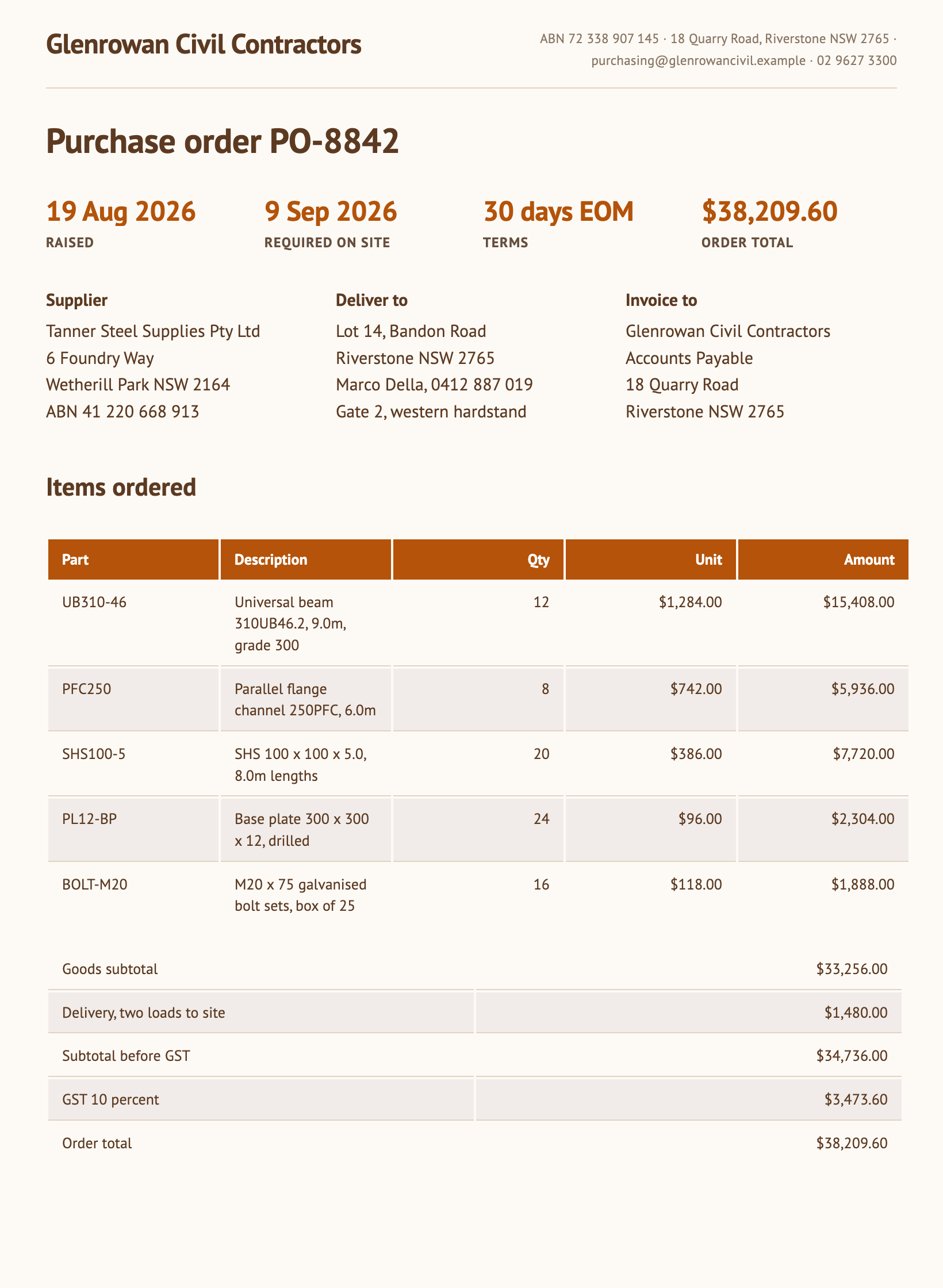 Purchase orderA civil contractor buys structural steel for a job that starts in three weeks. The order is written by the buyer, not the seller, and almost everything on it exists to stop a surprise arriving on the truck.
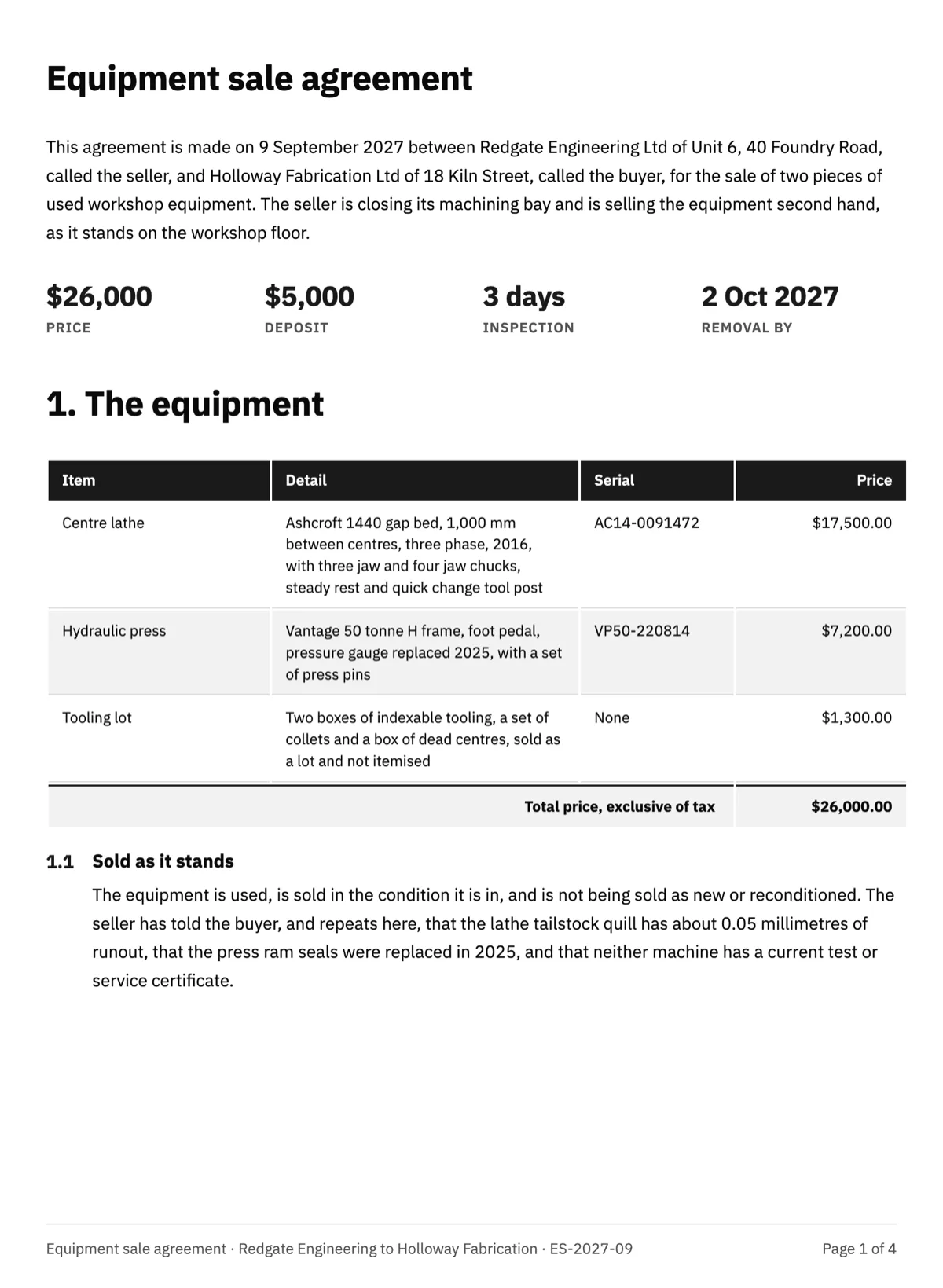 Equipment sale agreement with serial numbers and an inspection windowUsed machinery changes hands on a workshop floor, and the argument afterwards is always about condition or about who damaged the door frame on the way out. This agreement records the serial numbers and the known faults, gives the buyer two days to power the machines up, and puts the rigging, the making good and the storage charge in writing.
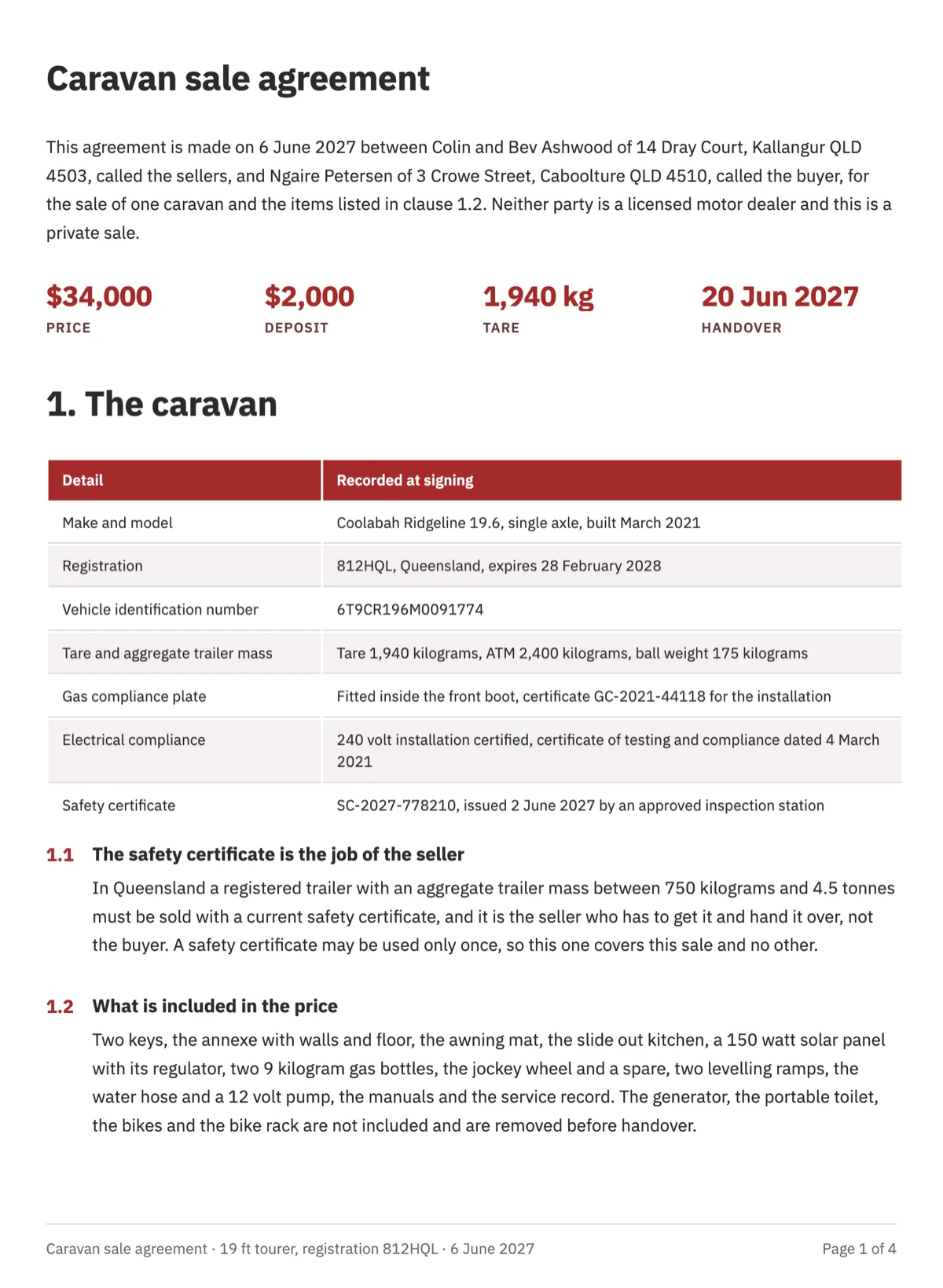 Caravan sale agreement with the compliance plates recordedA caravan is a trailer, a gas installation and a 240 volt circuit in one object, and each of those carries its own paperwork. This agreement records all three, puts the safety certificate where the law puts it, on the seller, and gives the buyer a window to have a gas fitter and an electrician look before the balance moves.
Questions people ask
How long should an inspection period be?
Long enough to do the check the goods actually need. Two to five business days suits counted or boxed goods that can be checked by eye, a few hours suits perishables, and machinery that must be installed and run may need several weeks. The period should start on delivery to the named place, not on dispatch or on the invoice date.
Does paying an invoice mean the goods are accepted?
Not by itself under section 35 of the UK Sale of Goods Act, which lists saying so, acting inconsistently with the seller's ownership and keeping goods beyond a reasonable time. Under the Uniform Commercial Code the buyer's inspection right normally applies before payment or acceptance. A contract can change the position, so the clause should state what payment means.
What is deemed acceptance?
Deemed acceptance treats goods as accepted when an event happens, even if the buyer never says so. The usual triggers are the end of the inspection period without a rejection notice, using the goods, or reselling them. Suppliers like it because invoicing and warranty periods can start on a known date, and buyers accept it when the window is realistic.
Can a buyer reject only part of a delivery?
A clause can allow it, and most supply agreements do by letting the buyer reject individual cartons or units that do not conform. Care is needed with goods sold as one commercial unit, such as a set of machine parts. Under UK law a buyer that accepts any goods in a commercial unit is deemed to accept the whole unit.
Who pays to return rejected goods?
The contract should say, and it is usually the supplier, because it delivered goods that did not conform. Under the Uniform Commercial Code a buyer that rightfully rejects must hold the goods with reasonable care for the seller to remove, and inspection costs can be recovered from the seller when nonconforming goods are rejected.
What if a defect appears after the inspection period ends?
Under a strict deemed acceptance clause the buyer may lose the right to reject, although a warranty or damages claim can remain. A buyer of goods with faults that only show in use should negotiate a latent defect carve out, which keeps the right to reject or claim for a defect that a reasonable inspection at delivery would not have found.
Put the clause in a finished document
The button opens the document generator with a starting description already filled in. Change it to match your own agreement before you run it.
Create a document with OneCraftRelated clauses
- Delivery clause: where, when and how the handover happensA delivery clause sets where, when and how goods or deliverables are handed over. Sample site delivery wording, plus fixed date, window and on call variants.
- Passing of risk clause: whose loss is itA passing of risk clause fixes when a buyer becomes responsible for loss or damage to goods. Sample wording plus dispatch, acceptance and US variants.
- Acceptance testing clause: deciding when the work is doneAn acceptance testing clause sets how a deliverable is tested and when it counts as accepted. Sample 10 day test wording, deemed acceptance and staged variants.
- Returns and refunds clause: change of mind and faulty goodsA returns and refunds clause sets when customers can bring goods back and what they get. Australian change of mind wording and where consumer law overrides it.
For everything the document generator can do, see the document maker.
Step by step in the builder: Create a document with AI, then Document builder components.
Sources
Written and checked by the OneCraft team. Last checked .