Contract clause
Passing of risk clause: whose loss is it
A passing of risk clause fixes the moment a buyer becomes responsible for loss of or damage to goods, such as on dispatch, on delivery or on acceptance. It is separate from the passing of ownership, and without it the law usually ties risk to ownership, which can move at a very different time.
When a pallet of tiles is crushed by a forklift, the only question anyone asks is whose loss it is. The answer depends on a moment in time, and a clause that names that moment and the insurance that goes with it saves an argument between two parties who each thought the other was covered.
Indunil Asanka · Co-founder
4 min read · Published
Sample clause
a supply agreement between Kookaburra Tiles and Stone, a fictional tile importer in Dandenong, and a commercial builder receiving tiles for an apartment project in Victoria
9. Risk 9.1 Risk of loss of or damage to the Goods passes to the Builder when the Goods are unloaded at the Site and the delivery docket is signed by the Builder's representative. 9.2 Until risk passes, Kookaburra Tiles and Stone bears the risk of loss or damage, including while the Goods are with its carrier, and must insure the Goods for their full invoice value. 9.3 If the Builder is not ready to accept delivery on the agreed date, risk passes at the time delivery was tendered, and the Builder must pay reasonable storage and redelivery costs. 9.4 The passing of risk does not affect when title passes, which is governed by clause 11, or the Builder's right to reject Goods that do not conform to this agreement. 9.5 From the time risk passes, the Builder must insure the Goods for their full replacement value until they are installed.
Sample wording, not legal advice.
Variants
Risk on dispatch
A supplier selling from a warehouse, where the buyer arranges or pays for freight.
Risk in the Goods passes to the Buyer when the Goods are handed to the carrier for delivery to the Buyer, whether the carrier is nominated by the Buyer or by the Seller. The Seller must make a reasonable contract of carriage for the Goods and, where the Goods are to be sent by sea, must give the Buyer enough notice to insure them in transit.
Risk on acceptance
Equipment that must be installed and tested before the buyer can tell whether it works.
Risk in the Equipment remains with the Supplier during delivery, installation and commissioning, and passes to the Customer only when the Customer signs the Acceptance Certificate after the Equipment has passed the acceptance tests in Schedule 3. If the Customer neither signs nor rejects within 10 business days after the tests are passed, risk passes at the end of that period.
United States sale
A contract governed by the law of a US state that has adopted Article 2 of the Uniform Commercial Code.
Risk of loss passes to Buyer upon Buyer's receipt of the Goods at the delivery address stated in the Order, whether or not Seller is a merchant, and this term displaces any contrary rule in Section 2-509 of the Uniform Commercial Code as adopted in the governing state. Until Buyer's receipt, Seller bears all risk of loss, including loss while the Goods are in the possession of a carrier.
What to negotiate
Dispatch or delivery
Suppliers prefer risk to pass on dispatch because they lose control of the goods once the carrier leaves. Buyers prefer delivery, because they cannot insure or inspect goods they have never seen. Whoever chooses and pays the carrier is usually best placed to carry transit risk, so the risk point often follows the freight arrangement.
Insurance that matches the risk
A risk clause without matching insurance leaves a gap. The party carrying risk at each stage should hold cover for that stage, and the clause should say who insures goods delivered to a site but not yet installed. Builders often rely on contract works insurance for that period, which is worth checking before the first delivery.
The risk of leaving it out
Without a risk clause the sale of goods legislation applies, and in Victoria the Goods Act 1958 puts goods at the buyer's risk once property has passed, whether or not they have been delivered. Because property in specific goods can pass when the contract is made, a buyer may carry the loss for goods still sitting in the seller's warehouse.
The default rule and why it surprises people
The Goods Act 1958 (Vic) says that, unless otherwise agreed, goods remain at the seller's risk until property is transferred, and are at the buyer's risk once property is transferred, whether delivery has been made or not. If delivery is delayed through the fault of either party, the goods are at the risk of the party at fault for any loss that would not otherwise have occurred. Delivery to a carrier for transmission to the buyer is treated as delivery to the buyer. The other states have equivalent sale of goods legislation.
Consumer and international sales
In a consumer sale the Australian Consumer Law guarantees continue to apply to the goods, so a risk clause cannot be used to shift the cost of a defect onto the consumer. In the United Kingdom, the general rule in the Sale of Goods Act 1979 does not apply to consumer contracts covered by the Consumer Rights Act 2015, which has its own rule on passing of risk. For international shipments, parties often name an Incoterms rule such as DAP or FOB to fix the delivery point, and the contract should say whether that rule also decides risk.
Where it sits in a generated document
A generated supply agreement numbers risk as its own clause, usually just before retention of title, so the difference between risk and ownership is visible in consecutive clauses. The generated text does not cite sources, so the governing sale of goods legislation and any Incoterms rule named in a draft are checked before signing.
Documents that carry this clause
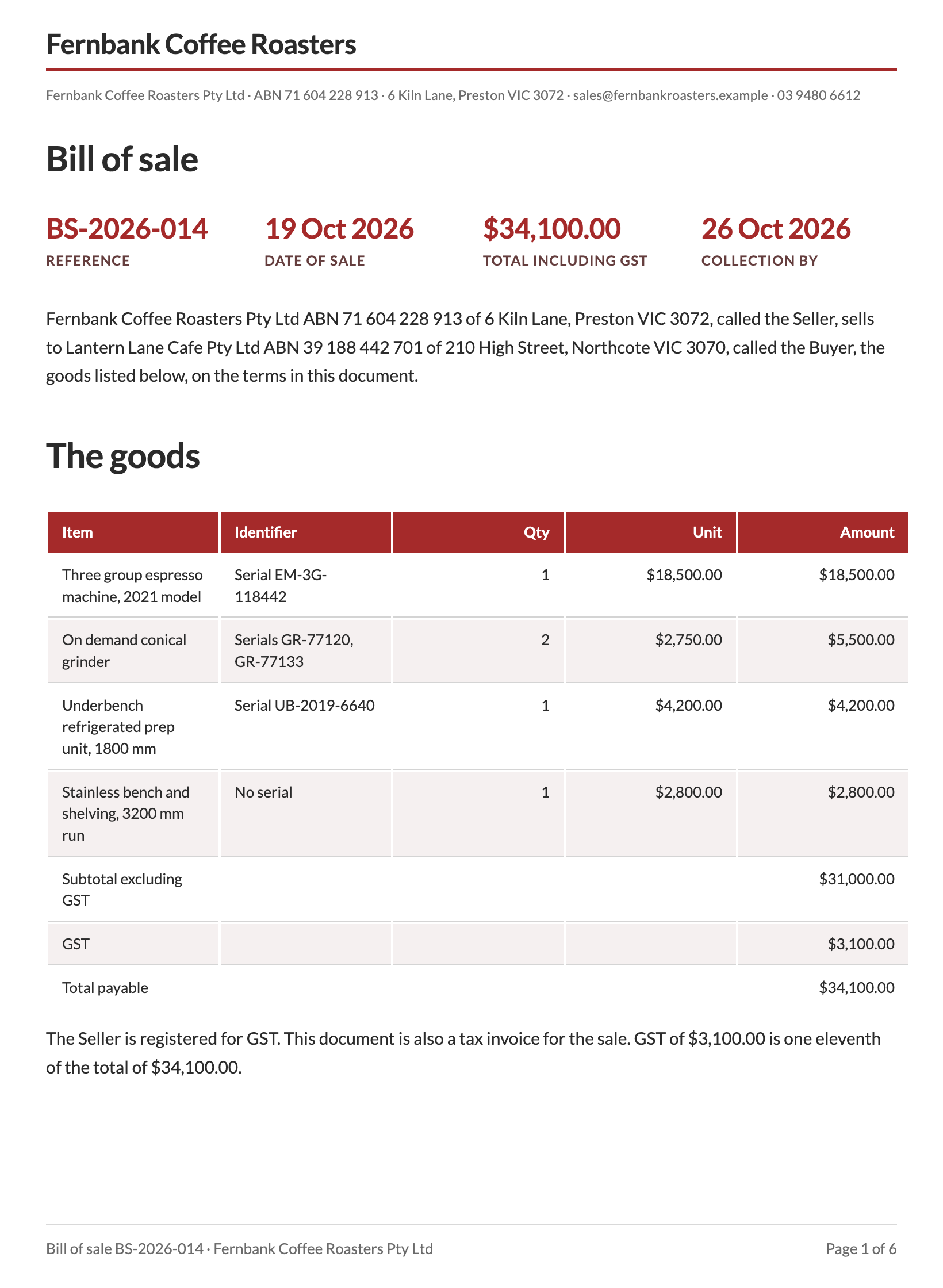 Bill of sale templateA coffee roaster is selling four pieces of used cafe equipment to a cafe down the road for $34,100. The interesting part is not the price. It is that the buyer searched the register against the serial numbers three days earlier, and the search date is written into the warranty.
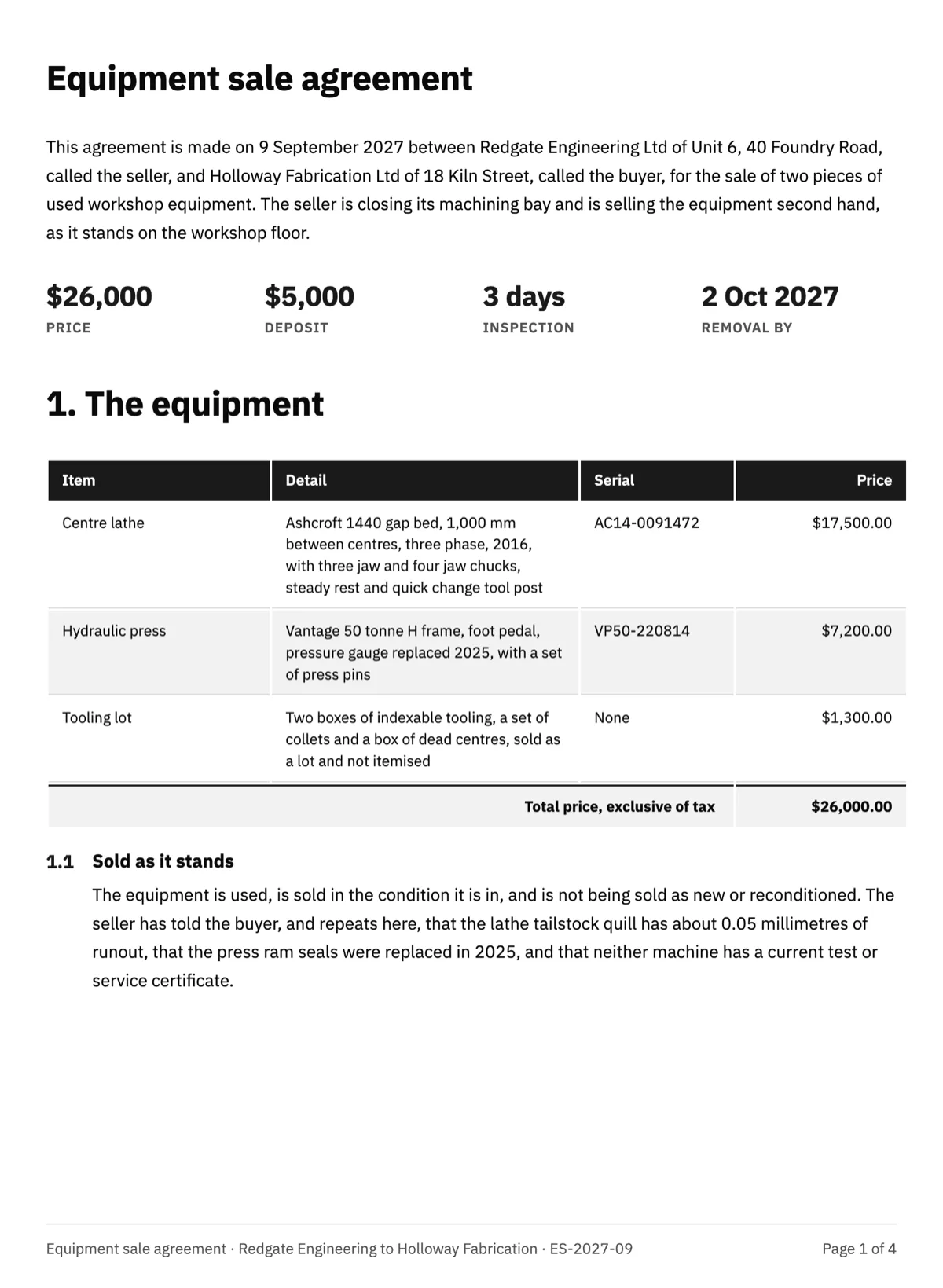 Equipment sale agreement with serial numbers and an inspection windowUsed machinery changes hands on a workshop floor, and the argument afterwards is always about condition or about who damaged the door frame on the way out. This agreement records the serial numbers and the known faults, gives the buyer two days to power the machines up, and puts the rigging, the making good and the storage charge in writing.
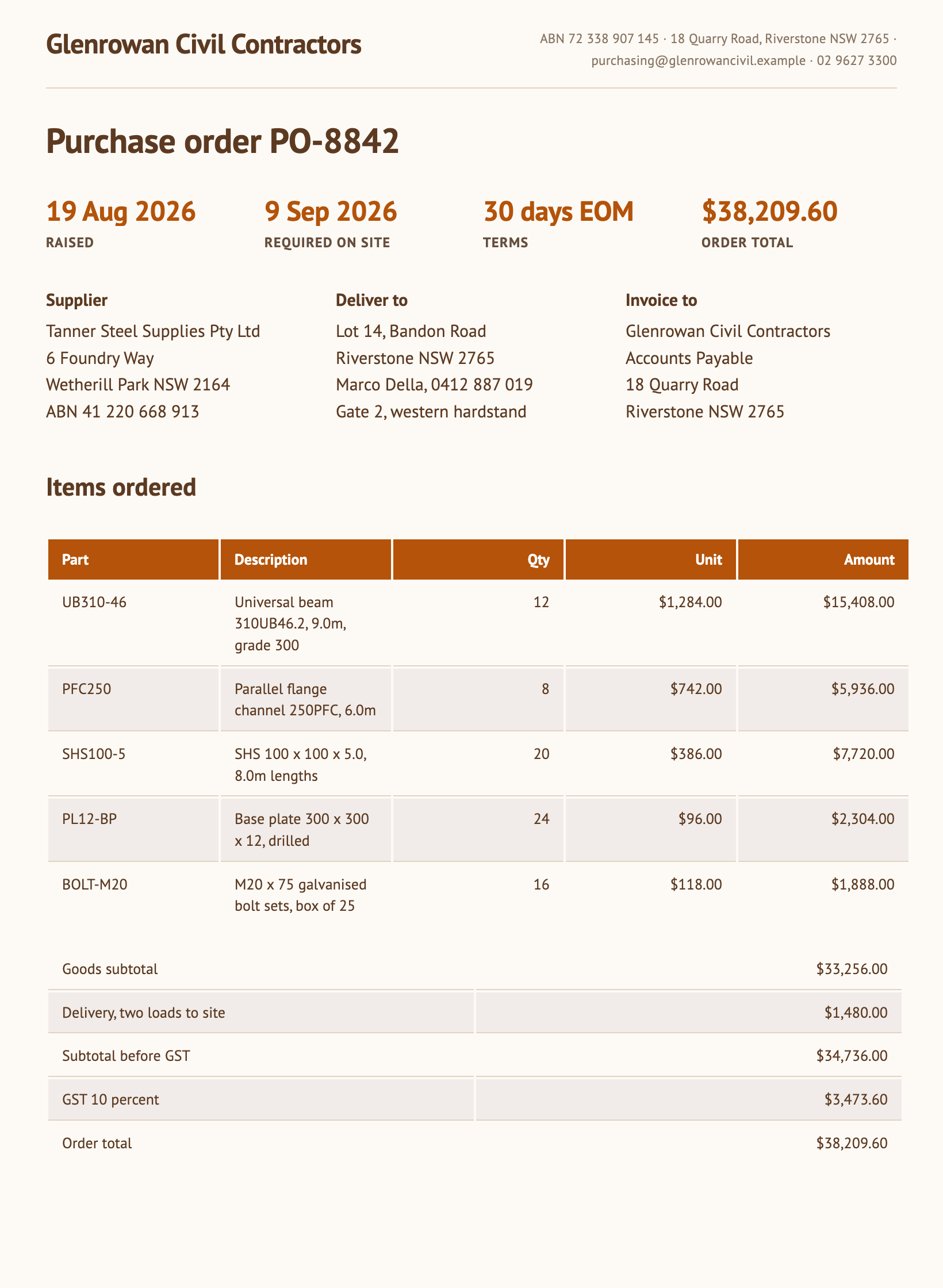 Purchase orderA civil contractor buys structural steel for a job that starts in three weeks. The order is written by the buyer, not the seller, and almost everything on it exists to stop a surprise arriving on the truck.
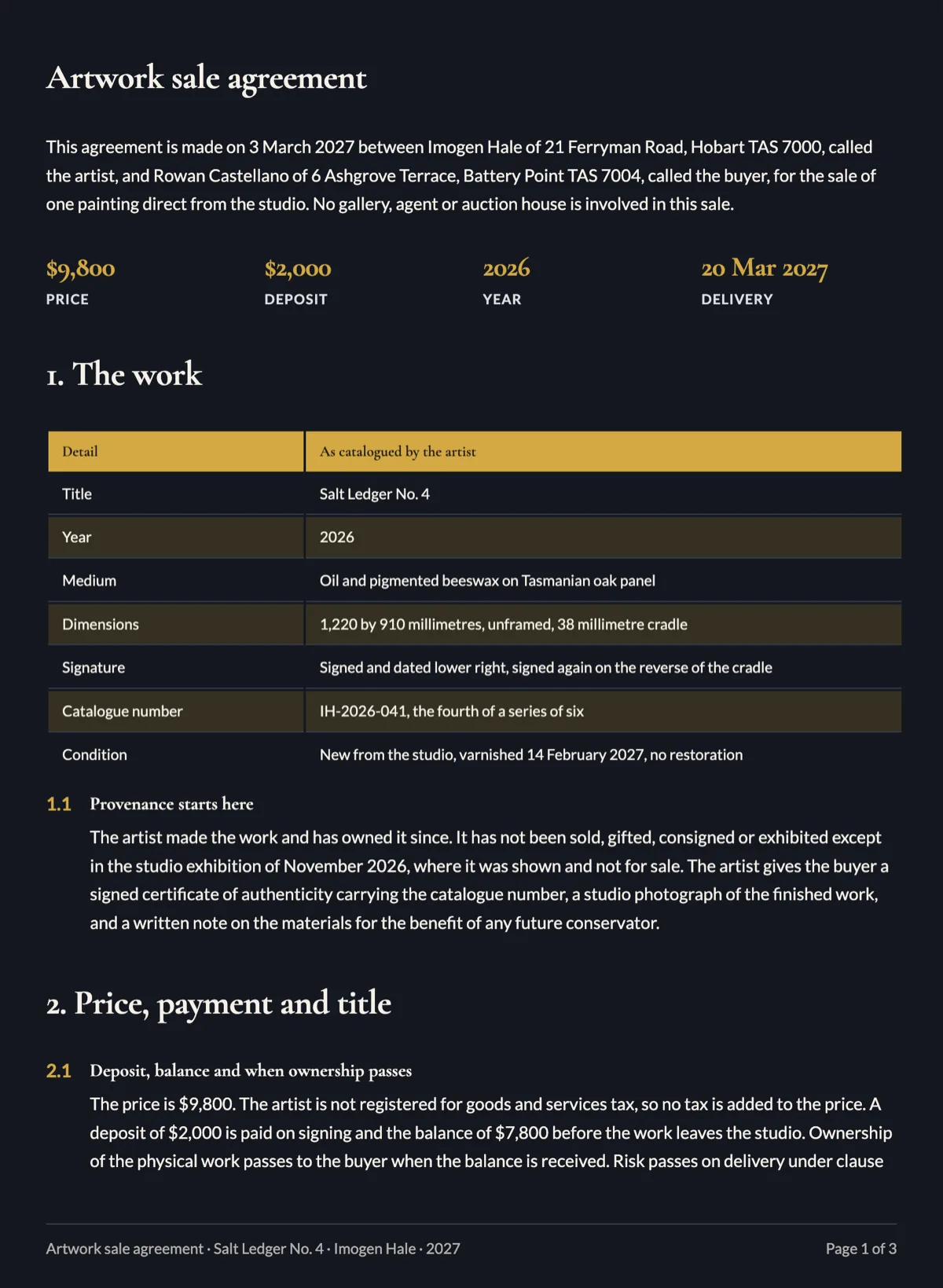 Artwork sale agreement with provenance and a resale royalty noteWhen a painting leaves a studio it takes its provenance with it, and whatever is not written down on the first sale is gone by the third. This agreement catalogues the work, keeps the copyright with the artist in plain words, and explains where the Australian resale royalty starts, which is not on this sale.
Questions people ask
Is passing of risk the same as passing of title?
No. Title is ownership, while risk is responsibility for loss or damage. By default they pass at the same time under the sale of goods legislation, but the parties can separate them, and commercial contracts often do: risk passes on delivery so the buyer insures goods in its care, while title passes only on payment.
Who bears the risk while goods are with a carrier?
Under the Goods Act 1958 (Vic), delivery to a carrier for transmission to the buyer is treated as delivery to the buyer, so the buyer often carries transit risk once property has passed. A contract saying risk passes on delivery at the buyer's premises reverses that position and leaves the transit risk with the seller.
What happens if the buyer delays taking delivery?
If delivery is delayed through the fault of one party, the goods are at that party's risk for any loss that would not have occurred but for the delay. A well drafted clause makes this explicit by passing risk at the time delivery was tendered and allowing the seller to charge reasonable storage costs.
Do Incoterms decide when risk passes?
Each Incoterms rule allocates delivery, costs and the point at which risk moves from seller to buyer for the carriage of goods, but the rules do not deal with when ownership passes or with payment. A contract naming a rule, such as DAP Melbourne under Incoterms 2020, still needs its own title and payment clauses.
Can a consumer be made to bear transit risk?
Terms can say when risk passes, but the Australian Consumer Law guarantees about the goods cannot be excluded, and in the United Kingdom the Consumer Rights Act 2015 generally keeps goods at the trader's risk until they come into the consumer's physical possession. Consumer terms that put transit risk on the buyer need careful drafting.
Who should insure goods delivered to a building site?
The party carrying risk at that stage. Once risk passes to a builder on delivery, the builder should confirm that its contract works or site insurance covers goods delivered but not yet installed, including theft and damage by other trades. The supply agreement can require evidence of that cover before the first delivery.
Put the clause in a finished document
The button opens the document generator with a starting description already filled in. Change it to match your own agreement before you run it.
Create a document with OneCraftRelated clauses
- Retention of title clause and the PPSRA retention of title clause keeps ownership with the seller until goods are paid for. Australian sample wording, all monies variants and the PPSR timing rules.
- Delivery clause: where, when and how the handover happensA delivery clause sets where, when and how goods or deliverables are handed over. Sample site delivery wording, plus fixed date, window and on call variants.
- Inspection of goods clause: checking and rejecting a deliveryAn inspection of goods clause gives a buyer a window to check a delivery and reject goods that do not conform. Sample wording plus AU, UK and US time limits.
- Incoterms clause: naming the delivery point, risk and freightAn incoterms clause names the trade rule that fixes delivery point, risk and freight. Sample DAP Melbourne wording, FOB, CIF and FCA variants, and all 11 rules.
For everything the document generator can do, see the document maker.
Step by step in the builder: Create a document with AI, then Document builder components.
Written and checked by the OneCraft team. Last checked .