Contract clause
Incoterms clause: naming the delivery point, risk and freight
An Incoterms clause adopts one of the International Chamber of Commerce's three letter trade rules, such as FOB or DAP, together with a named place. That choice fixes where the seller delivers, when risk in the goods passes to the buyer, and who pays freight, insurance and customs costs. It does not decide ownership or payment.
Three letters and a place name can decide who pays for a container lost at sea, so the clause is short but carries real money. Most disputes come from a vague named place or an outdated version of the rules rather than from the rule itself.
Nuwan Madhusanka · Co-founder
4 min read · Published
Sample clause
a supply contract under which Oltremare Ceramiche, a fictional tile maker in northern Italy, sells porcelain tiles to Merri Creek Stoneworks, a fictional importer in Melbourne
9. Delivery Terms 9.1 The Goods are sold DAP 18 Kilburn Road, Campbellfield VIC 3061, Australia, Incoterms 2020. 9.2 The Seller delivers the Goods when they are placed at the Buyer's disposal on the arriving vehicle at that address, ready for unloading. 9.3 Risk of loss of or damage to the Goods passes to the Buyer on delivery under clause 9.2. 9.4 The Buyer is responsible for unloading, import clearance, customs duty, import GST and any biosecurity inspection charges. 9.5 The Seller must insure the Goods for 110 per cent of the Price until delivery, even though the named rule does not require it. 9.6 Title to the Goods passes to the Buyer only when the Price has been paid in full. 9.7 If this clause is inconsistent with the rule named in clause 9.1, this clause prevails.
Sample wording, not legal advice.
Variants
FOB for goods loaded straight onto a ship
Bulk or break bulk cargo loaded over the ship's side at the origin port, with the buyer booking and paying the sea freight.
The Goods are sold FOB Port of Laem Chabang, Thailand, Incoterms 2020. The Seller must deliver the Goods on board the vessel nominated by the Buyer at that port within the shipment period stated in the Order and clear them for export. Risk passes to the Buyer when the Goods are on board. The Buyer must nominate the vessel at least 10 days before the shipment period begins and pays all freight from the port.
CIF with insurance raised above the default
The seller books sea freight and insurance to the destination port, while risk still passes at loading in the origin country.
The Goods are sold CIF Port of Fremantle, Australia, Incoterms 2020. The Seller must contract for carriage to Fremantle and obtain cargo insurance for 110 per cent of the Price on terms at least equal to Institute Cargo Clauses (A), rather than the lower default cover the rule provides. Risk passes to the Buyer when the Goods are on board the vessel at the port of shipment. The Seller must send the insurance certificate with the shipping documents.
FCA at the seller's premises for containers
Containerised goods collected by the buyer's forwarder, where FOB would leave risk with the seller while the container waits at a terminal it does not control.
The Goods are sold FCA Seller's warehouse, Via Radici Nord, Sassuolo, Italy, Incoterms 2020. The Seller delivers the Goods by loading them onto the transport provided by the Buyer's nominated carrier at that address, cleared for export. Risk passes to the Buyer when loading is complete. The Buyer must instruct its carrier to issue an on board bill of lading to the Seller if the Seller's bank requires one to release payment.
What to negotiate
The named place
A rule without a precise place is the most common failure. FOB Shanghai leaves open which terminal, and DAP Melbourne says nothing about whether delivery is to a warehouse door or a container park. Parties usually settle on a full street address for the delivered rules and a named port or terminal for the maritime rules, written the way a carrier would read it.
Maritime rules for container cargo
FOB, CFR and CIF were built for goods loaded onto a ship. Container cargo is handed to a carrier at a terminal days earlier, so a seller on FOB can carry risk for goods it no longer controls. The ICC's own guidance points container shipments to FCA, CPT or CIP instead, and experienced buyers expect that substitution.
Destination charges
The delivered rules split destination costs in ways buyers do not expect. Under DAP the buyer unloads, under DPU the seller does, and under DDP the seller also pays import duty and taxes, which an overseas seller may be unable to recover. The clause should say who pays terminal handling, storage and biosecurity charges, because those sit outside the quoted price.
What the rules leave out
Incoterms say nothing about when ownership passes, when payment is due, what happens on breach or which law applies. Parties that treat the three letters as a complete delivery clause find this out when a buyer becomes insolvent holding unpaid goods. A retention of title clause and a payment clause do that work, and the delivery clause should refer to both.
The risk of leaving it out
Without a trade rule, delivery, risk and costs fall back on the governing law, which differs between countries and between the contract of sale and the contract of carriage. For an international sale that can mean a cargo loss followed by an argument over which country's sale of goods law decides whether risk had passed and who was meant to insure.
The 11 rules in one pass
Incoterms 2020 has seven rules for any mode of transport and four for sea and inland waterway only. EXW and FCA leave the main freight with the buyer, with delivery at the seller's premises or to the buyer's carrier. CPT and CIP have the seller pay freight to the destination while risk passes when the goods reach the first carrier, and CIP adds insurance at the higher Institute Cargo Clauses (A) level. DAP, DPU and DDP have the seller carry risk and freight to the destination, with DPU adding unloading and DDP adding import duties and taxes. For sea freight, FAS and FOB leave freight with the buyer, while CFR and CIF have the seller pay it, CIF adding insurance at the lower Clauses (C) default.
Incoterms and United States contracts
Domestic sales in the United States are governed by the Uniform Commercial Code, whose own shipping terms, including FOB, carry meanings that differ from the ICC rules. A contract between a US buyer and an overseas seller that says FOB without naming Incoterms 2020 invites an argument about which definition applies. Naming the rule, the version and the place removes it.
Where it sits in a generated document
A generated supply contract or purchase agreement carries the trade rule as a numbered delivery clause, with risk, title and insurance as sub clauses beside it. The rule, the named place and the version year are written in as plain content. The document does not reproduce or cite the ICC rules, so the full text of the chosen rule should be read from the ICC's own publication before signing.
Documents that carry this clause
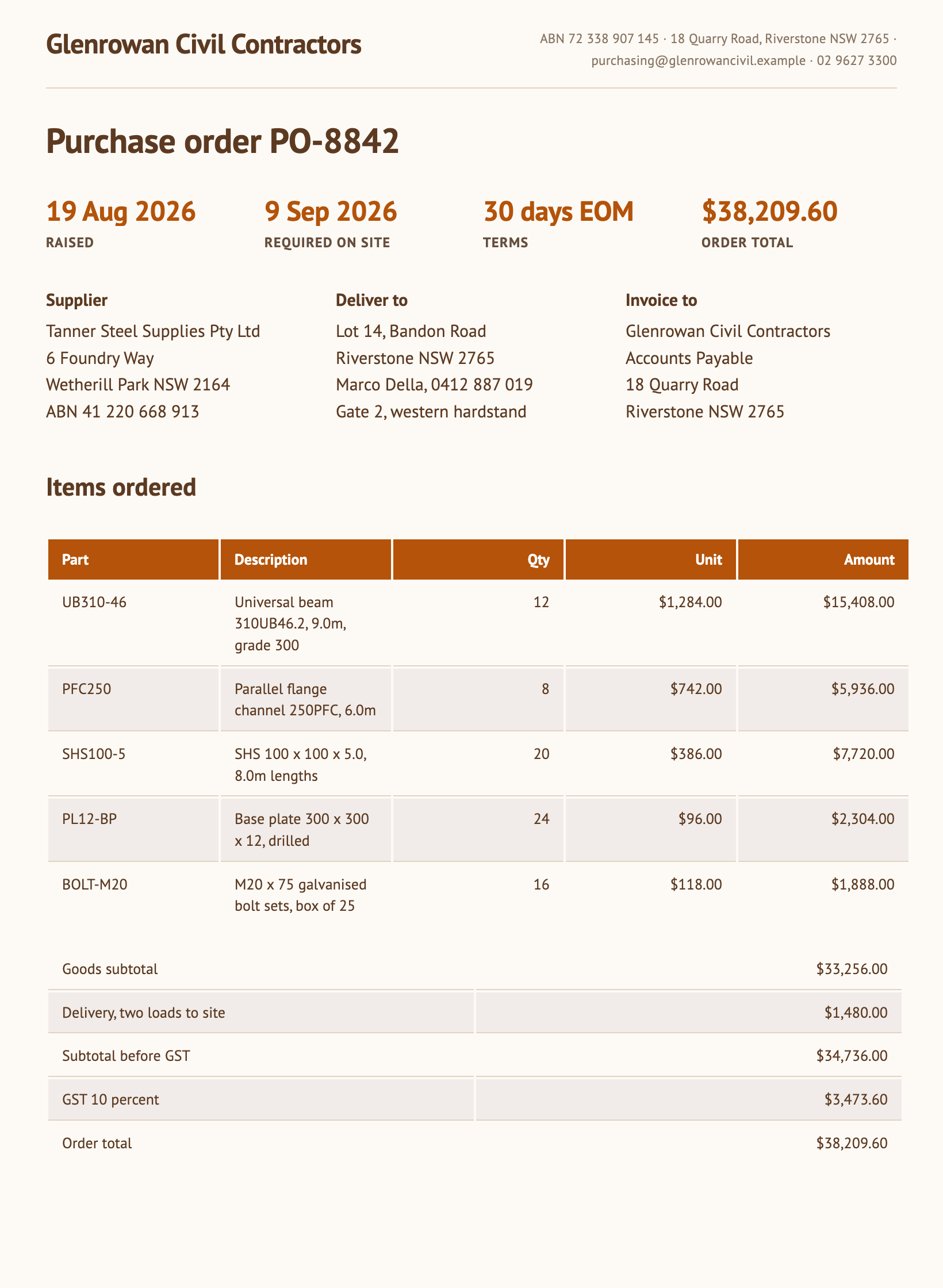 Purchase orderA civil contractor buys structural steel for a job that starts in three weeks. The order is written by the buyer, not the seller, and almost everything on it exists to stop a surprise arriving on the truck.
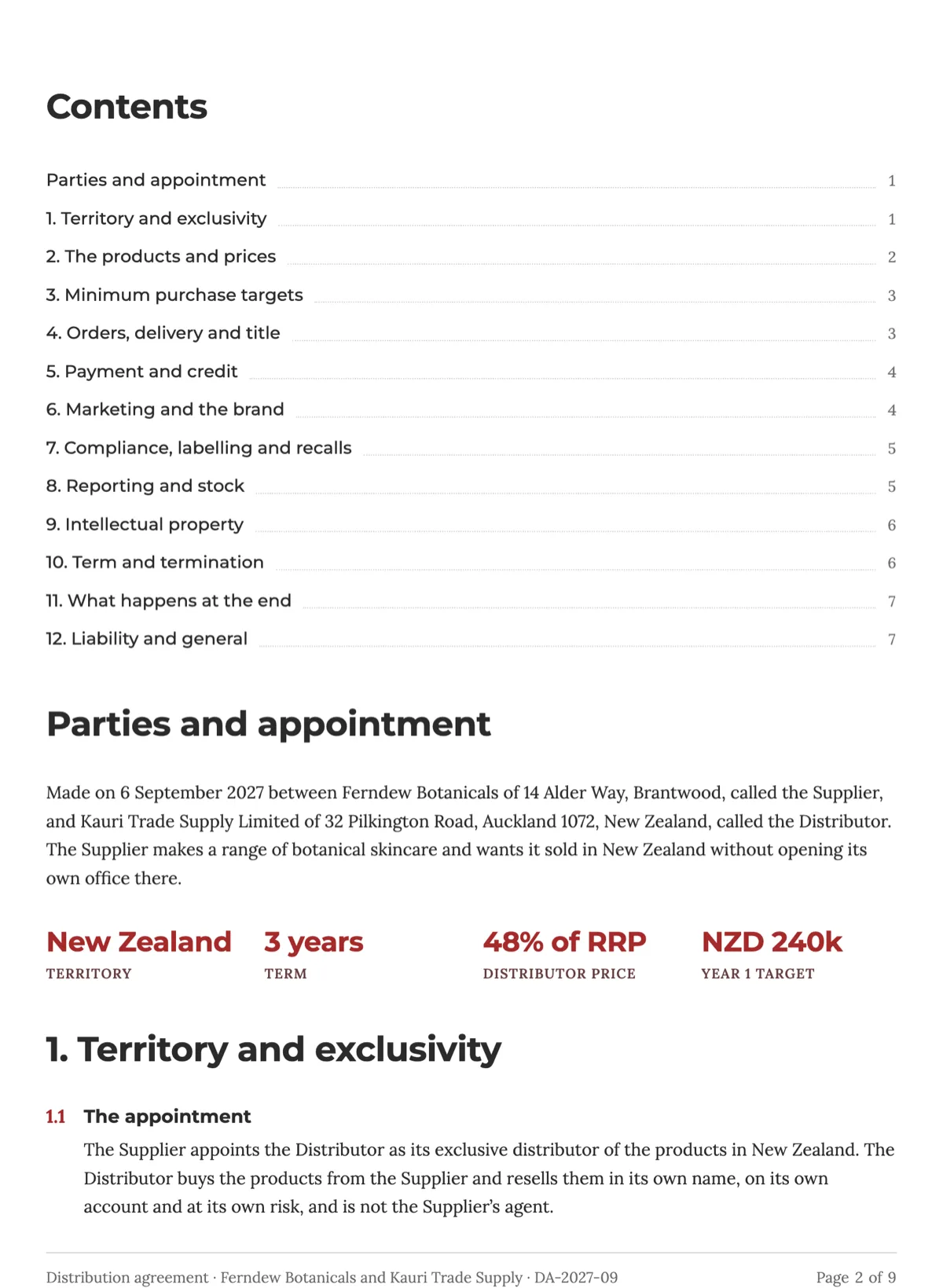 Distribution agreement template with territory and targetsAn exclusive distribution agreement is a trade: a territory in exchange for volume. This one appoints a New Zealand distributor for a skincare range at 48 per cent of recommended retail, with purchase targets rising from NZD 240,000 to NZD 420,000 across three years, and exclusivity that converts to non exclusive if a target is missed by more than 15 per cent.
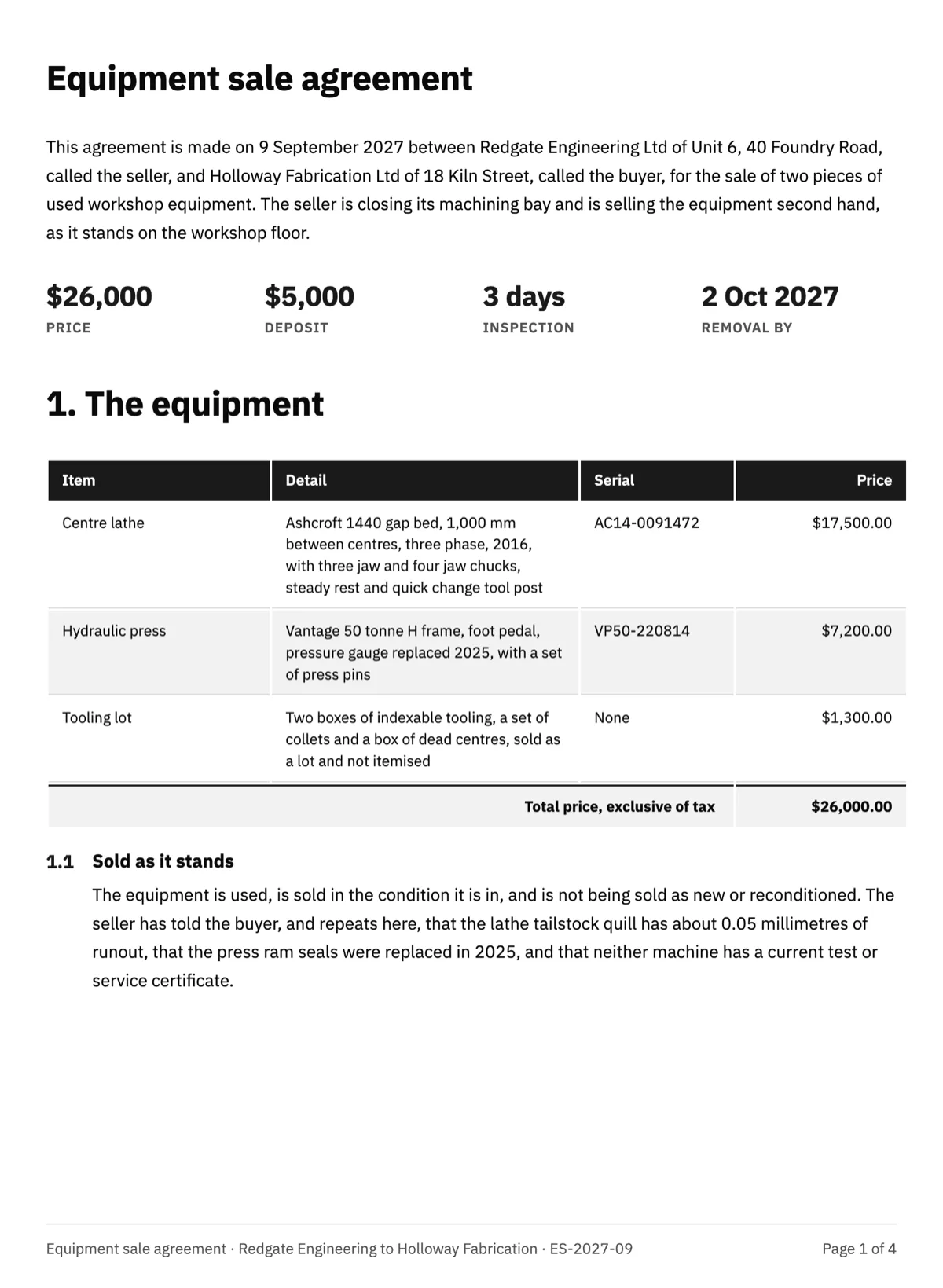 Equipment sale agreement with serial numbers and an inspection windowUsed machinery changes hands on a workshop floor, and the argument afterwards is always about condition or about who damaged the door frame on the way out. This agreement records the serial numbers and the known faults, gives the buyer two days to power the machines up, and puts the rigging, the making good and the storage charge in writing.
Questions people ask
Do Incoterms apply automatically to a contract?
No. Incoterms apply only when the contract adopts them, ideally by naming the rule, the place and the version, such as DAP Melbourne Incoterms 2020. A price quote that simply says FOB without a version can be read against older rules or against national law, which is why the full reference belongs in the contract itself.
Which Incoterms rules make the seller pay freight?
The seller pays the main freight under CPT, CIP, CFR, CIF, DAP, DPU and DDP. The buyer pays it under EXW, FCA, FAS and FOB. Paying freight is not the same as carrying risk, though, because under CPT, CIP, CFR and CIF risk passes to the buyer at the origin even though the seller booked the transport.
Is FOB suitable for container shipments?
The ICC recommends against it. FOB delivery happens when goods are on board the vessel, but containers are usually handed to the carrier at a terminal some days before loading, leaving the seller carrying risk for goods it no longer controls. FCA with a named terminal or the seller's premises is the usual substitute for containerised cargo.
Do Incoterms decide when ownership passes?
No. The rules deal with delivery, risk, costs and customs formalities only. Ownership, payment terms, remedies for breach and governing law all have to be set out elsewhere in the contract. Sellers that ship before payment usually pair the trade rule with a retention of title clause so the goods stay theirs until the price is paid.
Which Incoterms rules require insurance?
Only CIP and CIF oblige the seller to insure the goods for the buyer's benefit. Under the 2020 rules CIP requires cover equivalent to Institute Cargo Clauses (A), while CIF keeps the lower Clauses (C) as its default. Under every other rule insurance is a commercial choice, so the contract should say who insures if the parties want cover.
What replaced DAT in Incoterms 2020?
DAT, delivered at terminal, was renamed DPU, delivered at place unloaded. The change reflects that the destination need not be a terminal, and DPU remains the only rule under which the seller must unload the goods at the destination. Contracts still quoting DAT refer to the 2010 rules and are worth updating when they are renewed.
Put the clause in a finished document
The button opens the document generator with a starting description already filled in. Change it to match your own agreement before you run it.
Create a document with OneCraftRelated clauses
- Minimum order quantity clause: the smallest order a supplier acceptsA minimum order quantity clause sets the smallest order a supplier accepts. Sample wording with a per SKU minimum, a small order surcharge and three variants.
- Product recall clause: who decides, who runs it and who paysA product recall clause decides who calls a recall, who runs it and who pays. Australian sample wording, the recall steps in order and three variants.
- Passing of risk clause: whose loss is itA passing of risk clause fixes when a buyer becomes responsible for loss or damage to goods. Sample wording plus dispatch, acceptance and US variants.
- Delivery clause: where, when and how the handover happensA delivery clause sets where, when and how goods or deliverables are handed over. Sample site delivery wording, plus fixed date, window and on call variants.
For everything the document generator can do, see the document maker.
Step by step in the builder: Create a document with AI, then Document builder components.
Written and checked by the OneCraft team. Last checked .