Contract clause
Minimum order quantity clause: the smallest order a supplier accepts
A minimum order quantity clause sets the smallest order a supplier must accept under a supply arrangement, measured in units, cartons or order value. It says whether a smaller order is rejected, filled at a surcharge or held until it reaches the minimum, and whether the minimum applies per product line or per order.
Small orders cost a manufacturer the same setup, picking and freight as large ones, so without a floor a buyer can quietly turn a wholesale account into a retail one. The clause protects the buyer too, because a minimum written into the contract cannot be raised halfway through a season by an email.
Indunil Asanka · Co-founder
4 min read · Published
Sample clause
a wholesale supply agreement between Saltbush Ceramics, a fictional tableware maker in Adelaide, and Corella Homewares, a fictional group of five gift stores
6. Minimum Order Quantity 6.1 Each Order must be for at least 200 Units of each SKU it includes (the Minimum Order Quantity). 6.2 Saltbush Ceramics may accept an Order for fewer than 200 Units of a SKU, in which case a Small Order Surcharge of 12 per cent of the Price of that line applies and is shown on the order confirmation before dispatch. 6.3 Saltbush Ceramics may decline any line below 50 Units by written notice within 2 Business Days of receiving the Order. 6.4 Units of the same design in different colourways count together towards the Minimum Order Quantity, even where each colourway has its own SKU. 6.5 Saltbush Ceramics may change the Minimum Order Quantity for a SKU by giving 60 days written notice, and a change does not apply to an Order accepted before the notice takes effect. 6.6 Nothing in this clause obliges Corella Homewares to place any Order.
Sample wording, not legal advice.
Variants
Hard minimum, smaller lines rejected
A manufacturer running batch production, where a short run costs more to make than it earns.
The Supplier is not required to accept an Order for fewer than 500 Units of any Product. An Order that includes a line below that quantity is treated as an offer for the remaining lines only, and the Supplier must notify the Buyer within 2 Business Days of any line it rejects under this clause. The Buyer may withdraw the whole Order by notice within 1 Business Day of receiving that notice, without cost.
Order value minimum with a delivery fee
A wholesaler shipping mixed lines, where the cost that matters is the delivery run rather than the production run.
Each Order must have a total value of at least $600 excluding GST. An Order below that value is delivered with the next scheduled run for the Buyer's area and attracts a delivery fee of $45 excluding GST. Orders placed on the same Business Day for the same delivery address are combined when the total value is calculated, and the delivery fee is charged once for each combined delivery.
Annual volume review instead of a per order floor
The buyer wants flexibility order by order and the supplier is content to judge volume over a year, without turning it into a promise to buy.
There is no minimum quantity for an individual Order. If the Buyer's Orders in a Contract Year total fewer than 2,400 Units, the Supplier may, by notice given within 30 days after the end of that Contract Year, apply the Small Account Price List to Orders placed in the following Contract Year. This clause does not oblige the Buyer to order any quantity, and repricing under it is the Supplier's only remedy for low annual volume.
What to negotiate
Per line or per order
Suppliers prefer a minimum per SKU, because each line carries its own production or picking cost. Buyers testing a new range push for a minimum per order or per order value, so units can be spread across lines. A common middle ground counts colourways or sizes of one product together and sets a lower minimum for the first order of a new line.
What happens below the minimum
An outright rejection is cleanest for the supplier but leaves the buyer short of stock. A surcharge keeps the order moving and prices the inconvenience. Buyers ask for the surcharge to be a fixed percentage stated in the contract, shown on the confirmation before the goods ship, and never charged where the supplier itself split or shorted the delivery.
Changing the number
A minimum that can be raised by notice is a price increase in another form. Buyers ask for a notice period, protection for orders already accepted, and a right to end the agreement if the new minimum does not suit. Suppliers usually accept those limits where the minimum is reviewed no more than once a year.
Standard form terms with a small business
Where the terms are the supplier's standard form and the buyer is a small business, an unfair term can be void under the Australian Consumer Law, and penalties now apply to proposing one. A right to change the minimum at any time, without notice or an exit for the buyer, is the kind of one sided term that attracts that scrutiny.
The risk of leaving it out
Without a minimum, a framework agreement that obliges the supplier to accept orders at the agreed price obliges it to fill an order for a single unit at that price, and a surcharge added afterwards is a price the buyer never accepted. The buyer loses something too, because nothing then stops a minimum being introduced by email partway through the term.
Minimum order against minimum commitment
The two clauses are often confused and do different jobs. A minimum order quantity sets the smallest order the supplier has to handle, and the buyer remains free to order nothing at all. A minimum commitment is a promise to buy a stated volume or pay for the shortfall, which moves demand risk onto the buyer and needs its own clause and its own negotiation. A supply agreement can carry both, but the drafting has to keep them apart, or a surcharge on small orders gets read as a promise to keep ordering.
Setting the number
The minimum should come from the supplier's own costs rather than a round figure. For a made to order product it is usually the smallest economic batch, for a stocked product the smallest quantity that justifies a pick and a freight run, and for imported goods often a full carton or pallet layer. Stating the basis in the price list, the way a wholesale bakery sets a dollar minimum per delivery, makes the number easier to defend and easier for the buyer to plan around.
Where it sits in a generated document
In a generated supply agreement the minimum order sits in the ordering section as its own numbered clause, with the surcharge and the notice to change it as sub clauses a reader can point to. The figures are written in as plain content, so the per SKU number and the surcharge percentage read exactly as the parties settled them. The generated text does not cite legislation, so any reference to consumer law has to be checked before signing.
Documents that carry this clause
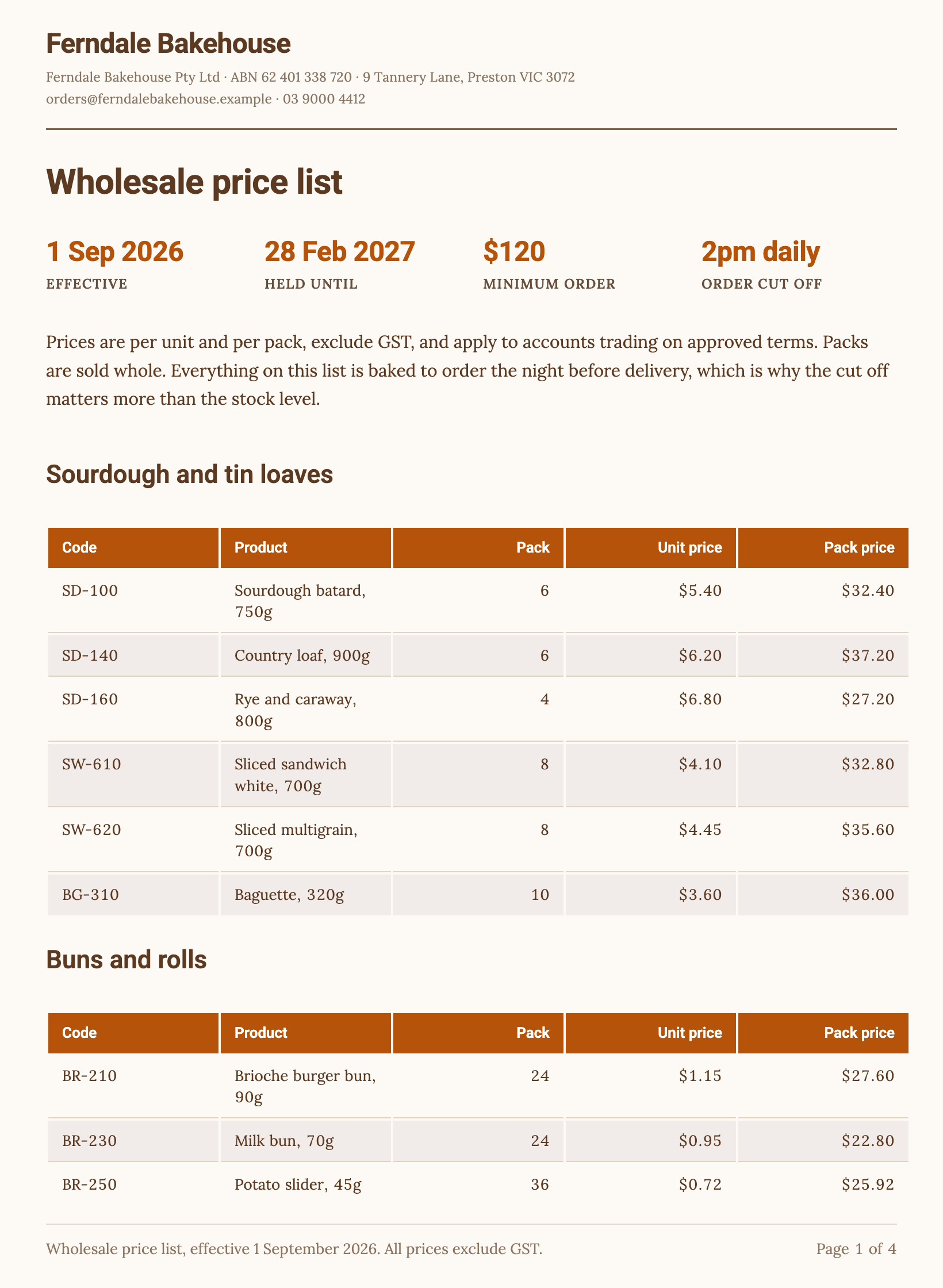 Wholesale price listA bakehouse sells to cafes, so the price that matters is the pack price, not the unit price. This list shows both for seventeen products, then the four things that decide what a cafe actually pays: volume, zone, cut off and terms.
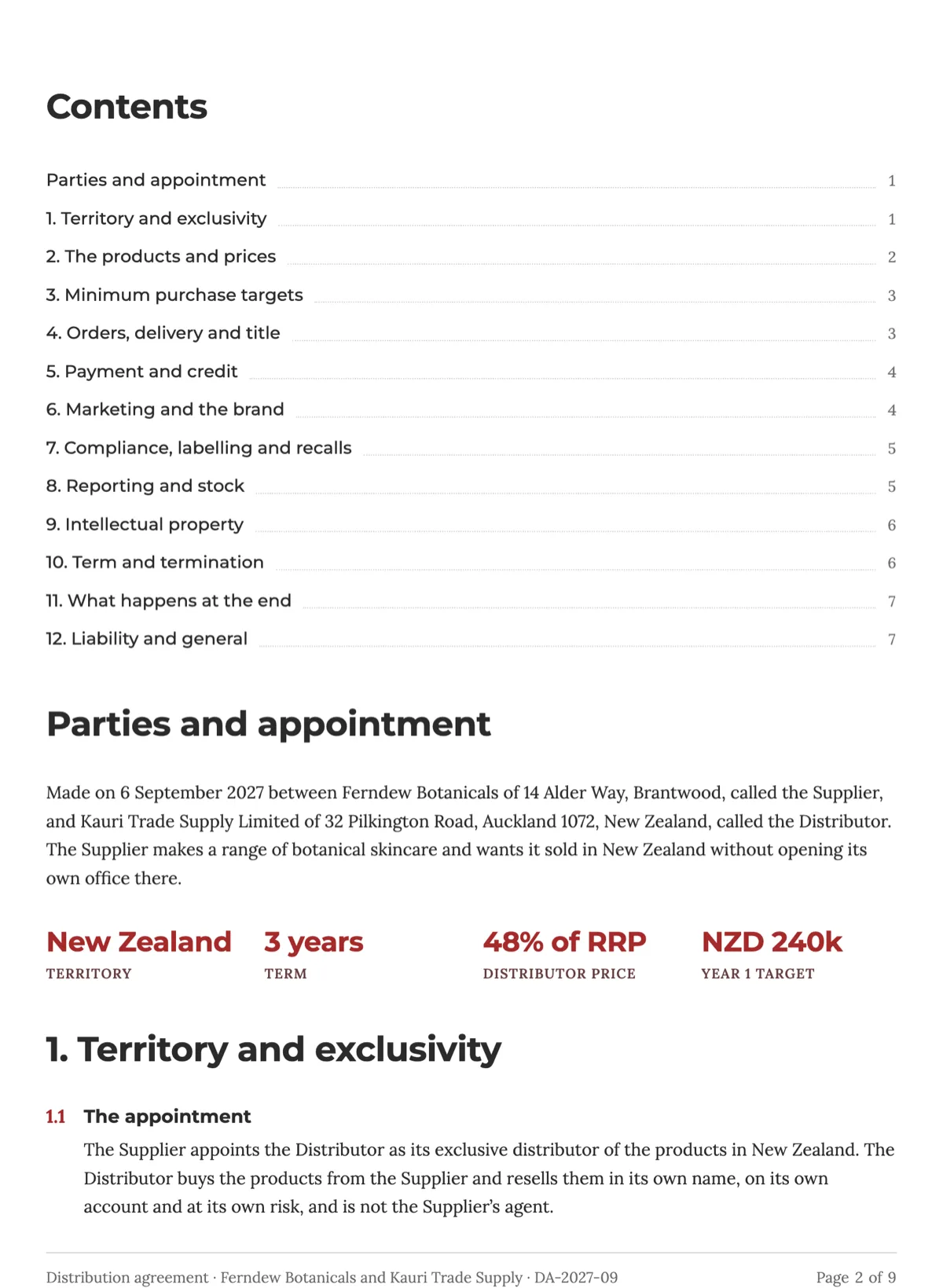 Distribution agreement template with territory and targetsAn exclusive distribution agreement is a trade: a territory in exchange for volume. This one appoints a New Zealand distributor for a skincare range at 48 per cent of recommended retail, with purchase targets rising from NZD 240,000 to NZD 420,000 across three years, and exclusivity that converts to non exclusive if a target is missed by more than 15 per cent.
Questions people ask
What is a typical minimum order quantity?
There is no standard figure, because the minimum reflects the supplier's own costs. Made to order goods often carry a minimum equal to the smallest economic production run, while stocked wholesale goods tend to use a dollar value per delivery or a full carton. The right number is the one the supplier can explain from its batch, picking and freight costs.
Can a supplier refuse an order below the minimum?
Yes, if the contract says so. Where an agreement obliges the supplier to accept orders that meet its terms, the minimum is one of those terms, and an order below it is not a valid order. Without the clause the supplier may be bound to fill any order placed under a framework agreement at the agreed price.
Is a small order surcharge enforceable?
A surcharge agreed in the contract is a price term and is generally enforceable between businesses. The risk comes when the surcharge is introduced later without agreement, or sits in a standard form contract with a small business on terms that let the supplier set or change it at will, which the unfair contract terms rules can catch.
Does a minimum order quantity mean the buyer must keep ordering?
No. A minimum order quantity only sets the size of any order the buyer chooses to place. A promise to buy a set volume over a period, or to pay if it does not, is a minimum commitment and needs clear separate wording. The clause should say expressly that it creates no obligation to order, so the two are never confused.
Should the minimum be per product or per order?
It depends on where the cost falls. A manufacturer whose cost is the production run needs a minimum per product line. A wholesaler whose cost is picking and delivery is better served by a minimum order value per delivery. Many agreements combine a per line minimum for made to order items with a value minimum for stocked items.
How do overseas suppliers set minimum order quantities?
Overseas manufacturers commonly quote minimums per style or per colour and often tie them to a full carton or container load. The clause should state the unit of measure, whether mixed cartons count, and which trade term governs delivery, because the extra cost of a part container shipment usually lands on the buyer.
Put the clause in a finished document
The button opens the document generator with a starting description already filled in. Change it to match your own agreement before you run it.
Create a document with OneCraftRelated clauses
- Exclusive distribution clause: one territory, one distributorAn exclusive distribution clause gives one distributor a territory the supplier will not share. Sample wording, a sales target, sole and non exclusive options.
- Incoterms clause: naming the delivery point, risk and freightAn incoterms clause names the trade rule that fixes delivery point, risk and freight. Sample DAP Melbourne wording, FOB, CIF and FCA variants, and all 11 rules.
- Price adjustment clause: moving a price after signingA price adjustment clause lets a price move after signing and says how. Australian sample wording with notice and an exit right, plus three variants to compare.
- Minimum purchase commitment clause: buying a set amount or paying anywayA minimum purchase commitment clause makes a buyer take a set volume or pay for the shortfall. Sample quarterly wording, take or pay and true up variants.
For everything the document generator can do, see the document maker.
Step by step in the builder: Create a document with AI, then Document builder components.
Written and checked by the OneCraft team. Last checked .