Contract clause
Exclusive distribution clause: one territory, one distributor
An exclusive distribution clause appoints one distributor for a defined territory and binds the supplier not to appoint anyone else there, and usually not to sell there itself. It names the products, the territory and the term, and it often ties the exclusivity to a sales target the distributor must meet to keep it.
Exclusivity is what a distributor pays for with its marketing spend, warehouse and sales team, so this clause is usually the commercial heart of the agreement. The word exclusive settles very little on its own, which is why disputes tend to start over direct sales, online orders and missed targets.
Nuwan Madhusanka · Co-founder
4 min read · Published
Sample clause
a distribution agreement under which Kinglake Coffee Roasters, a fictional Victorian roaster, appoints Swan Valley Beverage Supply, a fictional wholesaler, for Western Australia
4. Appointment and Exclusivity 4.1 Kinglake appoints the Distributor as its exclusive distributor of the Products in the Territory, being the State of Western Australia, for 3 years from the Commencement Date. 4.2 During the Term Kinglake must not appoint another distributor, agent or reseller of the Products in the Territory, and must not itself sell the Products to Trade Customers in the Territory. 4.3 Kinglake may continue to sell the Products to consumers through its own website, and must pay the Distributor 8 per cent of the net value of those sales delivered to addresses in the Territory each quarter. 4.4 The Distributor must buy Products with a net invoice value of at least $420,000 in each Contract Year (the Minimum Target). 4.5 If the Distributor does not meet the Minimum Target in a Contract Year, Kinglake may, by notice within 60 days after that Contract Year, convert the appointment to a non exclusive appointment for the rest of the Term. 4.6 The Distributor must not actively seek Trade Customers outside the Territory.
Sample wording, not legal advice.
Variants
Sole distribution, supplier keeps its direct accounts
The supplier already sells to a few large customers in the territory and wants to keep them while appointing no other distributor.
The Supplier appoints the Distributor as its sole distributor of the Products in the Territory. The Supplier will not appoint any other distributor or reseller in the Territory during the Term, but it may continue to supply the Products directly to the customers listed in Schedule 3. Sales to those customers do not count towards the Distributor's Minimum Target, and no commission is payable on them.
Non exclusive appointment
A new market where the supplier is testing more than one partner before committing to a single distributor.
The Supplier appoints the Distributor as a non exclusive distributor of the Products in the Territory. The Supplier may appoint other distributors in the Territory and may sell the Products there itself. The Supplier must give the Distributor 30 days notice before appointing another distributor in the Territory, and the Distributor may then terminate this agreement by 60 days notice without paying any termination fee.
United States exclusive dealing with an efforts standard
An agreement governed by the law of a US state, where the Uniform Commercial Code implies best efforts duties into exclusive dealing unless the parties agree otherwise.
Supplier appoints Distributor as its exclusive distributor of the Products in the Territory during the Term. Distributor shall use commercially reasonable efforts to promote and sell the Products in the Territory, and Supplier shall use commercially reasonable efforts to fill Distributor's accepted orders. The parties agree that these obligations are the full extent of any efforts obligation implied by law. Failure to achieve the Minimum Purchase Commitment is not by itself a breach of this Section.
What to negotiate
Targets that end exclusivity
Suppliers want a target the distributor must hit to stay exclusive. Distributors accept a target but resist losing the whole agreement for missing it. The usual settlement is conversion to a non exclusive appointment rather than termination, a target measured on invoiced sales over a full year, a lower first year figure, and a cure right where the shortfall is small or caused by supply problems.
Direct and online sales
A supplier's website can sell into any territory, so the clause needs to say whether online sales to consumers breach exclusivity. Distributors ask for a ban on direct sales to trade customers and a commission on consumer sales delivered in the territory. Suppliers usually accept a commission where the distributor also handles warranty claims and returns for those customers.
Competing products
Suppliers often ask the distributor not to carry competing brands. That is a second layer of exclusive dealing and needs care under competition law in most markets. Distributors limit it to directly competing products, exclude brands they already carry at signing, and ask that it fall away if the appointment becomes non exclusive.
Territory boundaries and unsolicited orders
Distributors want the territory drawn wide enough to protect their investment, and suppliers want it narrow enough to leave room for others. Both usually accept a ban on actively seeking customers outside the territory while leaving the distributor free to fill orders that arrive unsolicited, which is also broadly the approach vertical agreement rules in the UK expect.
The risk of leaving it out
If the clause is missing or vague, a distributor can spend years building a market and then find the supplier selling direct to its best accounts or appointing a second distributor, with no contractual answer. A supplier without a target mechanism faces the opposite problem, a territory locked up by a partner that has stopped selling.
Competition law in Australia, the UK and the US
Under the Competition and Consumer Act, exclusive dealing is prohibited only where it has the purpose, effect or likely effect of substantially lessening competition, and a business that sees a real risk can notify the ACCC for protection before it starts. A single territory appointment between a regional roaster and a state wholesaler rarely comes close. In the UK, distribution agreements are assessed under the Competition Act 1998, with a block exemption order covering most vertical agreements below market share thresholds. In the US, the Uniform Commercial Code implies best efforts duties into lawful exclusive dealing unless the contract says otherwise.
Exclusive, sole and non exclusive
The labels are used loosely, so the clause should define them rather than rely on them. Exclusive usually means no other distributor and no direct sales by the supplier. Sole usually means no other distributor, while the supplier keeps its own right to sell. Non exclusive means the supplier can appoint anyone. A contract that says exclusive and then reserves online sales has created something closer to a sole appointment, and the commission, reporting and target clauses should be written for that reality.
Where it sits in a generated document
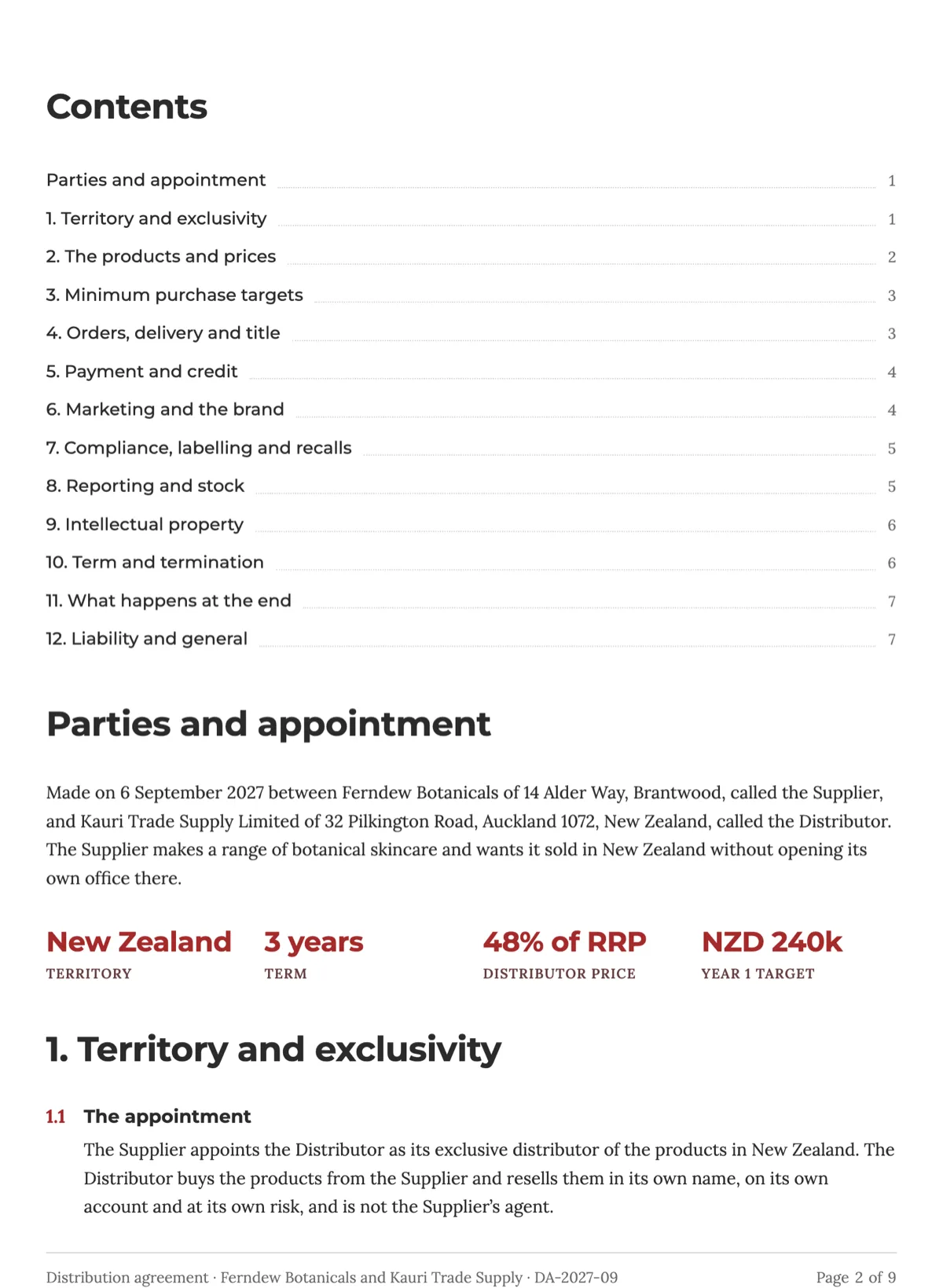
The appointment is normally the first operative clause of a generated distribution agreement, numbered so the target, reporting and termination clauses can refer back to it. Territory, term and target figures are written in as content rather than left as blanks. The document does not cite the competition legislation it is drafted around, so any statement about notification to the ACCC should be confirmed before the agreement is signed.
Documents that carry this clause
Questions people ask
What is the difference between exclusive and sole distribution?
In an exclusive appointment the supplier promises not to appoint another distributor and not to sell into the territory itself. In a sole appointment the supplier still appoints no one else but keeps the right to sell directly. Neither label is fixed by statute, so the agreement should spell out which direct sales, if any, the supplier keeps.
Is an exclusive distribution agreement legal in Australia?
Usually, yes. Exclusive dealing breaches the Competition and Consumer Act only where it has the purpose, effect or likely effect of substantially lessening competition in a market. Most territory appointments involve businesses without that kind of market power. Where there is a real risk, the conduct can be notified to the ACCC, which gives protection while the notification stands.
How long should an exclusive distribution term be?
Long enough for the distributor to recover its launch costs, which is why three to five years is common, often with a lower target in the first year. Suppliers balance a longer term with a performance review or a conversion right, so a distributor that stops selling does not keep the territory for the full period.
Can a supplier sell online into an exclusive territory?
Only if the agreement allows it. Silence invites a dispute, because a website order delivered into the territory looks like a direct sale. A common solution lets the supplier keep online consumer sales, pays the distributor a commission on those delivered in the territory, and bars direct sales to trade customers there.
What happens if the distributor misses its sales target?
Whatever the clause says, which is why the consequence has to be written down. The options are termination, conversion to a non exclusive appointment, a smaller territory, or a cure period to make up the shortfall. A target with no stated consequence leaves the supplier with an argument about breach and no clean way out of the exclusivity.
Does exclusivity stop the distributor selling competing products?
Not automatically. Exclusivity usually restricts the supplier, not the distributor. A promise by the distributor not to carry competing brands is a separate restriction that needs its own words, and it is assessed separately under competition law. Distributors commonly limit it to directly competing products and to the period the appointment stays exclusive.
Put the clause in a finished document
The button opens the document generator with a starting description already filled in. Change it to match your own agreement before you run it.
Create a document with OneCraftRelated clauses
- Minimum order quantity clause: the smallest order a supplier acceptsA minimum order quantity clause sets the smallest order a supplier accepts. Sample wording with a per SKU minimum, a small order surcharge and three variants.
- Product recall clause: who decides, who runs it and who paysA product recall clause decides who calls a recall, who runs it and who pays. Australian sample wording, the recall steps in order and three variants.
- Most favoured customer clause: promising the best priceA most favoured customer clause promises nobody else gets a better price. Sample wording with a rebate mechanism, three variants and the competition law risk.
- Termination for cause clauseA termination for cause clause ends a contract for serious breach. Sample wording, what counts as material, cure periods and immediate termination events.
For everything the document generator can do, see the document maker.
Step by step in the builder: Create a document with AI, then Send a document for signature.
Written and checked by the OneCraft team. Last checked .