Contract clause
Retention of title clause and the PPSR
A retention of title clause says that ownership of goods stays with the seller until the buyer has paid for them, even though the buyer already has the goods. In Australia the clause usually creates a security interest, so the seller must register it on the Personal Property Securities Register to rely on it against a liquidator.
Retention of title clauses are often well written and never registered, which leaves the supplier as an unsecured creditor on the day it matters most. The clause and the registration work as a pair, so the timing of the registration deserves as much care as the wording.
Nuwan Madhusanka · Co-founder
4 min read · Published
Sample clause
terms of trade between Stringybark Timber Supplies, a fictional timber merchant in Toowoomba, and building companies that buy framing timber on 30 day account
11. Retention of Title 11.1 Title in Goods supplied by Stringybark Timber Supplies does not pass to the Customer until the Customer has paid the price of those Goods in full. 11.2 Until title passes, the Customer holds the Goods as bailee for Stringybark Timber Supplies, must store them so they can be identified as its property, and must keep them insured. 11.3 The Customer may use the Goods or sell them in the ordinary course of its business. If it does so before paying for them, it holds the proceeds, and any right to receive the proceeds, for Stringybark Timber Supplies to the extent of the unpaid price. 11.4 The Customer acknowledges that this clause creates a security interest in the Goods and their proceeds under the Personal Property Securities Act 2009 (Cth), and must sign any document and give any information reasonably required to register that interest. 11.5 If the Customer fails to pay by the due date, or an insolvency event occurs, Stringybark Timber Supplies may enter the place where the Goods are stored, on reasonable notice where practicable, and recover Goods it has not been paid for.
Sample wording, not legal advice.
Variants
All monies retention of title
A supplier with a running account, where individual deliveries cannot easily be matched to individual invoices.
Title in all Goods supplied to the Customer remains with the Supplier until the Customer has paid every amount it owes the Supplier on any account, including amounts for other Goods and services. The Customer acknowledges that the Supplier may make separate registrations on the Personal Property Securities Register for the part of its security interest that is a purchase money security interest and for any part that is not.
One off sale of serial numbered equipment
A single sale of a serial numbered item on deferred payment terms.
Ownership of the Equipment, serial number FL30498, remains with the Seller until the Buyer has paid the full Price and any interest on late payment. Until then the Buyer must keep the Equipment at its Dalby depot, insure it for its replacement value, and not sell, lend or encumber it. The Buyer consents to the Seller registering its interest in the Equipment against the serial number on the Personal Property Securities Register.
Consignment stock
Stock supplied to a retailer that pays only when an item sells.
The Supplier retains ownership of all Consigned Stock until the Retailer sells it to a customer, at which point title passes directly to that customer and the Retailer must account to the Supplier for the price within 14 days. The Retailer must return unsold Consigned Stock on request and acknowledges that the Supplier may register its interest in the Consigned Stock on the Personal Property Securities Register.
What to negotiate
Registration against the customer's name
Customers sometimes object to a registration appearing against their name. Suppliers can explain that registration is what makes the clause effective against a liquidator or another secured creditor, and that it describes only the collateral supplied. A customer can reasonably ask for the registration to be removed once its account is closed and paid in full.
Goods that are processed or mixed
Timber cut into frames or flour baked into bread may no longer be identifiable goods. Suppliers extend the clause to proceeds and to products made from the goods, but protection weakens as goods lose their identity. Customers who process goods quickly may ask for the clause to apply only to goods still in their original form.
The risk of leaving it out
Without a retention of title clause, property in the goods usually passes under the sale of goods legislation well before payment, so an unpaid supplier is just another unsecured creditor if the customer fails. With a clause but no registration the outcome is often the same, because the register's own guidance says an unregistered retention of title interest leaves the supplier unsecured.
Why registration on the PPSR matters
A retention of title arrangement generally creates a security interest, and when goods are supplied on credit it is usually a purchase money security interest, which can rank ahead of other security interests over the same goods. The Personal Property Securities Register guidance is plain: a supplier that does not register its retention of title security interest will be an unsecured creditor. A registration against a company grantor should be made within 20 working days after the security agreement is signed, or more than 6 months before the company enters insolvency.
The timing rules for purchase money priority
To keep purchase money priority the registration has to be in place in time. For goods that will form part of the customer's inventory, such as timber a builder buys to use in its jobs, registration must happen before the customer gets possession of the goods. For goods that will not be inventory, such as equipment for the customer's own use, registration must happen within 15 working days after the customer gets possession. Serial numbered goods may need their own registrations.
Where it sits in a generated document
Generated terms of trade number retention of title as its own clause after the payment terms, with the passing of title, the bailment, the proceeds and the right to recover as separate sub clauses. The generated document does not cite the Act or the register's guidance, so the registration timing is checked against the register before the first delivery is made.
Documents that carry this clause
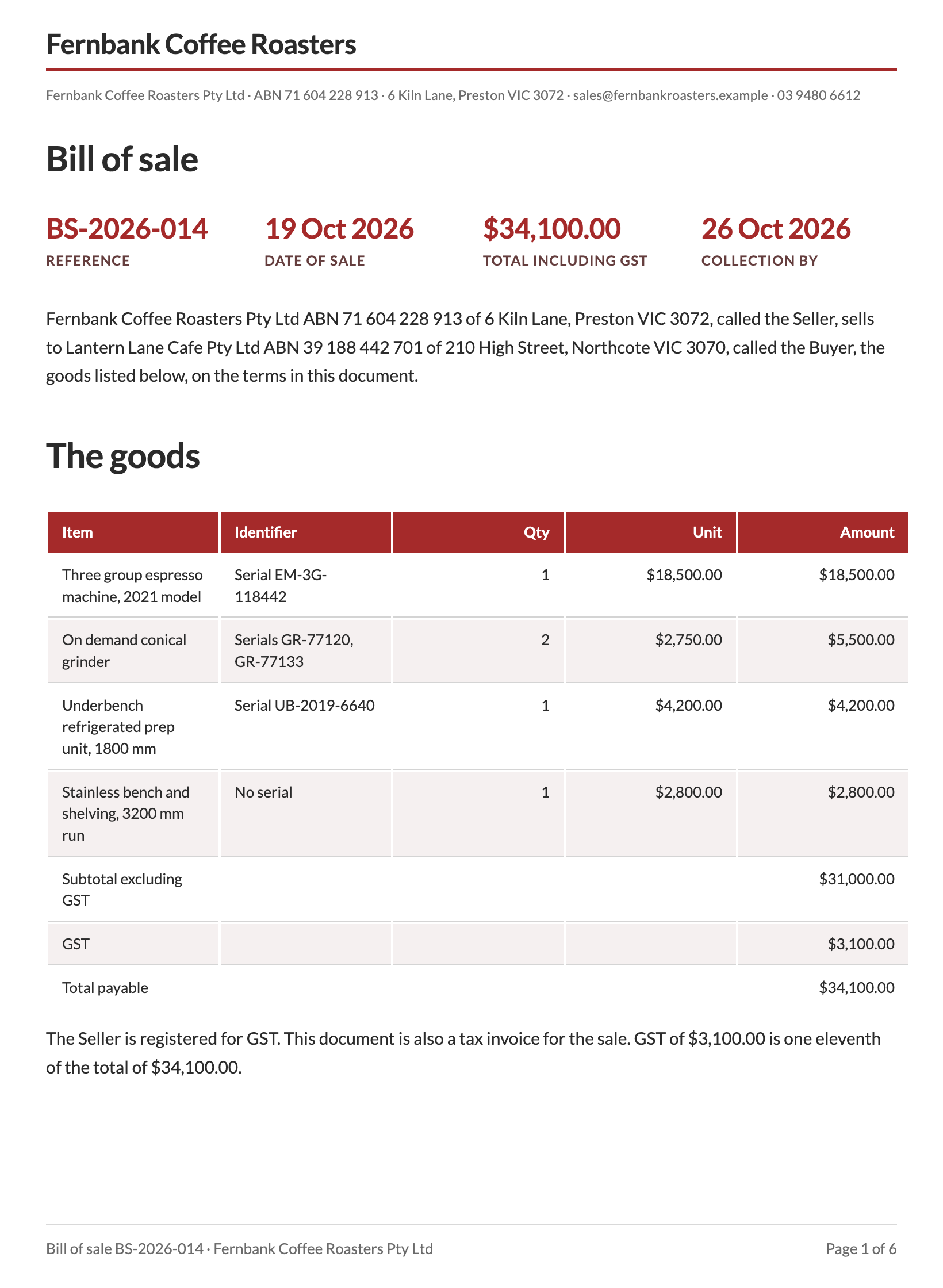 Bill of sale templateA coffee roaster is selling four pieces of used cafe equipment to a cafe down the road for $34,100. The interesting part is not the price. It is that the buyer searched the register against the serial numbers three days earlier, and the search date is written into the warranty.
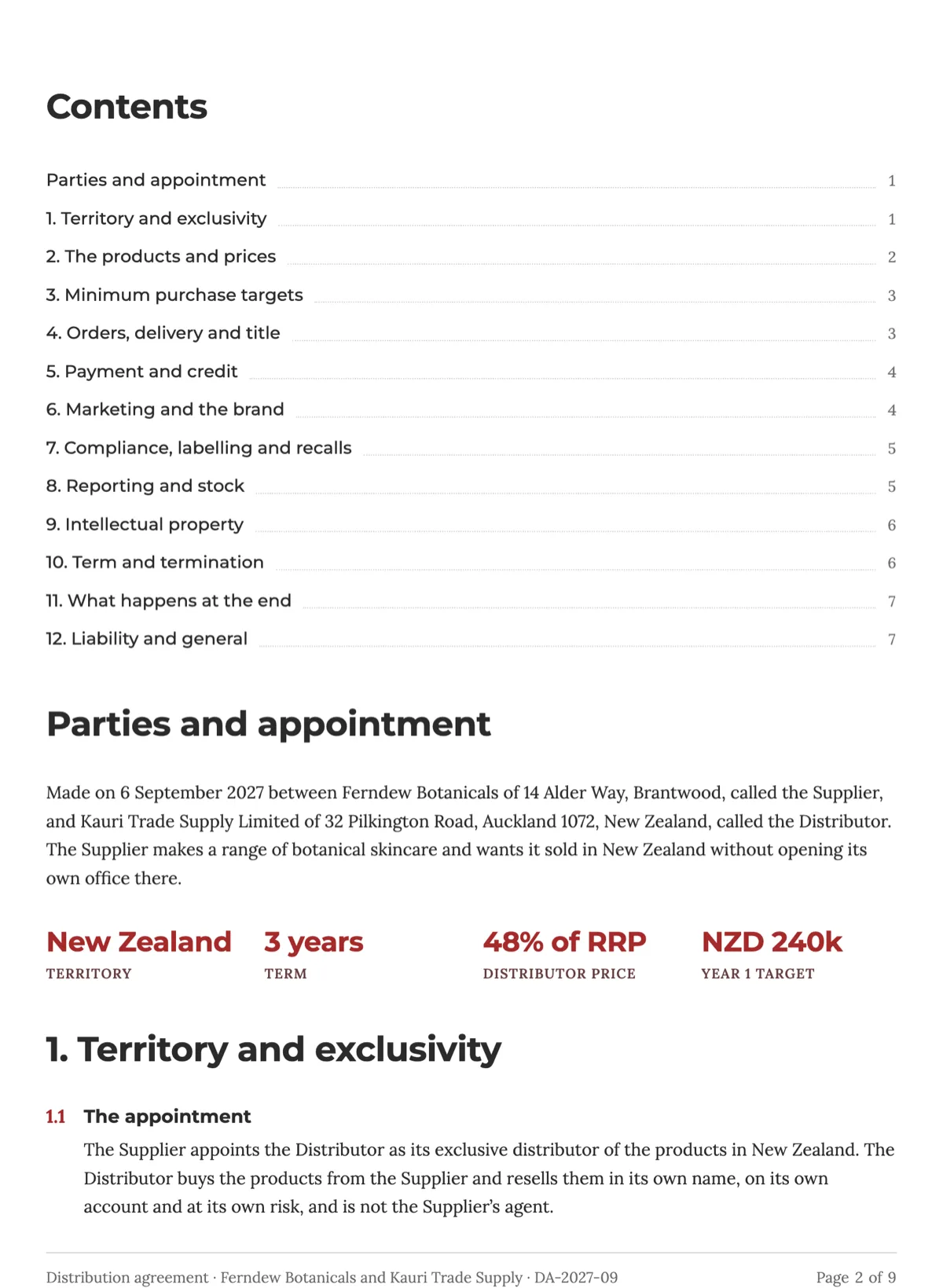 Distribution agreement template with territory and targetsAn exclusive distribution agreement is a trade: a territory in exchange for volume. This one appoints a New Zealand distributor for a skincare range at 48 per cent of recommended retail, with purchase targets rising from NZD 240,000 to NZD 420,000 across three years, and exclusivity that converts to non exclusive if a target is missed by more than 15 per cent.
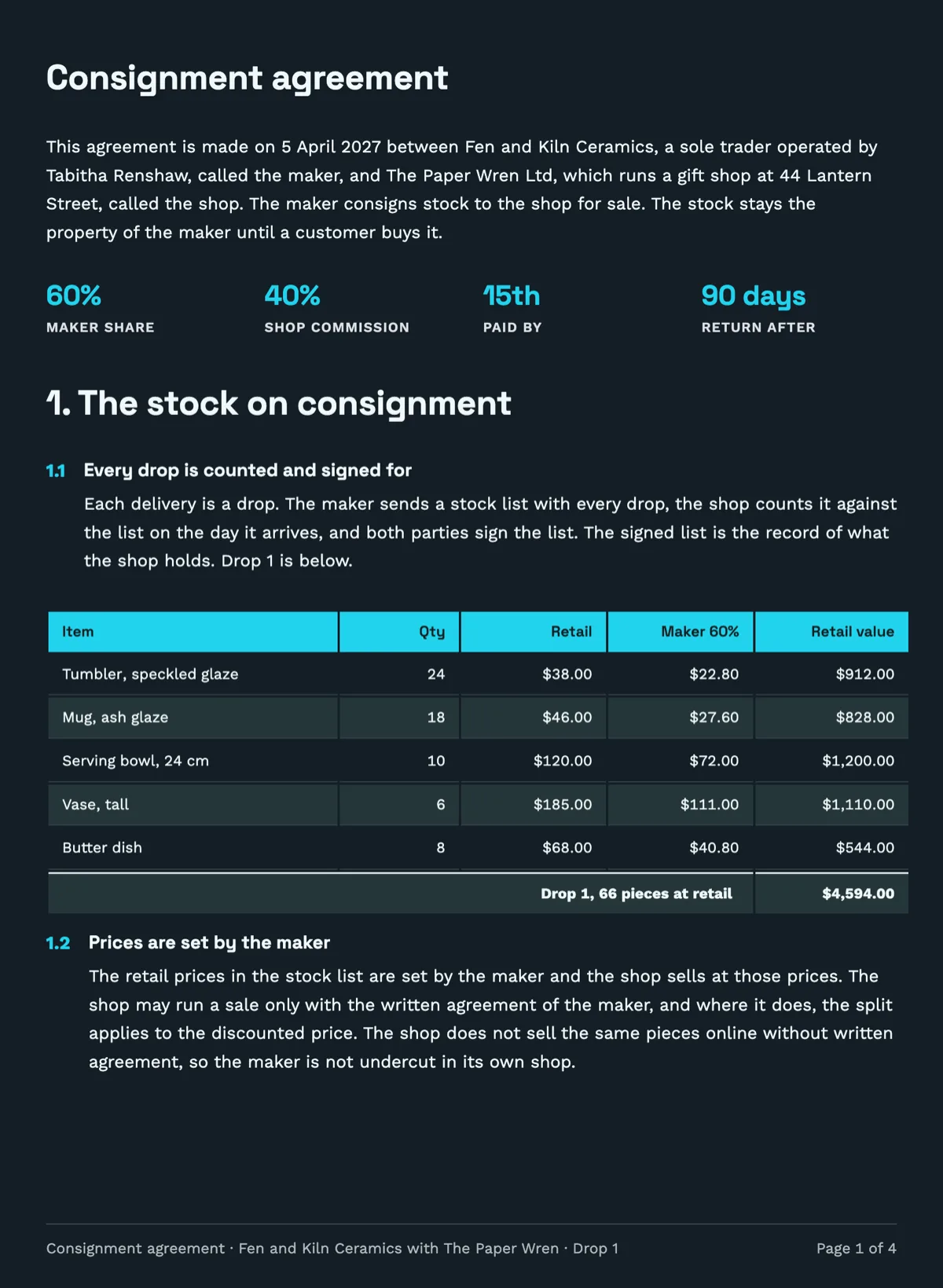 Consignment agreement template with the split and a stock listConsignment only works when both sides can agree on two things: what the shop is holding, and who carries the loss when a bowl gets knocked off a shelf. This agreement signs a stock list on every drop, fixes the split at 60 to 40, and puts breakage and theft squarely on the shop until the piece sells.
Questions people ask
What is a Romalpa clause?
Romalpa clause is another name for a retention of title clause, taken from a 1976 English case about a supplier of aluminium foil. The name is still used in Australia, but since the Personal Property Securities Act 2009 the clause is treated mainly as creating a security interest that needs registration to be effective against third parties.
Does a retention of title clause need to be registered on the PPSR?
To be effective against a liquidator, an administrator or another secured creditor, generally yes. The register's own guidance says a supplier that does not register its retention of title security interest will be an unsecured creditor. Registration also has strict time limits if the supplier wants purchase money priority over other secured parties.
What is a purchase money security interest?
It is a security interest that secures credit given or money lent to acquire the goods themselves, such as goods supplied on account under a retention of title clause. It can rank ahead of earlier registered interests over the same goods, but only if it is registered within the time limits and correctly identified as a purchase money security interest.
What happens if a registration is wrongly marked as a purchase money security interest?
According to the register's guidance, claiming that a registration is a purchase money security interest when it is not makes the whole registration ineffective. Not ticking the box when it is one leaves the registration effective but without the special priority, and that choice cannot be changed later. All monies clauses often need two registrations for that reason.
Can a customer resell goods before paying for them?
Most clauses allow resale in the ordinary course of business, because a builder or retailer could not operate otherwise. The clause then tries to capture the proceeds for the supplier. A buyer from the customer in the ordinary course of business will often take the goods free of the supplier's security interest, which is why the proceeds wording matters.
When does title pass if there is no clause?
Under the sale of goods legislation, property passes when the parties intend it to pass. For specific goods in a deliverable state under an unconditional contract, the default rule is that property passes when the contract is made, even if payment and delivery happen later. A retention of title clause displaces that default by stating a different intention.
Put the clause in a finished document
The button opens the document generator with a starting description already filled in. Change it to match your own agreement before you run it.
Create a document with OneCraftRelated clauses
- Passing of risk clause: whose loss is itA passing of risk clause fixes when a buyer becomes responsible for loss or damage to goods. Sample wording plus dispatch, acceptance and US variants.
- Payment terms clause: when the money is actually dueA payment terms clause fixes when an invoice falls due and how it is paid. Australian sample wording, net 30 and seven day variants, and what to negotiate.
- Delivery clause: where, when and how the handover happensA delivery clause sets where, when and how goods or deliverables are handed over. Sample site delivery wording, plus fixed date, window and on call variants.
For everything the document generator can do, see the document maker.
Step by step in the builder: Create a document with AI, then Document builder components.
Written and checked by the OneCraft team. Last checked .