Contract clause
Workplace safety clause: the WHS duties a contractor accepts on site
A workplace safety clause sets out the work health and safety obligations a contractor accepts when working on another party's site. It requires compliance with the safety laws, safe work method statements for high risk work, induction and site rules, incident reporting, and cooperation with everyone else who shares safety duties on the job.
Safety duties under Australian law cannot be handed away by contract, but a contract can make sure each business on site knows what it must do and when. That clarity is what stops a crew starting work at height on a morning when nobody has handed over the safe work method statement.
Indunil Asanka · Co-founder
4 min read · Published
Sample clause
a roof plumbing subcontract between Sandstone Build Group, a fictional principal contractor, and Northshore Roof Plumbing, a fictional subcontractor, on a three storey apartment building in Wollongong, New South Wales
11. Workplace Safety 11.1 Northshore Roof Plumbing must comply with the Work Health and Safety Act 2011 (NSW), the regulations made under it, and Sandstone's WHS Management Plan for the Project. 11.2 Before starting any high risk construction work, Northshore must give Sandstone a Safe Work Method Statement for that work and must carry out the work in accordance with it. 11.3 Northshore must ensure every worker has completed general construction induction training and Sandstone's site specific induction before starting work on Site. 11.4 Northshore must notify Sandstone immediately of any notifiable incident and within 24 hours of any other incident, injury or near miss, and must preserve an incident site where the law requires. 11.5 Sandstone may direct Northshore to stop any work Sandstone reasonably considers unsafe, and a stoppage caused by Northshore's unsafe work is at Northshore's cost. 11.6 Northshore must consult, cooperate and coordinate with Sandstone and other contractors on all safety matters.
Sample wording, not legal advice.
Variants
Victorian occupational health and safety version
Work in Victoria, which has not adopted the model WHS laws and applies its own legislation.
The Contractor must comply with the Occupational Health and Safety Act 2004 (Vic), the Occupational Health and Safety Regulations 2017 (Vic) and the Principal's site safety plan. Before starting high risk construction work the Contractor must prepare a safe work method statement and give a copy to the Principal. The Contractor must notify WorkSafe Victoria immediately of any incident the Act requires to be notified and must give the Principal a copy of the notification the same day.
United Kingdom CDM version
A UK project, where the Construction (Design and Management) Regulations 2015 allocate duties to the client, principal designer and principal contractor.
The Subcontractor must comply with the Health and Safety at Work etc. Act 1974 and the Construction (Design and Management) Regulations 2015, and must work in accordance with the construction phase plan prepared by the Principal Contractor. The Subcontractor must provide its risk assessments and method statements before starting each activity, ensure its workers receive a suitable site induction, and report any accident or dangerous occurrence to the Principal Contractor within 24 hours.
United States OSHA version
A US construction project, where federal construction safety standards apply and more than one employer can be responsible for a hazard.
Subcontractor shall comply with the Occupational Safety and Health Act of 1970, the OSHA construction standards at 29 CFR Part 1926, any applicable state plan, and Contractor's site safety program. Subcontractor shall designate a competent person for each activity where the standards require one, provide a written hazard analysis before starting each activity, and report any recordable injury or serious incident to Contractor within 24 hours.
What to negotiate
Flowing down the project safety system
Principal contractors want every subcontractor bound by the project WHS management plan and site rules. Subcontractors accept that but ask to see the plan before signing and to have their own safety system recognised where it meets the same standard. The practical settlement attaches the plan to the subcontract and requires notice of any change that adds cost.
Stop work directions
A principal contractor needs power to stop unsafe work at once. Subcontractors accept the power but want the cost of a stoppage to depend on who caused the hazard, with an extension of time where the stoppage was caused by others or by the site itself. Clear wording on cost stops safety directions being resisted for commercial reasons.
Incident reporting times
Notifiable incidents must be reported to the regulator immediately by the business involved, so a contractual reporting time must never suggest waiting. Clauses commonly require immediate notice of notifiable incidents, a written report within 24 hours for other injuries and near misses, and a full investigation report within a set number of days.
Indemnities and fines
Principals sometimes ask to be indemnified for safety penalties. Some Australian jurisdictions, New South Wales among them, now prohibit insurance and indemnity arrangements that cover liability for WHS penalties, so such a clause may be unenforceable and can create exposure of its own. Indemnities are better confined to third party claims and costs, with each business carrying its own statutory responsibility.
The risk of leaving it out
Without a safety clause the statutory duties still apply to every business on site, but the principal contractor has no contractual right to demand a safe work method statement, stop unsafe work at the subcontractor's cost, or receive incident information on time. When something goes wrong, those gaps in coordination are exactly what the regulator examines.
Who holds which duty
Under the model Work Health and Safety Act, each person conducting a business or undertaking must ensure, so far as is reasonably practicable, the health and safety of its workers and others affected by its work. Officers, such as company directors, must exercise due diligence. Workers must take reasonable care for their own safety and for others. On a construction project above the cost threshold, the principal contractor must prepare and maintain the WHS management plan. A business carrying out high risk construction work must have a safe work method statement before starting. Duties are shared rather than transferred, so each holder must consult and coordinate with the others.
Victoria, the UK and the US
Victoria has not adopted the model laws and applies the Occupational Health and Safety Act 2004, which places duties on employers and self employed people with a similar practical effect. In the UK, the Construction (Design and Management) Regulations 2015 allocate duties to the client, principal designer, principal contractor and contractors, with a construction phase plan at the centre. In the US, federal OSHA construction standards apply, with state plans in some states, and more than one employer on a site can be cited for the same hazard.
Where it sits in a generated document
A generated subcontract carries safety as a numbered clause with each obligation as a sub clause, so a stop work direction can cite the precise requirement breached. A safe work method statement is usually a separate document with its own work steps and sign on sheet. The generated clause does not cite the WHS Act or regulations, so the legislation named in a draft should be confirmed for the state where the work is done.
Documents that carry this clause
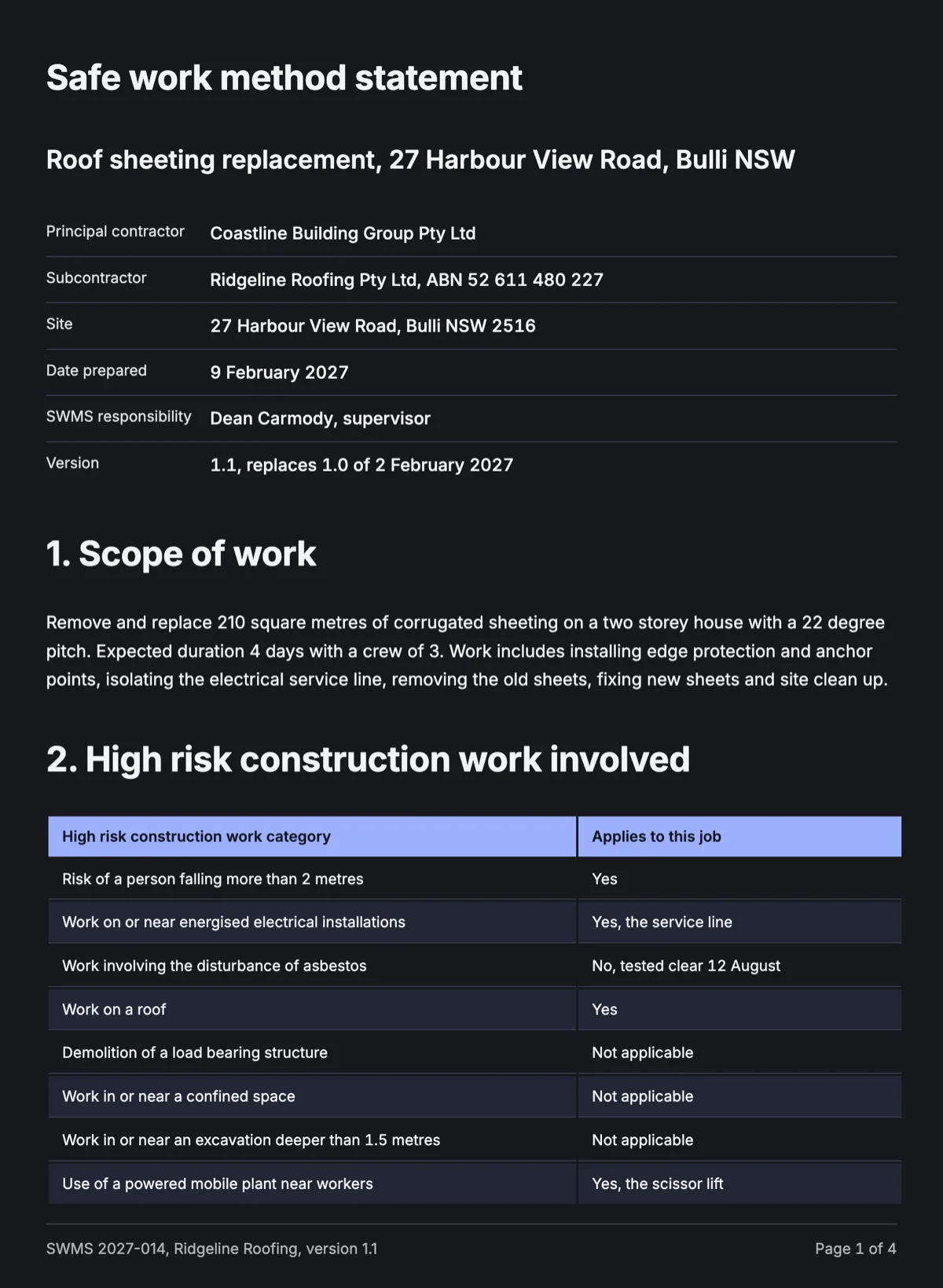 Safe work method statement template a site supervisor will acceptA SWMS is required before high risk construction work starts, and the one that gets accepted is the one that names the work, breaks it into steps and shows a control for every hazard with a name against it. This one is for roof sheeting on a two storey house, six steps, rated before and after controls, with the sign on table the site keeps.
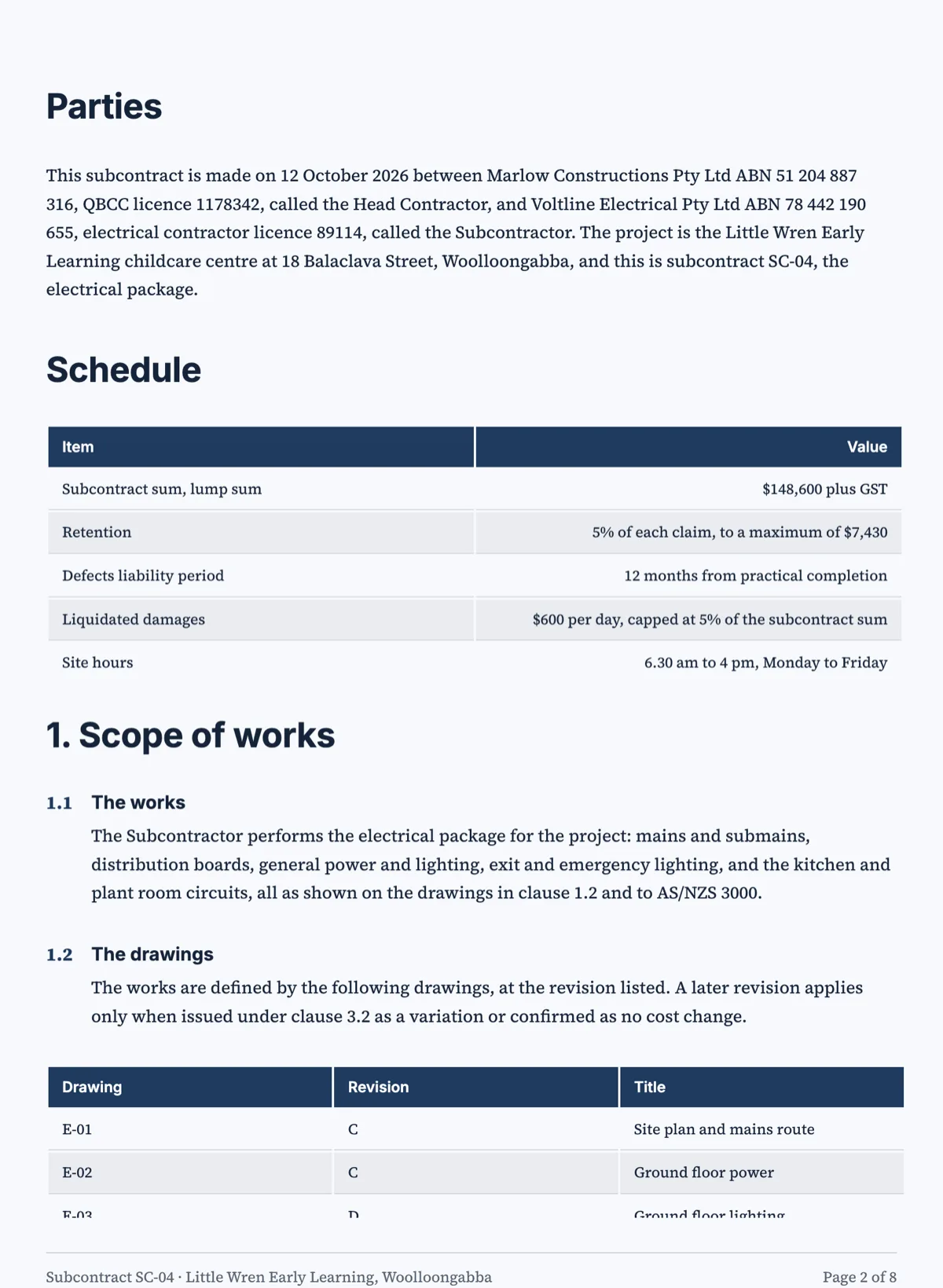 Subcontractor agreement template that flows the head contract downA subcontract exists to pass the head contract's obligations down one level and move the money back up on time. This one names the scope by drawing, sets the progress claim dates against the security of payment rules, holds retention and states the insurances, so the trade knows exactly when it is paid and for what.
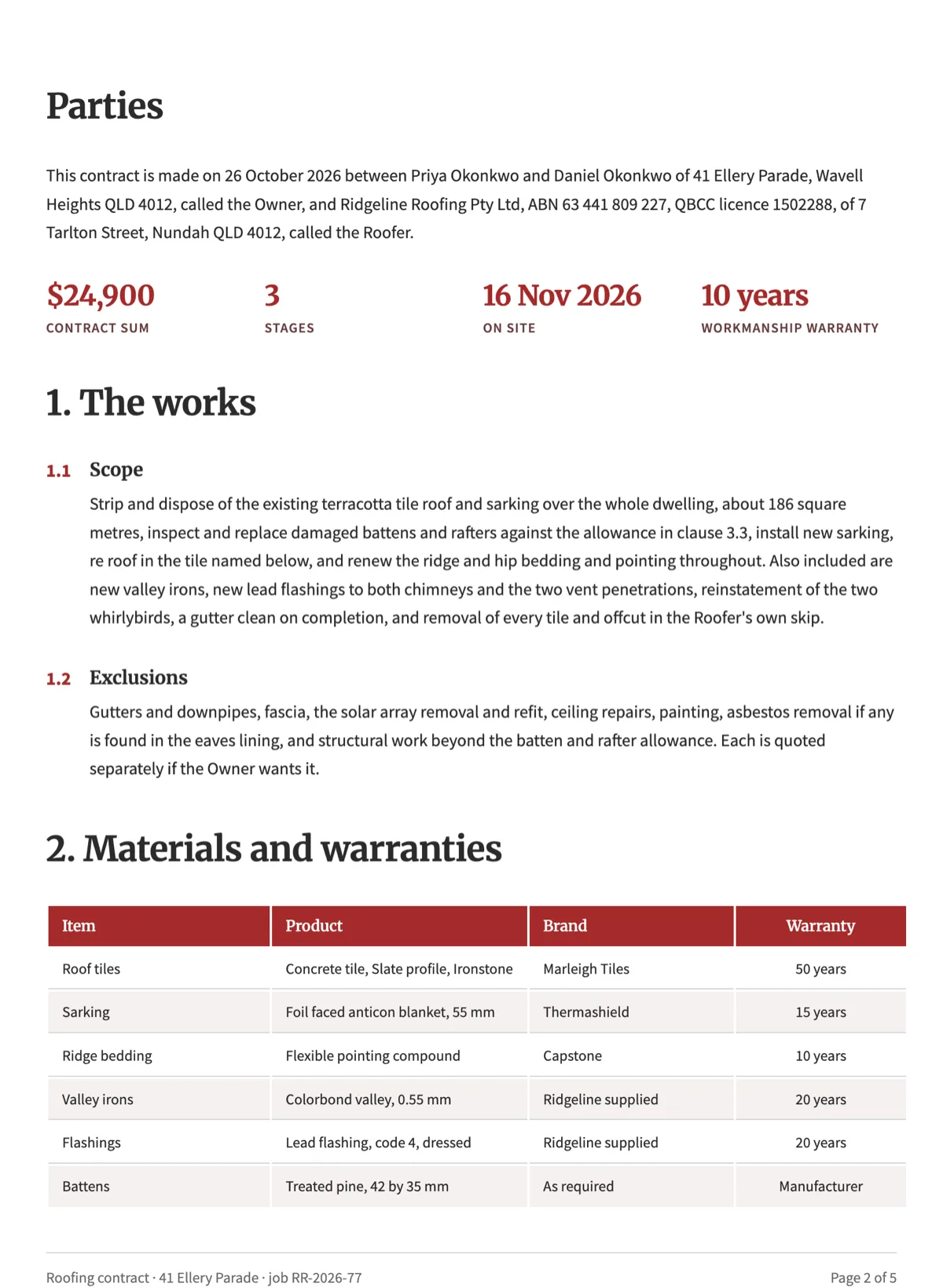 Roofing contract template with a materials table and a weather ruleA roof replacement is the one job where the house is open to the sky at the end of the day, so the clause that matters most is the one about closing it. This contract limits how much roof can be stripped at once, names every product with its warranty years, and says who pays when water gets in.
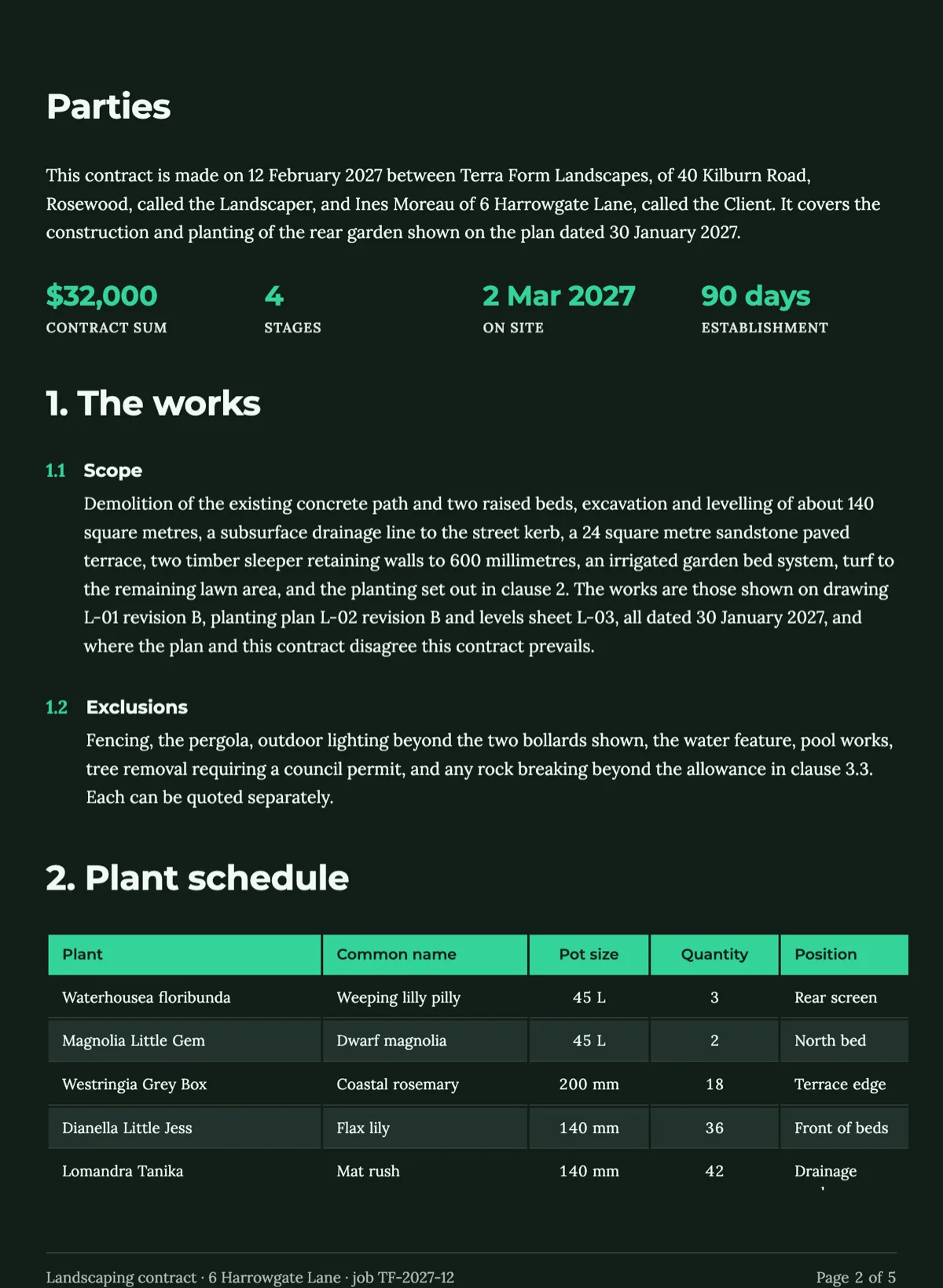 Landscaping contract template with a plant schedule and an establishment periodA garden build is two jobs in one: construction that is finished when it is finished, and planting that is only finished three months later. This contract prices the construction in four stages, lists every plant with its pot size and quantity, and holds the landscaper to a 90 day establishment period for anything that dies.
Questions people ask
Can a principal contractor transfer its WHS duties to a subcontractor?
No. Work health and safety duties cannot be transferred by contract, and several people can hold the same duty at the same time. A contract can allocate practical tasks, such as preparing a safe work method statement or running inductions, but each business remains responsible for its own duty and must consult and coordinate with the others.
When is a safe work method statement required?
Before high risk construction work starts. That includes work with a risk of a person falling more than 2 metres, work on or near energised electrical installations, work in trenches or shafts deeper than 1.5 metres, and work likely to disturb asbestos, among other categories. The business doing the work prepares it, and the principal contractor must obtain it.
How quickly must a workplace incident be reported?
A notifiable incident, such as a death, a serious injury or illness, or a dangerous incident, must be reported to the work health and safety regulator immediately after the business becomes aware of it, and the incident site must generally be preserved. Contracts should require immediate notice to the principal as well, with written reports for lesser incidents within a set time.
Does a safety clause need to name the legislation?
Naming the correct legislation helps, especially across state lines, because Victoria applies its own Occupational Health and Safety Act while the other jurisdictions have adopted versions of the model WHS laws. A clause naming the model Act for a Melbourne site still works as a promise to work safely, but it points site teams to the wrong rules.
What is a WHS management plan?
It is the written plan the principal contractor must prepare before work starts on a construction project costing $250,000 or more. It sets out the people with safety responsibilities, arrangements for consultation and coordination, incident management, site safety rules, and how safe work method statements are collected and reviewed. Everyone working on the project must be told about it.
Can a contractor refuse to work if the site is unsafe?
Workers have a statutory right to cease or refuse work where they have a reasonable concern about a serious risk from an immediate or imminent hazard. A contract should protect that right rather than treat a justified refusal as delay by the contractor, and it should extend time where the hazard was created by the site or by another contractor.
Put the clause in a finished document
The button opens the document generator with a starting description already filled in. Change it to match your own agreement before you run it.
Create a document with OneCraftRelated clauses
- Principal contractor clause: appointing the WHS lead on a projectA principal contractor clause appoints who holds the WHS principal contractor role on a construction project. Australian sample wording, duties and variants.
- Site access clause: possession, hours and conditions of entryA site access clause sets when a contractor may enter the site and what the owner must provide. Australian sample for occupied sites, hours and induction.
- Insurance clause: which policies, what amounts, what proofAn insurance clause sets the policies a contractor must hold, the amounts and the proof. Australian sample wording, typical cover levels and three variants.
For everything the document generator can do, see the document maker.
Step by step in the builder: Create a document with AI, then Document builder components.
Written and checked by the OneCraft team. Last checked .