Contract clause
Principal contractor clause: appointing the WHS lead on a project
A principal contractor clause appoints the business that holds the principal contractor role under work health and safety laws for a construction project, and gives it the authority to manage and control the site. It records the appointment, the duties that come with it, and what the owner must do to support them.
Under the model WHS laws a construction project has only one principal contractor, and the role carries duties that cannot be met without real control of the site. A clause that appoints a builder in name while the owner keeps control fails in the way that matters most, on the day of an incident.
Nuwan Madhusanka · Co-founder
4 min read · Published
Sample clause
a building contract under which Coolabah Veterinary Group, a fictional veterinary business, engages Redgum Construct, a fictional builder, to extend its clinic in Dubbo, New South Wales, for $300,000
9. Principal Contractor 9.1 Coolabah Veterinary Group appoints Redgum Construct as principal contractor for the Project under the Work Health and Safety Regulation 2017 (NSW), and authorises Redgum Construct to have management and control of the Site to the extent necessary to discharge that role. 9.2 Redgum Construct accepts the appointment and must, before work starts, prepare a written WHS Management Plan for the Project and give a copy to Coolabah. 9.3 Redgum Construct must obtain a Safe Work Method Statement before any high risk construction work starts, install signage showing its name and contact details, and secure the Site. 9.4 Coolabah must ensure its staff, clients and any separate contractors comply with Redgum Construct's site rules while on the Site. 9.5 Coolabah must give Redgum Construct all information it holds about hazards at the Site, including any asbestos register. 9.6 The appointment ends when Coolabah takes back control of the Site at Practical Completion.
Sample wording, not legal advice.
Variants
Owner remains principal contractor
An owner that directs several trades itself on a project above the threshold, without appointing a builder to manage the site.
The Owner is the principal contractor for the Project and retains management and control of the Site. The Trade Contractor must comply with the Owner's WHS Management Plan and site rules, provide a Safe Work Method Statement for any high risk construction work before starting it, and consult, cooperate and coordinate with the Owner and the other trade contractors on all health and safety matters.
Project manager appointed as principal contractor
A developer that engages a project manager to run a site with separate trade packages, where the project manager genuinely controls the workplace.
The Principal appoints the Project Manager as principal contractor for the Project and authorises it to have management and control of the Site, including the power to exclude any person, to stop any work and to give binding safety directions to every trade contractor. The Principal must include in each trade contract an obligation to comply with those directions, and must not give site instructions except through the Project Manager.
Staged handback of the role
Staged projects where the owner occupies completed areas while construction continues next door.
The Contractor is principal contractor for each Separable Portion until the Date of Practical Completion of that Separable Portion. On that date the Contractor must update the WHS Management Plan to exclude the completed area, install physical separation between it and the continuing works, and give the Principal written confirmation, after which the Principal controls the completed area and access to it.
What to negotiate
Control must match the appointment
Owners sometimes appoint a builder as principal contractor while keeping the right to direct trades or operate inside the site. Builders ask that the appointment come with genuine management and control, including the right to exclude people and stop work. Without that authority the appointment may not be effective, and the builder carries duties it cannot perform.
The owner's people on site
Clinics, schools and factories often keep operating next to the works. Builders want the owner's staff, visitors and separate contractors bound by site rules and induction, with the owner responsible for their compliance. Owners accept this inside the fenced work area but want clear boundaries, so ordinary business outside the hoarding is not caught by construction site rules.
The cost of the role
Principal contractor duties bring real cost: plans, signage, security, inductions and a site supervisor. Builders price that as preliminaries and resist later demands for extra safety measures without a variation. Owners want the price to include compliance with the law as it stands at signing, with later changes in the law treated as a variation.
Hazard information from the owner
The owner often holds information the builder needs, such as asbestos registers, service locations and past incident reports. Builders ask for a warranty that the owner has disclosed everything it holds. Owners resist warranting accuracy but usually accept a duty to disclose, since withholding known hazard information exposes both parties.
The risk of leaving it out
If the clause is missing, the business that commissioned a construction project costing $250,000 or more is generally the principal contractor itself under the model WHS Regulations, whether or not it realises it. A clinic owner who assumed the builder was responsible can find it holds the management plan, site security and signage duties with no site team to meet them.
The duties that come with the role
Under the model WHS Regulations a construction project is construction work costing $250,000 or more. Its principal contractor must prepare a written WHS management plan before work starts, keep it up to date, and make sure everyone working on the project knows its contents and their right to inspect it. The principal contractor must also obtain safe work method statements for high risk construction work before that work starts, install signs showing its name and contact details, and secure the workplace. Everyone else keeps their own duties, so the role adds to the other businesses' obligations rather than replacing them.
Victoria and the project threshold
Victoria sits outside the model laws, and its Occupational Health and Safety Regulations deal with principal contractors on construction projects under their own definitions and dollar threshold, so a Victorian clause should name those regulations instead. In every jurisdiction the value that counts is the cost of the construction work, so a project priced near the threshold should say who checks whether it has been crossed once variations are added.
Where it sits in a generated document
A generated building contract places the principal contractor appointment at the start of the safety provisions, as a numbered clause the site access and incident reporting clauses can refer to. The project value, the regulation named and the end of the appointment are written in as content. The document does not cite or check the regulations, so the legislation named in a draft should be confirmed for the state concerned.
Documents that carry this clause
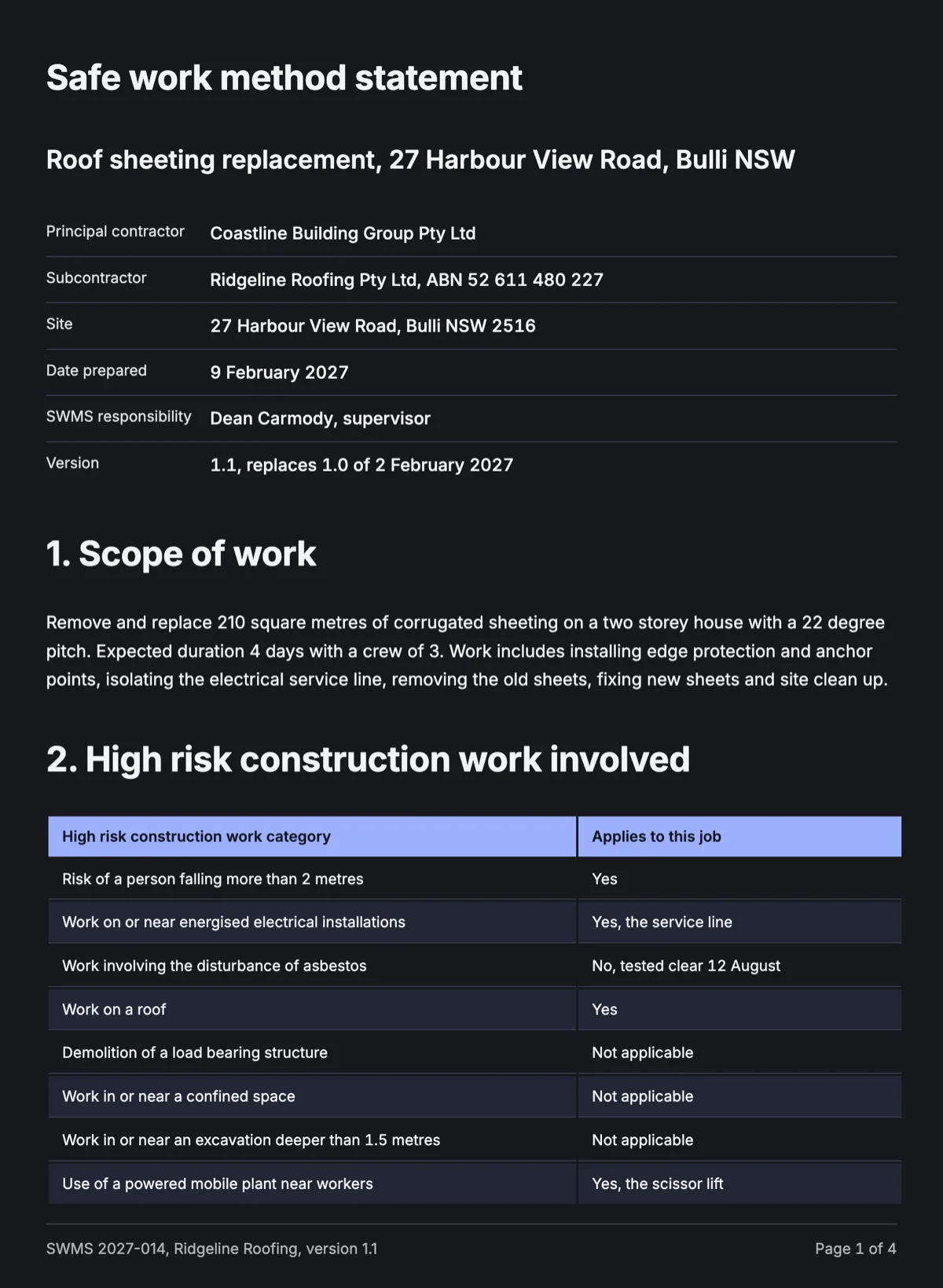 Safe work method statement template a site supervisor will acceptA SWMS is required before high risk construction work starts, and the one that gets accepted is the one that names the work, breaks it into steps and shows a control for every hazard with a name against it. This one is for roof sheeting on a two storey house, six steps, rated before and after controls, with the sign on table the site keeps.
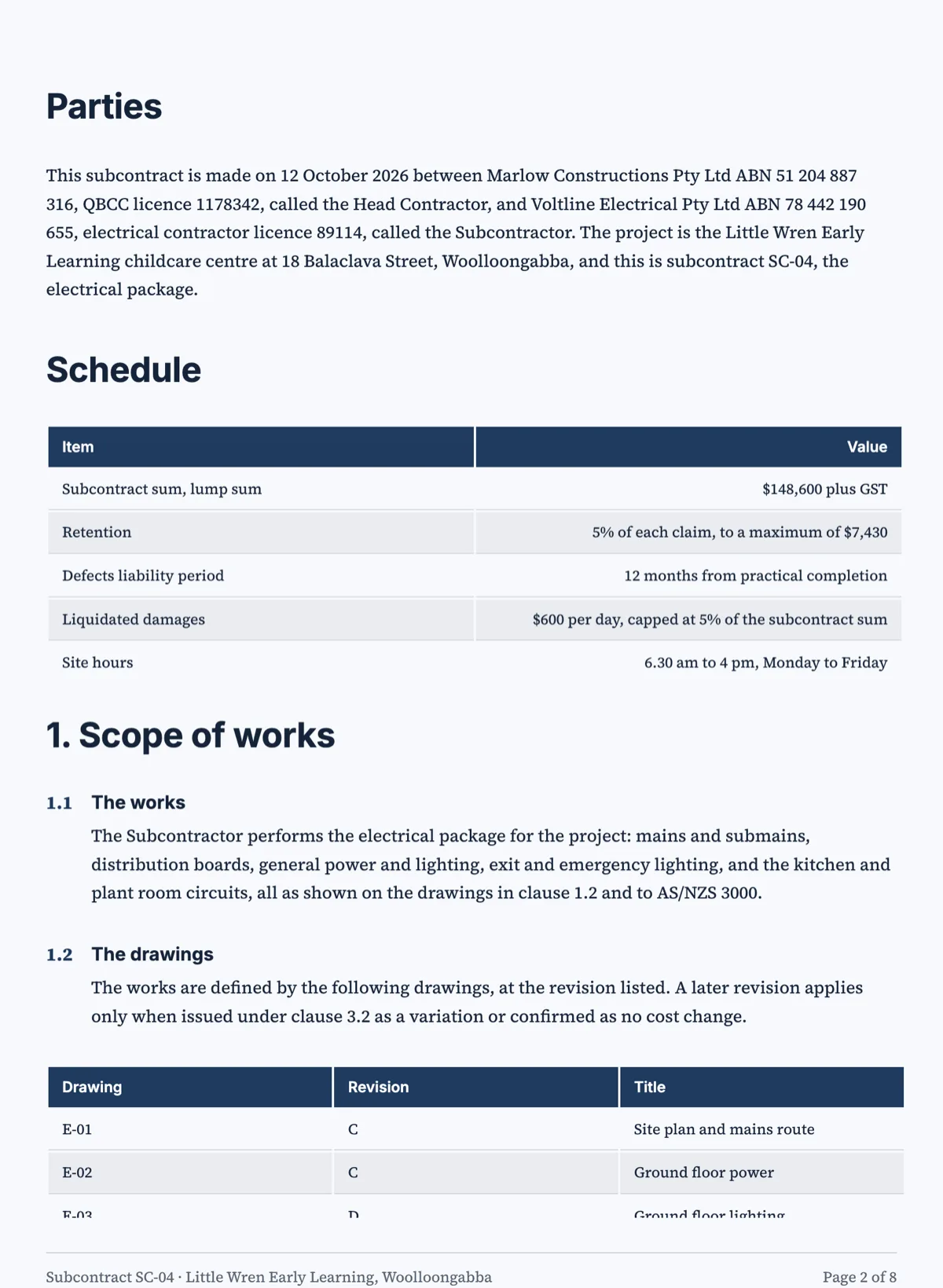 Subcontractor agreement template that flows the head contract downA subcontract exists to pass the head contract's obligations down one level and move the money back up on time. This one names the scope by drawing, sets the progress claim dates against the security of payment rules, holds retention and states the insurances, so the trade knows exactly when it is paid and for what.
Questions people ask
Who is the principal contractor on a construction project?
Under the model WHS Regulations, the business that commissions a construction project is the principal contractor unless it appoints another business as principal contractor and authorises it to have management or control of the workplace. There is only one principal contractor for a project at a time, which is why the appointment should be written down and matched with real control.
What is the dollar threshold for a construction project?
Under the model WHS Regulations adopted in most states and territories, a construction project is construction work where the cost is $250,000 or more. Below that value the principal contractor duties do not apply, although every business still holds its general safety duties. Victoria applies its own regulations with a different framework, so its rules should be checked separately.
Can a homeowner be a principal contractor?
A homeowner who is not conducting a business or undertaking is generally not treated as the commissioning business for WHS purposes, so the builder normally carries the role on a home. Owner builders are different, because they manage the work themselves and may take on duties of their own. The state regulator's guidance for owner builders should be read before starting.
Does appointing a principal contractor remove the owner's safety duties?
No. An owner that conducts a business keeps its own duty to ensure health and safety so far as is reasonably practicable, and to consult, cooperate and coordinate with the builder. The appointment moves the specific principal contractor duties, not every duty, so an owner operating beside the works must still manage its own staff and visitors safely.
What must a WHS management plan contain?
It must set out the names, positions and safety responsibilities of people with specific roles, the arrangements for consultation, cooperation and coordination, how incidents will be managed, the site specific safety rules and how people are told about them, and how safe work method statements are collected, assessed, monitored and reviewed. It must also be kept up to date.
When does the principal contractor role end?
When the construction project ends or management and control of the workplace passes back to the owner, which in most contracts happens at practical completion. On staged projects each stage can be handed back separately, provided the areas still under construction stay physically separated and the WHS management plan is updated to reflect the change.
Put the clause in a finished document
The button opens the document generator with a starting description already filled in. Change it to match your own agreement before you run it.
Create a document with OneCraftRelated clauses
- Workplace safety clause: the WHS duties a contractor accepts on siteA workplace safety clause sets the WHS duties a contractor accepts on site. Australian sample wording, who holds which duty, and Victorian, UK and US variants.
- Site access clause: possession, hours and conditions of entryA site access clause sets when a contractor may enter the site and what the owner must provide. Australian sample for occupied sites, hours and induction.
- Indemnity clause: promising to cover someone else's lossAn indemnity clause is a promise to cover the other party's loss from a named event. Australian sample wording, three variants and what each side negotiates.
For everything the document generator can do, see the document maker.
Step by step in the builder: Create a document with AI, then Send a document for signature.
Written and checked by the OneCraft team. Last checked .