Contract clause
Collateral warranty clause: a UK sample and who gets one
A collateral warranty is a separate contract in which a contractor, subcontractor or consultant promises a third party, such as a funder, purchaser or tenant, that it has performed its building contract or appointment with proper skill and care. It gives that third party a direct claim it would not otherwise have.
A collateral warranty gives someone outside the building contract, typically a funder, a buyer or a tenant, a direct contractual claim against the builder or designer if the work is defective. In the UK it is often required by the main contract, and its terms, especially net contribution, caps and assignment, decide how valuable it is.
Nuwan Madhusanka · Co-founder
3 min read · Published
Sample clause
Written for warranty given by Penarth Quay Architects, a fictional design practice, to the purchaser and the first tenant of a new office building in Cardiff.
Warranty. (a) The Architect warrants to the Beneficiary that it has exercised, and will continue to exercise, the reasonable skill, care and diligence to be expected of a properly qualified architect in performing the Appointment. (b) The Architect's liability under this Deed is no greater than it would have been had the Beneficiary been a party to the Appointment, and the Architect may rely on any defence it has under the Appointment. (c) The Architect's liability for any loss is limited to the proportion of that loss which it would be just and equitable for the Architect to pay, assuming the other consultants and the contractor had given equivalent warranties and paid their share. (d) The Architect's total liability under this Deed is limited to £2 million. (e) The Beneficiary may assign this Deed twice without consent, and no action may be brought more than 12 years after practical completion.
Sample wording, not legal advice.
Variants
Funder warranty
A bank financing the development, which wants step in rights to take over the appointment if the developer defaults.
If the Funder gives notice under clause 6, the Architect will continue to perform the Appointment for the Funder, or its appointee, on the same terms, provided the Funder pays any fees then due.
Purchaser warranty
A buyer of the completed building, who wants a direct claim for latent defects in the design or construction.
The Contractor warrants to the Purchaser that it has carried out the Works in accordance with the Building Contract, and that it has not used materials generally known to be deleterious at the time of specification.
Tenant warranty
A tenant with full repairing obligations, who may be liable for defects it did not cause and wants a claim against those who did.
The Contractor warrants to the Tenant that it has performed the Building Contract with reasonable skill and care, and its liability to the Tenant is limited to the reasonable cost of repairing defects in the Premises.
What to negotiate
Net contribution
A net contribution clause limits the warrantor to its fair share of a loss, as though everyone else responsible had paid theirs. Without it, joint liability could leave one warrantor paying the whole loss and chasing others. Beneficiaries resist it, but it is standard in consultant warranties.
Caps and assignment
Warrantors cap total liability, often at a figure linked to their professional indemnity insurance, and limit how many times the warranty can be assigned. Beneficiaries want enough assignments to cover future buyers and funders. Two assignments without consent, as in the sample, is a common compromise.
Adjudication
Whether a party can adjudicate a dispute under a collateral warranty depends on whether the warranty is a construction contract under section 104 of the Housing Grants, Construction and Regeneration Act 1996. In Abbey Healthcare v Simply Construct in 2024 the Supreme Court held that a warranty is generally not a construction contract unless it contains an undertaking to carry out construction operations, so statutory adjudication is usually unavailable.
The risk of leaving it out
Without collateral warranties, a purchaser or tenant who finds a defect in a new building usually has no contract with the contractor or designer, and claims in negligence for pure economic loss generally fail. A funder without a warranty cannot step in to keep a project going if the developer fails. That is why development agreements and leases often require them.
Who gets a warranty and what each gets
Funder: a warranty of skill and care plus step in rights to take over the contract or appointment if the borrower defaults. Purchaser: a warranty of skill and care and against deleterious materials, assignable to later buyers. Tenant: a warranty limited to repair costs, because the tenant's exposure is under its repairing covenant. Each usually includes net contribution, a cap and a limitation period of 12 years from practical completion when signed as a deed.
Warranties and third party rights
The Contracts (Rights of Third Parties) Act 1999 lets a contract give enforceable rights to a person who is not a party, and many building contracts and appointments now grant third party rights schedules instead of separate warranty deeds. Third party rights do the same job with less paperwork, though funders often still prefer deeds. Either way, the same terms on caps, net contribution and assignment matter. Law checked on 21 October 2026. This page explains how the law works and is not legal advice.
Adjudication after the 2024 decision
Before 2024 the Court of Appeal had treated some collateral warranties as construction contracts, allowing quick statutory adjudication. The Supreme Court's 2024 decision in Abbey Healthcare v Simply Construct reversed that approach for typical warranties, which promise that work under another contract has been or will be done, rather than undertaking construction operations themselves. Beneficiaries who want adjudication must now agree it expressly in the warranty.
Where the clause sits in a generated document
Subcontracts, consultant appointments and service agreements in UK construction often require the subcontractor or consultant to give warranties in an agreed form. When asking the AI document generator for one, name the beneficiary type, the standard of care, net contribution, the cap, the assignment limit, any step in rights and whether adjudication is agreed.
Documents that carry this clause
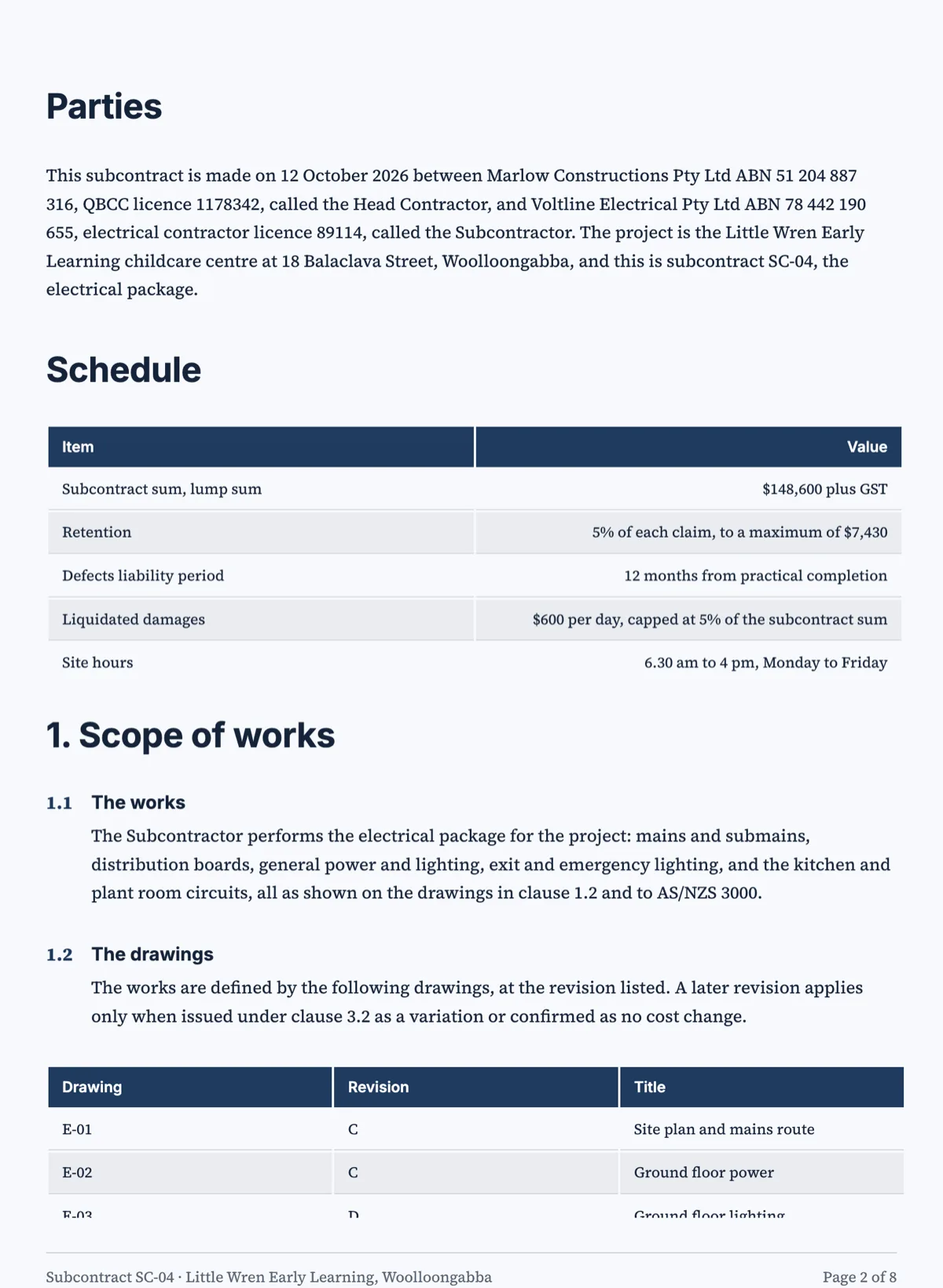 Subcontractor agreement template that flows the head contract downA subcontract exists to pass the head contract's obligations down one level and move the money back up on time. This one names the scope by drawing, sets the progress claim dates against the security of payment rules, holds retention and states the insurances, so the trade knows exactly when it is paid and for what.
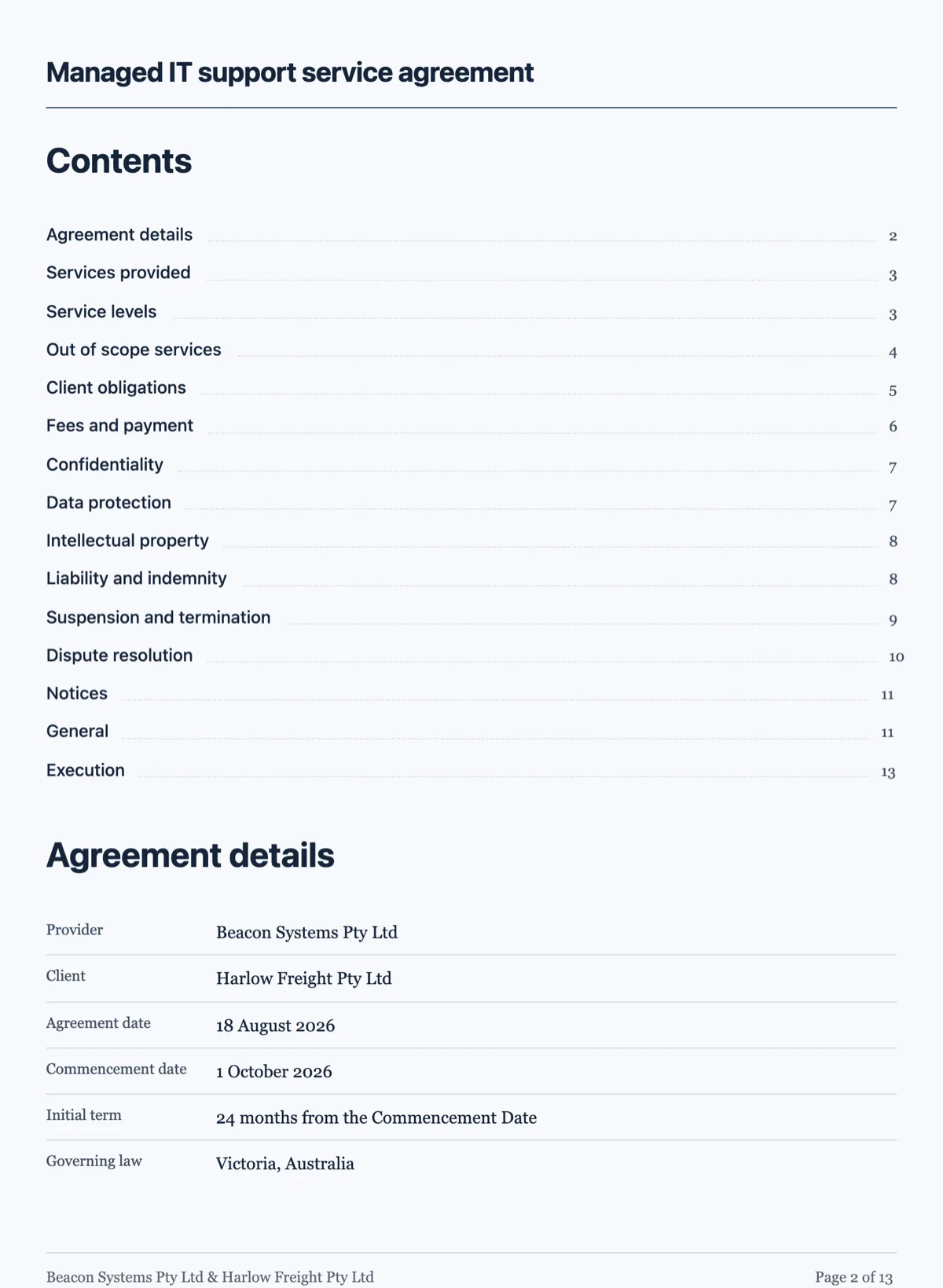 Service agreement template with scope, service levels and an exitA service agreement template has to say what is supplied, how well, for what fee, who is liable for what, and how either side gets out. This one is filled in for Beacon Systems supporting Harlow Freight's IT for an initial 24 months from 1 October 2026 at $8,400 a month plus GST, with 40 hours included and $220 an hour beyond them. Twelve numbered clauses cover the services, a four level severity table, client duties, fees with a CPI adjustment, confidentiality, privacy, IP, a liability cap, termination and a three step dispute ladder under Victorian law.
Questions people ask
What is a collateral warranty?
A separate contract in which a contractor, subcontractor or consultant promises a third party, such as a funder, buyer or tenant, that it has performed its building contract or appointment properly. It gives that third party a direct claim if the work turns out to be defective.
Do tenants need a collateral warranty?
Tenants with full repairing obligations in new or refurbished buildings often ask for one, because they may have to repair defects they did not cause. A warranty, or third party rights, gives them a claim against the contractor or designers responsible, usually limited to repair costs.
Can a collateral warranty be adjudicated?
Usually not by statute. In 2024 the UK Supreme Court held that a typical collateral warranty is not a construction contract under the Housing Grants Act, so the statutory right to adjudicate does not apply. Parties can still agree contractual adjudication in the warranty.
What is a net contribution clause?
A term limiting the warrantor's liability to the share of a loss it would be just for it to bear, assuming others responsible also paid their share. It stops one warrantor being made to pay the whole of a loss caused by several parties.
How long does a collateral warranty last?
Warranties signed as deeds usually allow claims for 12 years, often from practical completion, while simple contracts allow 6 years. The warranty itself often states the period, which should match the main contract or appointment. Check both before signing. Diarise the end date.
Put the clause in a finished document
The button opens the document generator with a starting description already filled in. Change it to match your own agreement before you run it.
Create a document with OneCraftRelated clauses
- Step in rights clause: funders, customers and failing contractsA step in rights clause for a funder on a Cardiff student housing build and a customer of a failing IT service: triggers, notice, cure periods and who pays.
- Fitness for purpose clause: a promise that the design worksA fitness for purpose clause for a marine contractor's pontoon: the strict duty, the reasonable skill and care alternative, insurance and MT Højgaard.
- Proportionate liability clause: paying only your shareA proportionate liability clause decides whether a wrongdoer pays only its share. Australian sample wording, the state by state position on contracting out.
- Defects liability clause: fixing defects after practical completionA defects liability clause sets how long a builder must return to fix defects after completion. Australian sample wording, typical periods and three variants.
For everything the document generator can do, see the document maker.
Step by step in the builder: Create a document with AI, then Document builder components.
Written and checked by the OneCraft team. Last checked .