Contract clause
Defects liability clause: fixing defects after practical completion
A defects liability clause sets a period after practical completion during which the contractor must come back and fix defects in its work at its own cost. It fixes when the period starts and ends, how defects are notified, how quickly the contractor must attend, and what the owner may do if the contractor does not.
The defects liability period is the contractor's right to fix its own work at cost as much as the owner's right to have it fixed. It also decides when retention and security come back, so its dates matter to cash flow long after the last trade leaves site.
Indunil Asanka · Co-founder
4 min read · Published
Sample clause
a tiling subcontract between Stringybark Constructions, a fictional head contractor, and Coral Coast Tiling, a fictional subcontractor, on an office refurbishment in Newcastle, New South Wales
17. Defects Liability 17.1 The Defects Liability Period is 12 months starting on the Date of Practical Completion of the Main Works. 17.2 During the Defects Liability Period Stringybark may give Coral Coast Tiling written notice of any Defect in the Subcontract Works, with photographs and its location. 17.3 Coral Coast Tiling must attend within 10 Business Days of the notice, or within 24 hours where the Defect creates a safety risk, and must rectify the Defect within the reasonable time stated in the notice. 17.4 Rectified work carries a further Defects Liability Period of 12 months from the date it is rectified, but no period extends beyond 24 months after the Date of Practical Completion. 17.5 If Coral Coast Tiling does not rectify a Defect as required, Stringybark may have it rectified by others and recover the reasonable cost as a debt or from security. 17.6 This clause does not limit any other right or remedy for defective work.
Sample wording, not legal advice.
Variants
Single period with no restart
Smaller jobs where the parties want one clear end date for both rectification and the release of security.
The Contractor must rectify any Defect notified in writing during the period of 6 months after Practical Completion, within 10 Business Days of each notice. The period does not restart for rectified work. At the end of the period the Principal must return the remaining security within 15 Business Days, less any amount properly applied to Defects notified during the period that the Contractor did not rectify.
Longer period for key elements
Work where some failures only show after a full season of weather, such as waterproofing and roof membranes.
The Defects Liability Period is 12 months after Practical Completion, except that for the Waterproofing Works and the Roof Membrane it is 24 months. The Contractor must inspect the Roof Membrane with the Principal's representative within the last 30 days of that longer period and give a written report on its condition. Security held for the Waterproofing Works may be retained until the end of the longer period.
Urgent make safe by the owner
Occupied premises where a leak or a live electrical fault cannot wait for the contractor to attend.
Where a Defect causes or threatens damage to property or injury to any person and the Contractor cannot be contacted or cannot attend within 4 hours, the Principal may take the minimum steps needed to make the Defect safe without prior notice. The Principal must notify the Contractor within 1 Business Day, and the Contractor must pay the reasonable cost of those steps and then rectify the Defect under this clause.
What to negotiate
When the clock starts
A subcontractor finishing early on a long project wants its period to start when its own works are complete, not when the whole building is handed over. Head contractors prefer one start date for every trade so the periods line up with the head contract. A common compromise uses the main works date but caps the subcontractor's total exposure at a stated number of months from its own completion.
A restart for rectified work
Owners want repaired work to carry a fresh period, since a repair can fail as easily as the original. Contractors accept a restart only for the rectified item and only with an outer cap, often 24 months from completion, so one recurring defect does not keep the whole job open indefinitely.
What counts as a defect
Contractors want fair wear and tear, misuse, failures of owner maintenance and work by others excluded. Owners want the definition to cover anything that does not comply with the contract, including the specification and applicable standards, whether or not it has caused a problem yet. Most clauses settle on non compliance with the contract, with those named exclusions.
Access to fix it
A contractor can only fix a defect it can reach. In occupied premises the clause should oblige the owner to give reasonable access in working hours, allow after hours work where the owner asks for it at the owner's cost, and pause the attendance time while access is refused.
The risk of leaving it out
Without the clause the owner still has a damages claim for defective work, and residential owners keep their statutory warranties, but there is no agreed process for getting the contractor back on site. The contractor loses the chance to fix its own work at cost and instead faces a bill for another trade's rectification plus the owner's costs of pursuing it.
Typical periods by type of work
Periods are set by the contract, not by statute, and vary with the trade and the risk. Many commercial head contracts and subcontracts use 12 months from practical completion. Minor works and maintenance contracts often use 3 to 6 months. Waterproofing, roofing and facade packages commonly carry 24 months or an inspection at the end of a longer period, and landscaping contracts pair a short defects period with a plant establishment period of their own. Whatever the number, the contract should state it and the date it starts rather than leave it to a schedule nobody fills in.
The defects period and statutory warranties
A defects liability period is a contractual process, and in residential building work it runs alongside statutory warranties that cannot be shortened by agreement. In New South Wales the Home Building Act gives homeowners 6 years for major defects and 2 years for other defects from completion, and other states set their own warranty periods. The end of a 12 month defects liability period therefore ends the contractor's duty to attend under the contract, not its legal exposure for defective work.
Where it sits in a generated document
In a generated subcontract the defects liability clause follows practical completion and comes before the release of security, each numbered so the release can refer to the end of the period by clause number. The period, the start date and the attendance times are written in as content. The document does not cite the Home Building Act or any other statute, so warranty periods mentioned in a draft should be checked.
Documents that carry this clause
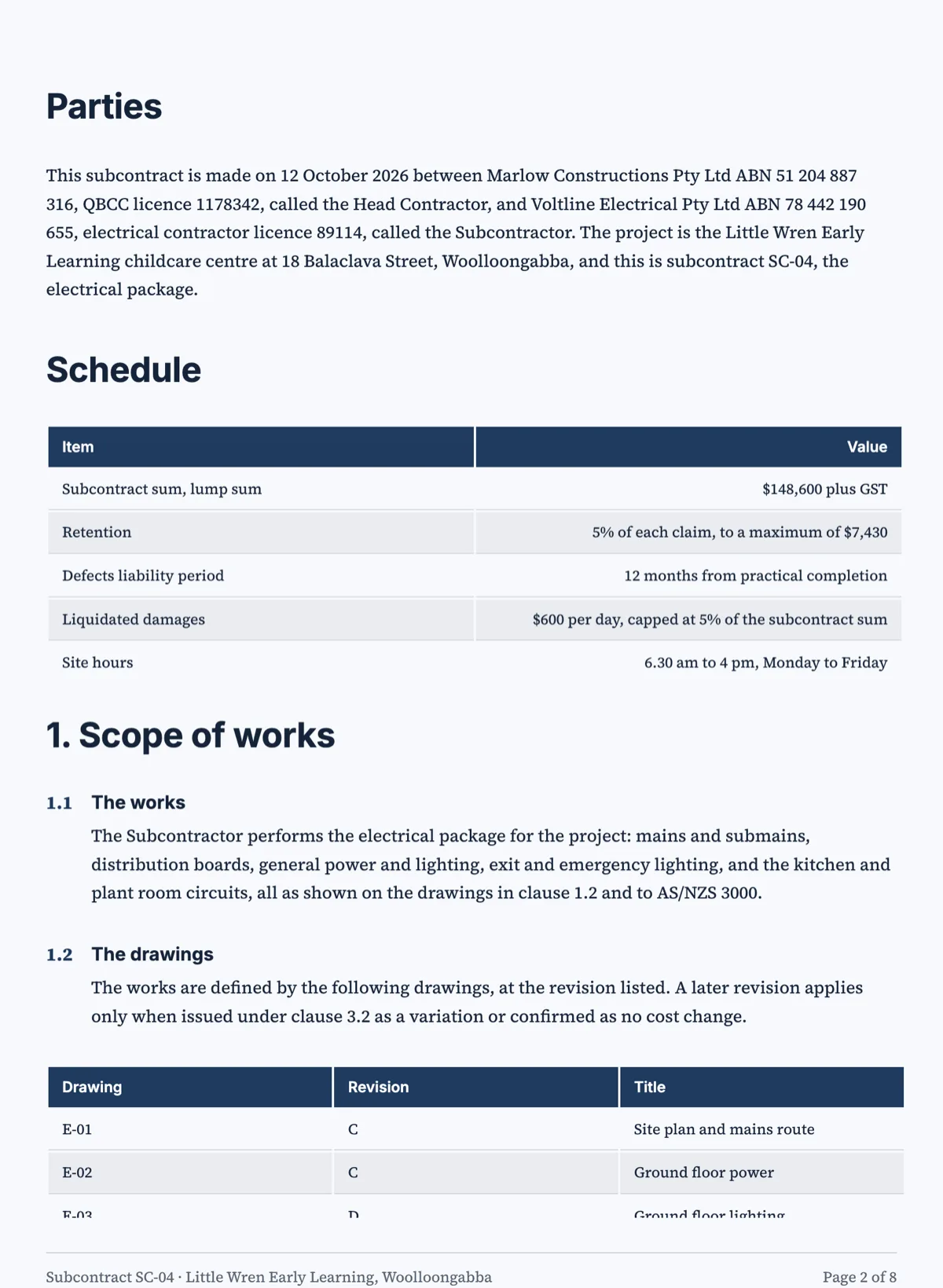 Subcontractor agreement template that flows the head contract downA subcontract exists to pass the head contract's obligations down one level and move the money back up on time. This one names the scope by drawing, sets the progress claim dates against the security of payment rules, holds retention and states the insurances, so the trade knows exactly when it is paid and for what.
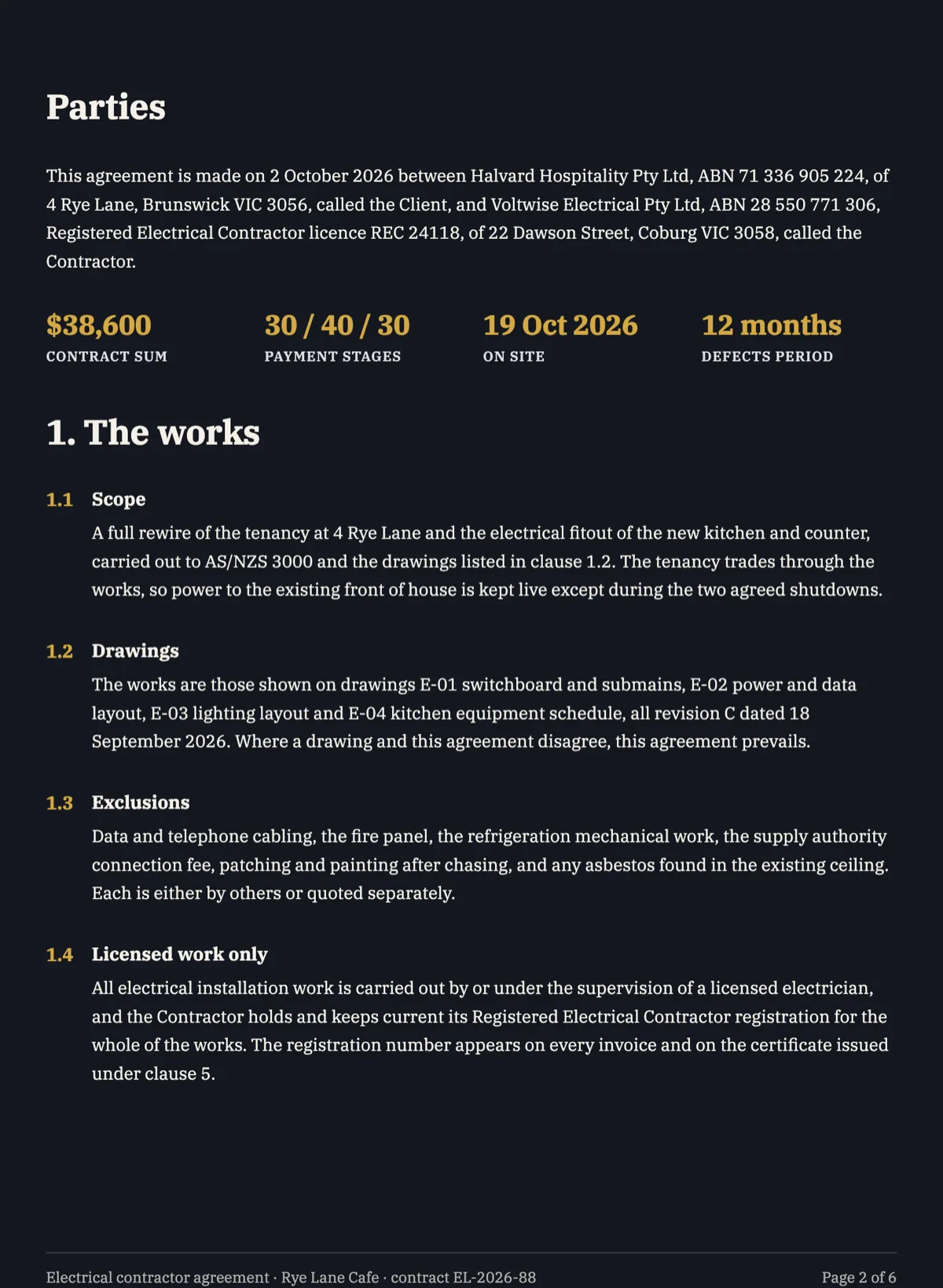 Electrical contractor agreement with a licence clause and staged paymentsElectrical work is the one trade where the paperwork at the end matters as much as the work, because without the certificate the installation is not signed off. This agreement ties the last payment stage to that certificate and sets the progress claim deadlines the payment legislation actually uses.
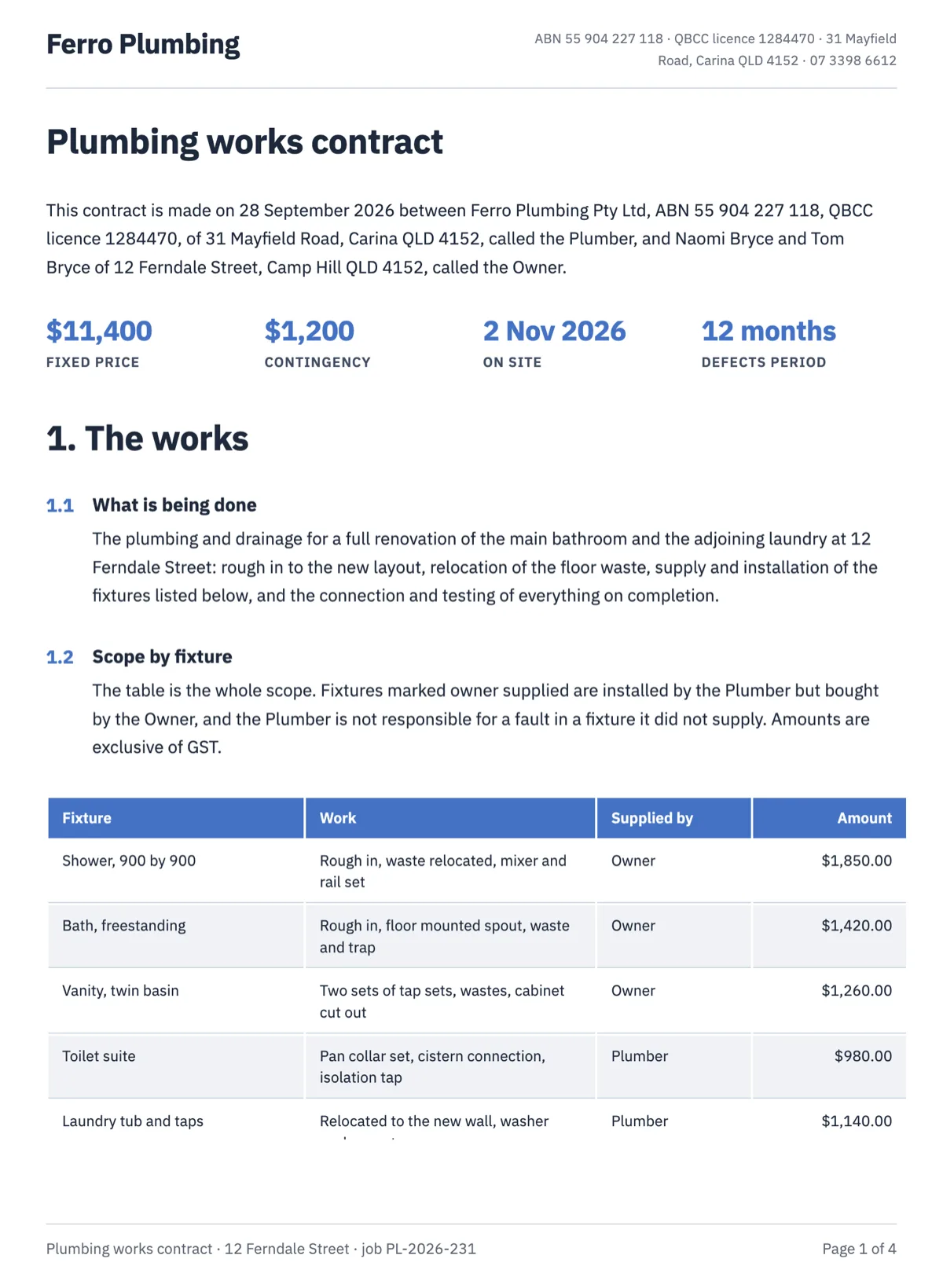 Plumbing works contract with a fixture scope table and a compliance certificateA bathroom job goes over budget in the hour the floor comes up and somebody finds old cast iron drainage. This contract prices every fixture separately, holds a named allowance for what nobody could see, and makes the final payment wait for the compliance certificate.
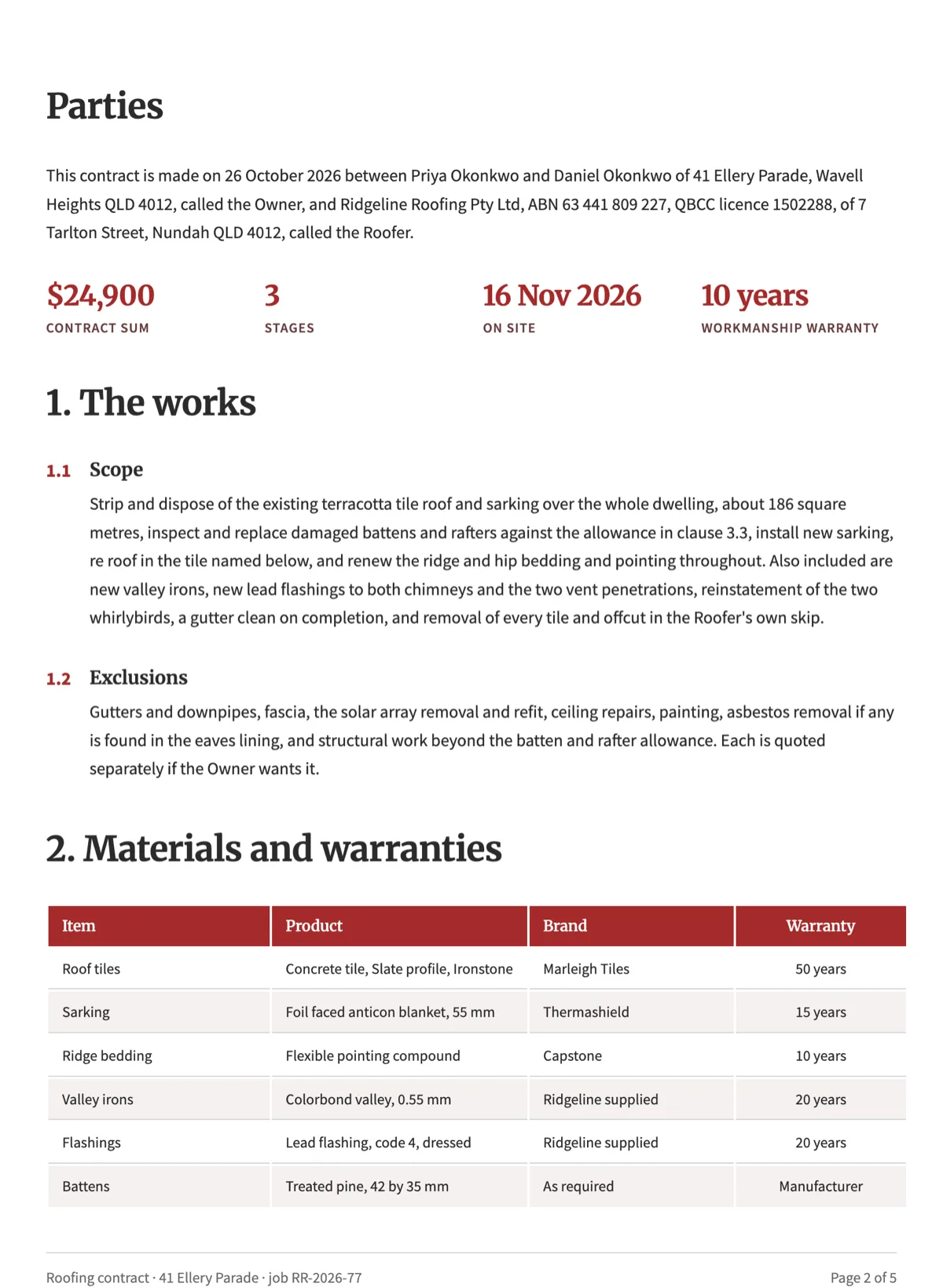 Roofing contract template with a materials table and a weather ruleA roof replacement is the one job where the house is open to the sky at the end of the day, so the clause that matters most is the one about closing it. This contract limits how much roof can be stripped at once, names every product with its warranty years, and says who pays when water gets in.
Questions people ask
How long is a defects liability period in Australia?
There is no fixed statutory length for the contractual period. Twelve months from practical completion is the most common figure in commercial construction, with shorter periods on minor works and longer ones, often 24 months, on waterproofing, roofing and facades. The contract should state the number and the start date expressly, because a period left blank gives neither party certainty.
Does the defects liability period limit the builder's liability?
No. It sets a period in which the contractor must return and rectify notified defects, but the owner keeps its ordinary claim for breach of contract for the full limitation period, and homeowners keep their statutory warranties. A contract that tries to end all liability when the period ends needs very clear words and may not work at all against a homeowner.
What happens to retention at the end of the defects liability period?
Most contracts release the balance of retention or security within a set number of business days after the period ends, less amounts properly used to rectify notified defects the contractor did not fix. The release is tied to the end of the period, which is why the start date of the period needs to be certain from the outset.
Can the owner use another contractor to fix defects?
Only after following the clause. The usual sequence is written notice of the defect, a reasonable time to attend and rectify, and then a right to engage others and recover the cost. Skipping the notice step can cost the owner the right to recover, because the contractor was denied the chance to fix its own work.
Does the defects liability period restart after a repair?
Only if the contract says so. Many contracts give rectified work a fresh period, usually 12 months, but only for the repaired item and subject to an outer limit such as 24 months from practical completion. Without a restart clause, a repair made in the eleventh month is covered by the contractual process for just one more month.
Who decides whether something is a defect?
The contract usually lets the principal or its representative identify defects by notice, and the contractor can dispute a notice under the dispute resolution clause. Defining a defect as any part of the work that does not comply with the contract, with exclusions for fair wear and tear and misuse, leaves much less room for argument.
Put the clause in a finished document
The button opens the document generator with a starting description already filled in. Change it to match your own agreement before you run it.
Create a document with OneCraftRelated clauses
- Practical completion clause: when the works are ready to useA practical completion clause defines when building work is finished enough to use. Australian sample wording, a handover checklist and certificate steps.
- Materials and workmanship clause: the quality standard for the buildA materials and workmanship clause sets the quality standard for what is installed and how. Australian sample wording naming the NCC and Australian Standards.
- Retention money clause: holding back part of a progress claimA retention money clause holds back part of each progress claim until defects are fixed. Australian sample wording, release triggers and a bank guarantee swap.
- Warranty clause: promising a standard and backing itA warranty clause promises a fact is true or that work meets a standard. Australian sample wording for a ninety day defects warranty, variants and remedies.
For everything the document generator can do, see the document maker.
Step by step in the builder: Create a document with AI, then Document builder components.
Written and checked by the OneCraft team. Last checked .