Contract clause
Practical completion clause: when the works are ready to use
A practical completion clause defines the point at which building work is finished enough to be used for its intended purpose, even though minor defects remain. It lists the tests the work must pass, the documents that must be handed over, and how the date is certified, because so many other rights run from it.
Practical completion is the date the contractor stops paying delay damages, the defects period starts and part of the retention comes back, so both sides watch it closely. A definition that relies on the word practical alone leaves each side free to argue its own meaning at the moment money changes hands.
Indunil Asanka · Co-founder
4 min read · Published
Sample clause
a fit out contract between Mangrove Interiors, a fictional commercial builder, and Lorikeet Early Learning, a fictional childcare operator fitting out a new centre in Townsville, Queensland
20. Practical Completion 20.1 Practical Completion is reached when: (a) the Works are complete except for Minor Defects; (b) all tests in Schedule 6 have been passed; (c) the documents listed in Schedule 7 have been delivered, including certificates of compliance and operation manuals; and (d) the Works can lawfully be occupied and used as a childcare centre. 20.2 Minor Defects means defects that do not prevent the Works being used for their intended purpose and can be rectified without undue interference with that use. 20.3 When Mangrove Interiors considers Practical Completion has been reached, it must give written notice to the Superintendent. 20.4 Within 5 Business Days of that notice the Superintendent must either issue a Certificate of Practical Completion stating the date it was reached, or give written reasons listing what remains to be done. 20.5 If the Superintendent does neither within that time, Practical Completion is taken to have been reached on the date of the notice.
Sample wording, not legal advice.
Variants
Certificate only, no deemed date
A principal that needs a formal decision before taking over the building, for example because a lender or landlord relies on the certificate.
Practical Completion occurs only on the date stated in a Certificate of Practical Completion issued by the Principal's Representative. The Principal's Representative must inspect the Works within 5 Business Days of the Contractor's request and must issue the certificate, or a written list of the work required to reach Practical Completion, within 3 Business Days after the inspection. The Contractor may make a further request once that work is done.
Deemed on early occupation
Projects where the owner may start trading before the paperwork is finished, such as a retail tenancy opening for a busy season.
If the Principal occupies or uses any part of the Works for its business before a Certificate of Practical Completion is issued, Practical Completion of that part is taken to have occurred on the first day of that occupation or use. Access for fitting out by the Principal's own contractors agreed in writing beforehand is not occupation or use. Liquidated damages stop accruing for that part from that date.
Staged completion by separable portion
Buildings handed over in stages, such as a school where the classrooms open before the hall.
The Works are divided into the Separable Portions described in Schedule 4, each with its own Date for Practical Completion. This clause, the defects liability clause, the liquidated damages clause and the release of security apply separately to each Separable Portion as if it were a separate contract. The Principal is responsible for the care of each Separable Portion from its Date of Practical Completion.
What to negotiate
What minor defects means
Contractors want minor defects defined broadly enough to cover the snag list every job has at handover. Principals want a narrow definition and the right to refuse completion where the defects together prevent comfortable use. The usual landing point is a functional test, whether the work can be used for its purpose, plus a limit on the value or number of outstanding items.
Documents as a precondition
Principals want certificates, manuals, as built drawings and warranties delivered before completion is certified. Contractors accept that for documents they control but resist conditions that depend on others, such as an occupancy approval delayed by the principal's own design consultants. Clauses often split the list, making some documents preconditions and requiring the rest within a set period afterwards.
Deemed completion
A certificate that is never issued is the most common reason retention stays unpaid and delay damages keep running. Contractors ask for deemed completion if the certifier does not respond within a short time. Principals accept it where the notice must attach evidence of the tests and documents, so a deemed date cannot be triggered by an unfinished job.
What passes at completion
Completion usually moves care of the works, insurance and security of the site to the principal. Contractors want that transfer stated clearly so they are not insuring a building they no longer control. Principals want an inspection and a handover meeting on the day, with keys, access cards and codes transferred against a signed receipt.
The risk of leaving it out
Without a definition, practical completion falls back on a general idea of work being complete apart from trivial items, and the parties argue about it exactly when delay damages, the defects period and retention release depend on the answer. The contractor also has no way to force a decision if the principal simply never agrees the work is finished.
The handover checklist
Most practical completion disputes are settled by a list agreed at the start. A workable checklist covers all work complete apart from minor defects listed in a signed schedule, commissioning and tests passed with results recorded, certificates of compliance for electrical, plumbing, fire and waterproofing work, the occupancy approval the building needs, operation and maintenance manuals, as built drawings, manufacturer warranties registered, the site cleaned with all waste removed, and keys, access cards and alarm codes handed over. Writing the list into a schedule turns the certificate into a check rather than a judgment.
AS 4000 and the 2025 update
Standards Australia's general conditions of contract, AS 4000, have long carried a defined practical completion certified by the superintendent. The 2025 revision, released on 30 June 2025, lists clarified practical completion definitions and procedures among its changes, and Standards Australia has said the design and construct form, AS 4902, will be revised to align. Contracts still on the 1997 edition should be read against their own definitions, since the wording differs between editions.
Where it sits in a generated document
A generated construction contract carries practical completion as a numbered clause with its tests as lettered sub clauses, and the defects, retention and liquidated damages clauses refer back to it by number. The checklist items are written in as content. The document does not cite the Australian Standard or any statute, so references to AS 4000 in a draft should be checked against the edition the parties actually use.
Documents that carry this clause
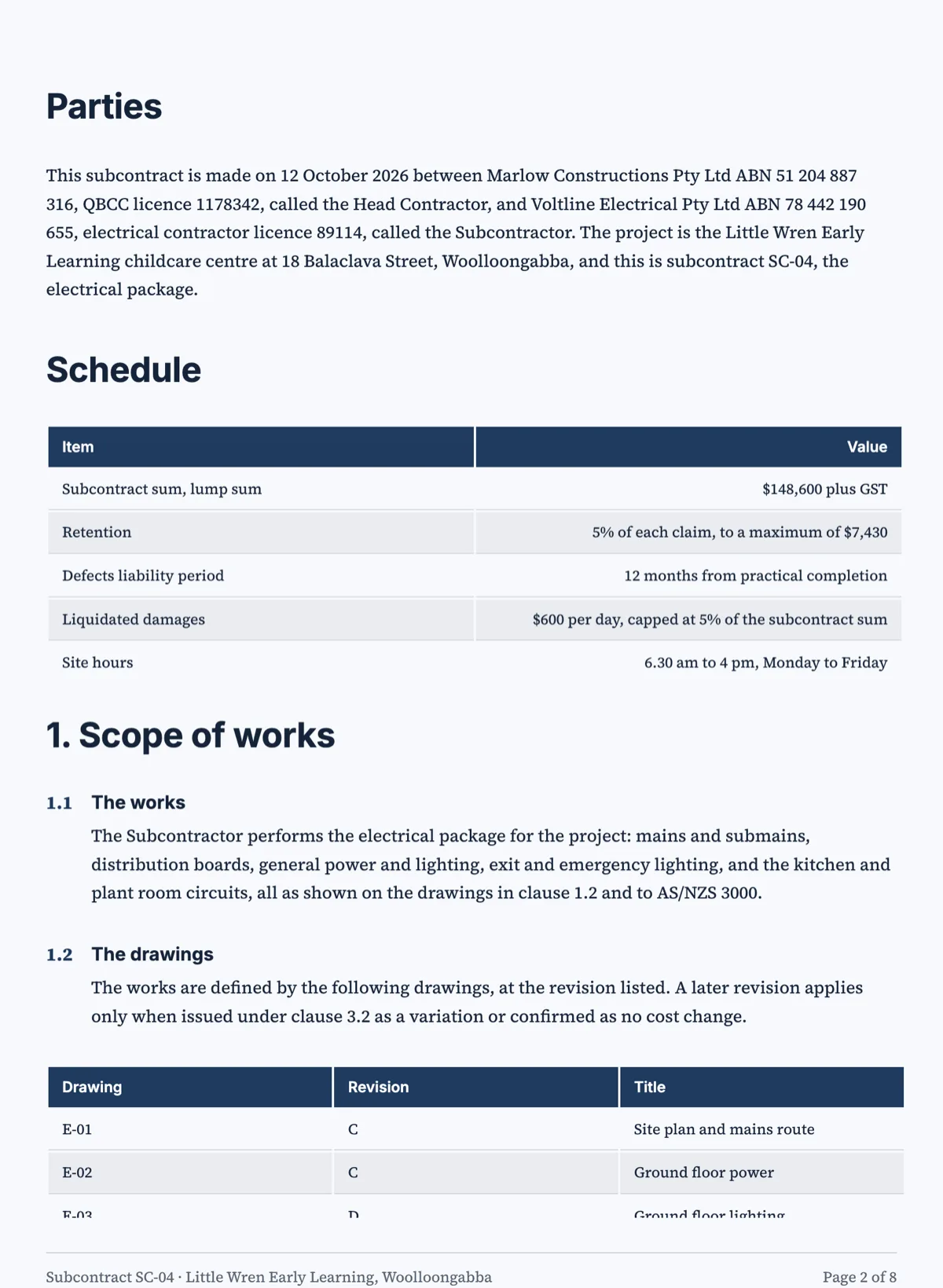 Subcontractor agreement template that flows the head contract downA subcontract exists to pass the head contract's obligations down one level and move the money back up on time. This one names the scope by drawing, sets the progress claim dates against the security of payment rules, holds retention and states the insurances, so the trade knows exactly when it is paid and for what.
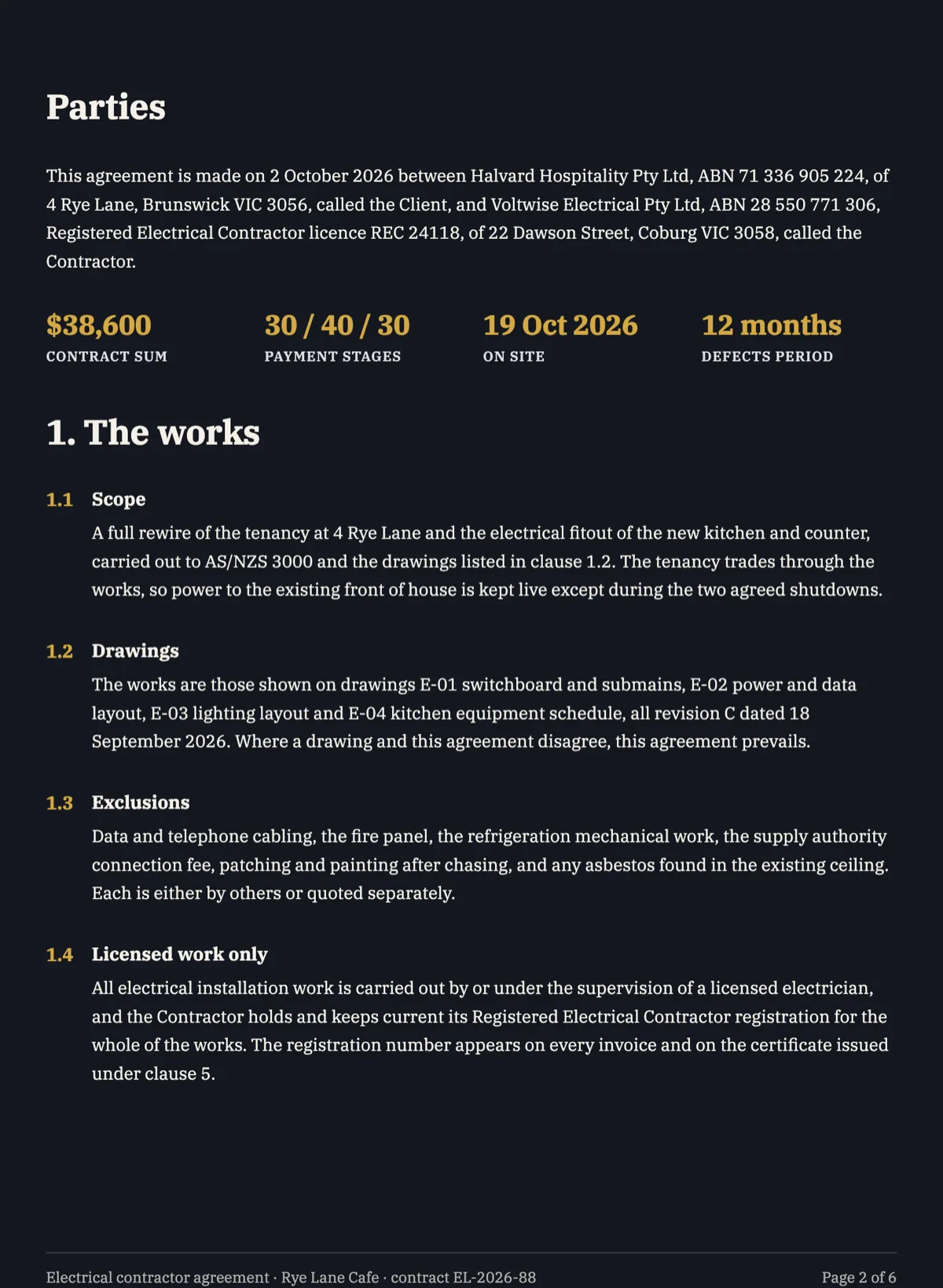 Electrical contractor agreement with a licence clause and staged paymentsElectrical work is the one trade where the paperwork at the end matters as much as the work, because without the certificate the installation is not signed off. This agreement ties the last payment stage to that certificate and sets the progress claim deadlines the payment legislation actually uses.
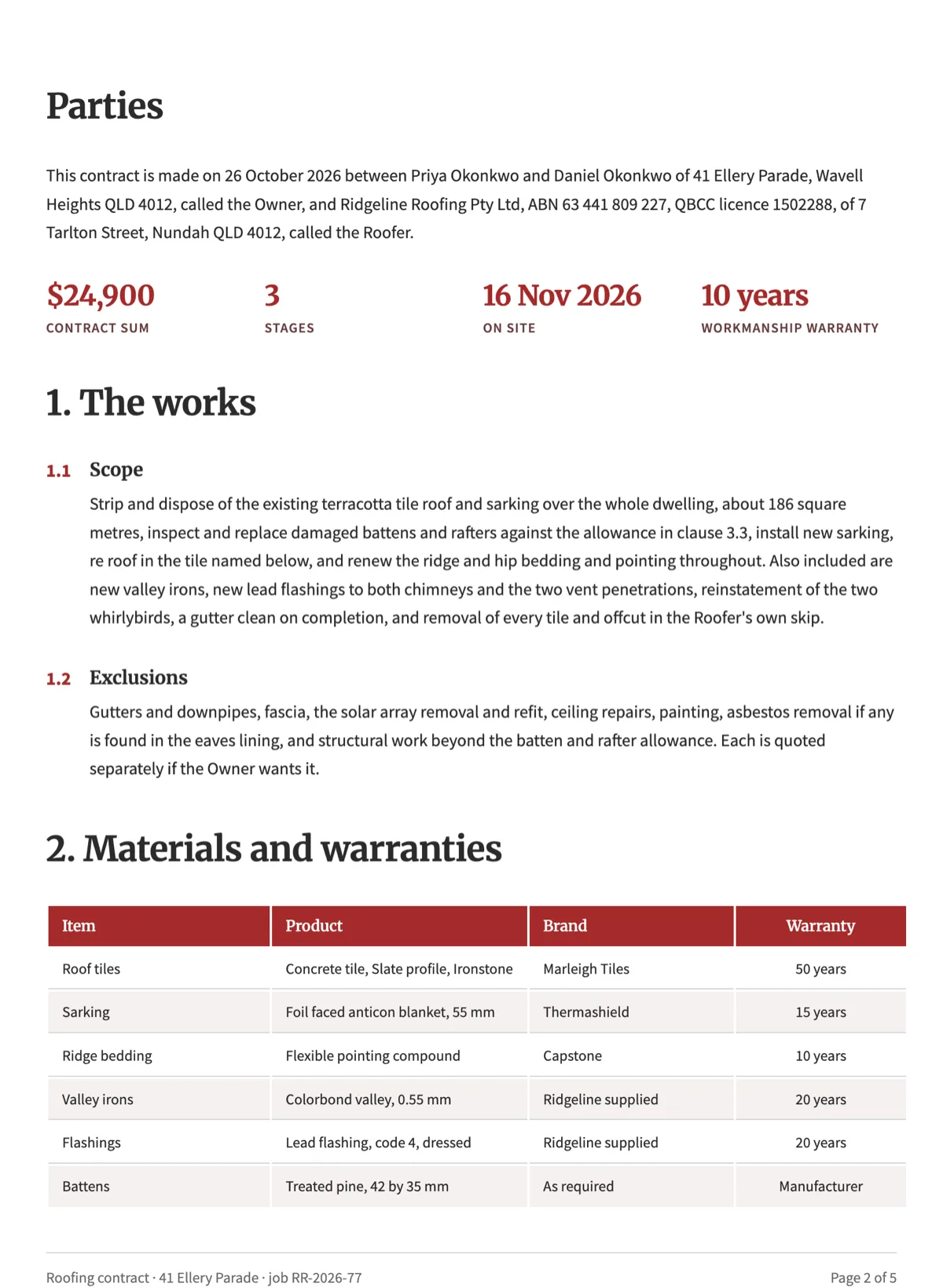 Roofing contract template with a materials table and a weather ruleA roof replacement is the one job where the house is open to the sky at the end of the day, so the clause that matters most is the one about closing it. This contract limits how much roof can be stripped at once, names every product with its warranty years, and says who pays when water gets in.
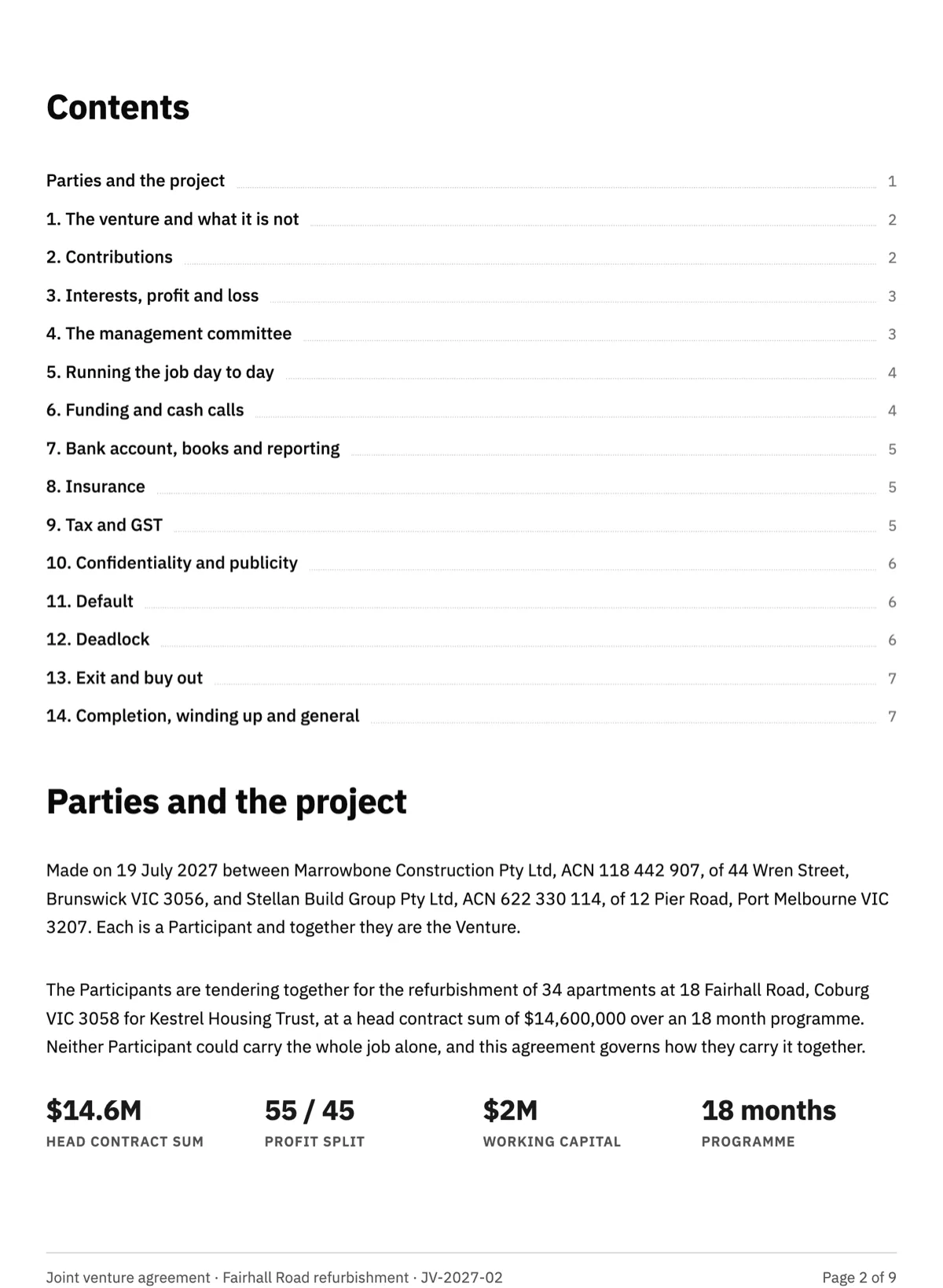 Joint venture agreement template with contributions and splitAn unincorporated joint venture has no company to fall back on, so everything a company structure would supply has to be written down. This one puts two builders together for a single $14.6 million refurbishment, splits it 55/45, and sets out who funds it, who decides, how a deadlock breaks and how either of them gets out.
Questions people ask
What is the difference between practical completion and final completion?
Practical completion is the point the works can be used for their purpose with only minor defects outstanding. Final completion comes after the defects liability period, once notified defects have been fixed and the final account is settled, and is often marked by a final certificate. Different rights attach to each, so contracts usually define both separately.
Can the owner move in before practical completion?
Only with the contractor's agreement or where the contract allows it. Early occupation can shift risk and insurance, interfere with remaining work, and in some contracts is itself treated as practical completion of the occupied area. Owners who need early access should agree the terms in writing, including who insures and whether delay damages stop.
What happens if the superintendent will not issue the certificate?
The contractor's remedy depends on the clause. Well drafted contracts require a certificate or written reasons within a set time and deem completion if neither arrives. Without that, the contractor has to use the dispute resolution clause, and meanwhile delay damages may keep accruing, which is why deemed completion is one of the most requested amendments.
Do minor defects stop practical completion?
No, by definition. Practical completion allows for defects that do not prevent the works being used for their purpose. The difficulty lies in where minor ends, because a long list of individually small items can together make a building unusable. Contracts often combine the functional test with a limit on the number or value of outstanding items.
What starts running at practical completion?
Typically the defects liability period begins, liquidated damages stop, the first part of retention or security is released, and care of the works and insurance pass to the principal. In residential work statutory warranty periods also run from completion. That concentration of consequences is why the date must be certain and recorded in writing.
Is an occupancy certificate required for practical completion?
Only if the contract makes it a condition, which most contracts do where the building needs one to be lawfully used. Contractors should ask that an approval depending on the owner's own consultants or design does not delay completion, or that completion is reached once everything within the contractor's control is done.
Put the clause in a finished document
The button opens the document generator with a starting description already filled in. Change it to match your own agreement before you run it.
Create a document with OneCraftRelated clauses
- Defects liability clause: fixing defects after practical completionA defects liability clause sets how long a builder must return to fix defects after completion. Australian sample wording, typical periods and three variants.
- Progress claims clause: getting paid as the work advancesA progress claims clause sets how a contractor claims payment as work advances. NSW sample wording, the claim to payment timetable and three variants.
- Liquidated damages clauseA liquidated damages clause fixes what delay costs before it happens. Sample fit out wording, the Australian penalty test, caps, and what each side negotiates.
- Site access clause: possession, hours and conditions of entryA site access clause sets when a contractor may enter the site and what the owner must provide. Australian sample for occupied sites, hours and induction.
For everything the document generator can do, see the document maker.
Step by step in the builder: Create a document with AI, then Document builder components.
Written and checked by the OneCraft team. Last checked .