Contract clause
Progress claims clause: getting paid as the work advances
A progress claims clause sets out how a contractor claims payment for work completed so far, usually each month or at each stage. It fixes the claim date, what a claim must include, how long the principal has to assess it and respond with a payment schedule, and when the scheduled amount must be paid.
Construction runs on progress payments, because a contractor cannot fund months of labour and materials until handover. The clause sets the rhythm of that cash, and in every Australian state it works alongside security of payment laws that override anything in it restricting a claim.
Nuwan Madhusanka · Co-founder
4 min read · Published
Sample clause
a head contract between Kurrajong Health Properties, a fictional developer, and Blackbutt Constructions, a fictional builder, for a two storey medical suites building in Orange, New South Wales
15. Progress Claims 15.1 Blackbutt Constructions may submit a Progress Claim on the 25th day of each month for work carried out up to that date. 15.2 Each Progress Claim must identify the work claimed against the Schedule of Values, include the value of approved variations, and be accompanied by a statement that subcontractors and workers have been paid the amounts then due to them. 15.3 Within 10 Business Days after receiving a Progress Claim, the Superintendent must issue a Payment Schedule stating the amount Kurrajong proposes to pay and, if that is less than the amount claimed, the reasons. 15.4 Kurrajong must pay the scheduled amount within 15 Business Days after the Progress Claim was made. 15.5 Payment of a Progress Claim is payment on account only and is not evidence that the work is complete or free of defects. 15.6 Nothing in this clause limits any right under the Building and Construction Industry Security of Payment Act 1999 (NSW).
Sample wording, not legal advice.
Variants
Monthly claims on the last day of the month
The simplest form, matching the default claim date under the New South Wales security of payment law.
The Contractor may make a Progress Claim on the last Business Day of each month for work carried out in that month and not previously claimed. The Principal must give a payment schedule within 10 Business Days after the claim is made and pay the scheduled amount within 15 Business Days after the claim is made. The Contractor makes a final Progress Claim within 28 days after the end of the Defects Liability Period.
Milestone claims
Fixed price trade packages where payment is tied to stages that are easy to verify on site, such as rough in and fit off.
The Subcontractor may claim the amount set against each Milestone in Schedule 2 on the last Business Day of the month in which that Milestone is achieved. A Milestone is achieved when the Head Contractor's site manager confirms in writing that the work described for it is complete, and that confirmation must not be unreasonably withheld or delayed beyond 3 Business Days after the Subcontractor asks for it.
Subcontract claim carrying the statutory statement
A New South Wales subcontract connected with a residential construction contract, where a subcontractor's claim must say it is made under the security of payment legislation.
Each payment claim by the Subcontractor must state the amount claimed, identify the construction work and related goods and services to which it relates, and include the words: This is a payment claim made under the Building and Construction Industry Security of Payment Act 1999 NSW. The Head Contractor must pay the scheduled amount within 20 Business Days after the claim is made.
What to negotiate
Claim date and frequency
Contractors want to claim as often and as early as possible, while principals want one claim a month on a date that suits their own finance drawdowns. Security of payment law in most states guarantees at least a monthly claim, so the real negotiation is the day of the month and whether a stage claim can be made mid month once a milestone is reached.
Supporting evidence
Principals ask for quantity reports, photos, subcontractor payment statements and updated programmes with every claim. Contractors accept reasonable evidence but resist conditions that would invalidate a claim if one document is missing. Because a contract cannot cut down statutory claim rights, missing evidence is better treated as a reason to schedule a lower amount than as grounds to reject the claim outright.
Unfixed materials
Contractors buying expensive plant or materials months before installation want to claim for them. Principals will pay only if ownership passes on payment, the goods are marked, stored securely and insured, and there is evidence that no supplier holds a registered security interest over them that could defeat the principal's ownership.
Deductions from a claim
Principals want to deduct delay damages, defect costs and other amounts from progress payments. Contractors ask that any deduction be shown in the payment schedule with reasons, limited to amounts actually due, and not taken for unrelated matters. The schedule is the right place for it, since an unexplained deduction is exposed quickly at adjudication.
The risk of leaving it out
Without a progress claims clause a contractor on a lump sum has traditionally had no right to payment until the whole work is done, although security of payment legislation now supplies a default monthly right to claim. That statutory default does not settle what evidence is needed, who assesses the claim, or how variations and materials are treated, so disputes follow.
The claim to payment timetable in NSW
For a head contract in New South Wales the sequence runs like this. The contractor makes a claim on the date the contract allows, or on the last day of the month if the contract is silent. The principal then has at most 10 business days to give a payment schedule, and if it gives none the full claimed amount becomes payable. Payment is due within 15 business days after the claim for a head contractor and within 20 business days for a subcontractor. A head contractor claiming from a principal also has to serve a supporting statement that its own subcontractors have been paid.
How this clause relates to security of payment
Security of payment legislation in each state gives a statutory right to claim and a fast adjudication process, and it overrides contract terms that exclude, modify or restrict those rights. A progress claims clause therefore does its best work on the matters the statute leaves to the parties: the claim date, the schedule of values, the evidence expected, how variations and unfixed materials are claimed, and who assesses the claim for the principal. The statutory process and adjudication belong in the security of payment clause.
Where it sits in a generated document
In a generated head contract the progress claims clause follows the contract sum and variations clauses, numbered so the retention and set off clauses can refer to it. The claim date, the response times and the milestone amounts are written in as content. The document does not cite the security of payment legislation, so any statutory wording a claim must carry should be checked for the state concerned.
Documents that carry this clause
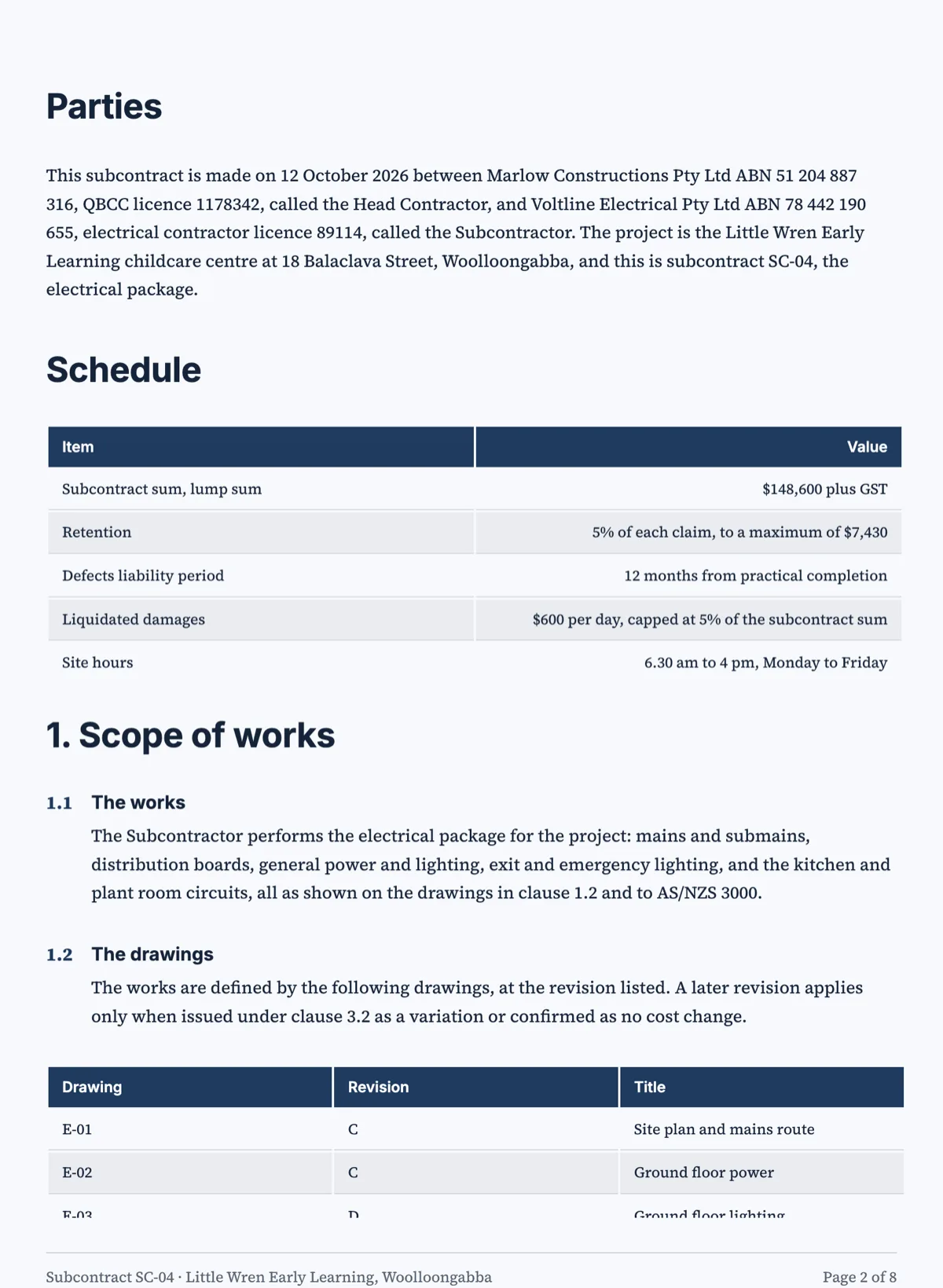 Subcontractor agreement template that flows the head contract downA subcontract exists to pass the head contract's obligations down one level and move the money back up on time. This one names the scope by drawing, sets the progress claim dates against the security of payment rules, holds retention and states the insurances, so the trade knows exactly when it is paid and for what.
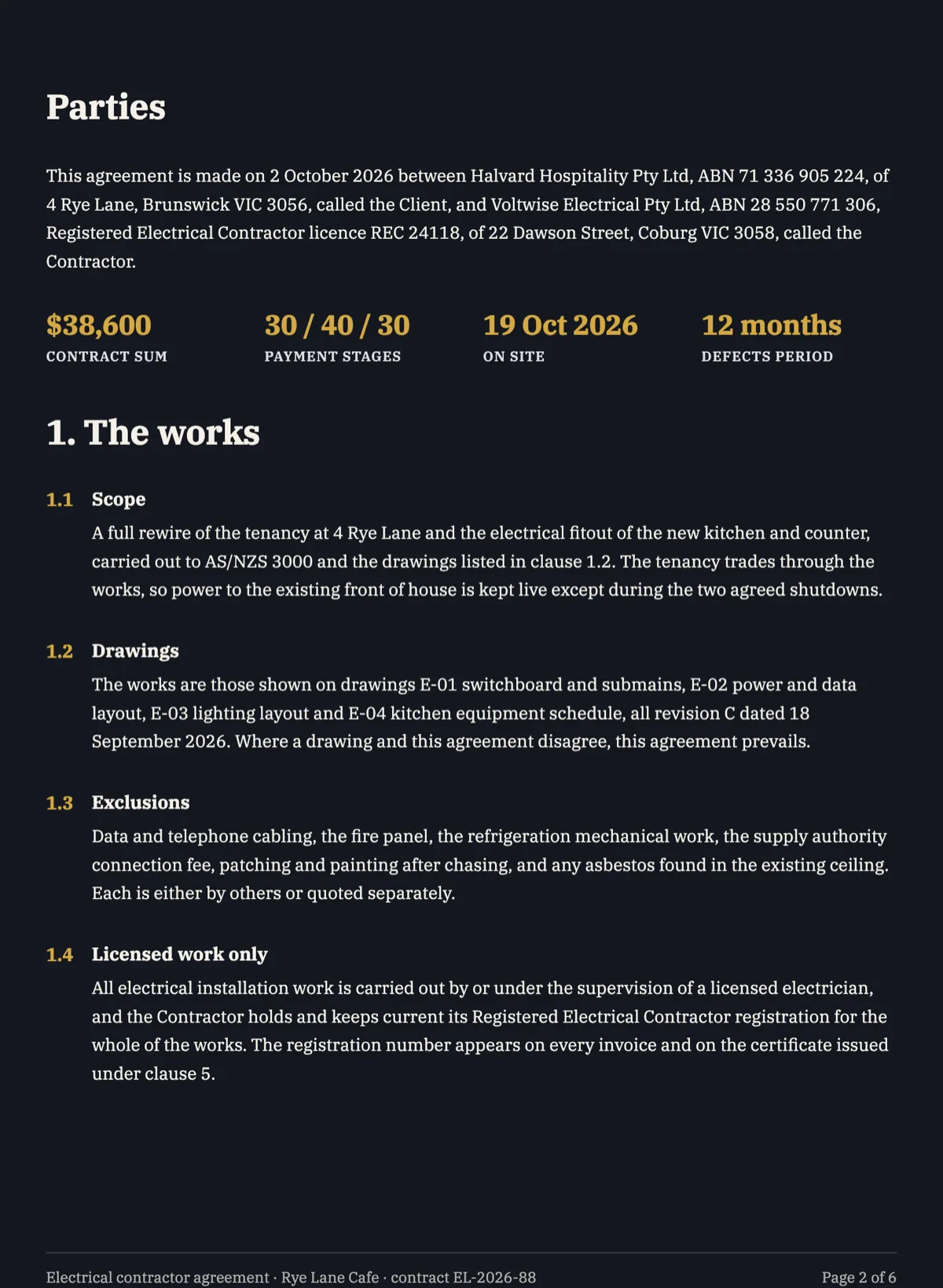 Electrical contractor agreement with a licence clause and staged paymentsElectrical work is the one trade where the paperwork at the end matters as much as the work, because without the certificate the installation is not signed off. This agreement ties the last payment stage to that certificate and sets the progress claim deadlines the payment legislation actually uses.
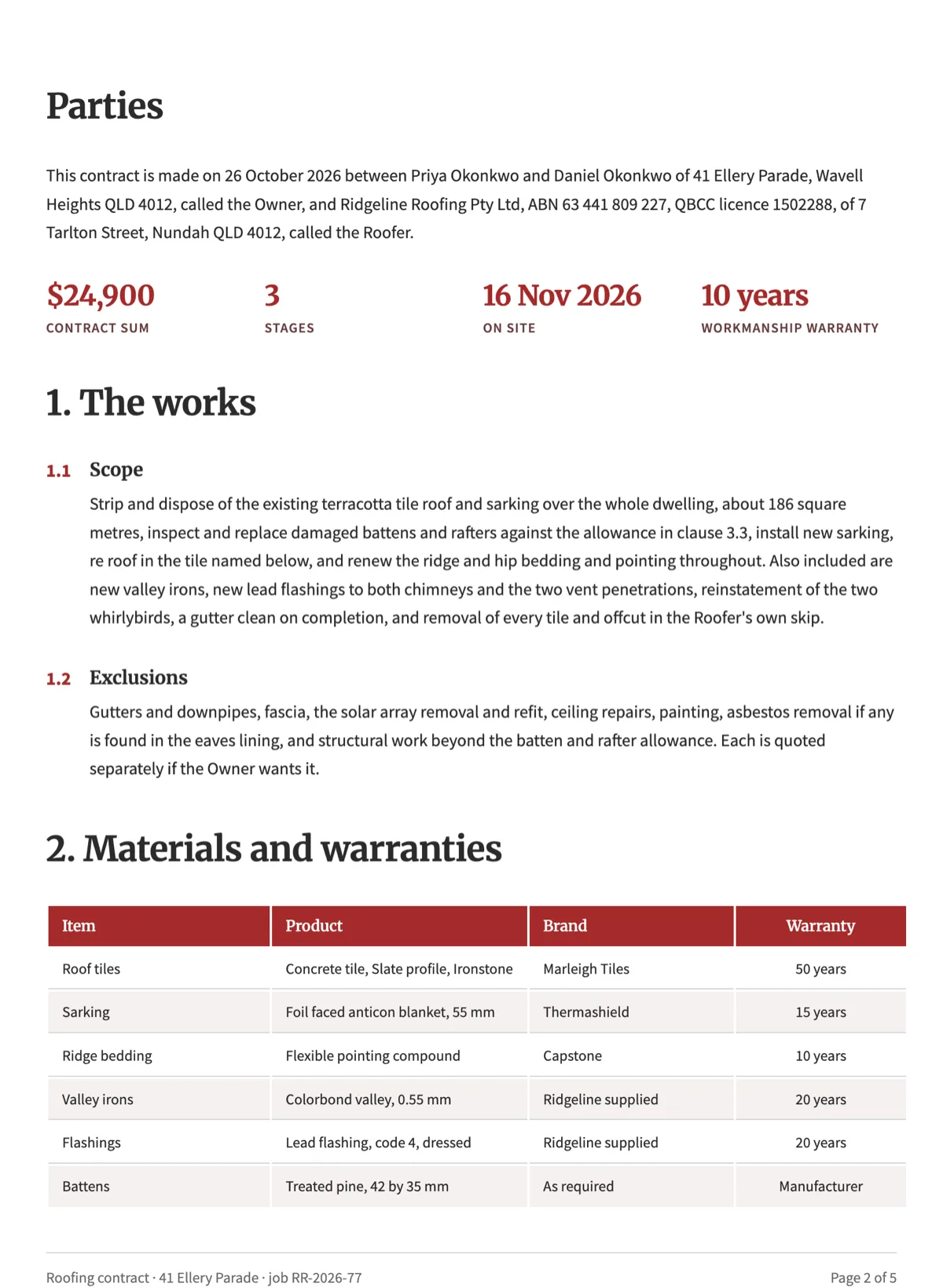 Roofing contract template with a materials table and a weather ruleA roof replacement is the one job where the house is open to the sky at the end of the day, so the clause that matters most is the one about closing it. This contract limits how much roof can be stripped at once, names every product with its warranty years, and says who pays when water gets in.
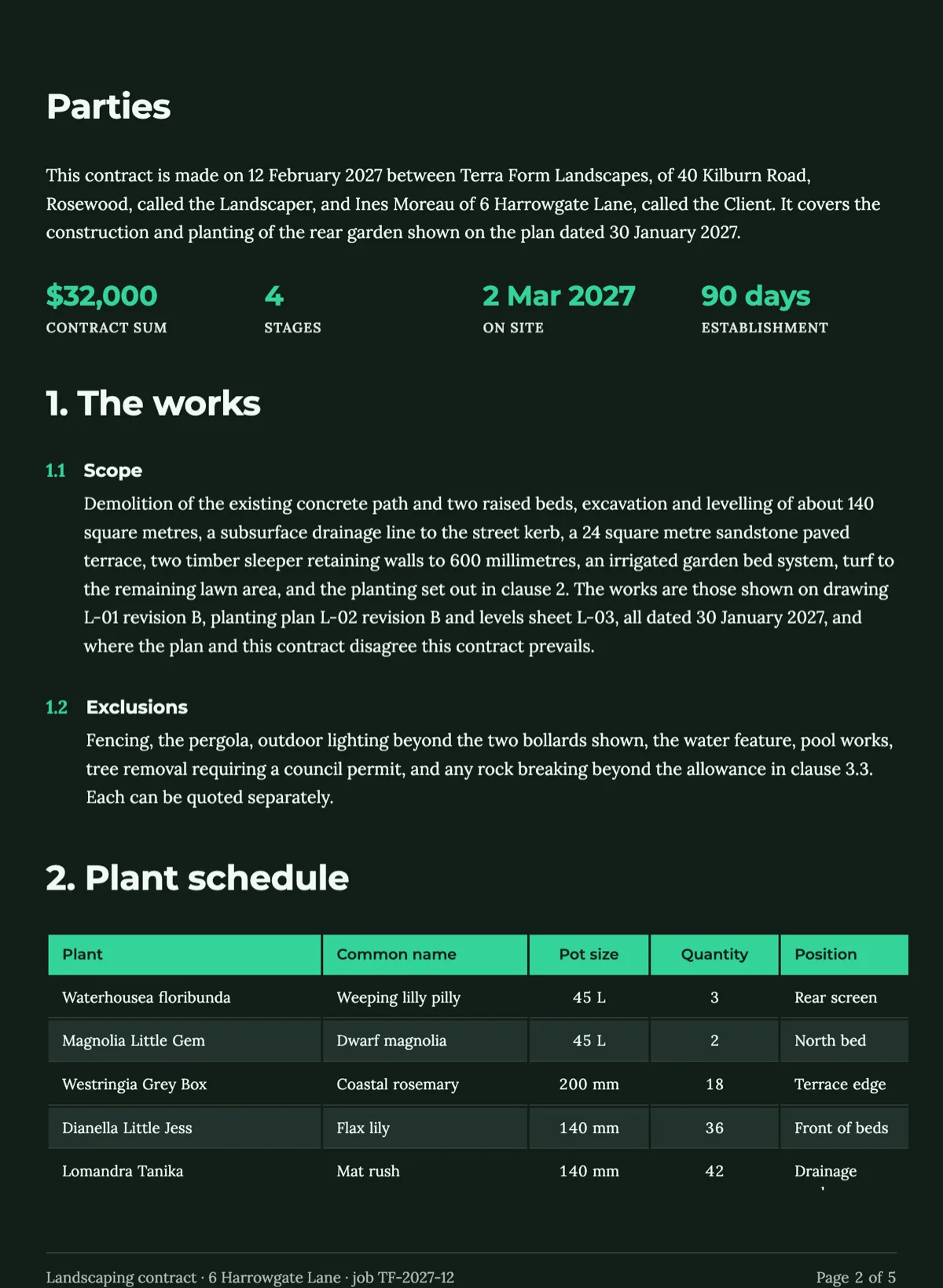 Landscaping contract template with a plant schedule and an establishment periodA garden build is two jobs in one: construction that is finished when it is finished, and planting that is only finished three months later. This contract prices the construction in four stages, lists every plant with its pot size and quantity, and holds the landscaper to a 90 day establishment period for anything that dies.
Questions people ask
How often can a contractor make a progress claim?
As often as the contract allows, and in most Australian states at least once a month under security of payment legislation. In New South Wales a claim can be made on the last day of each month, or on an earlier date the contract sets. Milestone contracts often allow a claim when each stage is reached as well.
What must a progress claim include?
At a minimum it should state the amount claimed and identify the work, goods or services it covers. Contracts usually add a breakdown against the schedule of values, approved variations and supporting evidence. In New South Wales a subcontractor's claim may also need to state that it is made under the security of payment legislation.
What happens if the principal does not respond to a progress claim?
Under security of payment legislation, a principal that fails to give a payment schedule within the time allowed generally becomes liable for the full claimed amount. The contractor can then recover it as a debt or apply for adjudication, depending on the state. That consequence is why principals record the date every claim arrives.
Is payment of a progress claim approval of the work?
Not if the contract says it is payment on account, which most do. Progress payments are provisional, so the principal can still reject defective work and adjust the value in later claims or at the final account. Contractors should not treat a paid claim as proof the work was accepted, and principals should keep that wording in the clause.
Can materials not yet installed be claimed?
Only if the contract allows it. Principals usually agree to pay for unfixed materials when ownership passes to them on payment, the goods are clearly marked and stored securely, and insurance covers them. Without those conditions a principal risks paying for goods that a supplier or a liquidator can later reclaim.
How long does the principal have to pay a progress claim in NSW?
In New South Wales the scheduled amount under a head contract must be paid within 15 business days after the claim is made, and under a subcontract within 20 business days, or earlier if the contract says so. The payment schedule itself must be given within 10 business days of the claim, otherwise the full amount becomes payable.
Put the clause in a finished document
The button opens the document generator with a starting description already filled in. Change it to match your own agreement before you run it.
Create a document with OneCraftRelated clauses
- Security of payment clause: working with the state payment lawsA security of payment clause sets how a contract works with the state payment laws. NSW sample wording, Victorian and Queensland variants and a guide by state.
- Construction variations clause: directing and pricing changed workA construction variations clause sets how changes to building work are directed and priced. Australian sample wording with schedule rates, cost plus and quotes.
- Retention money clause: holding back part of a progress claimA retention money clause holds back part of each progress claim until defects are fixed. Australian sample wording, release triggers and a bank guarantee swap.
- Practical completion clause: when the works are ready to useA practical completion clause defines when building work is finished enough to use. Australian sample wording, a handover checklist and certificate steps.
For everything the document generator can do, see the document maker.
Step by step in the builder: Create a document with AI, then Document builder components.
Written and checked by the OneCraft team. Last checked .