Contract clause
Security of payment clause: working with the state payment laws
A security of payment clause records how a construction contract works with the state or territory security of payment legislation. It confirms the statutory right to make payment claims, names the claim dates and the address for serving claims and schedules, and makes clear that nothing in the contract limits the right to adjudication.
Security of payment laws give contractors and suppliers down the chain a fast route to progress payments, and nobody can contract out of them. The clause matters because missed deadlines under those laws cost real money, and a contract that states the dates and service addresses plainly keeps both sides on time.
Indunil Asanka · Co-founder
4 min read · Published
Sample clause
a steel fabrication subcontract between Ironbark Structures, a fictional head contractor, and Hunter Valley Steel Fabrication, a fictional subcontractor, on a warehouse project in Maitland, New South Wales
22. Security of Payment 22.1 In this clause, the Act means the Building and Construction Industry Security of Payment Act 1999 (NSW). 22.2 Hunter Valley Steel may make a payment claim under the Act on the last day of each month, which is also the Claim Date under this Subcontract. 22.3 Payment claims and payment schedules must be served by email to the Payment Address of the receiving party stated in Item 9 of the Schedule, and a change of Payment Address takes effect 5 Business Days after written notice of it. 22.4 Ironbark Structures must give any payment schedule within 10 Business Days after a payment claim is served. 22.5 Ironbark Structures must pay a progress payment within 20 Business Days after the payment claim is made. 22.6 Nothing in this Subcontract excludes, modifies or restricts the operation of the Act, and any provision that would do so has no effect to that extent. 22.7 A payment made under an adjudication determination is on account of amounts payable under this Subcontract.
Sample wording, not legal advice.
Variants
Victorian subcontract with excluded amounts
Work in Victoria, where the legislation limits what a statutory payment claim may include.
Each payment claim made under the Building and Construction Industry Security of Payment Act 2002 (Vic) must identify the construction work or related goods and services to which it relates and state the amount claimed. The Subcontractor must not include in a payment claim any excluded amount within the meaning of that Act, and must claim any such amount separately under clause 30 of this Subcontract. The Head Contractor must give any payment schedule within 10 Business Days after the claim is served.
Queensland head contract
Work in Queensland under the Building Industry Fairness (Security of Payment) Act 2017.
A payment claim under the Building Industry Fairness (Security of Payment) Act 2017 (Qld) may be given on or after the last day of each month for work carried out to that day. The Principal must give any payment schedule within 10 Business Days after receiving a payment claim, which is shorter than the longest period the Act allows. Payment claims and payment schedules may be given by email to the addresses in the Contract Particulars.
Suspension right restated for site teams
A subcontractor that wants the statutory right to suspend work for non payment spelled out in the contract its supervisors read.
If the Head Contractor fails to pay the whole of a scheduled amount or an adjudicated amount by the due date, the Subcontractor may give written notice of its intention to suspend work under the Act and, if payment is not made within 2 Business Days after that notice, may suspend work until payment is made. A suspension under this clause is not a breach of this Subcontract, and the Date for Completion is extended by the period of suspension.
What to negotiate
Service addresses
Most adjudication fights about deadlines are really fights about service. Both sides benefit from naming one email address for payment claims and schedules, a person who monitors it, and a rule for changing it. Claimants want email service accepted, and respondents want the address specific enough that a claim sent to a site supervisor's inbox does not start the clock.
Pay when paid wording
Head contractors sometimes want payment to depend on being paid by the principal. Security of payment legislation makes that kind of provision ineffective, so negotiating it only creates false comfort. The legitimate points to negotiate are the payment period within the statutory maximum, the evidence a claim should attach, and how disputed amounts are shown in the schedule.
Claim dates
The statute sets a default, but a contract can set an earlier claim date in some states. Subcontractors ask for claim dates aligned to the head contractor's own cycle, so they are paid from the same funds. Head contractors want claims early enough in the month to assess them before their own claim to the principal falls due.
Time bars and final claims
Contracts often bar claims not made within a set time after completion. Those bars cannot cut down the statutory right to claim within the period the Act allows, but they can still affect contractual entitlements. Subcontractors check that any contractual time bar is at least as long as the statutory window, so the two do not give different answers for the same work.
The risk of leaving it out
The legislation applies whether or not the contract mentions it, so leaving the clause out does not remove anyone's rights. What goes missing is the practical detail: where claims are served, what the claim date is, and which state's timeframes the site team should follow, which is exactly the detail that decides whether a payment schedule arrives in time.
The Acts by state
New South Wales applies the Building and Construction Industry Security of Payment Act 1999, with a payment schedule due within 10 business days and payment within 15 business days for a head contractor or 20 for a subcontractor. Victoria applies its 2002 Act of the same name, with a payment schedule within 10 business days and an excluded amounts regime that keeps some claims out of a statutory payment claim. Queensland applies the Building Industry Fairness (Security of Payment) Act 2017, with a payment schedule within 15 business days or an earlier contract date. Western Australia has a 2021 Act, South Australia, Tasmania and the ACT each have a 2009 Act, and the Northern Territory has the Construction Contracts (Security of Payments) Act 2004.
What the clause cannot do
Every Australian security of payment Act voids contract terms that exclude, modify or restrict its operation, and several also make pay when paid provisions ineffective. A contract therefore cannot lengthen the statutory time for a payment schedule, stop a claimant from applying for adjudication, or make payment depend on the head contractor being paid. What it can do is shorten times, fix claim dates where the Act allows, and set up the service details that let the statutory process run smoothly.
Where it sits in a generated document
In a generated subcontract the security of payment clause usually sits straight after the progress claims clause, with the Act named once as a defined term and the payment addresses set out in the schedule. Dates and business day counts are written in as content. The document does not cite or check the legislation, so the Act named and its timeframes should be confirmed for the state where the work is done.
Documents that carry this clause
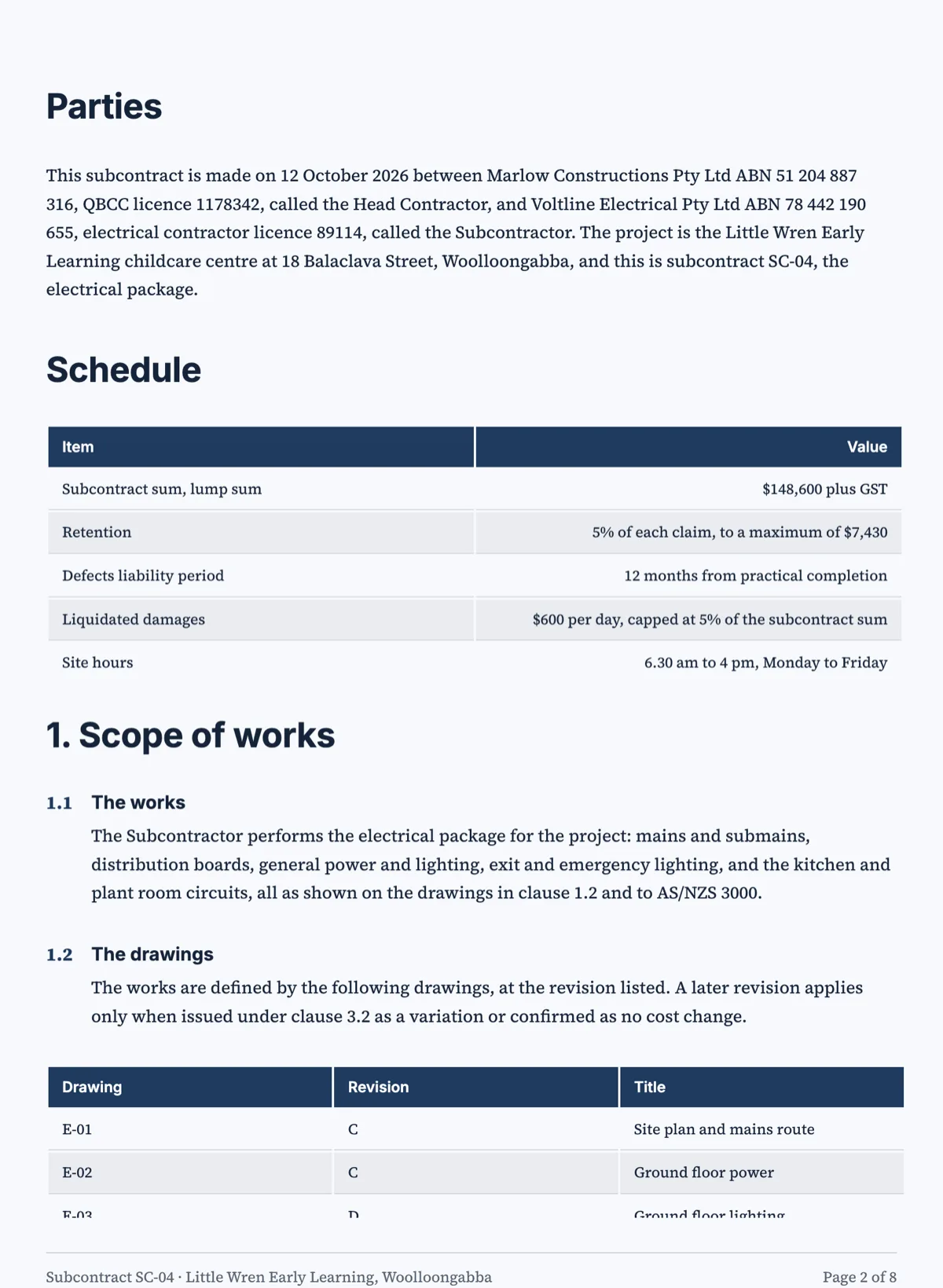 Subcontractor agreement template that flows the head contract downA subcontract exists to pass the head contract's obligations down one level and move the money back up on time. This one names the scope by drawing, sets the progress claim dates against the security of payment rules, holds retention and states the insurances, so the trade knows exactly when it is paid and for what.
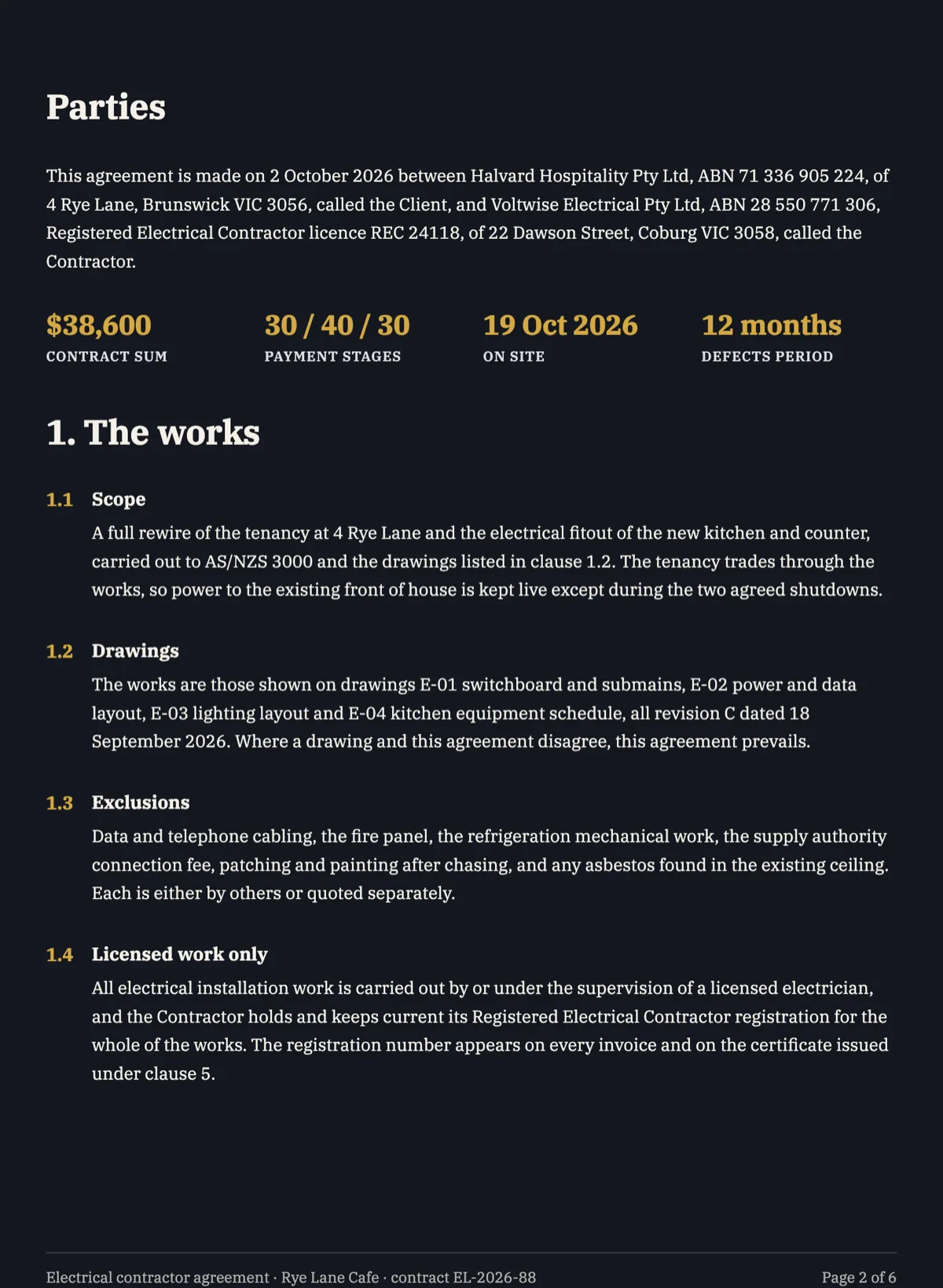 Electrical contractor agreement with a licence clause and staged paymentsElectrical work is the one trade where the paperwork at the end matters as much as the work, because without the certificate the installation is not signed off. This agreement ties the last payment stage to that certificate and sets the progress claim deadlines the payment legislation actually uses.
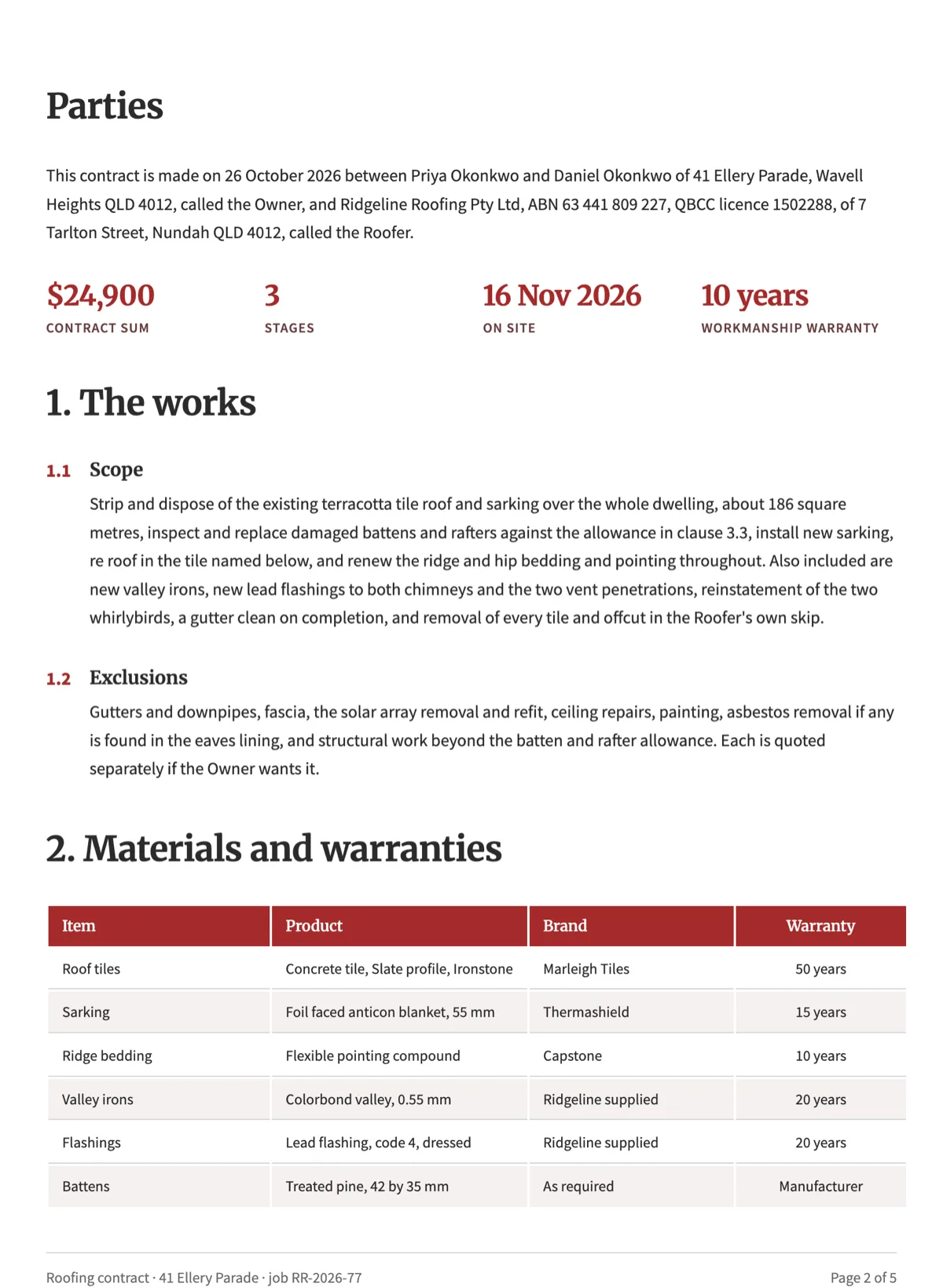 Roofing contract template with a materials table and a weather ruleA roof replacement is the one job where the house is open to the sky at the end of the day, so the clause that matters most is the one about closing it. This contract limits how much roof can be stripped at once, names every product with its warranty years, and says who pays when water gets in.
Questions people ask
Can a contract exclude the Security of Payment Act?
No. Each state and territory Act makes contract provisions that exclude, modify or restrict its operation ineffective, so a subcontractor keeps its statutory rights whatever the contract says. A clause acknowledging the Act does not create those rights, but it helps both sides administer them by stating claim dates, service addresses and response times.
Does security of payment apply to residential building work?
It depends on the state. In New South Wales the government's guidance states that the Act also applies to owner occupier construction contracts, with some different rules for that work. Other states treat residential work for a homeowner differently, so the rules for the state where the home is built need to be checked before relying on a statutory claim.
How long does a respondent have to provide a payment schedule?
It varies by state. New South Wales and Victoria allow at most 10 business days after the claim is served, and Queensland allows 15 business days, with an earlier deadline in each where the contract requires one. Missing the deadline generally exposes the respondent to the full claimed amount, so the date each claim arrives should be recorded.
Can a subcontractor suspend work for non payment?
Yes, under the security of payment legislation, provided the statutory steps are followed. In New South Wales a claimant that has not been paid a scheduled or adjudicated amount by the due date can give notice of its intention to suspend and may suspend work after 2 business days. Suspending without following those steps can itself be a breach of contract.
What is adjudication under security of payment laws?
Adjudication is a fast, interim decision on a payment dispute made by an adjudicator appointed through an authorised nominating authority. Both parties make written submissions with evidence, and the determination is binding for payment purposes, although the underlying contractual rights can still be argued later in court or arbitration. In New South Wales an adjudicated amount must be paid within 5 business days.
Which state's Act applies to a construction contract?
Generally the Act of the state or territory where the construction work is carried out, or the related goods and services are supplied, whatever law the contract names. A Sydney head contractor engaging a subcontractor for a project in Brisbane is dealing with the Queensland Act, so the clause should name the Act for the site rather than the head office.
Put the clause in a finished document
The button opens the document generator with a starting description already filled in. Change it to match your own agreement before you run it.
Create a document with OneCraftRelated clauses
- Progress claims clause: getting paid as the work advancesA progress claims clause sets how a contractor claims payment as work advances. NSW sample wording, the claim to payment timetable and three variants.
- Set off clause: deducting what the other side owesA set off clause lets one party deduct what the other owes it from what it owes. Australian sample wording, a no set off variant, and the insolvency position.
- Suspension for non payment clause: pausing work, not ending itA suspension for non payment clause lets a supplier pause work on an overdue invoice without terminating. Sample wording, notice periods and three variants.
For everything the document generator can do, see the document maker.
Step by step in the builder: Create a document with AI, then Send a document for signature.
Written and checked by the OneCraft team. Last checked .