Contract clause
Construction variations clause: directing and pricing changed work
A construction variations clause sets how changes to the building work are instructed, priced and added to the contract. It says who can direct a variation, that the direction must be in writing, how the price and any extra time are worked out, and what happens when the contractor does extra work without a direction.
Almost every building job changes between the drawings and handover, and variations are where most construction money disputes begin. A clause that fixes the paperwork and the pricing method before work starts turns each change into a calculation rather than a negotiation held after the concrete has set.
Nuwan Madhusanka · Co-founder
4 min read · Published
Sample clause
a joinery subcontract between Ironwood Commercial Builders, a fictional head contractor, and Paperbark Joinery, a fictional subcontractor, for a medical centre fit out in Parramatta, New South Wales
12. Variations 12.1 Ironwood may direct Paperbark Joinery to vary the Subcontract Works by increasing, decreasing or changing them, or by omitting any part, but may not omit work in order to have it carried out by others. 12.2 A direction to vary is effective only if it is in writing and signed by Ironwood's Site Manager. 12.3 Paperbark Joinery must not vary the Subcontract Works without a written direction, and must notify Ironwood within 2 Business Days if it believes an instruction given on site is a variation. 12.4 Within 5 Business Days of a direction, Paperbark Joinery must give a written quote stating the price and any effect on the Date for Completion. 12.5 Unless a quote is accepted, a variation is valued first at the rates in Schedule 2, then at reasonable rates, and failing both at cost plus 15 per cent. 12.6 The value of each variation is added to the Subcontract Sum and may be claimed in the next progress claim.
Sample wording, not legal advice.
Variants
Rates based valuation only
Trade packages with a detailed schedule of rates, such as electrical or plumbing, where most changes are more or less of the same items.
Every variation is valued using the rates in the Schedule of Rates, applied to the measured quantity of work added or omitted. Where the Schedule of Rates contains no suitable rate, a rate is agreed in writing before the varied work starts or, failing agreement, is determined by the Contract Administrator as a reasonable rate including a margin of 12 per cent. Omitted work is deducted at the same rates.
Quoted variations agreed before work starts
Residential and small commercial work where the owner wants to know the cost of every change before approving it.
Before carrying out any variation, the Builder must give the Owner a written variation quote stating the work, the price including GST, and the number of days, if any, by which completion will be delayed. The Builder must not start the varied work until the Owner signs the quote, except where the variation is urgently required to comply with the law or make the site safe, in which case the Builder must give the quote within 2 Business Days.
Time and materials for uncertain changes
Changes whose extent cannot be known until the work is opened up, such as repairs to concealed framing.
Where the Principal directs a variation whose extent cannot reasonably be estimated in advance, the Contractor must carry it out on a time and materials basis at the labour rates in Schedule 3, with materials at cost plus 10 per cent. The Contractor must submit daily dockets signed by the Principal's representative by the end of the next Business Day, and work not recorded on a signed docket is not payable.
What to negotiate
Site instructions that are not written
Supervisors give verbal instructions every day, and contractors follow them to keep the job moving. A clause that makes only written directions effective protects the principal's budget but can leave a contractor unpaid for work it was plainly told to do. The fair middle is a short notice period in which the contractor flags an instruction as a variation, after which the principal must confirm or reject it quickly.
The margin and the fallback rate
The pricing order matters more than the rates. Contractors want cost plus a margin high enough to cover overheads and profit, often 15 to 20 per cent, while principals want schedule rates first so the margin already sits inside agreed prices. Both sides benefit from a stated fallback, because reasonable rates with no margin figure is an invitation to argue.
Omissions
A principal that removes work from the contract to give it to a cheaper trade takes away the profit the contractor priced. Contractors ask for an express ban on that, or payment of the lost margin on omitted work. Principals usually accept a ban on omitting work for others while keeping the right to omit work the project genuinely no longer needs.
Time as well as money
A variation that adds a week of work without moving the completion date exposes the contractor to delay damages. Contractors want every direction or quote to deal with time, and an extension of time for variations directed late in the job. Principals want any time effect stated in the quote so it cannot be raised months afterwards.
The risk of leaving it out
Without a variations clause the contractor has no clear right to be paid for extra work beyond the lump sum, and the principal has no clear right to direct changes at all. Disputes then turn on implied promises and claims for reasonable value, argued long after the change was made and usually with poor records of who asked for what.
How this differs from a general variation clause
An ordinary variation clause deals with changing the terms of a contract after signing, usually by written agreement of both parties. A construction variations clause is different in kind. It gives one party a power to change the scope of the work while the contract stays in place, sets a valuation method in advance, and links the result to progress claims and extensions of time. A software change control procedure is closer, but it rarely lets the customer impose a change without the supplier's agreement.
Residential building work
Home building legislation in several states adds rules a residential variations clause must respect. Victoria's Domestic Building Contracts Act and Queensland's building and construction commission legislation both regulate how variations to domestic building contracts are requested, documented and priced, and a builder that goes ahead without the required written variation risks being unable to recover the extra cost. A residential clause should follow the procedure for the state where the home is rather than borrow a commercial form.
Where it sits in a generated document
A generated subcontract places variations after the scope and price clauses, numbered so the progress claims clause can point to it for how varied work is claimed. The rates, the margin percentage and the quote deadline are written in as content. The document does not cite state building legislation, so a residential draft should be checked against the rules for the state concerned.
Documents that carry this clause
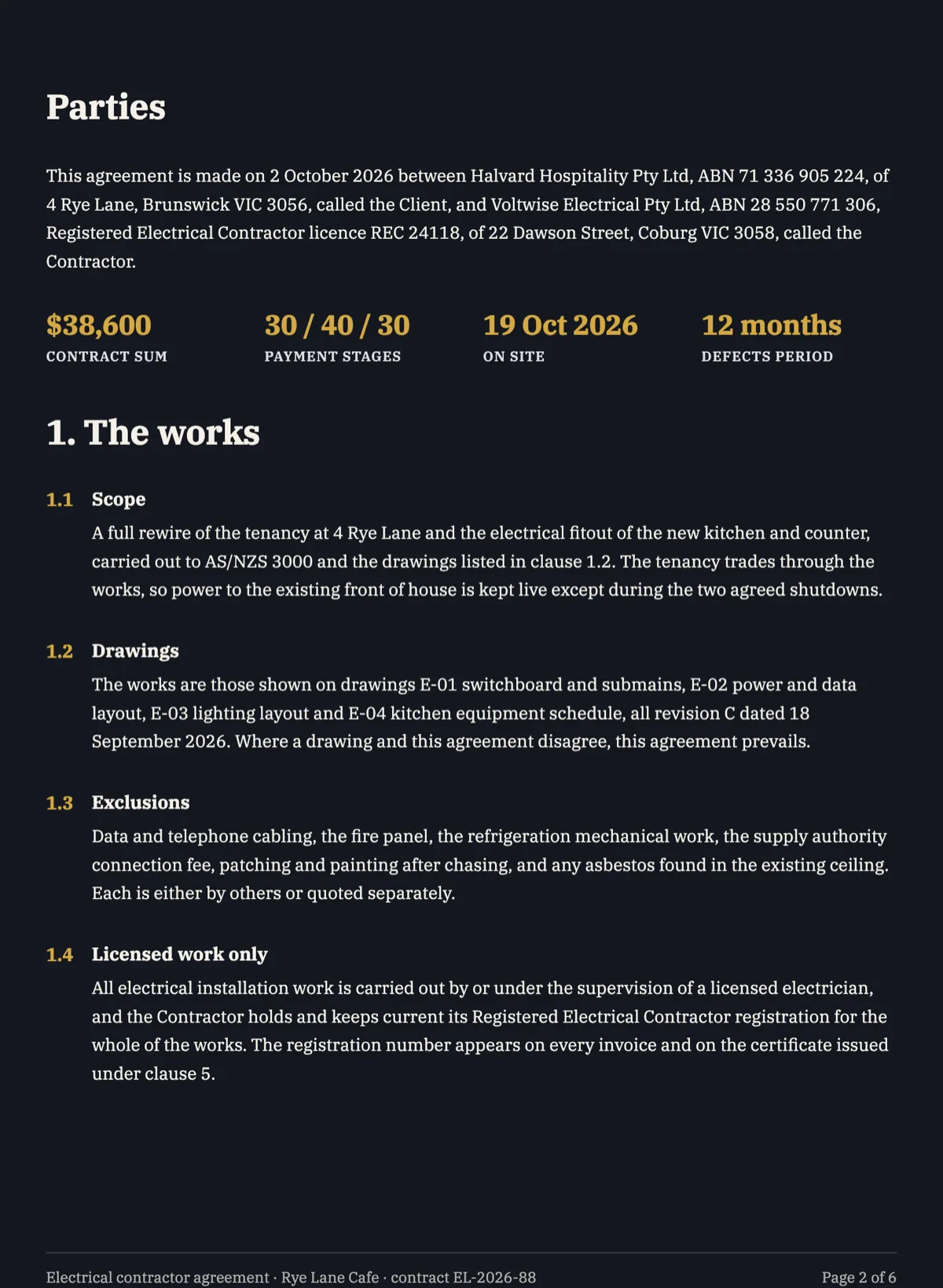 Electrical contractor agreement with a licence clause and staged paymentsElectrical work is the one trade where the paperwork at the end matters as much as the work, because without the certificate the installation is not signed off. This agreement ties the last payment stage to that certificate and sets the progress claim deadlines the payment legislation actually uses.
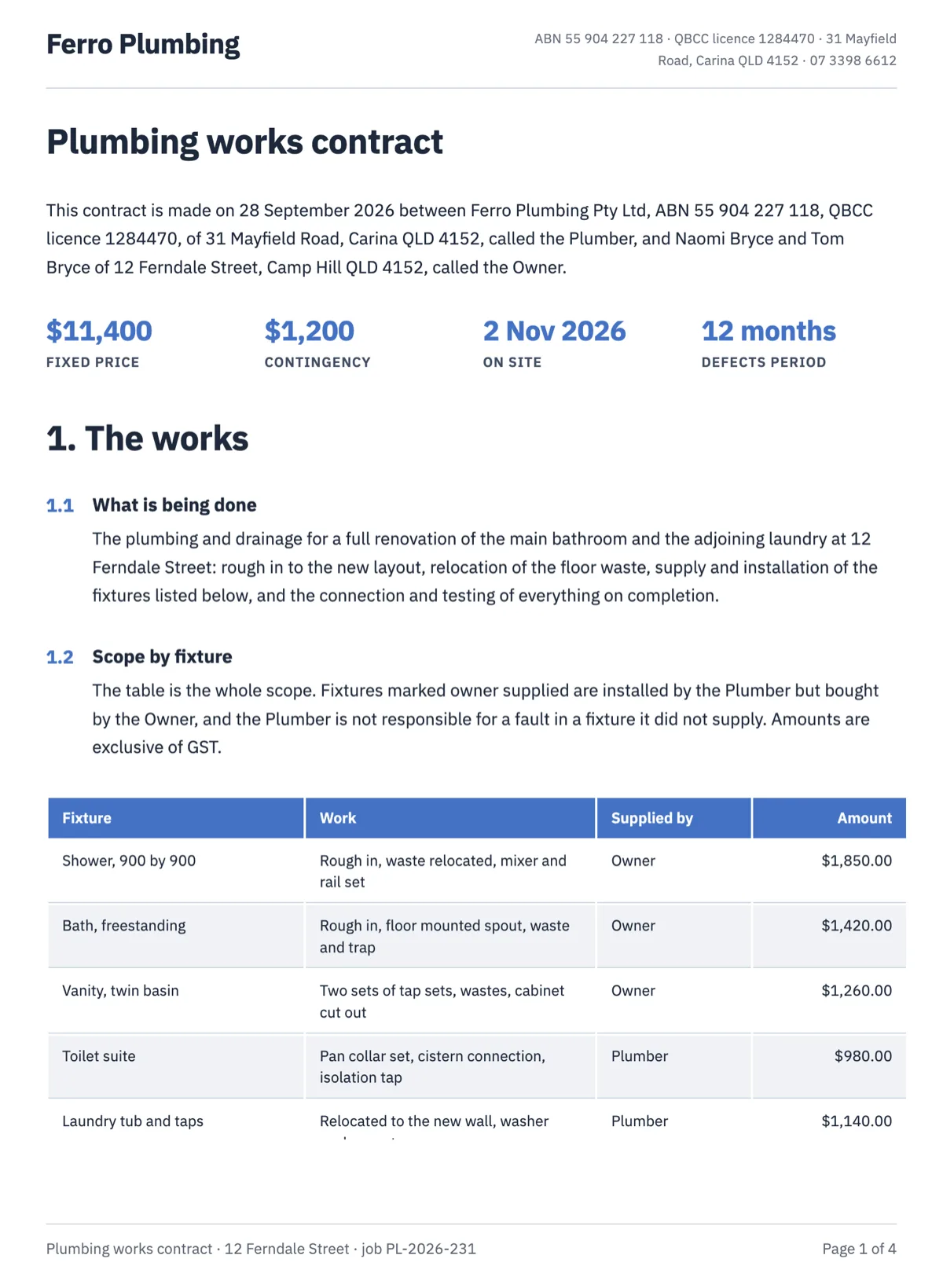 Plumbing works contract with a fixture scope table and a compliance certificateA bathroom job goes over budget in the hour the floor comes up and somebody finds old cast iron drainage. This contract prices every fixture separately, holds a named allowance for what nobody could see, and makes the final payment wait for the compliance certificate.
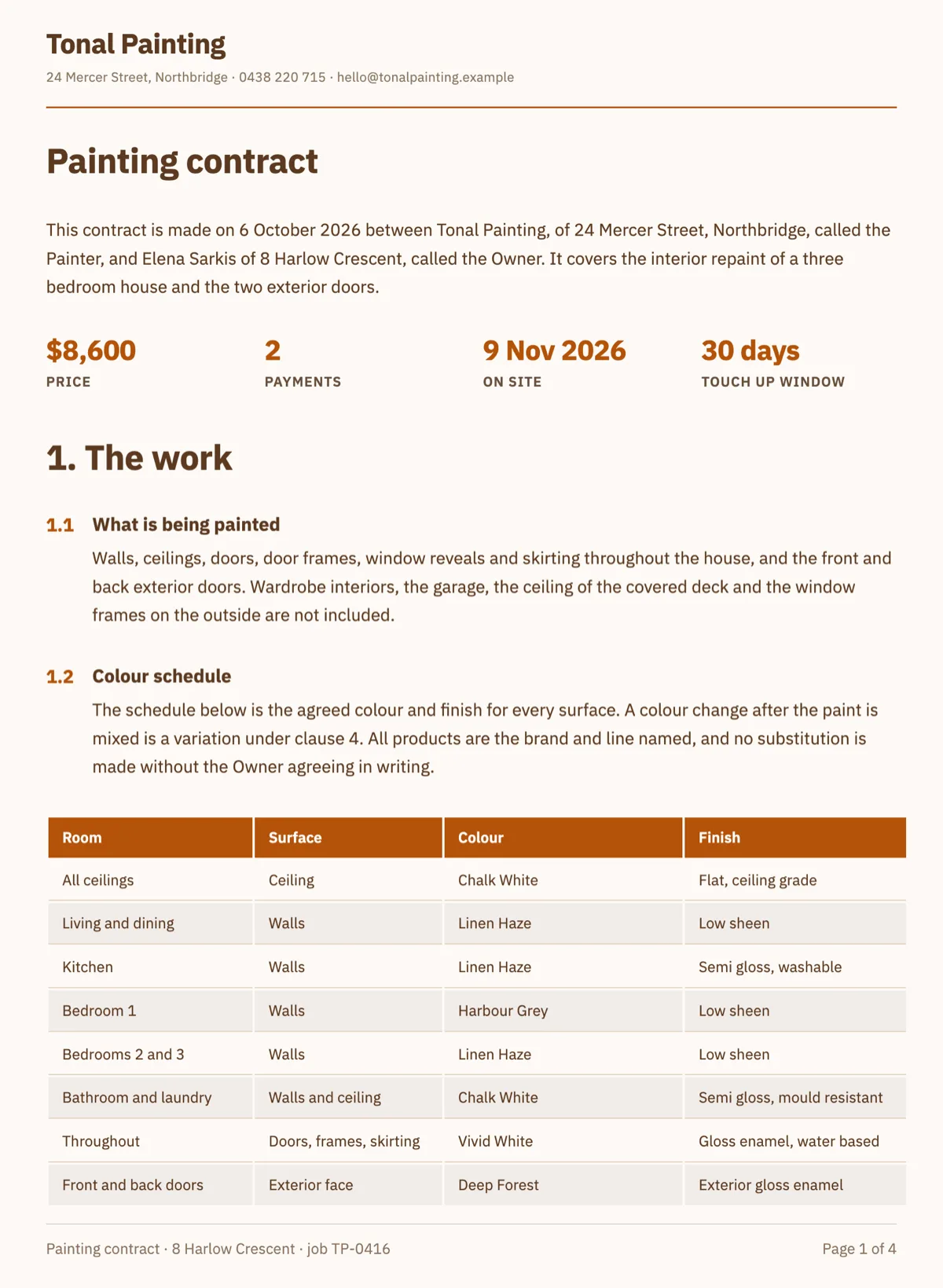 Painting contract template with a colour schedule and a coats standardMost painting disputes are really arguments about how many coats went on and what counts as preparation. This contract writes both down before the first drop sheet comes out, puts every room, colour and finish in a schedule, and leaves a touch up window open for 30 days after the furniture goes back.
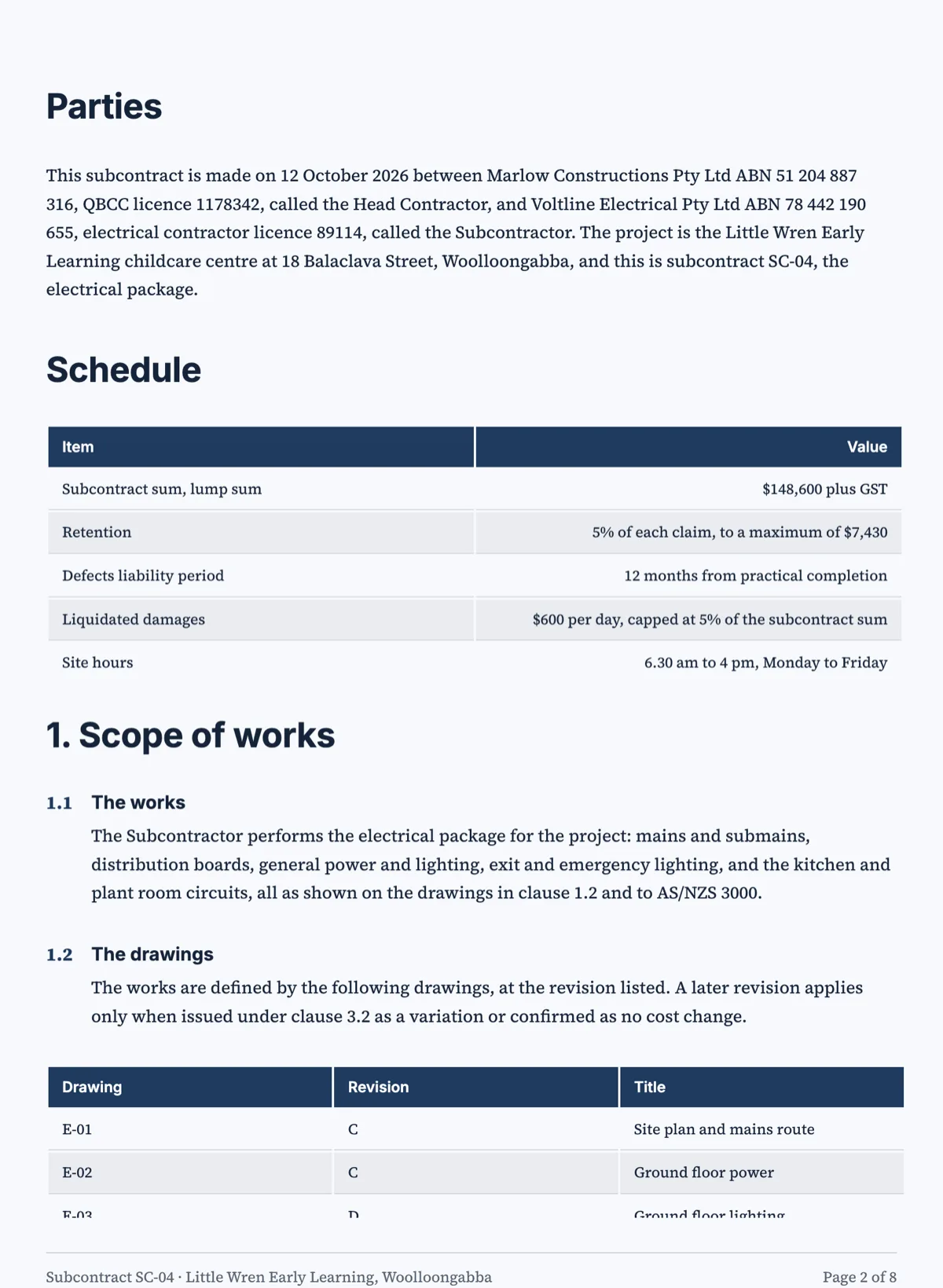 Subcontractor agreement template that flows the head contract downA subcontract exists to pass the head contract's obligations down one level and move the money back up on time. This one names the scope by drawing, sets the progress claim dates against the security of payment rules, holds retention and states the insurances, so the trade knows exactly when it is paid and for what.
Questions people ask
Does a construction variation have to be in writing?
Only if the contract or the law requires it, but most construction contracts do, and residential building laws in several states require written variations for domestic work. A contractor who proceeds on a verbal instruction can sometimes still recover payment, but the case becomes an argument about what was said, so a written direction or confirming email is the safer course.
How are variations priced in construction contracts?
The contract sets an order of methods. A common ladder is an agreed quote first, then the contract's schedule of rates, then reasonable rates, and finally cost plus a stated margin. The Australian Standard general conditions follow a similar sequence. Stating the margin percentage avoids the most frequent argument, which is what a reasonable rate includes.
Can a principal omit work and give it to another contractor?
Generally not without an express right. Courts have tended to read a power to omit work as a power to remove work the project no longer needs, rather than to reallocate it to a cheaper trade. Contracts that want the broader power need clear words, and contractors usually ask for payment of the lost margin if it is included.
Can a contractor refuse a variation?
Most construction contracts oblige the contractor to carry out directed variations within the general scope of the works. A contractor can usually refuse a change that falls outside that scope, needs a licence it does not hold, or would make the work unsafe or unlawful. Some clauses also let the contractor decline a variation above a stated value.
Do variations give the contractor more time?
Only if the contract provides a mechanism. Most do, either by treating a directed variation as a qualifying cause of delay for an extension of time or by requiring the time effect to be stated in the quote. Without that link, a contractor carrying out extra work may still be held to the original completion date.
Can variations be included in a progress claim?
Yes. Most contracts allow the value of directed variations to be claimed in the next progress claim once the work is done, and security of payment laws generally allow that value to be claimed too, although Victoria limits which variation amounts can go into a statutory claim. Disputed variations are usually claimed and then addressed in the payment schedule.
Put the clause in a finished document
The button opens the document generator with a starting description already filled in. Change it to match your own agreement before you run it.
Create a document with OneCraftRelated clauses
- Variation clause: the rule for changing the contract laterA variation clause sets how a contract can be changed after signing. Sample written variation wording, plus email and one sided price change variants.
- Change control clause: requesting, pricing and approving a scope changeA change control clause sets how scope changes on a services or software project are requested, priced and approved. Sample procedure, form fields and variants.
- Latent conditions clause: when the ground is not as expectedA latent conditions clause decides who pays when the site is not what anyone expected. Australian sample wording with notice, time and cost, and three variants.
- Security of payment clause: working with the state payment lawsA security of payment clause sets how a contract works with the state payment laws. NSW sample wording, Victorian and Queensland variants and a guide by state.
For everything the document generator can do, see the document maker.
Step by step in the builder: Create a document with AI, then Send a document for signature.
Written and checked by the OneCraft team. Last checked .