Contract clause
Latent conditions clause: when the ground is not as expected
A latent conditions clause deals with physical conditions on or under the site that differ from what a competent contractor could reasonably have expected when it priced the work, such as rock, contamination or old services. It sets the notice the contractor must give and whether extra time and cost are paid or the contractor carries the risk.
Nobody sees under the slab or behind the wall until the work starts, so this clause allocates the one risk neither party can fully price. Contractors who miss its notice deadline often lose a claim they would otherwise have won.
Nuwan Madhusanka · Co-founder
4 min read · Published
Sample clause
an earthworks and civil contract between Lilly Pilly Estates, a fictional land developer, and Wirra Civil, a fictional contractor, for a 40 lot residential subdivision near Toowoomba, Queensland
19. Latent Conditions 19.1 Latent Conditions means physical conditions on or near the Site, including subsurface rock, groundwater, contamination and buried services but excluding weather, that differ materially from those a competent contractor should reasonably have anticipated at the date of its tender, having regard to the Site Information and a reasonable inspection of the Site. 19.2 Wirra Civil must give written notice to the Superintendent within 5 Business Days of becoming aware of a Latent Condition and, where practicable, before the condition is disturbed. 19.3 The notice must describe the condition, how it differs from what was anticipated, and the additional work, time and cost Wirra Civil expects. 19.4 The Superintendent must, within 5 Business Days of the notice, direct how Wirra Civil is to deal with the condition. 19.5 The additional work is valued as a Variation, and Wirra Civil is entitled to an extension of time for resulting delay. 19.6 Wirra Civil is not entitled to any amount for costs incurred more than 5 Business Days before the notice was given.
Sample wording, not legal advice.
Variants
Owner bears the risk without a time bar
A principal that holds good geotechnical information and would rather pay for true conditions than a contingency in every tender.
The Principal bears the risk of all physical conditions on or under the Site that differ from those described in the Geotechnical Report. The Contractor must notify the Principal promptly after encountering such a condition, and the additional work it requires is valued as a Variation with an extension of time for any resulting delay. A late notice reduces the Contractor's entitlement only to the extent the Principal is prejudiced by the delay.
Contractor bears the risk
Design and construct or fixed price work where the contractor has had time to investigate the site and prices the risk itself.
The Contractor warrants that it has inspected the Site, carried out its own investigations and satisfied itself about all conditions on and under the Site. The Contractor is not entitled to any extension of time or additional payment arising from any physical condition of the Site, whether or not it could have been anticipated, and the Principal gives no warranty about the accuracy of any Site Information provided.
Shared risk with an allowance
Residential and small commercial jobs where a known unknown, such as rock or fill, can be allowed for up to a stated quantity.
The Contract Sum includes an allowance of 6 hours of rock breaking and 10 cubic metres of imported fill. Latent Conditions requiring work beyond that allowance are charged at the rates in Schedule 4, approved by the Owner in writing before the extra work proceeds. The Contractor must photograph each condition before it is disturbed and give the photographs to the Owner with the variation request.
What to negotiate
What site information can be relied on
Principals often provide geotechnical reports while stating they give no warranty about them. Contractors want to rely on the reports as the baseline for what was reasonably anticipated. The negotiation usually lands on reliance on the factual data, such as borehole logs, but not on the consultant's interpretation, with the contractor still expected to make a reasonable inspection.
Notice deadlines
Short notice periods protect the principal, who wants a chance to inspect and redesign before money is spent. Contractors accept notice but resist time bars that extinguish a claim entirely for a late notice. A common compromise limits recovery to costs incurred after notice, as in the sample, rather than losing the claim outright.
Contamination and asbestos
Contamination and hazardous materials carry cost, programme and regulatory consequences out of proportion to their volume. Contractors want them expressly treated as latent conditions whatever the site information said. Principals may accept that, but require the contractor to stop work, secure the area and follow the legal process for handling asbestos before claiming.
Weather and the definition
Most clauses exclude weather, since it is not a physical condition of the site. Contractors in wet regions sometimes seek to include groundwater brought up by rain events. The definition matters more than the remedy, because a narrow definition quietly moves most of the risk back to the contractor whatever the valuation clause says.
The risk of leaving it out
Without a latent conditions clause, a contractor on a lump sum generally carries the risk of unexpected ground or hidden conditions, because it promised to complete the work for the price. Principals pay for that too, through higher tenders carrying contingencies and through disputes arguing that the site information amounted to a warranty.
Three ways to allocate the risk
Owner bears means the contractor prices the expected conditions and is paid for the difference, which suits projects with good investigations and lowers tender prices. Contractor bears means the contractor prices a contingency and absorbs the difference, which suits design and construct work where it controls the investigation. Shared risk sets an allowance or a cap beyond which the owner pays, which suits residential and small commercial jobs where rock, fill or old services are likely but their extent is not. The Australian Standard general conditions have generally taken the first approach, subject to notice.
Victorian payment claims and hazardous materials
Latent conditions interact with other laws. In Victoria, the security of payment legislation keeps certain amounts, including claims arising from latent conditions, out of a statutory payment claim, so they have to be pursued under the contract. Where the condition is asbestos or another hazardous material, the work health and safety laws decide how it is handled and by whom, and the contract clause decides only who pays and how much time is allowed.
Where it sits in a generated document
A generated civil or building contract numbers the latent conditions clause next to the variations and extension of time clauses, so its valuation can simply point to them. The notice period and any allowance quantities are written in as content. The document does not cite security of payment or safety legislation, so any statement in a draft about how a latent condition claim is paid in a particular state should be checked.
Documents that carry this clause
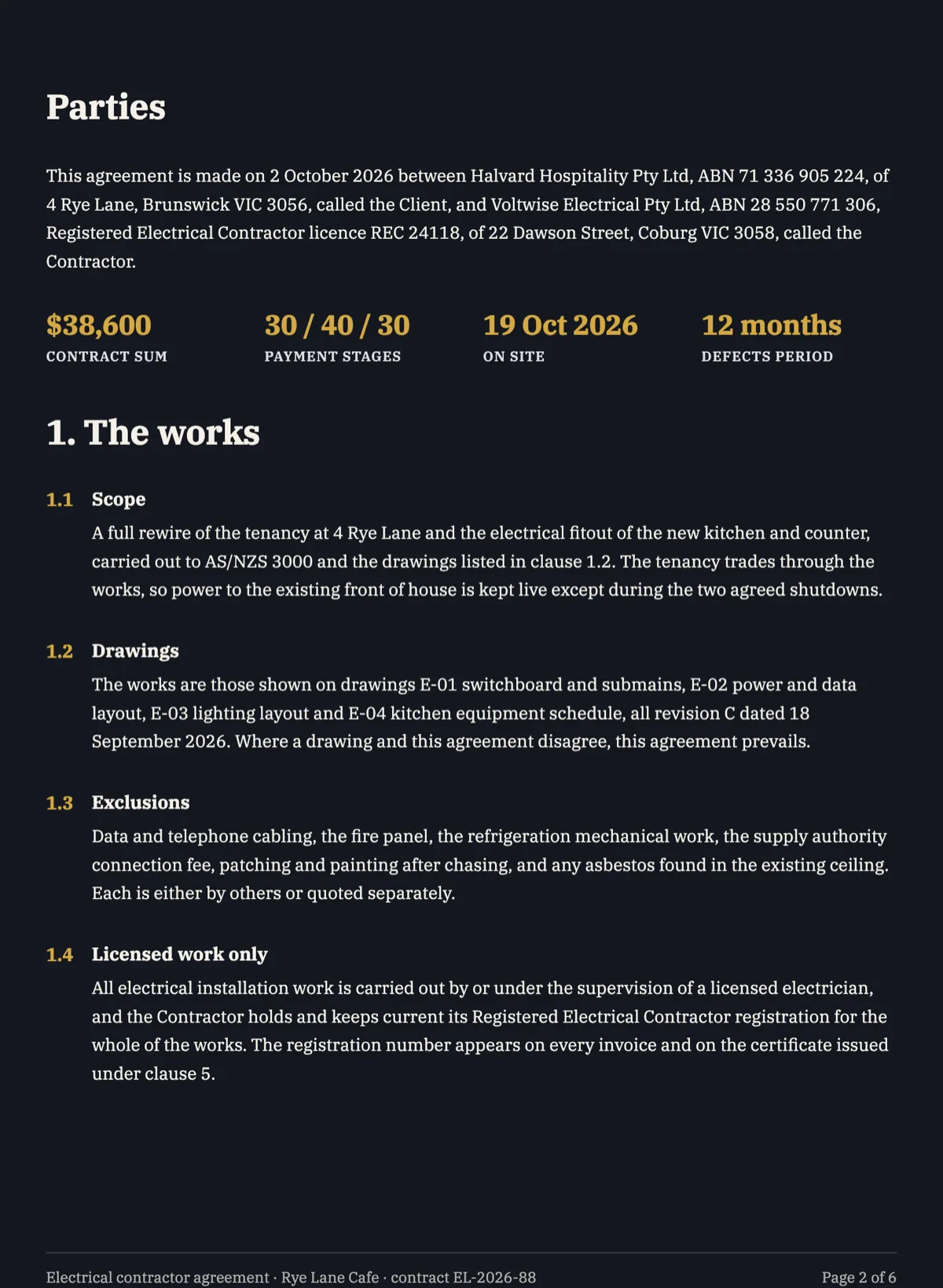 Electrical contractor agreement with a licence clause and staged paymentsElectrical work is the one trade where the paperwork at the end matters as much as the work, because without the certificate the installation is not signed off. This agreement ties the last payment stage to that certificate and sets the progress claim deadlines the payment legislation actually uses.
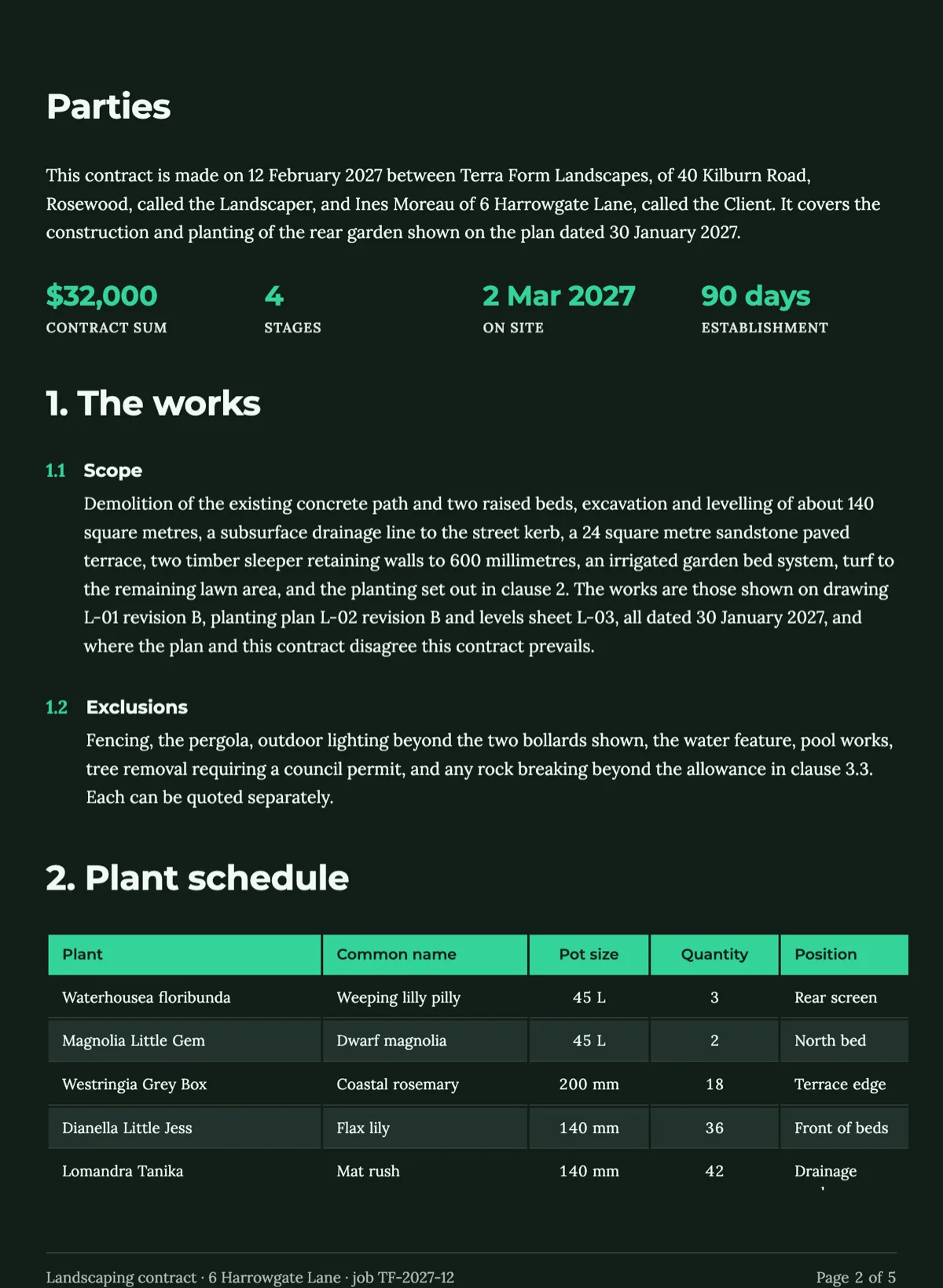 Landscaping contract template with a plant schedule and an establishment periodA garden build is two jobs in one: construction that is finished when it is finished, and planting that is only finished three months later. This contract prices the construction in four stages, lists every plant with its pot size and quantity, and holds the landscaper to a 90 day establishment period for anything that dies.
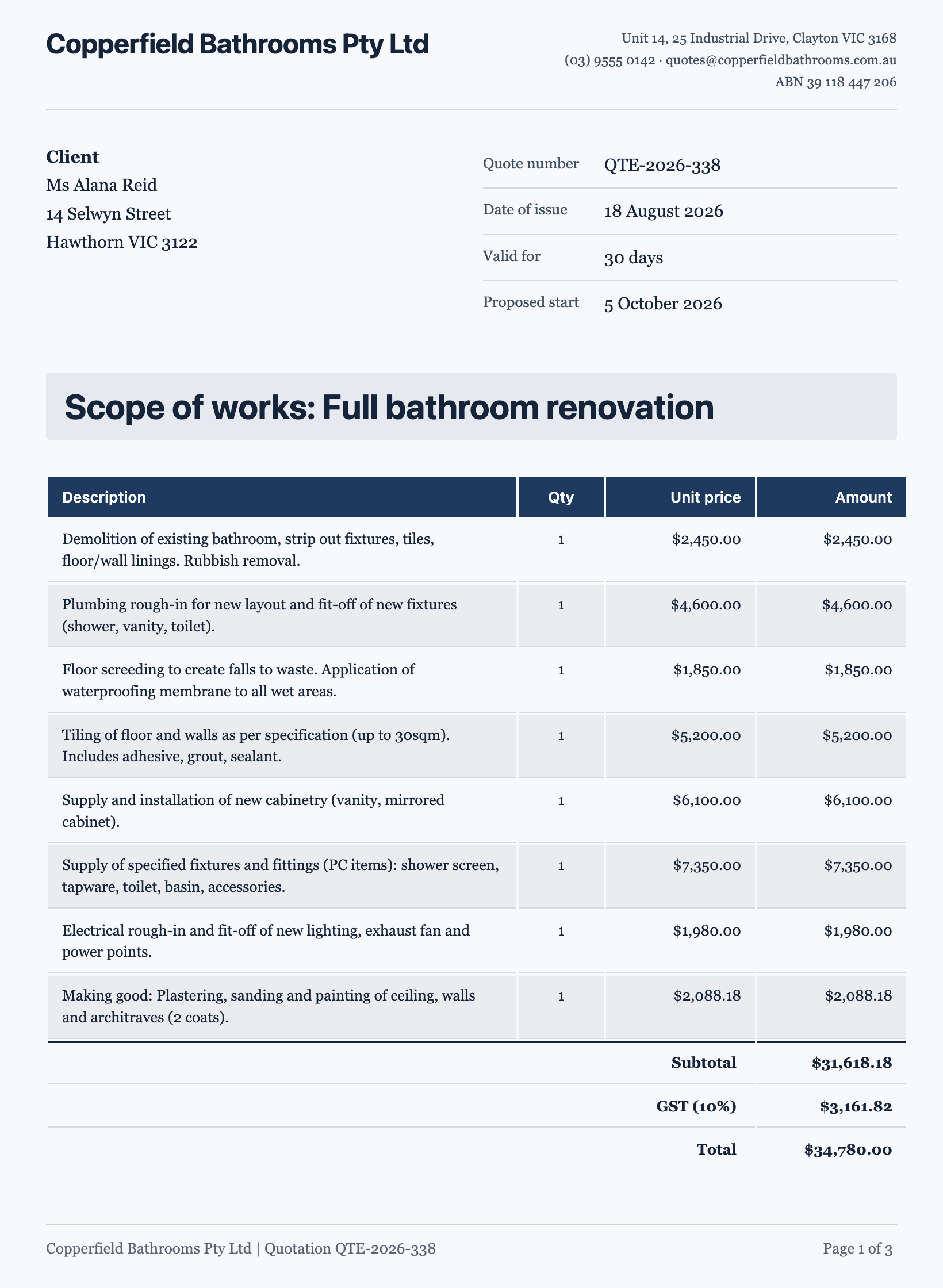 Quotation template priced trade by tradeCopperfield Bathrooms quotes Alana Reid $34,780 including GST for a full bathroom renovation at 14 Selwyn Street, Hawthorn. Eight trades are priced as separate lines, the tiles are a provisional sum, the job runs four weeks from 5 October, and the payment schedule takes 10 per cent on acceptance, 50 per cent when tiling is done and 40 per cent at practical completion.
Questions people ask
What counts as a latent condition?
A physical condition on or under the site that differs materially from what a competent contractor could reasonably have anticipated when it priced the work, judged against the site information and a reasonable inspection. Typical examples are unexpected rock, contamination, groundwater, old footings and unmapped services. Weather is usually excluded, and conditions visible on inspection are not latent.
Who pays for latent conditions in Australia?
Whoever the contract says. The Australian Standard general conditions have generally let the contractor claim time and cost for conditions it could not reasonably have anticipated, provided it gives notice. Many amended and design and construct contracts shift the risk to the contractor. With no clause at all, a lump sum contractor generally carries the risk itself.
How quickly must a latent condition be notified?
As quickly as the contract requires, which is often a few business days after discovery and, where practicable, before the condition is disturbed. The purpose is to let the principal inspect and redesign before costs build up. A late notice may reduce or defeat the claim depending on the wording, so site teams should know the period.
Does a geotechnical report create a warranty about site conditions?
Not usually, if the contract says the information is provided without warranty and the contractor must rely on its own investigations. Courts read those clauses together with any reliance the contract does allow. Contractors should check whether the factual data can be relied on and whether any claim for misleading conduct is excluded or preserved.
Is asbestos a latent condition?
It can be, if it was not reasonably discoverable and the contract's definition covers hazardous materials. Many contracts deal with asbestos expressly because of the safety rules for removal. Whatever the cost position, work must stop, the area must be made safe, and removal must be carried out as the work health and safety laws require.
Can latent condition costs be claimed under security of payment laws?
It depends on the state. In most states the value of a directed variation for a latent condition can form part of a payment claim. Victoria is different, because its legislation excludes certain amounts, including claims arising from latent conditions, from statutory payment claims, leaving them to the contract's own claims and dispute process.
Put the clause in a finished document
The button opens the document generator with a starting description already filled in. Change it to match your own agreement before you run it.
Create a document with OneCraftRelated clauses
- Construction variations clause: directing and pricing changed workA construction variations clause sets how changes to building work are directed and priced. Australian sample wording with schedule rates, cost plus and quotes.
- Site access clause: possession, hours and conditions of entryA site access clause sets when a contractor may enter the site and what the owner must provide. Australian sample for occupied sites, hours and induction.
- Scope of work clause: what the price includes and excludesA scope of work clause sets what is and is not included in the contract price. Sample bathroom renovation wording, inclusions and exclusions, and variants.
- Extension of time clause: moving the completion date fairlyAn extension of time clause gives a contractor more time for delay it did not cause. Australian shop fit out sample, qualifying delay events and notice rules.
For everything the document generator can do, see the document maker.
Step by step in the builder: Create a document with AI, then Document builder components.
Written and checked by the OneCraft team. Last checked .