Contract clause
Scope of work clause: what the price includes and excludes
A scope of work clause describes the work the contractor must carry out for the contract price and, just as importantly, what is excluded. It points to the drawings, specifications or schedules that define the work, lists inclusions and exclusions, names allowances for items not yet chosen, and sets which document wins if they conflict.
Most arguments about extras are really arguments about scope, because a price only means something once everyone agrees what it buys. Writing the exclusions down is what stops a homeowner assuming the tiles were included and a contractor assuming they were not.
Indunil Asanka · Co-founder
4 min read · Published
Sample clause
a renovation contract between Tuart Renovations, a fictional builder in Perth, and a homeowner renovating the main bathroom and ensuite of a 1970s house in Applecross, Western Australia
2. Scope of Work 2.1 Tuart Renovations must carry out the Works described in the Scope Schedule, the drawings listed in Item 4 and the Fixtures Schedule, for the Contract Price. 2.2 The Works include everything listed as included in the Scope Schedule and any minor work plainly necessary to complete the included work to the standard this contract requires. 2.3 The Works exclude everything listed as excluded in the Scope Schedule, including upgrades to the switchboard, removal of asbestos containing material, and rectification of concealed structural defects. 2.4 Items marked PC in the Fixtures Schedule are prime cost items with the allowance stated, and the difference between the allowance and the actual cost is added to or deducted from the Contract Price, with a margin of 10 per cent on any excess. 2.5 If the documents are inconsistent, they apply in this order: this contract, the Scope Schedule, the Fixtures Schedule, then the drawings.
Sample wording, not legal advice.
Variants
Scope by drawings and specification
Commercial work designed by consultants, where the documents already describe the work in detail.
The Contractor must carry out the Works shown in and reasonably inferable from the Drawings and Specification listed in Schedule 1, including any work not expressly shown that is necessary for the Works to be complete and fit for their stated purpose. The Contractor warrants that it has reviewed the Drawings and Specification before signing and must notify the Principal of any discrepancy it finds before carrying out the affected work.
Narrative scope for a small job
Small jobs without drawings, where a clear description and a short list of exclusions do the work.
The Works are the replacement of the existing timber deck at the rear of the house with a new treated pine deck of the same size and height, including new bearers, joists, decking boards, two steps and a handrail, finished with one coat of decking oil. The Works do not include any work to the wall of the house, the stormwater system, the lighting, or the pergola above the deck.
Schedule of rates for measured work
Maintenance or civil work where quantities are uncertain and the contractor is paid for what is actually done.
The Contractor must carry out the work described in each Work Order the Principal issues during the Term. Each item of work is paid at the rate stated in the Schedule of Rates multiplied by the quantity actually carried out, measured jointly when the Work Order is complete. The quantities in the Schedule of Rates are estimates only, and the Principal does not guarantee any minimum quantity of work.
What to negotiate
The catch all words
Principals like wording that includes all work necessary to complete the project, because it closes gaps in the documents. Contractors resist it, since it turns every design omission into free work. The usual compromise limits the catch all to minor work that is plainly necessary and reasonably inferable from the documents, and excludes anything that needs a design decision.
Allowances and prime cost items
Allowances let a job be priced before fixtures are chosen, but a low allowance makes a tender look cheaper than it really is. Owners ask for realistic allowances and a cap on the margin charged on any excess. Contractors want the right to charge that margin and to be paid for extra labour a more expensive selection causes.
Order of precedence
When the drawings show one thing and the specification another, the precedence clause decides which the price covers. Contractors prefer the more specific document to win, while principals sometimes want the more onerous requirement to win. Whichever is chosen, the contractor should have to flag discrepancies it notices rather than rely on them later.
Exclusions that shift risk
Long exclusion lists can move real risk to the owner, such as asbestos, concealed defects and authority fees. Owners should read them as carefully as the inclusions and ask for provisional sums against the likeliest items. Contractors benefit too, because an exclusion explained before signing is far easier to rely on than one buried in fine print.
The risk of leaving it out
Without a defined scope the price covers whatever a court later decides the parties must have intended, which usually means an expensive argument about industry practice and implied work. Owners lose the ability to hold the contractor to a complete job, and contractors lose the ability to charge for work they never priced.
Inclusions and exclusions for the sample bathroom
Included: demolition and removal of existing fixtures, tiles and linings; waterproofing of the wet areas with a certificate; floor tiling and wall tiling to 2.1 metres; supply and installation of the vanity, toilet and shower screen from the Fixtures Schedule; plumbing rough in and fit off to the existing locations; lighting and exhaust fans on existing circuits; painting of ceilings, walls and doors; and a final clean with waste removal. Excluded: switchboard upgrades; relocating plumbing more than 1 metre; asbestos removal; repairs to concealed structural framing; council fees; window replacement; and moving furniture.
Scope in construction and in services contracts
In construction, scope is anchored in drawings, specifications and site conditions, and changes run through a variations clause with its own pricing rules. In a services or software engagement the scope usually sits in a statement of work under a master agreement, and change runs through a change control procedure. The drafting principles are the same, describe the outcome and the deliverables, list what is not included, and say which document prevails, but the evidence of what was agreed looks different.
Where it sits in a generated document
A generated contract carries the scope as an early numbered clause that points to a scope schedule, and the inclusions and exclusions can be written out as content within that schedule. Allowances and the order of precedence are stated in words. The document does not cite residential building legislation, so any rules about how prime cost items must be described in a particular state should be checked before signing.
Documents that carry this clause
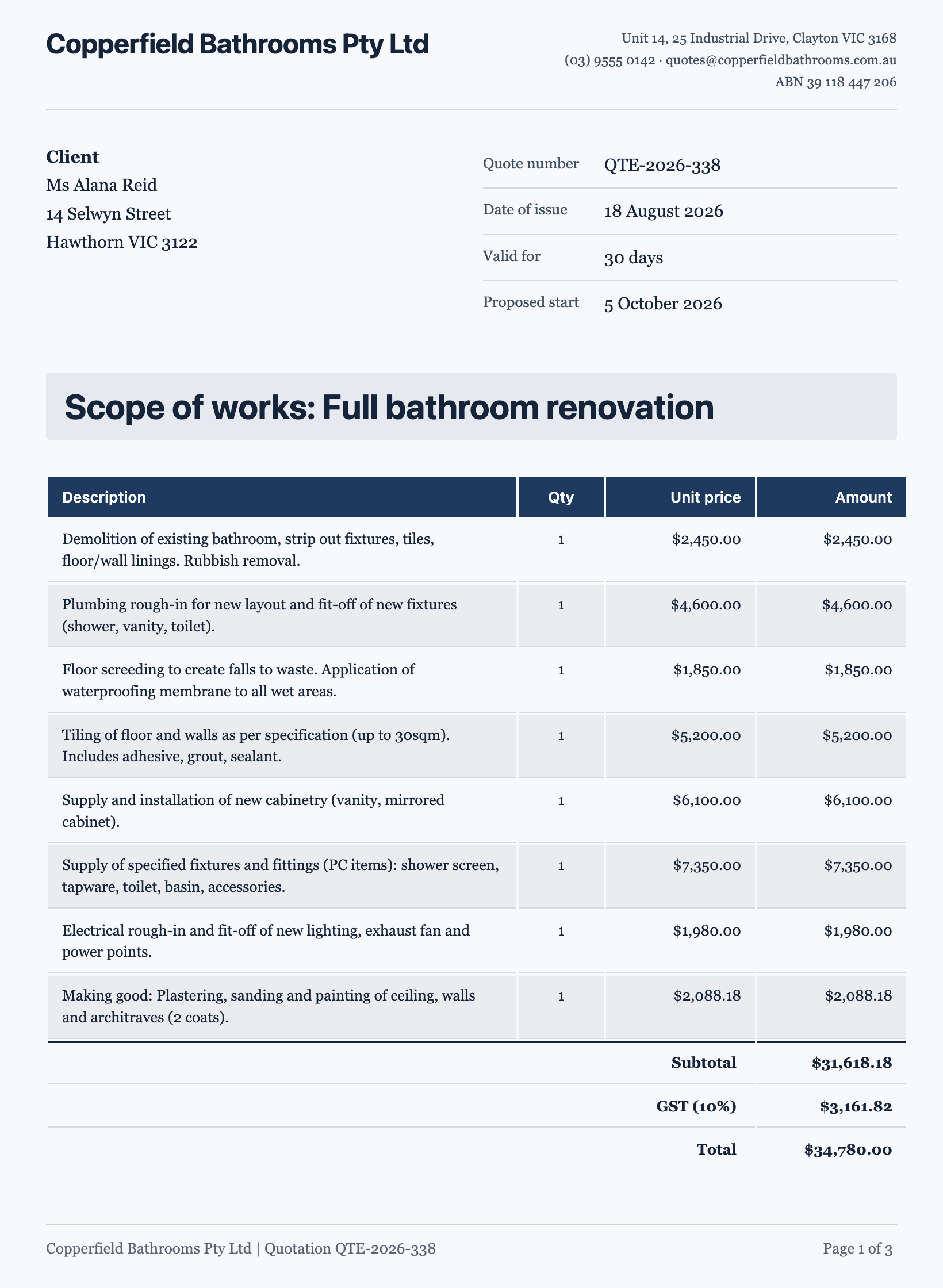 Quotation template priced trade by tradeCopperfield Bathrooms quotes Alana Reid $34,780 including GST for a full bathroom renovation at 14 Selwyn Street, Hawthorn. Eight trades are priced as separate lines, the tiles are a provisional sum, the job runs four weeks from 5 October, and the payment schedule takes 10 per cent on acceptance, 50 per cent when tiling is done and 40 per cent at practical completion.
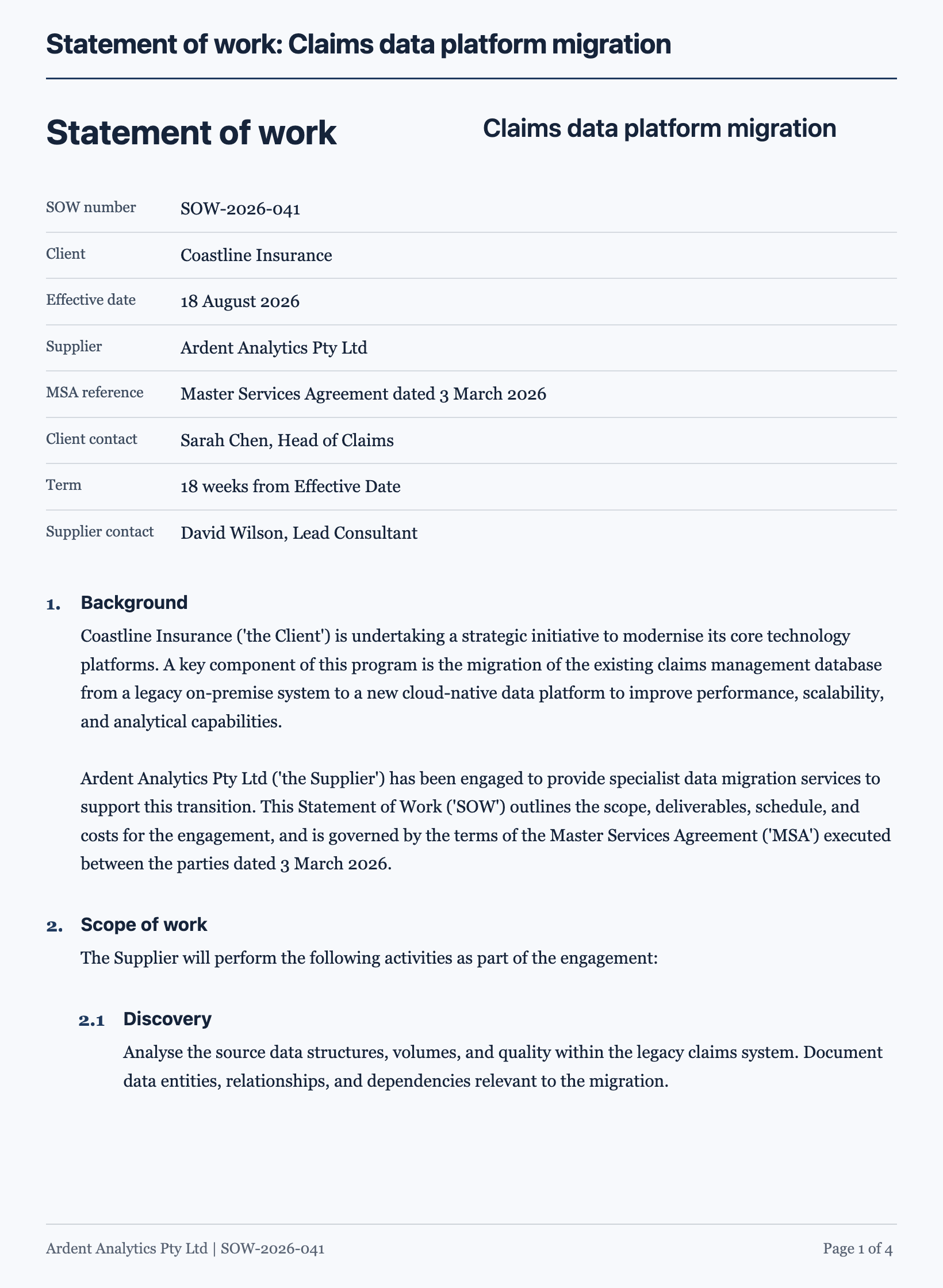 Statement of work template under a master agreementArdent Analytics migrates Coastline Insurance’s claims database to a cloud platform over 18 weeks under SOW-2026-041, governed by a master services agreement dated 3 March 2026. The work is time and materials with four roles priced by the day and a $412,000 estimate before GST, five dated deliverables, ten business days to accept each one, and five assumptions written down before anyone starts.
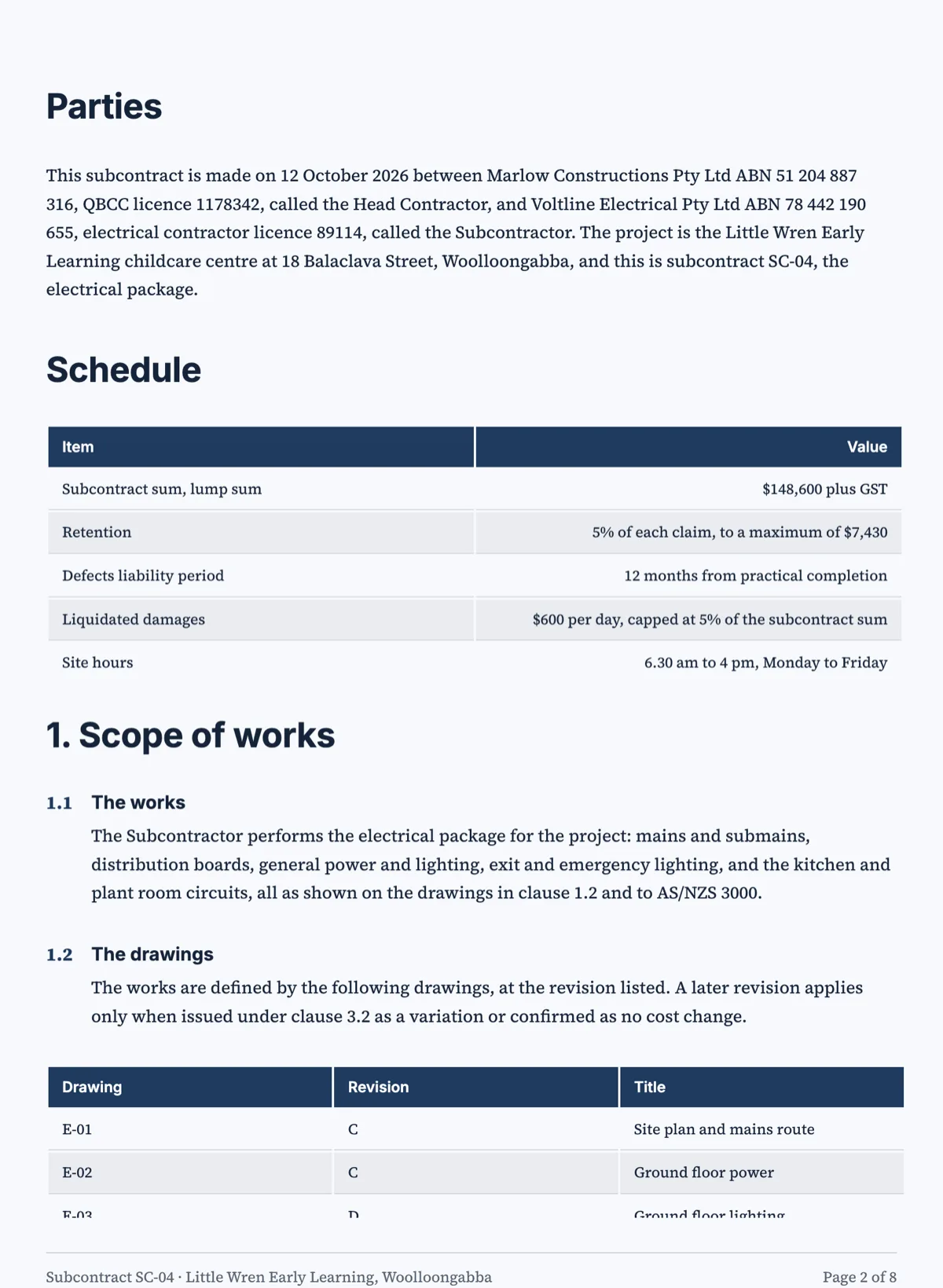 Subcontractor agreement template that flows the head contract downA subcontract exists to pass the head contract's obligations down one level and move the money back up on time. This one names the scope by drawing, sets the progress claim dates against the security of payment rules, holds retention and states the insurances, so the trade knows exactly when it is paid and for what.
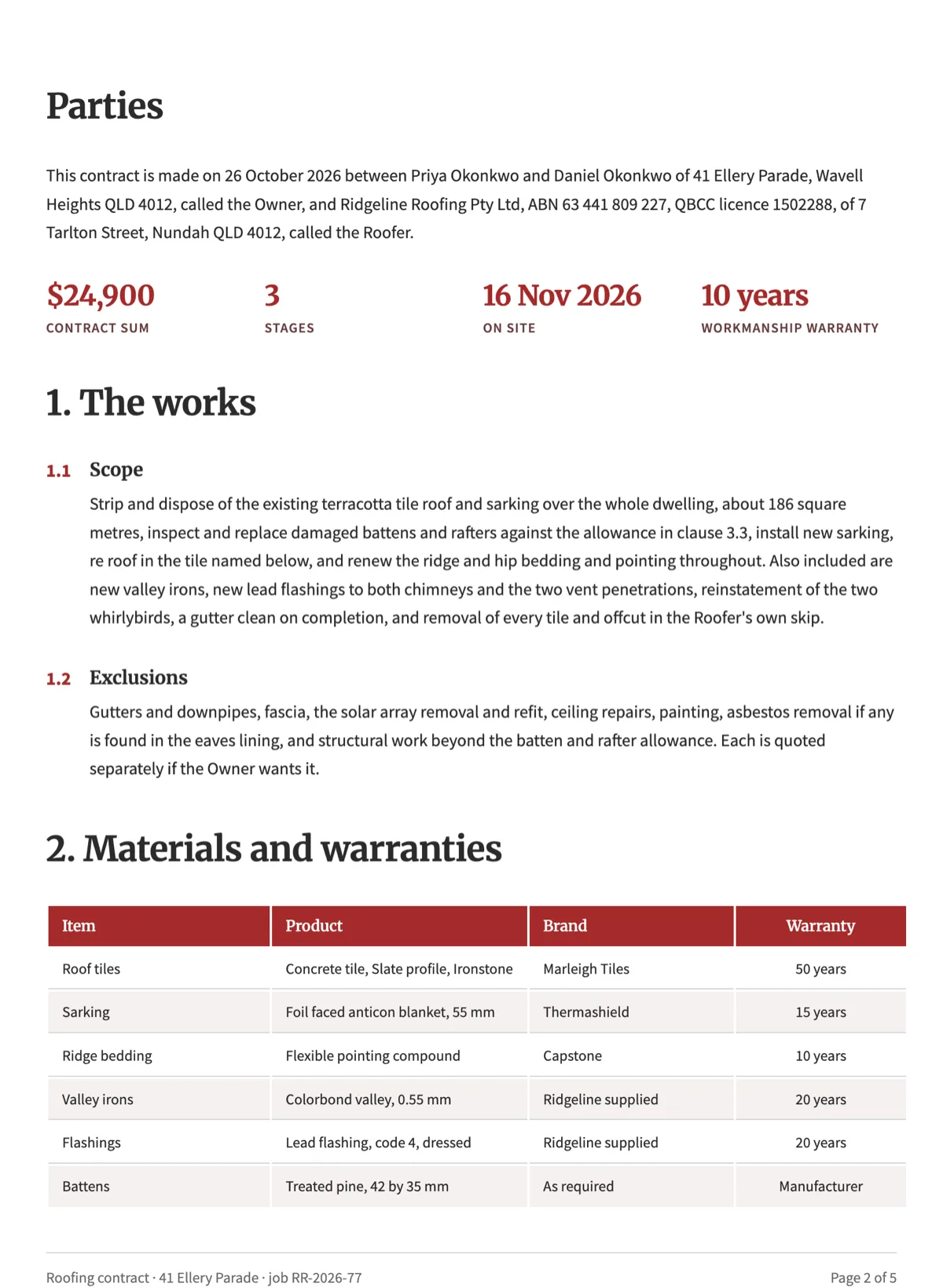 Roofing contract template with a materials table and a weather ruleA roof replacement is the one job where the house is open to the sky at the end of the day, so the clause that matters most is the one about closing it. This contract limits how much roof can be stripped at once, names every product with its warranty years, and says who pays when water gets in.
Questions people ask
What should a scope of work clause include?
It should identify the documents that describe the work, state what is included and excluded, list allowances or prime cost items for things not yet selected, set an order of precedence between documents, and say how minor necessary work is treated. A clear exclusions list is often the most valuable part, because it answers the questions owners ask later.
What is the difference between a prime cost item and a provisional sum?
A prime cost item is an allowance for supplying a fixture or material that has not yet been chosen, such as a vanity or tapware, with installation usually priced in the contract. A provisional sum is an allowance for work whose extent is uncertain, such as rock excavation, covering both labour and materials. Both are adjusted to actual cost.
Is work not mentioned in the scope included in the price?
Only if the contract says so. Many contracts include minor work plainly necessary to complete the described work, and some include everything reasonably inferable from the documents. Anything beyond that is generally a variation. The narrower the catch all wording, the more important it is that the documents are complete before the contract is signed.
How detailed should exclusions be?
Detailed enough that a reasonable owner reading the contract would understand what is not being done. Vague exclusions such as unforeseen works are hard to rely on. Naming the item, such as switchboard upgrades or asbestos removal, and saying whether a provisional sum applies to it, gives the exclusion real effect when the question comes up on site.
What happens when the drawings and the specification conflict?
The order of precedence clause decides. Without one, courts try to read the documents together and may favour the more specific provision, which produces uncertain results. Contractors are usually required to notify discrepancies they discover before carrying out the affected work, so the principal can decide which requirement applies before money is spent.
Is a scope of work the same as a statement of work?
They overlap. A scope of work clause describes the work inside a single contract, usually for construction or trade services. A statement of work is a separate document, common in professional services and technology, that sets scope, deliverables, timing and price for one engagement under a master agreement. Both need clear exclusions to do their job.
Put the clause in a finished document
The button opens the document generator with a starting description already filled in. Change it to match your own agreement before you run it.
Create a document with OneCraftRelated clauses
- Construction variations clause: directing and pricing changed workA construction variations clause sets how changes to building work are directed and priced. Australian sample wording with schedule rates, cost plus and quotes.
- Materials and workmanship clause: the quality standard for the buildA materials and workmanship clause sets the quality standard for what is installed and how. Australian sample wording naming the NCC and Australian Standards.
- Milestone payment clause: paying by stageA milestone payment clause splits the price into stages released on acceptance. Sample wording for a four stage software build, variants and what to negotiate.
For everything the document generator can do, see the document maker.
Step by step in the builder: Create a document with AI, then Document builder components.
Written and checked by the OneCraft team. Last checked .