Contract clause
Materials and workmanship clause: the quality standard for the build
A materials and workmanship clause sets the quality standard for the materials a contractor supplies and the way it carries out the work. It usually requires new materials suited to their purpose, work done in a proper and workmanlike manner, compliance with the building code and named standards, and a process for approving substitutes and rejecting defective work.
Drawings say what to build, but this clause says how well, and it is the benchmark every defect claim is measured against. Naming the code, the standards and the manufacturer's instructions turns a vague promise of quality into something both sides can check.
Indunil Asanka · Co-founder
4 min read · Published
Sample clause
a residential building contract between Wattleseed Homes, a fictional builder, and the owners of a new single storey house in Wagga Wagga, New South Wales
13. Materials and Workmanship 13.1 Wattleseed Homes must supply materials that are new, of the quality described in the Specification, and suitable for the purpose for which they are used. 13.2 Wattleseed Homes must carry out the Works in a proper and workmanlike manner, using tradespeople who hold any licence the law requires for their work. 13.3 The Works must comply with the National Construction Code, the Australian Standards referred to in it, including AS 3740 for waterproofing of domestic wet areas, and the manufacturer's installation instructions for each product. 13.4 A material or product named in the Specification may be replaced only with the Owners' written approval of a substitute of equal or better quality and performance. 13.5 The Owners may, by written notice, reject any material or work that does not comply with this clause, and Wattleseed Homes must remove and replace it at its own cost. 13.6 Wattleseed Homes must hand the Owners the manufacturer's warranties for installed products at Practical Completion.
Sample wording, not legal advice.
Variants
Standards listed by trade
Commercial specifications where each trade package names its own governing standards.
The Subcontractor must carry out the electrical works in accordance with AS/NZS 3000 Wiring Rules, the plumbing works in accordance with AS/NZS 3500, and all other works in accordance with the National Construction Code and the Specification. Where the Specification and a referenced standard differ, the more stringent requirement applies. The edition of each standard is the edition current at the date of this Subcontract, unless a later edition is required by law.
Short form for small jobs
Small repair or maintenance jobs where a full specification would cost more than the work itself.
The Contractor must carry out the work with due care and skill, in a good and workmanlike manner, using materials that are new unless otherwise agreed and suitable for their purpose. The work must comply with all applicable laws and building standards. The Contractor must fix, at its own cost, any part of the work that does not meet this standard and is notified within 6 months after completion.
Brand specified or approved equivalent
Owners and designers who have chosen particular products but accept that supply can change during a job.
Where the Specification names a brand or product, the Contractor must supply that product or an equivalent product approved in writing by the Architect. A request for approval must include the product data sheet, the warranty terms and any difference in price or lead time. Approval must not be unreasonably withheld where the proposed product meets the same standards and performance, and any saving from an approved substitute is passed on to the Principal.
What to negotiate
Fitness for purpose
Owners want materials and work that are fit for the purpose the owner made known. Contractors accept that for materials and workmanship but resist warranting the design itself, especially where an architect or engineer chose the system. The line is usually drawn so the contractor answers for building the design properly, and the designer answers for whether the design works.
Substitutions
Supply problems make substitutions routine, and contractors want the power to substitute equivalent products without delay. Owners want approval rights, because equivalent is often in the eye of whoever saves money. A short approval period, deemed approval if the owner does not respond in time, and savings passed on keep both concerns in balance.
Which edition of a standard
Standards and the building code are revised over time, and a long project can straddle an update. Contractors want the edition current at signing, with later mandatory changes treated as a variation. Owners sometimes want the edition current when the work is done. In practice the building approval for the project usually settles which code edition applies.
Inspections and hold points
Owners and certifiers want to inspect key stages, such as waterproofing before tiling or reinforcement before a pour, because defects there are expensive to find later. Contractors accept hold points but want notice periods short enough not to stall the programme, and the right to proceed if an inspection is not carried out in time.
The risk of leaving it out
Without an express standard, the contract relies on implied terms and, for homes, statutory warranties, which require proper work and suitable materials but say nothing about the specific standard, the product or the approval of substitutes. Disputes then turn on expert opinion about what a reasonable builder would have done instead of a document both sides signed.
The statutory warranties behind the clause
For residential building work, state home building laws imply warranties that a contract cannot remove. In New South Wales they include that work will be done with due care and skill, that materials will be good and suitable and new unless otherwise stated, and that the work will comply with the law, and the owner has 6 years to act on major defects and 2 years on others. A materials and workmanship clause should restate or build on those warranties and never try to narrow them.
The code and the standards
The National Construction Code sets the minimum performance requirements for building work across Australia and calls up many Australian Standards, such as AS 3740 for waterproofing domestic wet areas, while the wiring and plumbing standards apply to services through state laws. Naming the code and the key standards in the clause gives both parties a written benchmark, but it does not replace the specification, which should still describe the finishes and products the owner is paying for.
Where it sits in a generated document
A generated building contract carries materials and workmanship as a numbered clause close to the defects liability clause, so a defect notice can cite the requirement breached. Product names and the standards referred to are written in as content. The document does not cite or check the National Construction Code or any standard, so the editions and references in a draft should be confirmed.
Documents that carry this clause
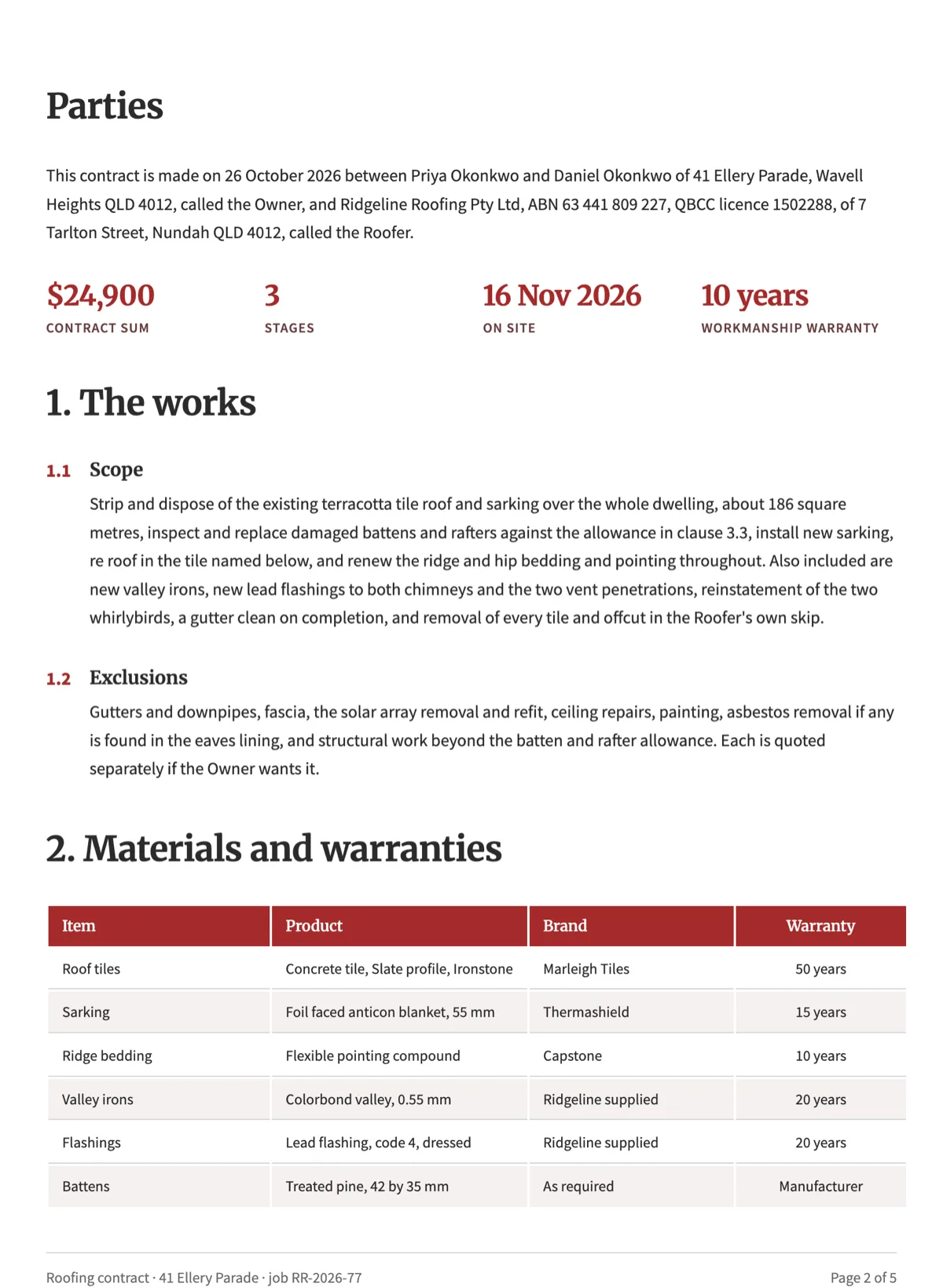 Roofing contract template with a materials table and a weather ruleA roof replacement is the one job where the house is open to the sky at the end of the day, so the clause that matters most is the one about closing it. This contract limits how much roof can be stripped at once, names every product with its warranty years, and says who pays when water gets in.
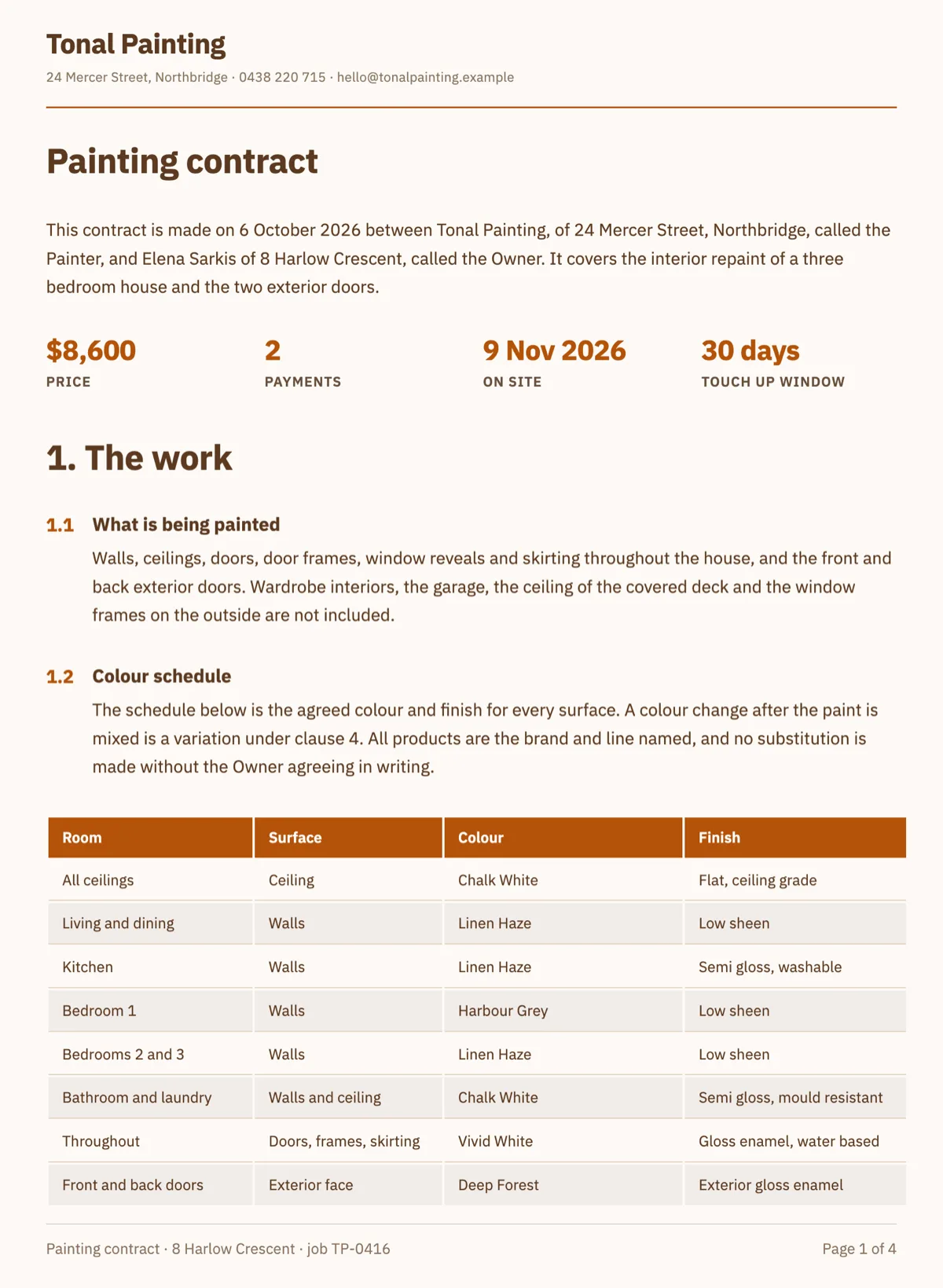 Painting contract template with a colour schedule and a coats standardMost painting disputes are really arguments about how many coats went on and what counts as preparation. This contract writes both down before the first drop sheet comes out, puts every room, colour and finish in a schedule, and leaves a touch up window open for 30 days after the furniture goes back.
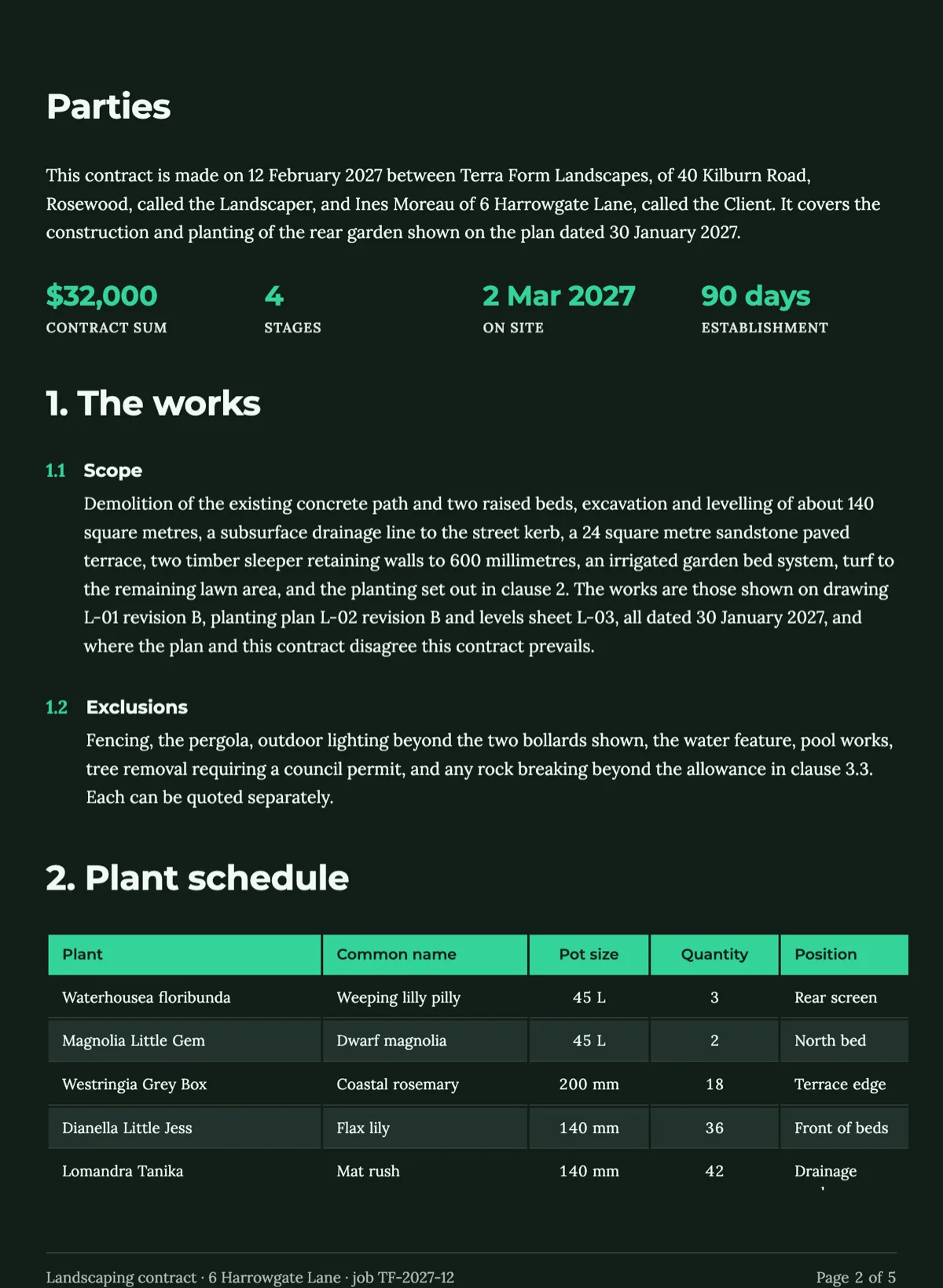 Landscaping contract template with a plant schedule and an establishment periodA garden build is two jobs in one: construction that is finished when it is finished, and planting that is only finished three months later. This contract prices the construction in four stages, lists every plant with its pot size and quantity, and holds the landscaper to a 90 day establishment period for anything that dies.
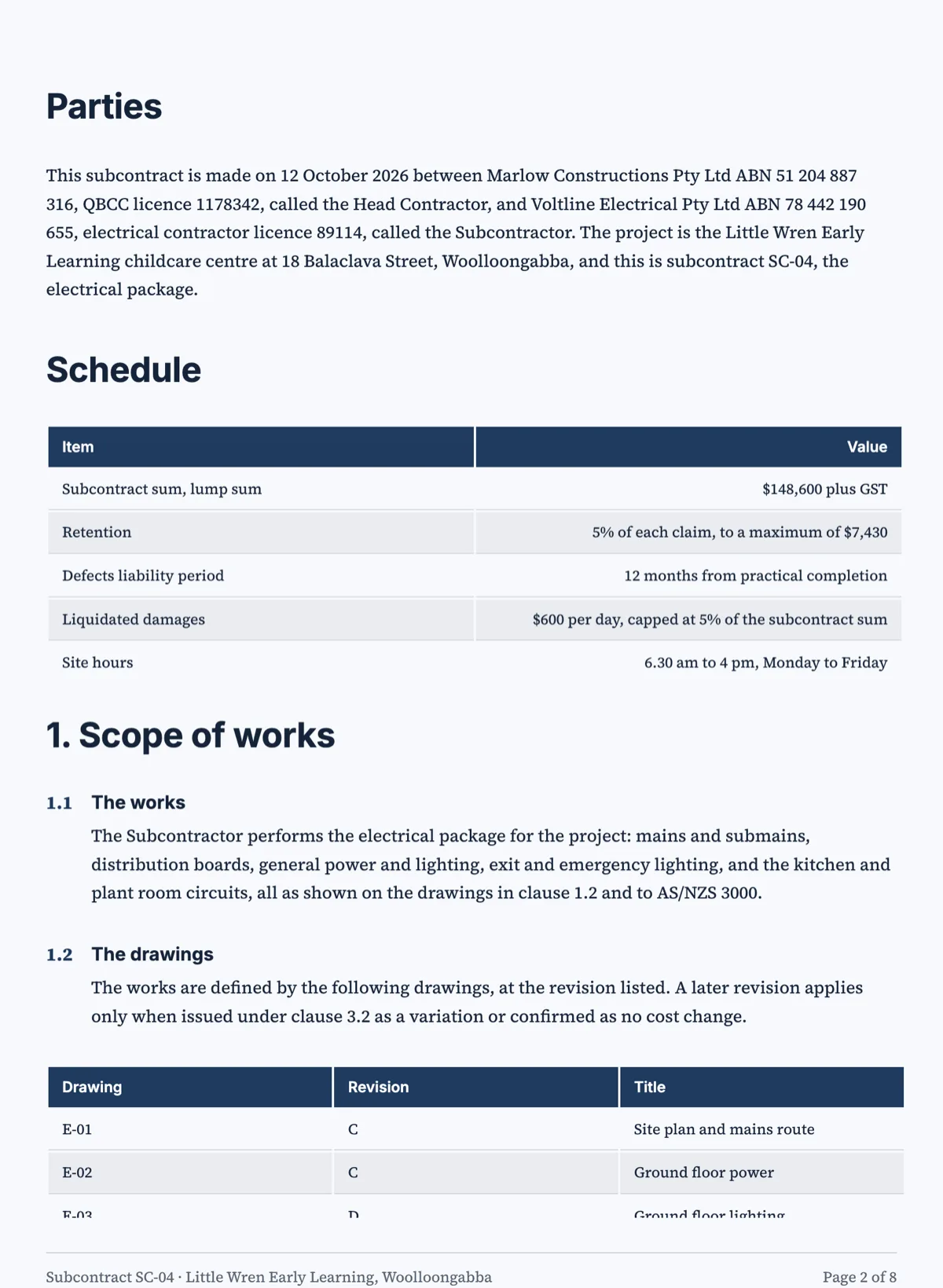 Subcontractor agreement template that flows the head contract downA subcontract exists to pass the head contract's obligations down one level and move the money back up on time. This one names the scope by drawing, sets the progress claim dates against the security of payment rules, holds retention and states the insurances, so the trade knows exactly when it is paid and for what.
Questions people ask
What does good and workmanlike manner mean?
It means the work is carried out with the skill and care a competent tradesperson in that trade would apply, to an accepted standard of finish and in line with the relevant codes and standards. It is judged objectively, usually with expert evidence, which is why many contracts add named standards and manufacturer instructions to give the phrase something concrete to measure against.
Must building materials be new?
Under many residential building laws, including in New South Wales, materials must be new unless the contract says otherwise. Used or recycled materials can be specified, and sometimes add character, but the contract should name them and describe their expected condition so the owner cannot later argue that new materials were promised.
Can a builder substitute a different product?
Only as the contract allows. Most clauses allow substitution with the owner's written approval of an equivalent product, and some allow it without approval if the named product is unavailable. Substituting without a required approval can be a breach even if the substitute performs well, so builders should keep every approval in writing.
Does complying with Australian Standards guarantee there are no defects?
Not necessarily. A standard sets a minimum method or performance level, and work can comply with a standard yet still fail because of poor workmanship on details the standard does not cover, or because the contract required something higher. Owners should read compliance with standards as a floor rather than the full measure of quality.
Who is responsible if a correctly installed product fails?
If the contractor installed the product properly and it failed because of a manufacturing fault, the owner will usually pursue the manufacturer's warranty and consumer guarantees, although the builder may still answer under statutory warranties for residential work. Clauses often require the builder to pass on warranties and assist with claims, which makes that route far easier.
Should the clause name the edition of each standard?
It helps. Standards change, and naming the edition current at signing removes an argument on long projects. Many contracts say the edition current at the contract date applies unless a later edition is required by law, and treat that legally required change as a variation, so any extra cost is dealt with openly.
Put the clause in a finished document
The button opens the document generator with a starting description already filled in. Change it to match your own agreement before you run it.
Create a document with OneCraftRelated clauses
- Defects liability clause: fixing defects after practical completionA defects liability clause sets how long a builder must return to fix defects after completion. Australian sample wording, typical periods and three variants.
- Scope of work clause: what the price includes and excludesA scope of work clause sets what is and is not included in the contract price. Sample bathroom renovation wording, inclusions and exclusions, and variants.
- Warranty clause: promising a standard and backing itA warranty clause promises a fact is true or that work meets a standard. Australian sample wording for a ninety day defects warranty, variants and remedies.
- Practical completion clause: when the works are ready to useA practical completion clause defines when building work is finished enough to use. Australian sample wording, a handover checklist and certificate steps.
For everything the document generator can do, see the document maker.
Step by step in the builder: Create a document with AI, then Document builder components.
Written and checked by the OneCraft team. Last checked .