Contract clause
Fitness for purpose clause: a promise that the design works
A fitness for purpose clause makes a designer or contractor promise that the finished work will be fit for a stated purpose, regardless of whether they took reasonable care. It is a stricter duty than reasonable skill and care, which only requires the designer to act as a competent professional would.
Reasonable skill and care asks whether the designer did a competent job. Fitness for purpose asks whether the thing works. The difference matters most when something fails despite everyone following the standards, as the UK Supreme Court showed in MT Højgaard v E.ON.
Indunil Asanka · Co-founder
4 min read · Published
Sample clause
Written for a design and build contract between a harbour authority and Solent Marine Works, a fictional Southampton contractor designing and building a floating pontoon.
Design Responsibility. (a) The Contractor must design the Works using the reasonable skill, care and diligence to be expected of a properly qualified and competent designer experienced in designing works of a similar size, scope and complexity. (b) The Contractor must design the Works to meet the performance requirements in Schedule 2, including mooring loads for vessels up to 15 metres and a design life of 25 years, and will be treated as having met them if the Works are designed in accordance with paragraph (a). (c) The Contractor gives no warranty that the Works will be fit for any purpose beyond the requirements in Schedule 2. (d) If the Employer's Requirements and Schedule 2 conflict, the Contractor must notify the Employer, and the Employer will decide which applies.
Sample wording, not legal advice.
Variants
Absolute fitness for purpose
The owner's first draft, often in design and build contracts where the owner wants a guaranteed outcome.
The Contractor warrants that the Works, when completed, will be fit for the purposes for which they are intended as stated in or reasonably to be inferred from the Employer's Requirements.
Reasonable skill and care
The usual negotiated position, matching what professional indemnity insurance covers.
In designing the Works, the Contractor's obligation is to exercise the reasonable skill, care and diligence of a competent designer, and nothing in this Contract imposes any greater obligation, including any obligation to achieve fitness for purpose.
Fitness limited to a specified purpose
Projects where both sides can agree a measurable output, such as a load or capacity, rather than an open ended purpose.
The Contractor warrants that the Works will achieve the performance criteria in Schedule 2 when tested in accordance with Schedule 3. This warranty applies only to those criteria and not to any other purpose.
What to negotiate
Why insurance usually excludes it
Professional indemnity insurance responds to negligence: failing to use reasonable skill and care. A promise of fitness for purpose goes further, making the designer liable even without negligence, and most PI policies exclude liability assumed by contract beyond what the law would impose. A contractor who agrees to fitness for purpose may be uninsured for the gap, which is why designers resist it.
Conflicts with the specification
In MT Højgaard v E.ON, the technical requirements said the wind turbine foundations would be designed for a 20 year lifetime, while also requiring compliance with an international standard that turned out to contain an error. The foundations followed the standard but failed. The Supreme Court held the contractor responsible, because the 20 year requirement was a binding obligation. If a contract contains both a performance outcome and a prescribed design standard, the outcome may prevail, so the hierarchy should be spelled out.
Implied fitness for purpose
Where goods are sold in the course of business, the Sale of Goods Act 1979 implies that they are reasonably fit for a purpose the buyer made known. For services, the Supply of Goods and Services Act 1982 implies reasonable care and skill. Design and build work can attract both. The clause should say clearly which standard applies to design, and any exclusion of implied terms must be reasonable under the Unfair Contract Terms Act.
The risk of leaving it out
If a contract is silent, the implied duties apply: often reasonable skill and care for design, but fitness for purpose where the contractor supplies goods or where the circumstances show the owner relied on the contractor's skill to deliver a working result. That uncertainty is a poor basis for pricing, insuring or disputing a failure, so the duty should be chosen expressly.
The two duties compared
Reasonable skill and care: the designer must act as a competent professional would; failure means negligence must be shown; following accepted practice and standards is usually a defence; PI insurance generally covers it. Fitness for purpose: the work must achieve its purpose; failure is shown by the result not working, with no need to prove negligence; following standards is no defence if the result fails; PI insurance often does not cover it. Performance specifications sit between the two, setting a measurable outcome. Law checked on 21 October 2026. This page explains how the clause works and is not legal advice.
Reading the sample
The sample keeps the design duty at reasonable skill and care in paragraph (a), then deals with the performance requirements in paragraph (b) by saying they are met if the design was carried out with reasonable care. That wording addresses the risk shown by Højgaard, where a stated lifetime became an absolute obligation. Paragraph (c) disclaims any wider fitness for purpose warranty, and paragraph (d) gives a process when documents conflict, rather than leaving it to a court to decide which prevails.
When fitness for purpose is appropriate
Some projects reasonably carry a fitness for purpose duty: a turnkey process plant built to produce a stated output, or equipment designed and supplied by a specialist for a known use. In those cases, the contractor should limit the purpose to defined, testable criteria, cap its liability, and confirm insurance cover before agreeing. An owner who insists on an open ended fitness duty should expect a higher price.
Australia
Australian law takes a similar approach: design professionals generally owe reasonable care and skill, while fitness for purpose can be implied in contracts for work and materials where the owner relies on the builder's skill, and the Australian Consumer Law guarantees fitness for any disclosed purpose in consumer contracts. The parent standard of care clause covers the Australian drafting.
Documents that carry this clause
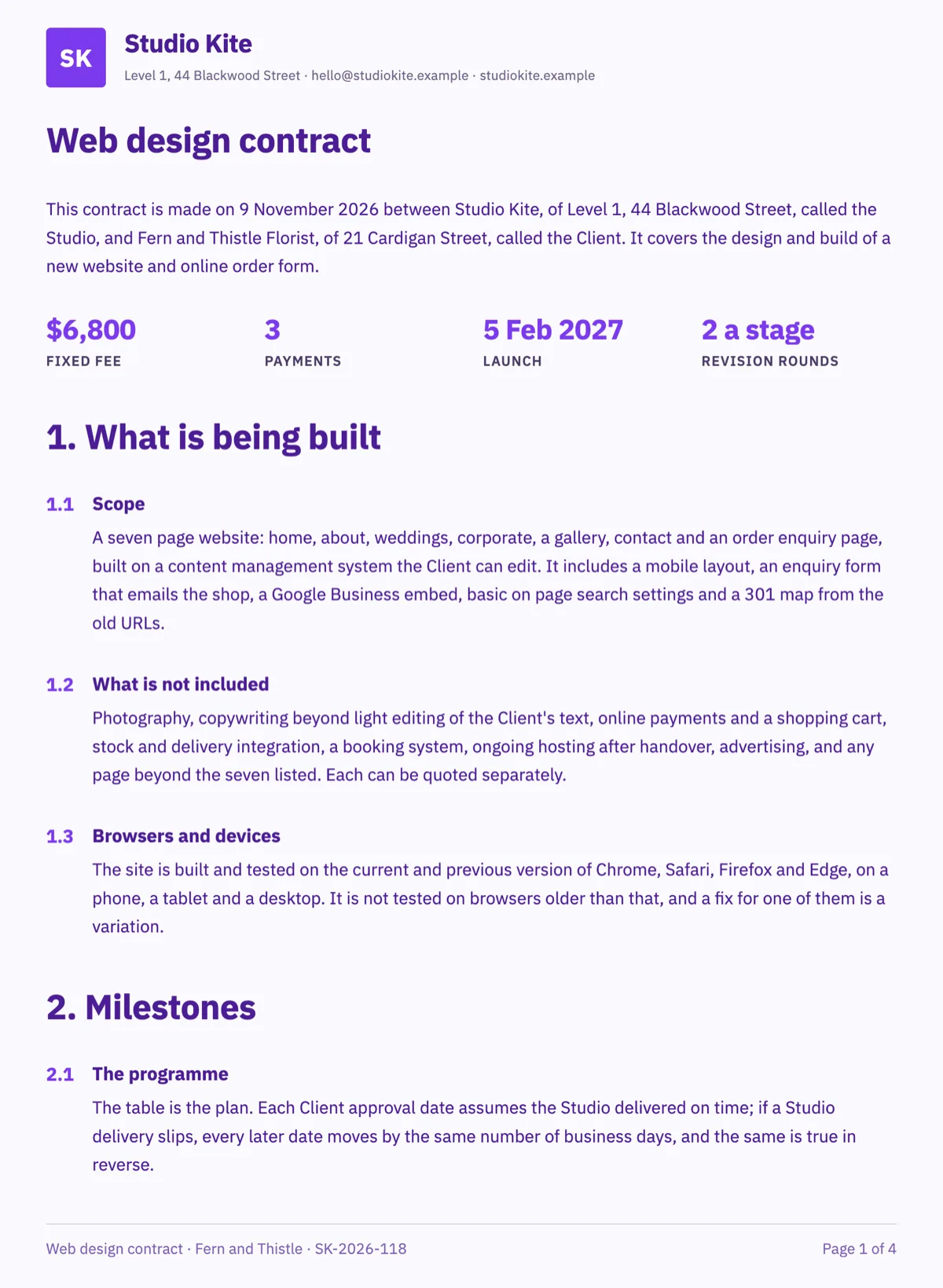 Web design contract template with milestones and revision roundsWebsite projects rarely fail on design. They stall because the content never arrives and nobody wrote down what happens next. This contract dates every milestone on both sides, deems a stage approved if the client goes quiet, and moves the launch by a day for every day the copy is late.
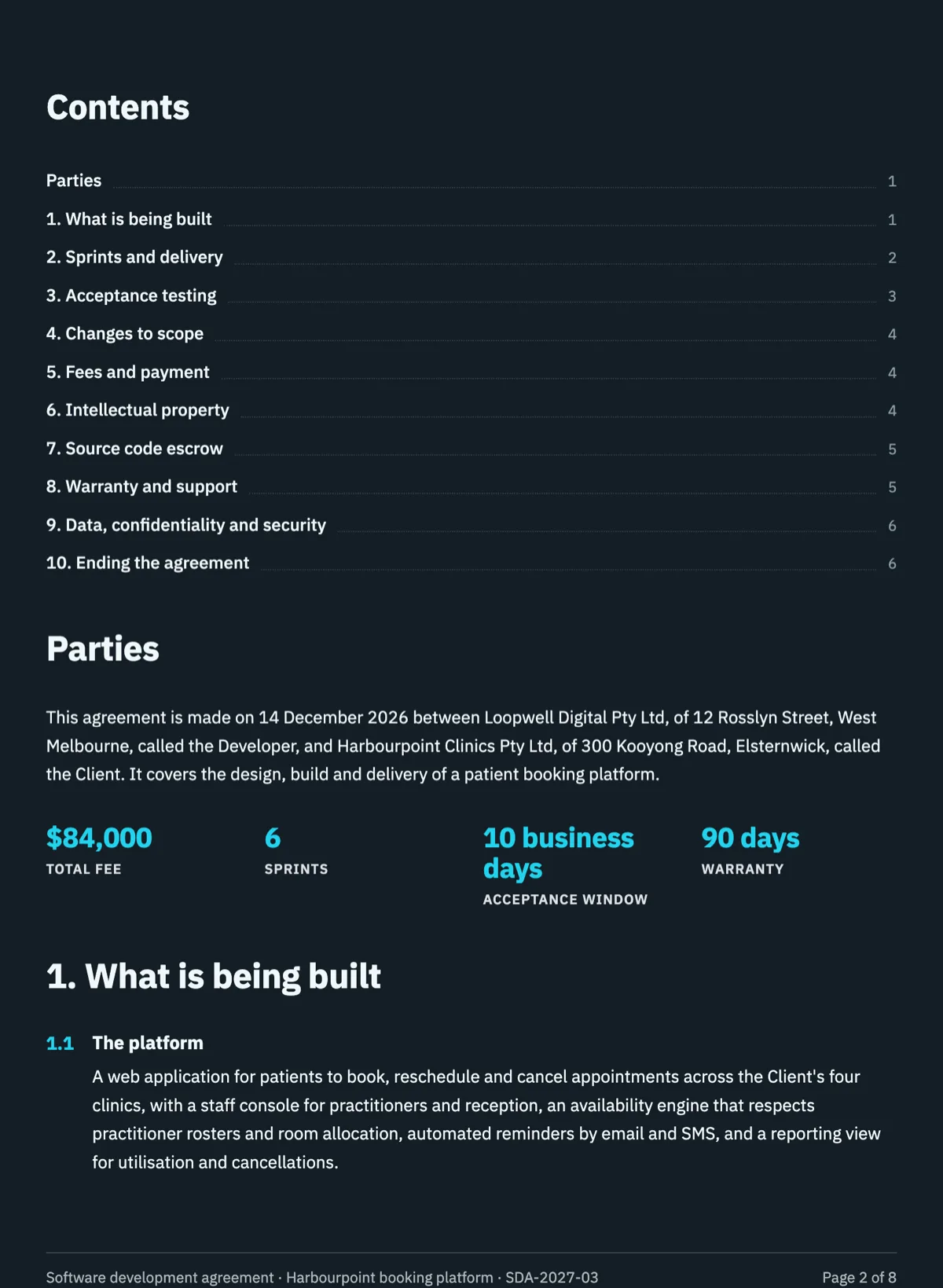 Software development agreement with sprints and an acceptance testCustom software goes wrong in the space between delivered and accepted, where one side thinks a sprint is finished and the other is still writing a list. This agreement fixes a ten business day acceptance window against criteria written before the sprint started, and assigns the intellectual property sprint by sprint as each invoice is paid.
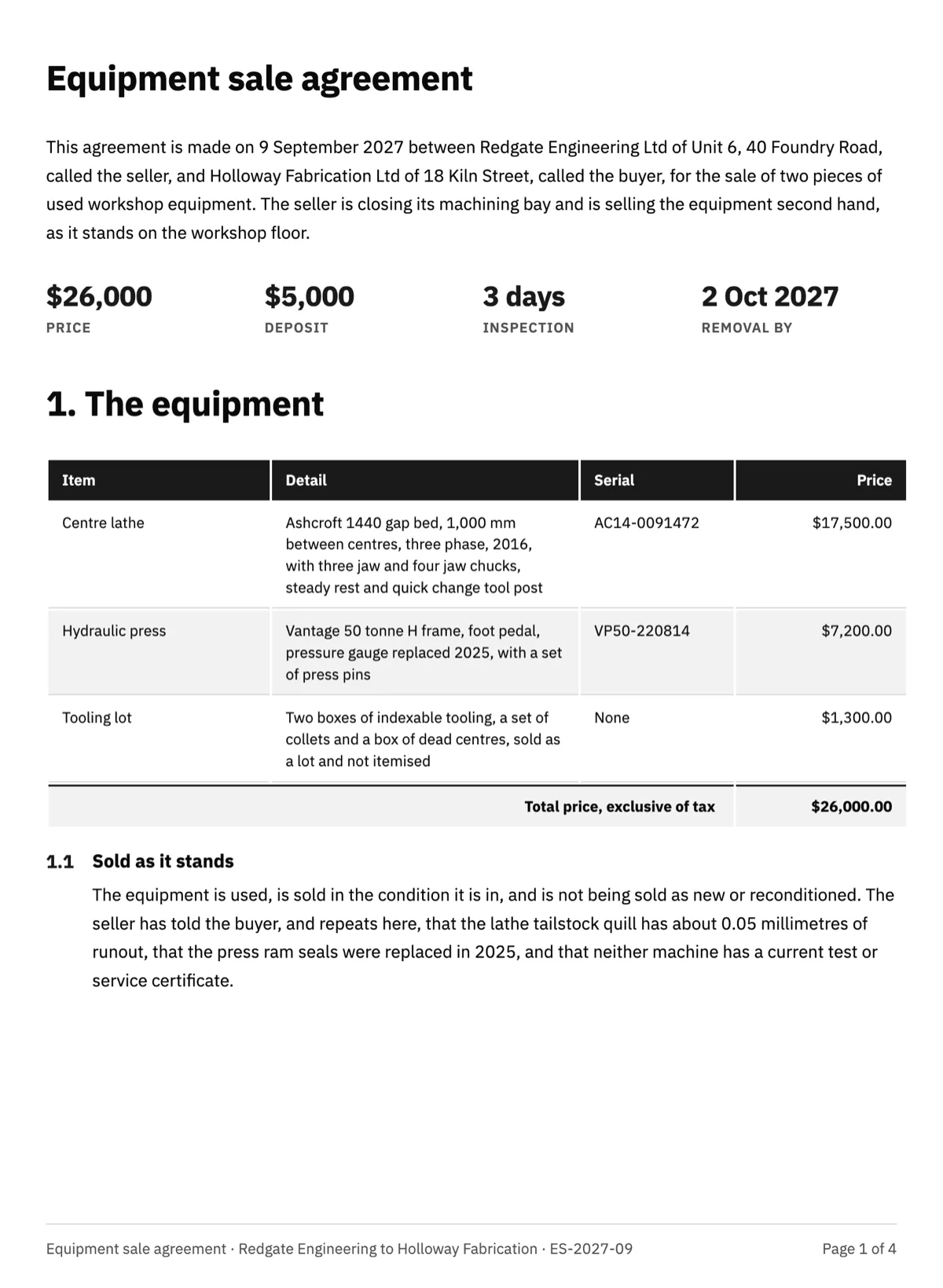 Equipment sale agreement with serial numbers and an inspection windowUsed machinery changes hands on a workshop floor, and the argument afterwards is always about condition or about who damaged the door frame on the way out. This agreement records the serial numbers and the known faults, gives the buyer two days to power the machines up, and puts the rigging, the making good and the storage charge in writing.
Questions people ask
What is the difference between fitness for purpose and reasonable skill and care?
Reasonable skill and care requires the designer to act as a competent professional would, and liability depends on proving negligence. Fitness for purpose requires the result to work for its purpose, and the designer is liable if it does not, even without negligence. Fitness for purpose is the stricter duty.
Is fitness for purpose insurable?
Often not fully. Professional indemnity insurance usually covers liability for negligence and excludes liability a designer takes on by contract beyond that. A designer who accepts a fitness for purpose obligation may be uninsured for claims where no negligence occurred, so check the policy before agreeing.
Does fitness for purpose override the specification?
It can. In MT Højgaard v E.ON, a requirement that foundations last 20 years applied even though the contractor followed the specified standard, which was flawed. Where a contract contains both an outcome and a design standard, a court may hold the contractor to the outcome unless the contract says otherwise.
Is fitness for purpose implied into construction contracts?
It can be. Where a contractor supplies materials or designs and builds, and the owner relies on its skill for a known purpose, a fitness for purpose term may be implied. For pure professional design services, the implied standard is usually reasonable skill and care. Clear express wording avoids the argument.
How can a contractor limit a fitness for purpose obligation?
By tying it to specific, measurable performance criteria and tests, excluding any wider purpose, capping liability, and excluding consequential loss. Some contracts provide that meeting the criteria using reasonable skill and care is enough, which keeps the duty within insurance cover.
Put the clause in a finished document
The button opens the document generator with a starting description already filled in. Change it to match your own agreement before you run it.
Create a document with OneCraftRelated clauses
- Standard of care clause: how good the work has to beA standard of care clause sets the quality bar for work. Australian sample wording, due care and skill, best and reasonable endeavours, and fitness for purpose.
- Materials and workmanship clause: the quality standard for the buildA materials and workmanship clause sets the quality standard for what is installed and how. Australian sample wording naming the NCC and Australian Standards.
- Warranty clause: promising a standard and backing itA warranty clause promises a fact is true or that work meets a standard. Australian sample wording for a ninety day defects warranty, variants and remedies.
- Consumer guarantees clause under the Australian Consumer LawA consumer guarantees clause tells customers the Australian Consumer Law guarantees apply and cannot be excluded. Sample warranty wording and what it must say.
For everything the document generator can do, see the document maker.
Step by step in the builder: Create a document with AI, then Document builder components.
Written and checked by the OneCraft team. Last checked .