Contract clause
Consumer guarantees clause under the Australian Consumer Law
A consumer guarantees clause is the statement in terms of sale, a warranty or a receipt that tells consumers the Australian Consumer Law guarantees apply and cannot be excluded. It sits beside any extra warranty the business offers, and for a written warranty against defects part of the required wording is prescribed by regulation.
A retailer's warranty document is where consumer law mistakes are most visible, because a promise of 12 months of repairs can read as though it replaces rights the law gives for longer. The clause has to present the business's own warranty as extra to the guarantees, never as a substitute for them.
Nuwan Madhusanka · Co-founder
4 min read · Published
Sample clause
a written warranty against defects issued by Pademelon Home Appliances, a fictional appliance retailer in Launceston, for its own brand of stick vacuum cleaners sold to consumers
Warranty Against Defects 1. Pademelon Home Appliances warrants that each Pademelon stick vacuum cleaner will be free from defects in materials and workmanship for 24 months from the date of purchase. 2. If a defect appears during that period, Pademelon Home Appliances will repair or replace the vacuum cleaner, or refund the price, at no cost to the consumer for parts, labour or return freight. 3. To claim, return the vacuum cleaner with proof of purchase to any Pademelon store, or email claims@pademelon.example with the order number, a description of the defect and a photo. Claims are assessed within 5 business days. 4. This warranty is given by Pademelon Home Appliances Pty Ltd, whose business address, telephone number and email address are printed on the proof of purchase. 5. The benefits of this warranty are in addition to other rights and remedies the consumer has under a law in relation to the goods. 6. [Insert here, word for word, the mandatory statement for goods set out in the Competition and Consumer Regulations 2010.]
Sample wording, not legal advice.
Variants
Statement on a receipt or website
A business that gives no extra warranty but wants its terms to describe consumer rights accurately.
Goods and services supplied to consumers come with guarantees under the Australian Consumer Law that cannot be excluded, restricted or modified. They include that goods are of acceptable quality, fit for any disclosed purpose and match their description, and that services are provided with due care and skill and within a reasonable time. Nothing in these terms limits those guarantees or the remedies available when a guarantee is not met.
Services supplied to consumers
A trade or service business, such as an electrician, whose work carries the service guarantees.
Tallowwood Electrical will perform the Services with due care and skill, and the Services will be reasonably fit for any purpose the Customer makes known before the work starts. Where no completion date is agreed, the Services will be completed within a reasonable time. These guarantees apply under the Australian Consumer Law, cannot be excluded, and are in addition to the 12 month workmanship warranty in clause 8.
Business goods not ordinarily for personal use
Commercial equipment sold to a business that is still a consumer because of the price, where liability can be limited.
Where the Goods are not of a kind ordinarily acquired for personal, domestic or household use or consumption, the Supplier's liability for a failure to comply with a consumer guarantee, other than a guarantee about title, undisturbed possession or undisclosed securities, is limited at the Supplier's option to replacing or repairing the Goods, supplying equivalent goods, or paying the cost of doing so, except where reliance on this limitation is not fair or reasonable.
What to negotiate
Length of the extra warranty
A warranty period is a commercial choice, but it does not cap the consumer guarantees. Goods can fail to be of acceptable quality after the warranty ends if a reasonable consumer would expect them to last longer. Businesses often set longer warranties on expensive items because that matches what the guarantees would require anyway.
Selling extended warranties
Extended warranties are lawful, but the seller should make clear exactly what they add to the consumer guarantees. A sales pitch implying a customer has no rights once the manufacturer's warranty expires risks misleading the customer. The terms should describe the extra cover in plain language, including what it costs and what it excludes.
The risk of leaving it out
A business that gives a written warranty against defects without the required contents, including the prescribed statement, risks civil and criminal penalties, and wording that suggests the guarantees are excluded can mislead consumers. Leaving the statement out does not remove the guarantees; it only leaves customers and staff with the wrong idea of what the business must do.
The guarantees in one list
For goods supplied to consumers, the Australian Consumer Law guarantees clear title, undisturbed possession and no undisclosed securities, acceptable quality, fitness for any disclosed purpose, a match with any description, sample or demonstration model, availability of repairs and spare parts for a reasonable time, and compliance with any express warranty. For services, it guarantees due care and skill, fitness for any disclosed purpose and supply within a reasonable time. A consumer includes anyone buying goods or services costing up to $100,000, or of a kind ordinarily bought for personal, domestic or household use.
What a warranty against defects must contain
A written warranty against defects must be transparent, in plain language and clearly presented. It must include the warrantor's name, business address, phone number and email address if it has one, set out the claim period and procedure, and include the mandatory statement that the warranty sits alongside the consumer guarantees, which cannot be excluded. Section 102 of the Australian Consumer Law and the Competition and Consumer Regulations 2010 set these requirements, and the prescribed statement is copied exactly rather than rewritten in a house style.
Where it sits in a generated document
A generated warranty or set of terms numbers each promise as a separate item. The generated text never cites sources and should not be assumed to reproduce prescribed wording, so the regulations are checked and the mandatory statement is inserted word for word before the document is issued to customers.
Documents that carry this clause
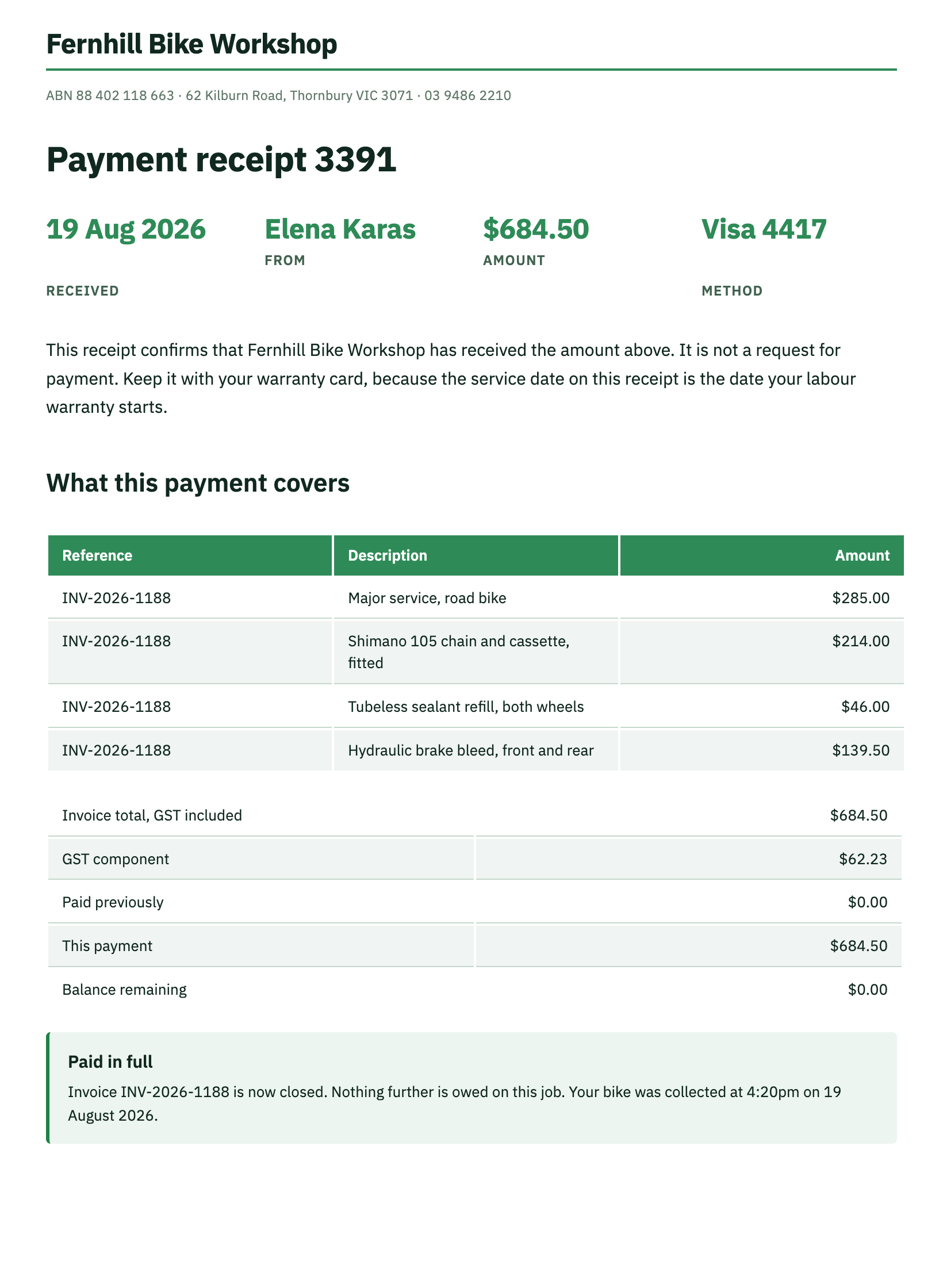 Payment receiptA bike workshop hands this over with the bike. It records money already taken rather than money owed, and it is the piece of paper the customer needs again if a fitted part fails.
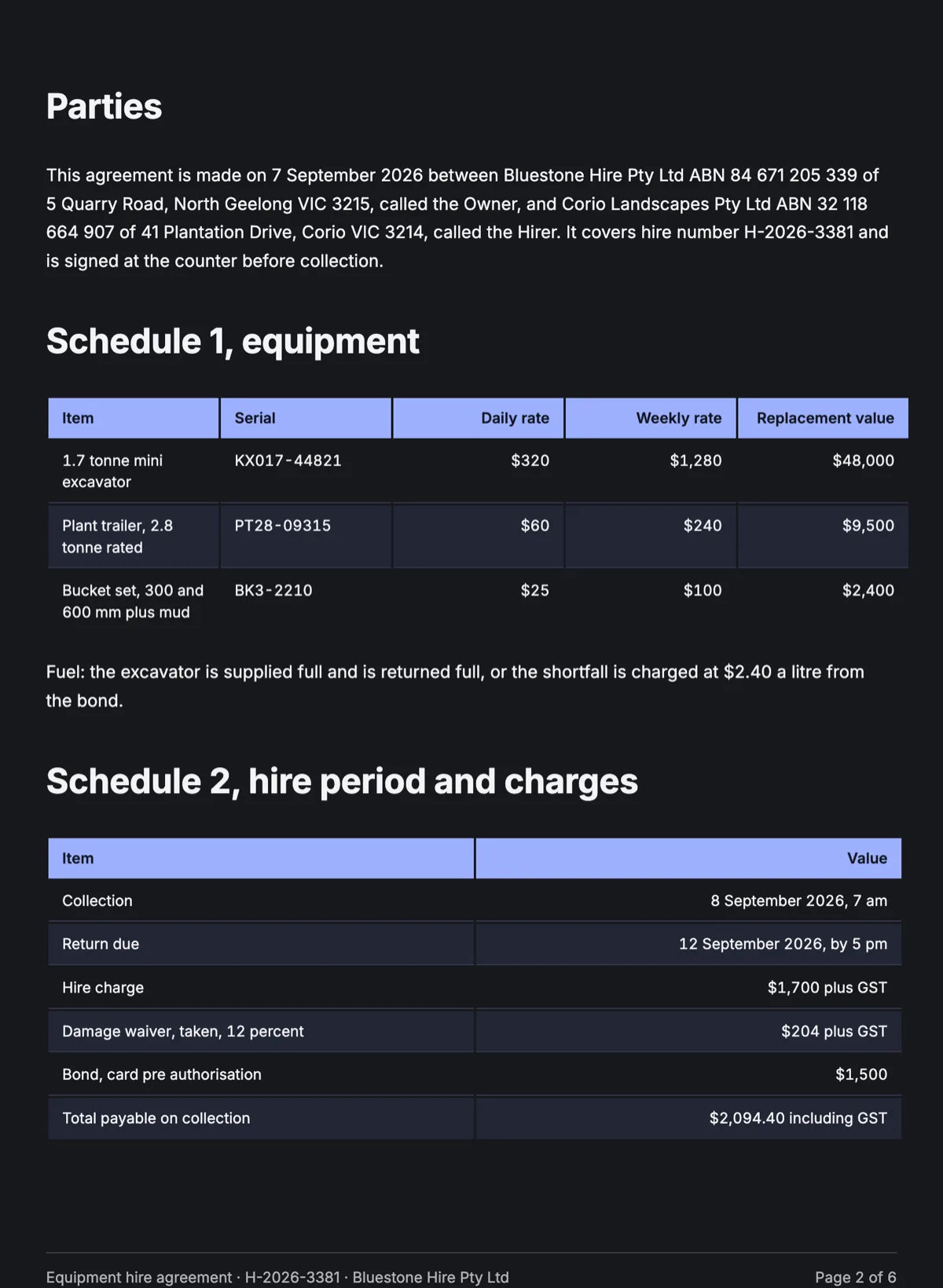 Equipment hire agreement template with the rates in a scheduleA hire agreement is a price list, an insurance decision and a return date, and the argument is always about the day it came back. This one puts the equipment and rates in a schedule, makes the damage waiver a choice with its price, and defines late return in hours so there is nothing to interpret.
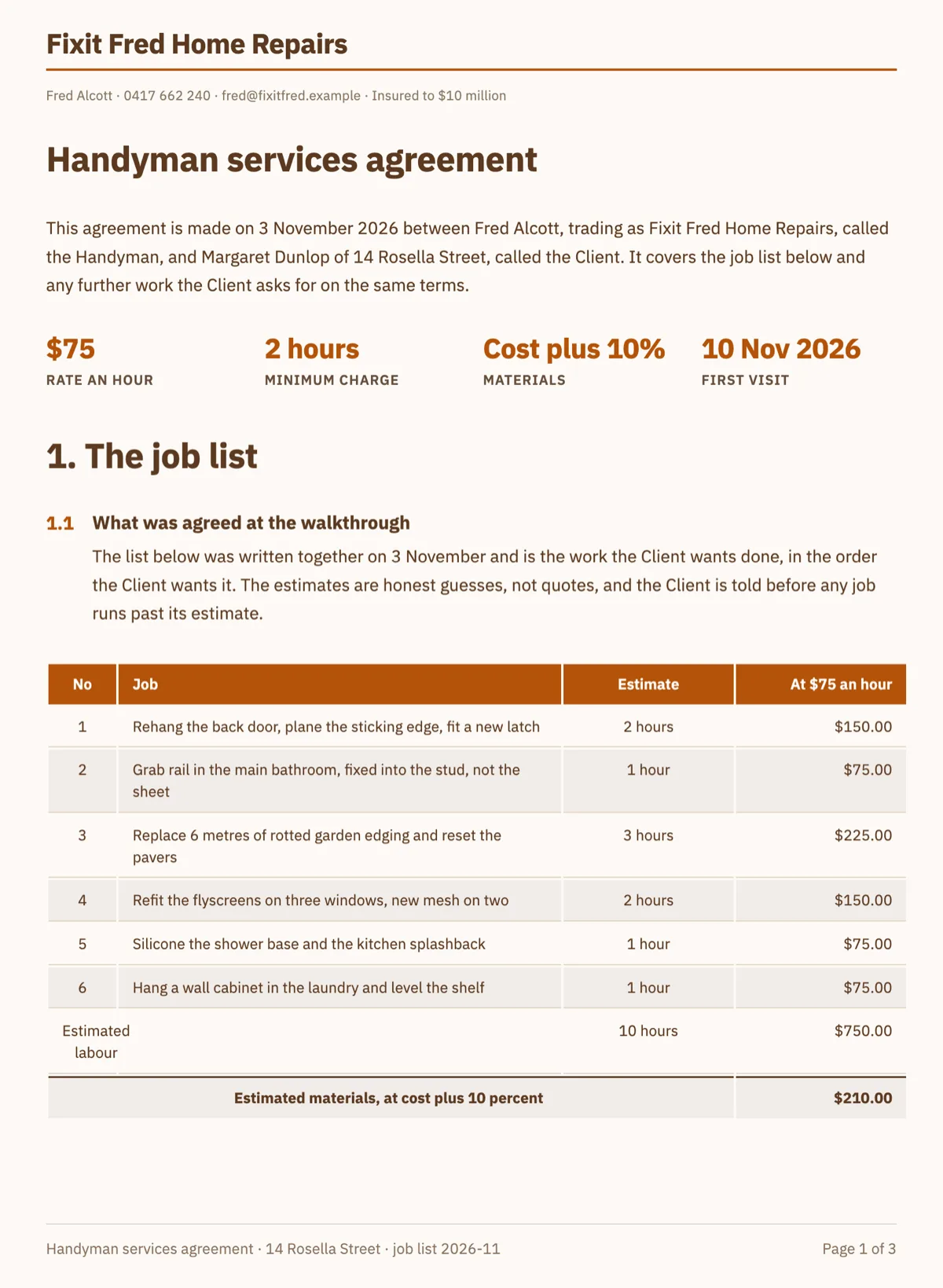 Handyman services agreement with an hourly rate and a job listHandyman work is bought by the hour but decided by the list, and the list is usually a conversation at the front door that nobody wrote down. This agreement turns the walkthrough into six numbered jobs with estimates, and then names the work a handyman is not allowed to do at all.
Questions people ask
Can a business exclude the consumer guarantees?
No. A term in a consumer contract that tries to exclude, restrict or modify the consumer guarantees is void to that extent. A business can add its own warranties, and for goods not ordinarily bought for personal use it can in some cases limit its liability to repair, replacement or the cost of either, where that is fair and reasonable.
Do the guarantees apply to second hand goods and sale items?
Yes, when they are supplied in trade or commerce. The guarantees apply to new and second hand goods and to sale items bought from a business, although acceptable quality takes into account matters such as the price and nature of the goods, and a consumer cannot claim for a fault they were told about before buying.
What is the difference between a major and a minor failure?
A major failure is one a reasonable consumer would not have bought the goods with, or where the goods are significantly different from their description, cannot do what they should and cannot easily be fixed, or are unsafe. For a major failure the consumer chooses a refund or replacement, or compensation. For a minor failure the business chooses the remedy.
Are goods bought at auction covered by the guarantees?
According to the ACCC, most consumer guarantees do not apply to goods bought at a traditional auction, where the auctioneer acts as agent for the owner, although the guarantees as to title, undisturbed possession and no hidden debts still do. Goods acquired for resale fall outside the guarantees, and most do not apply to a one off sale by a private seller.
Does a manufacturer's warranty period limit a consumer's rights?
No. A consumer can still rely on the guarantees after a manufacturer's warranty ends if the goods were not of acceptable quality, judged by what a reasonable consumer would expect for goods of that kind and price. Consumer Affairs Victoria gives the example of a $6,000 television that stops working after two years despite a 12 month warranty.
Who pays to return faulty goods?
Generally the consumer pays the initial cost of returning goods that can be posted or easily carried back, and can recover reasonable costs from the seller if a fault is confirmed. Where goods with a major failure are too large or difficult to return, such as an installed dishwasher, the seller must collect them within a reasonable time.
Put the clause in a finished document
The button opens the document generator with a starting description already filled in. Change it to match your own agreement before you run it.
Create a document with OneCraftRelated clauses
- Returns and refunds clause: change of mind and faulty goodsA returns and refunds clause sets when customers can bring goods back and what they get. Australian change of mind wording and where consumer law overrides it.
- As is clause: selling goods in their current conditionAn as is clause says a buyer takes goods in their current condition with no warranty. Sample Australian private car sale wording, auction and dealer variants.
- Warranty clause: promising a standard and backing itA warranty clause promises a fact is true or that work meets a standard. Australian sample wording for a ninety day defects warranty, variants and remedies.
- Disclaimer of warranties clause: what can and cannot be excludedA disclaimer of warranties clause removes implied warranties as far as the law allows. Australian sample wording with the consumer guarantees carve out.
For everything the document generator can do, see the document maker.
Step by step in the builder: Create a document with AI, then Document builder components.
Written and checked by the OneCraft team. Last checked .