Contract clause
Step in rights clause: funders, customers and failing contracts
A step in rights clause lets a third party, such as a funder, or a customer, take over the performance or management of a contract when the original party defaults, so that a project or service can continue. It sets the triggers, the notice, how long the step in lasts and who pays for it.
When a developer's finance is at risk, its lender wants to be able to take the developer's place in the building contract rather than watch the project stop. When an outsourced service fails, the customer wants to step in and fix it. Step in rights do both.
Nuwan Madhusanka · Co-founder
4 min read · Published
Sample clause
Written for a building contract for Harbourside Student Living, a fictional Cardiff student accommodation development, with a direct agreement in favour of the funder.
Funder Step In. (a) The Contractor must not terminate the Building Contract, or suspend the Works, for the Employer's default without first giving the Funder at least 15 business days' written notice stating the default. (b) Within that period the Funder may give the Contractor a step in notice, appointing itself or its nominee to take over the Employer's rights and obligations under the Building Contract. (c) From the date of the step in notice, the Contractor must accept the Funder or its nominee in place of the Employer, and the Funder becomes liable for amounts owed to the Contractor that are outstanding at that date. (d) The Funder may step out by giving 20 business days' notice, after which it is released from obligations arising afterwards, and the Employer remains liable as before.
Sample wording, not legal advice.
Variants
Funder step in
Development finance, where the lender needs to protect its security if the borrower developer defaults.
If the Employer defaults under its Facility Agreement, the Funder may by notice require the Contractor to continue the Works for the Funder or its appointee, on the terms of the Building Contract, and the Contractor must do so.
Customer step in to services
Outsourced IT and facilities services, where the customer cannot tolerate a failing service while disputes are resolved.
If a Critical Service Failure continues for more than 48 hours, the Customer may, on notice, take control of the affected Services itself or through a third party until the failure is remedied. The Supplier must cooperate, and the Customer may deduct its reasonable additional costs from the Charges.
Tenant step in for repairs
Leases where the landlord must repair the building and a tenant needs a remedy if it does not.
If the Landlord fails to carry out repairs it is obliged to make within 20 business days of the Tenant's notice, the Tenant may carry out those repairs itself and recover the reasonable cost from the Landlord on demand.
What to negotiate
Triggers
The clause should say exactly what allows step in: a termination notice under the building contract, a default under the funding agreement, or a service failure lasting longer than a set time. Vague triggers, such as the supplier failing to perform to the customer's satisfaction, invite disputes. Suppliers should limit customer step in to serious failures affecting critical services.
Cure period
Before a contractor can terminate for the employer's default, the funder needs time to decide whether to step in, often 10 to 20 business days in addition to any cure period the employer has. Suppliers facing customer step in should ask for a short chance to fix a problem first, unless the failure is causing urgent harm.
Who pays during step in
In construction, the funder that steps in usually takes on paying the contractor going forward and often the arrears up to the step in date. In services, the customer usually pays for its own or a third party's work but deducts the extra cost from the supplier's charges, while the supplier remains liable for the failure. The clause should also say who is liable for what the stepping in party does.
The risk of leaving it out
Without step in rights, a funder can only call in its loan and enforce its security if the developer defaults, by which time the contractor may have left the site. A customer of a failing service has to wait for the contract's remedies and disputes process while its business suffers. The cost of a stalled project or a failed service usually far exceeds the effort of the clause.
Construction and outsourcing step in compared
In construction, step in usually belongs to a funder, purchaser or tenant and is granted through a direct agreement or collateral warranty with the contractor and key consultants; it lets that party take the employer's place to keep the project going. In outsourcing, step in belongs to the customer and lets it take temporary control of a failing service, with the supplier still bound and liable. The first is about who is the employer; the second is about who runs the service for a while. Law checked on 21 October 2026. This page explains how the clause works and is not legal advice.
Collateral warranties and direct agreements
Step in rights for funders are usually not in the building contract alone, because the funder is not a party to it. They are given in a collateral warranty from the contractor, or a separate direct agreement, which JCT and other standard form publishers provide. In the UK, a collateral warranty can also give a funder or purchaser a direct claim for defects. The building contract should oblige the contractor to give these documents in the agreed form.
Public sector outsourcing
The UK government's Sourcing Playbook sets expectations for public sector outsourcing, including planning for supplier failure and resolution, and step in rights are a common contractual tool for keeping critical public services running if a supplier fails. Any customer step in clause should be matched by an exit plan and transition assistance, so the customer can take a service back or move it to another supplier in an orderly way.
Practical points
Step in only works if the stepping in party can actually perform: it needs access to the site or systems, information, staff cooperation and subcontracts that can be transferred. The clause should require the original party to provide those. Insurance should also cover the period of step in, including the stepping in party's activities.
Documents that carry this clause
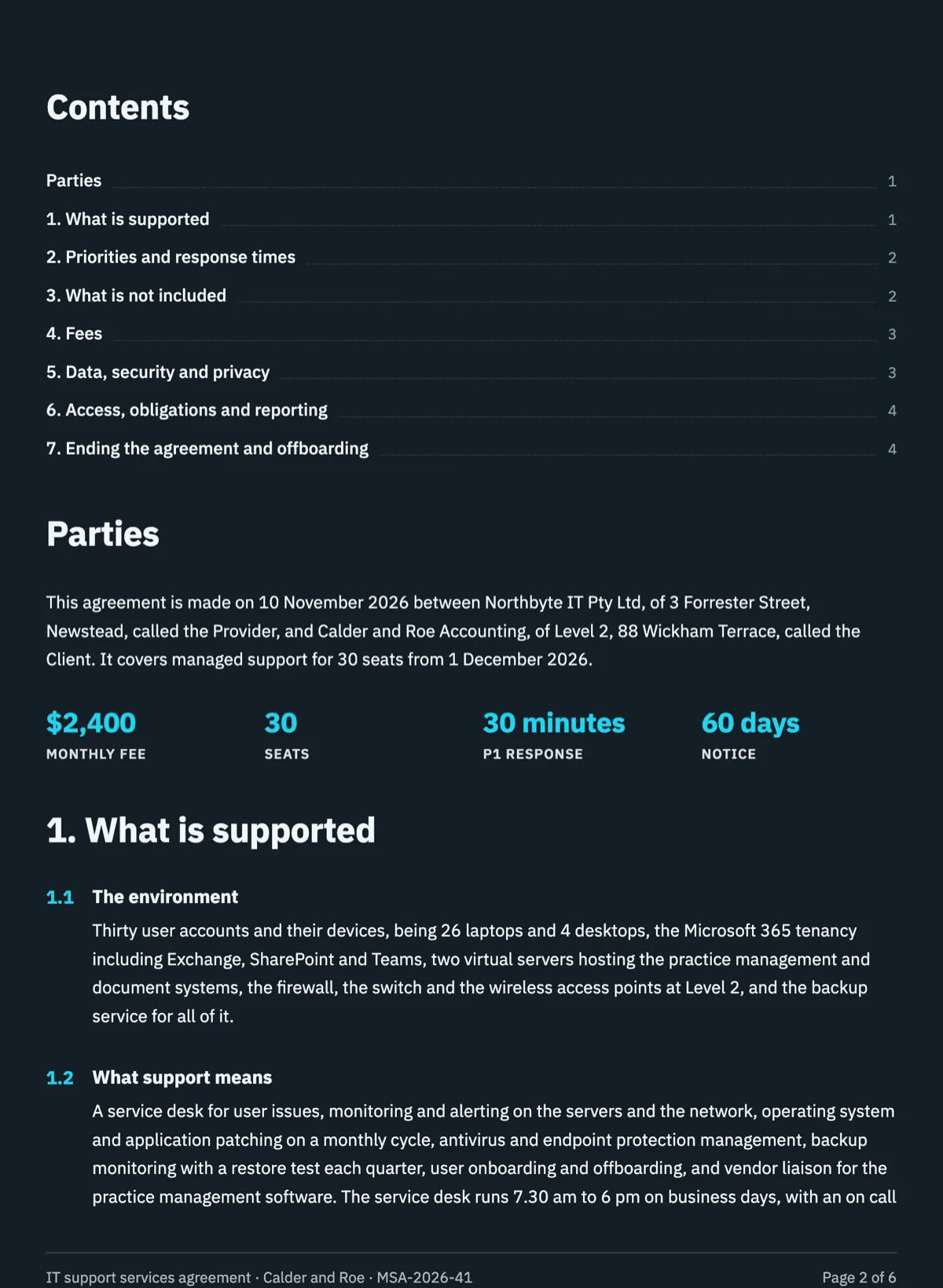 IT support services agreement with response times by priorityManaged support is sold on a monthly fee and judged on how fast the phone gets answered when nobody can work. This agreement grades every ticket into four priorities with a published response and resolution target, credits the fee when the target is missed, and writes down exactly what the provider hands back on the way out.
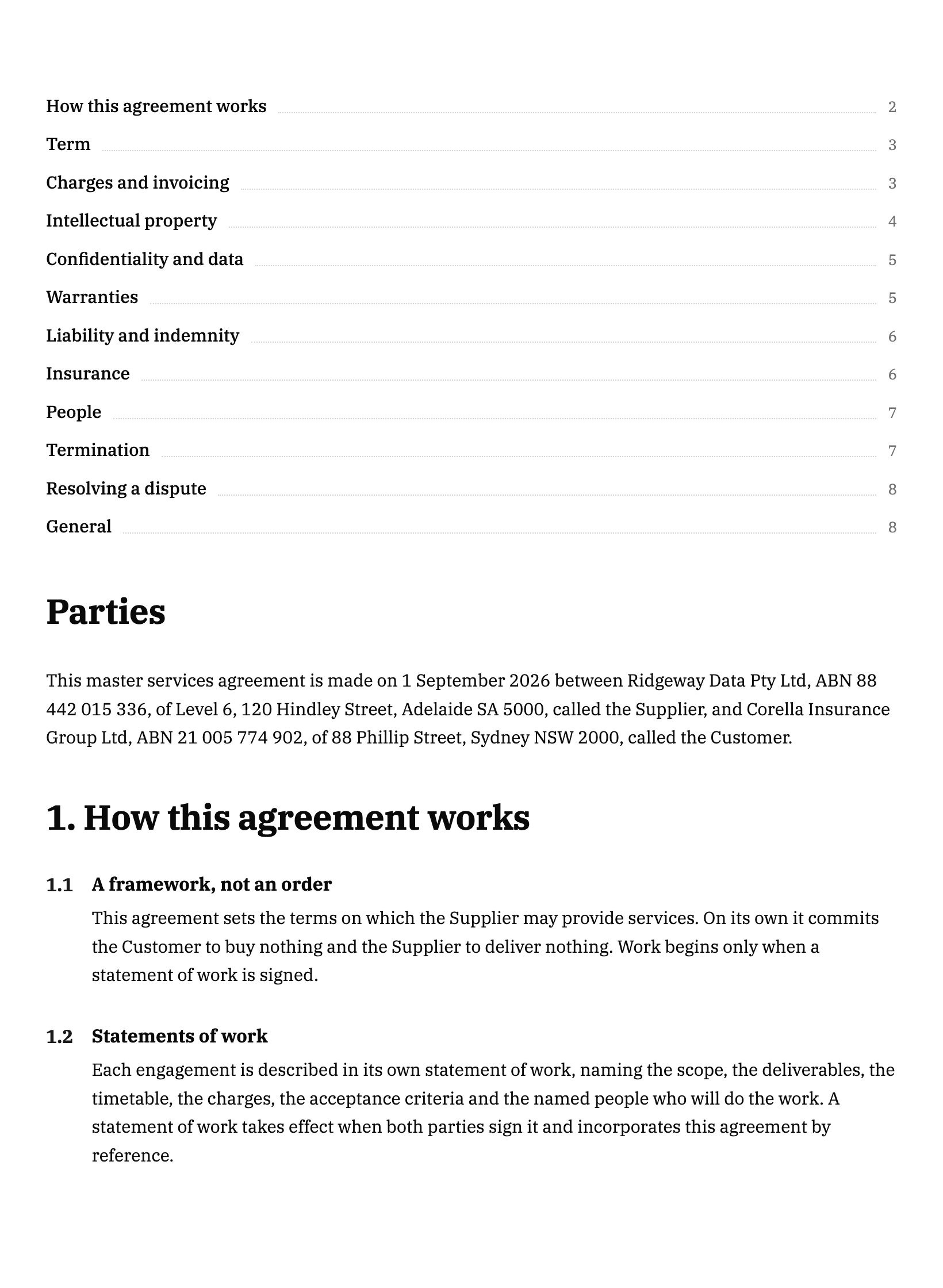 Master services agreementA data consultancy and an insurer sign this once and then buy work under it for three years. It is the rare contract whose whole purpose is to make the next twenty contracts short.
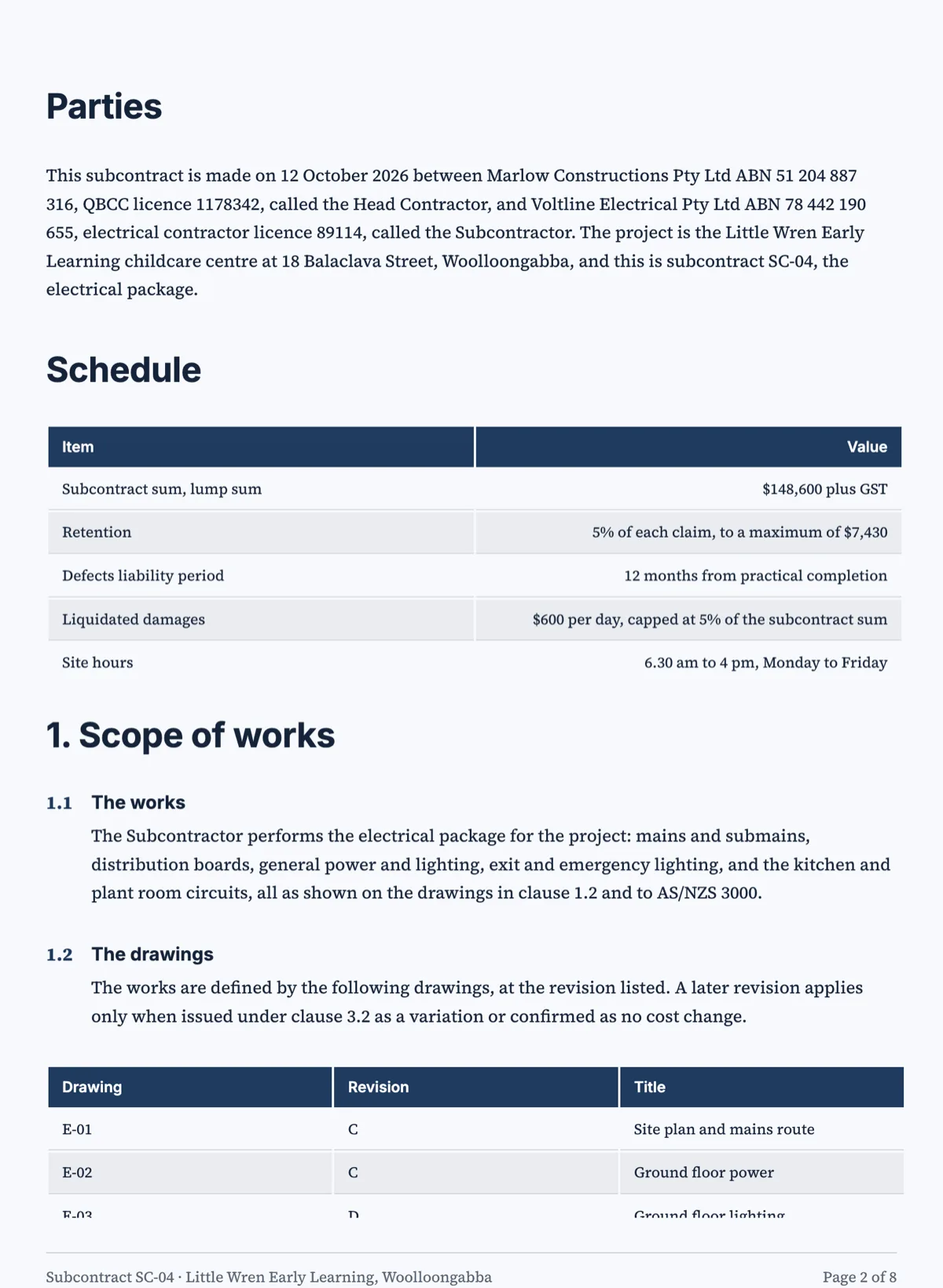 Subcontractor agreement template that flows the head contract downA subcontract exists to pass the head contract's obligations down one level and move the money back up on time. This one names the scope by drawing, sets the progress claim dates against the security of payment rules, holds retention and states the insurances, so the trade knows exactly when it is paid and for what.
Questions people ask
What are step in rights in a contract?
They are rights for someone other than the original party, usually a funder or customer, to take over a contract, or the running of a service, when the original party defaults. They keep a project or service going while problems are dealt with, rather than letting it stop.
When can a funder step in?
When the trigger in the direct agreement or collateral warranty occurs, usually when the contractor gives notice that it intends to terminate for the employer's default, or when the borrower defaults under its loan. The funder then has a set period to decide whether to step in.
Who pays the contractor during step in?
Usually the funder or its nominee, from the date of the step in notice, and often the arrears owed by the original employer up to that date. The direct agreement sets this out. If the funder steps out later, it is typically released from obligations arising after that.
Do step in rights end the supplier's responsibility?
Not in outsourcing. When a customer steps in to a failing service, the supplier usually remains bound by the contract and liable for the failure, and must cooperate. The customer can normally recover its extra costs. Once the problem is fixed, control returns to the supplier.
Are step in rights the same as novation?
No. Novation permanently replaces one party with another, with everyone's agreement. Step in is usually temporary or conditional, and the original party remains in the background. A funder stepping in may later novate the contract to a new developer, which is a separate step.
Put the clause in a finished document
The button opens the document generator with a starting description already filled in. Change it to match your own agreement before you run it.
Create a document with OneCraftRelated clauses
- Transition assistance clause for outsourcing exitsA transition assistance clause sets the help an outgoing supplier must give at exit. Sample wording, free and paid variants, data formats and what to negotiate.
- Termination for cause clause: defining material breach before you need itA termination for cause clause ends a contract for serious breach. Sample wording, what counts as material, cure periods and immediate termination events.
- Service level clause: turning good service into numbersA service level clause sets the measurable standards a service must meet. Sample uptime and response wording with a metrics table, and three variants.
- Novation clause: agreeing now to swap a party laterA novation clause commits the parties to replace one party with another when a trigger occurs. Australian sample wording, deed form and business sale variants.
For everything the document generator can do, see the document maker.
Step by step in the builder: Create a document with AI, then Document builder components.
Written and checked by the OneCraft team. Last checked .