Contract clause
Trademark licence clause: using a brand without owning it
A trademark licence clause permits another business to use a name, logo or other mark in a defined way, for defined goods or services, while the owner keeps control over quality and presentation. That control is not decoration: in Australia it is what makes the licensee's use count as authorised use by the owner.
A logo on someone else's shopfront, packaging or website says the owner stands behind what is sold there. The licence clause decides how far that promise reaches and what the owner can do when the licensee lets the standard slip.
Indunil Asanka · Co-founder
4 min read · Published
Sample clause
a licence between Quandong Roasters, a fictional Adelaide coffee brand, and Tidewater Kiosks, which runs espresso carts at two ferry terminals and wants to trade under the Quandong name using Quandong beans
6. Trade Mark Licence 6.1 Quandong Roasters grants Tidewater Kiosks a non exclusive, non transferable licence to use the Licensed Marks in Schedule 2 in Australia during the Term, solely on the Carts and in advertising for coffee prepared from Quandong beans at the Sites. 6.2 Tidewater Kiosks must use the Licensed Marks only in the forms, colours and positions shown in the Brand Guide, as updated by Quandong Roasters on 30 days notice. 6.3 Tidewater Kiosks must meet the Quality Standards, allow Quandong Roasters to inspect the Carts on reasonable notice, and submit any new signage or advertising bearing a Licensed Mark for written approval before it is used. 6.4 All goodwill arising from use of the Licensed Marks belongs to Quandong Roasters. 6.5 Tidewater Kiosks must not register or use any mark, business name or domain name that includes or resembles a Licensed Mark.
Sample wording, not legal advice.
Variants
Co marketing only
Two businesses running a joint promotion or sponsorship, where each needs to show the other's logo for a short campaign.
Each party grants the other a non exclusive, royalty free licence to reproduce its name and logo, in the form supplied, solely to promote the Campaign described in Schedule 1 during the Campaign Period. Each party must submit any material showing the other's name or logo for approval, and the other must respond within three Business Days. All rights not expressly granted are reserved, and the licence ends automatically at the end of the Campaign Period.
Full licence with royalties
Merchandise, distribution or franchise style arrangements where the licensee's revenue depends on the mark.
The Licensor grants the Licensee an exclusive licence to use the Licensed Marks on the Licensed Products in the Territory during the Term, in return for a royalty of eight percent of Net Sales, reported and paid quarterly. The Licensee must manufacture the Licensed Products to the approved specifications, submit production samples for approval before each release, and permit quality audits twice a year. The Licensor may terminate on 30 days notice if a quality failure is not corrected.
Approval per use
A brand owner with little trust yet in the licensee, or a mark used rarely, such as a supplier's logo on a client's case study.
The Customer may use the Supplier's name and logo only with the Supplier's prior written approval for each specific use. A request must include a copy of the proposed material and state where and for how long it will appear. Approval of one use is not approval of any other use. The Supplier may withdraw approval on 14 days notice, after which the Customer must stop distributing new copies of the material.
What to negotiate
How tight the quality control is
Owners want inspection rights, pre approval of every item and power to update brand guides at will. Licensees want a fixed guide, a reasonable response time, and deemed approval if the owner stays silent. The workable middle is approval of new formats only, a notice period for guide updates, and a transition allowance so printed stock can be used up.
Exclusivity and territory
An exclusive licence stops the owner appointing anyone else in the territory, and sometimes stops the owner trading there itself. Licensees paying a royalty want exclusivity. Owners grant it only with minimum sales or performance targets, and a right to convert the licence to non exclusive if the targets are missed.
What happens to stock at the end
When the licence ends the licensee may hold packaging, uniforms and signage carrying the mark. Without a sell off period that stock is unusable the day the term ends. Licensees ask for 60 to 90 days to clear it; owners agree if quality standards still apply and no new stock is ordered.
The risk of leaving it out
Use of a mark without written terms leaves the licensee exposed to an infringement claim if the relationship sours, and leaves the owner with no enforceable quality standard. Under the Trade Marks Act 1995, use by another person counts as the owner's use only where it is under the owner's control, so uncontrolled use can weaken the owner's position in a non use challenge.
Why control keeps the mark alive
Section 8 of the Trade Marks Act 1995 treats a person as an authorised user when they use the mark under the owner's control, and control includes quality control over the goods or services. Section 7 then treats authorised use as use by the owner. That link matters because a registered mark left unused for a continuous period can be removed from the register on application. A licensee trading under the brand keeps it in use only if the owner can show the control existed. The clause, the brand guide and a record of approvals are the evidence.
Licence, not assignment, and not a business name
A licence gives permission and leaves ownership with the brand owner, which is why goodwill wording matters: reputation built by the licensee accrues to the owner. Registering a business name or domain containing the mark is a separate act that the clause should forbid, since a registered business name gives no trade mark rights yet creates a record the owner then has to have cancelled. United States law adds its own risk, as uncontrolled licensing can support an argument that a mark has been abandoned.
Where it sits in a generated document
A trademark licence reads best as a numbered clause in the intellectual property section, with the marks, the brand guide and the quality standards pushed into schedules. A generated licence agreement numbers clauses and sub clauses, so approval steps and inspection rights can each have their own reference. Royalty figures and periods are written as content from the description and nothing is cited, so both need checking before the agreement goes out.
Documents that carry this clause
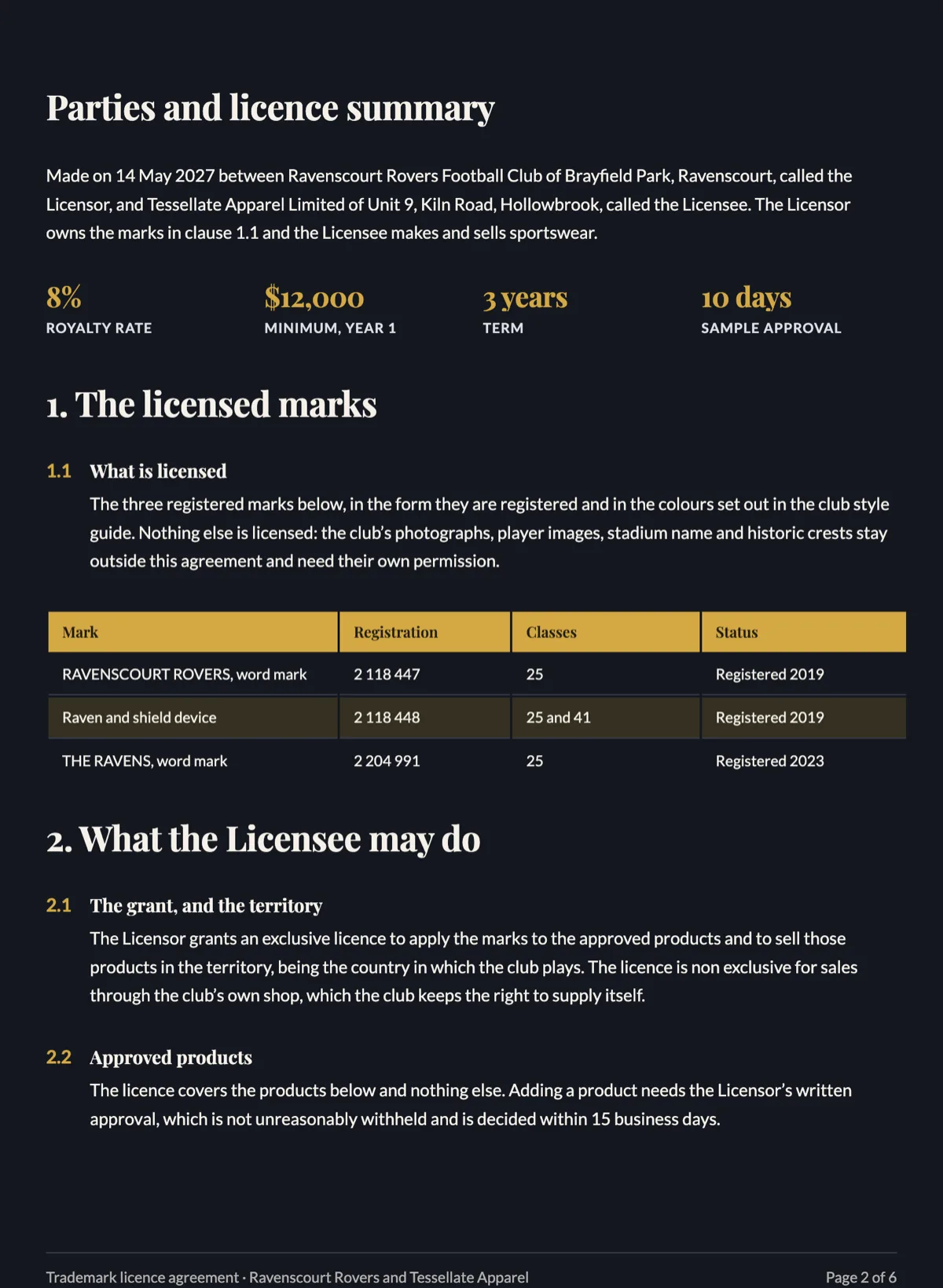 Trademark licence agreement with quality control and royaltiesA trademark licence lets someone else put your mark on their goods, and the clause that keeps it worth doing is quality control. This one licenses three registered marks from a football club to an apparel maker for three years, at 8 per cent of net wholesale sales with a rising minimum, and approval of every pre production sample in ten business days.
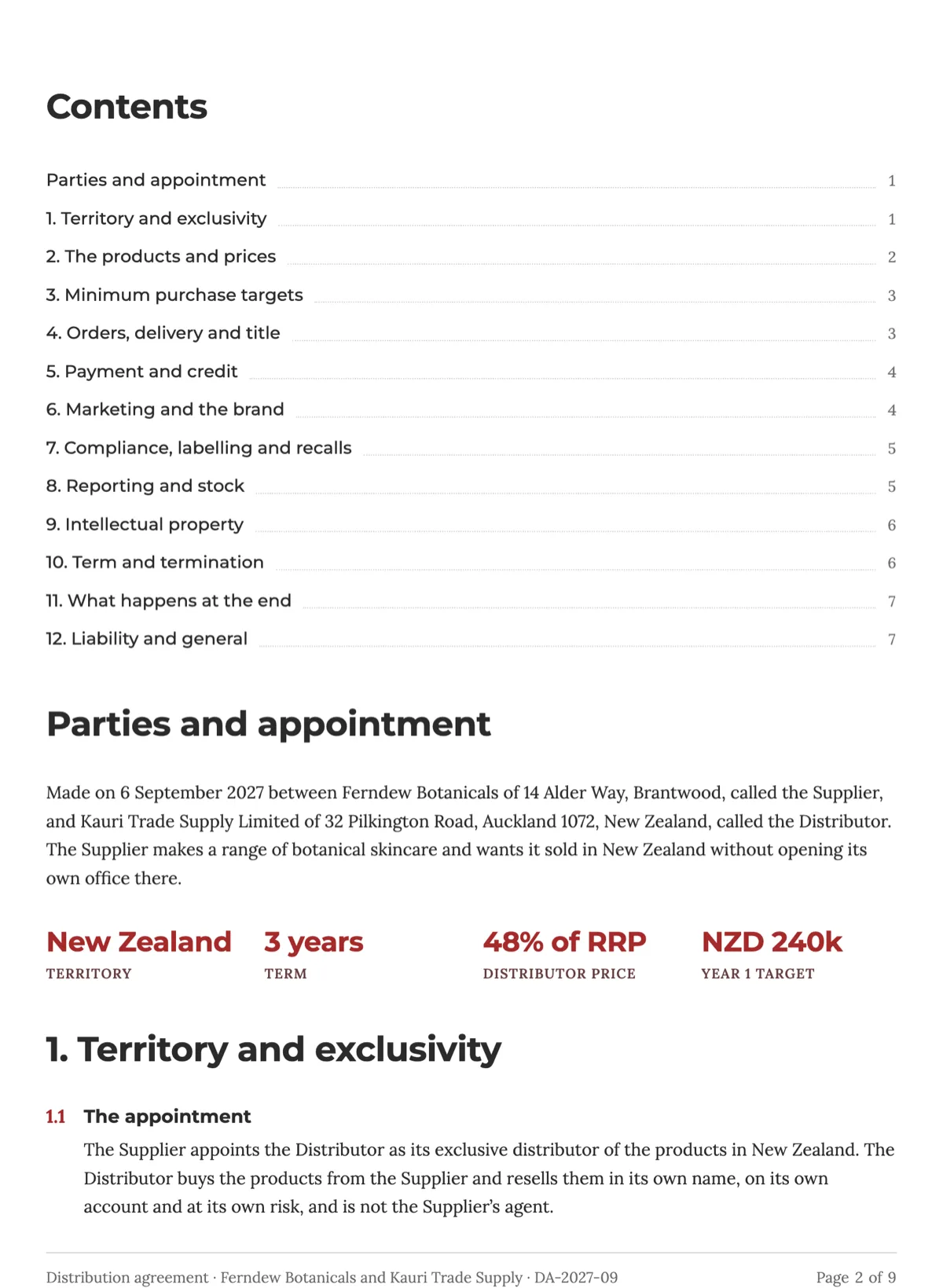 Distribution agreement template with territory and targetsAn exclusive distribution agreement is a trade: a territory in exchange for volume. This one appoints a New Zealand distributor for a skincare range at 48 per cent of recommended retail, with purchase targets rising from NZD 240,000 to NZD 420,000 across three years, and exclusivity that converts to non exclusive if a target is missed by more than 15 per cent.
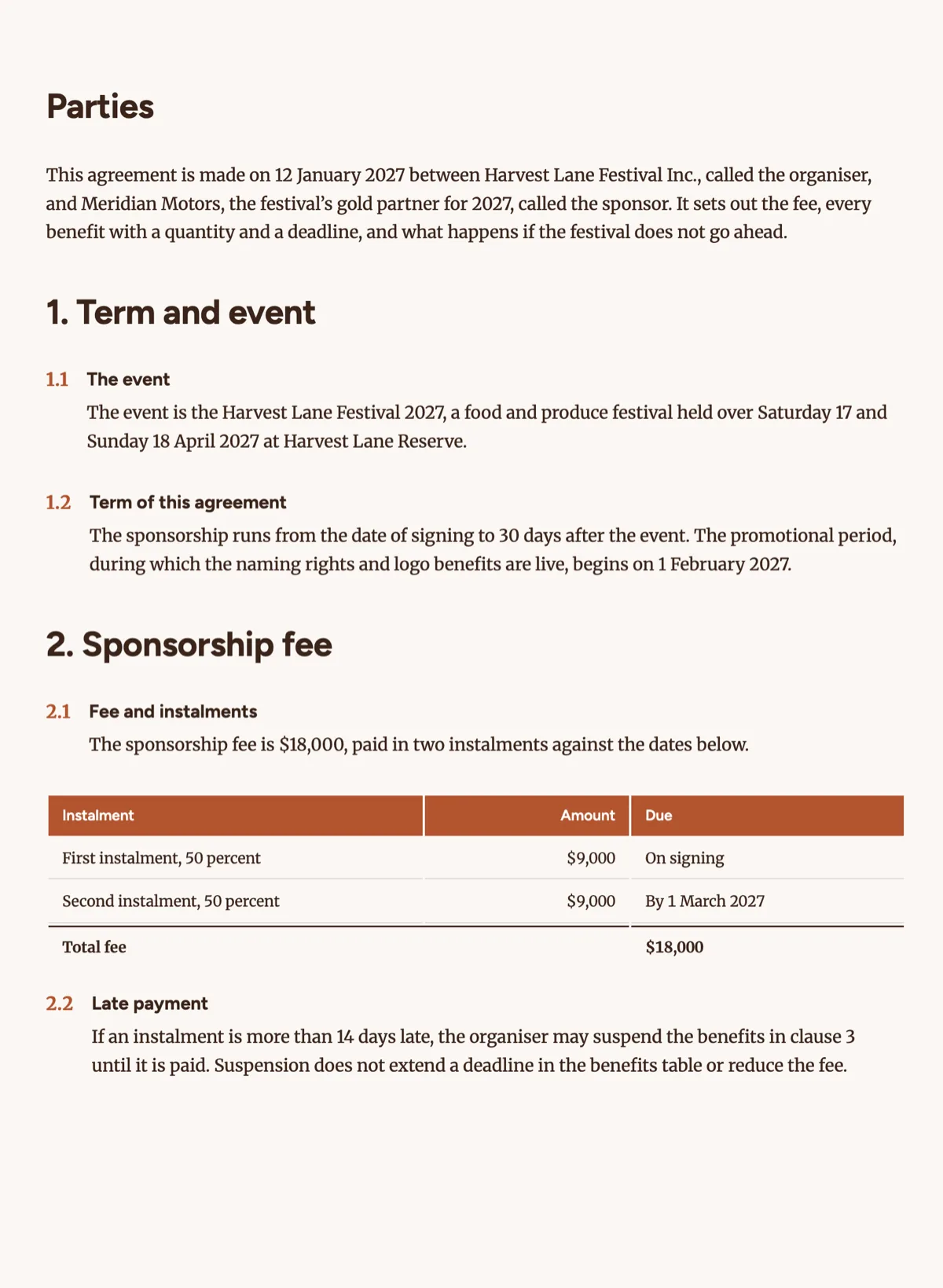 Sponsorship agreement template that lists every benefit with a numberSponsorship falls apart in the delivery, when nobody can find the email that said how many banners and which stage. This agreement is the benefits list as a table with quantities and dates, the $18,000 fee in instalments tied to those dates, and the two clauses sponsors care about most: exclusivity, and what happens if the event does not go ahead.
Questions people ask
Does a trademark licence have to be registered in Australia?
No. A licence between the owner and the user is effective as a contract without any filing. What matters for the owner's rights is that the licensee uses the mark under the owner's control. Registering the mark itself remains the owner's responsibility, and the clause should say the licensee acquires no ownership.
Can a licensee register the mark overseas?
A well drafted clause says no, and goes further by prohibiting any mark, business name or domain that includes or resembles the licensed mark anywhere. Licensees operating overseas sometimes register a brand first, which leaves the owner negotiating to recover its own name. Owners planning expansion register in the target country before licensing there.
What should a brand guide contain?
The approved versions of the logo, clear space and minimum size rules, colour values, typefaces, placement examples and uses that are not allowed. The licence should incorporate the guide by reference and allow updates on notice, so the owner can refresh the brand without renegotiating the contract.
Is a sponsorship logo swap a trademark licence?
In substance, yes, though usually a narrow one. Each party permits the other to reproduce its logo for a named campaign. A short mutual clause limited to the campaign, the period and approved material is enough, and it avoids either party later claiming broader rights from a one off promotion.
Who sues an infringer, the owner or the licensee?
The owner usually controls enforcement. Licence clauses commonly require the licensee to report suspected infringement promptly and assist, while the owner decides whether to act and keeps any damages. Exclusive licensees sometimes negotiate a right to act if the owner declines, at their own cost.
What happens if the licensee lets quality slip?
The clause should give the owner a notice to correct the failure within a set period and a right to terminate if it is not fixed. Without that remedy, the owner's only options are to tolerate the problem or argue repudiation, and tolerated poor quality undermines the control that protects the mark.
Put the clause in a finished document
The button opens the document generator with a starting description already filled in. Change it to match your own agreement before you run it.
Create a document with OneCraftRelated clauses
- Licence grant clauseA licence grant clause gives permission to use intellectual property without owning it. Sample photo licence wording and the six terms every grant settles.
- Publicity clauseA publicity clause says whether a supplier can name a client, use its logo or issue a release. Sample agency wording, consent variants and what to negotiate.
- Open source software clause: what a developer promises about code it did not writeAn open source software clause sets what a developer may put in a deliverable and what it must disclose. Sample wording, licence families and three variants.
- Feedback clause: who may use the suggestions a customer makesA feedback clause lets a supplier use the ideas a customer suggests without owing anything. Sample SaaS wording, licence and assignment variants, carve outs.
For everything the document generator can do, see the document maker.
Step by step in the builder: Create a document with AI, then Document builder components.
Written and checked by the OneCraft team. Last checked .