Contract clause
Feedback clause: who may use the suggestions a customer makes
A feedback clause gives a supplier the right to use suggestions, bug reports and feature ideas its customer volunteers, without paying for them or crediting the customer. It usually takes the form of a broad licence or an assignment, and it is drafted so that the customer's confidential information is kept out of it.
Software suppliers ask customers for ideas constantly, then build the good ones into a product sold to everyone. The feedback clause exists so that nobody later claims a share of a feature because they mentioned it on a support call.
Indunil Asanka · Co-founder
4 min read · Published
Sample clause
a subscription agreement between Tallowood Rostering, a fictional scheduling software supplier, and Coralbay Aged Care, a residential care provider in Townsville that uses the rostering platform across three sites
9. Feedback 9.1 Feedback means any suggestion, idea, enhancement request, bug report or other comment about the Platform that the Customer or its Users give to Tallowood Rostering, whether in writing, in a meeting or through the Platform. 9.2 The Customer grants Tallowood Rostering a perpetual, irrevocable, worldwide, royalty free licence to use, copy, modify and incorporate Feedback into any product or service, and to sublicense those rights. 9.3 Feedback does not include the Customer's Confidential Information, resident records or Personal Information, and clause 9.2 does not permit Tallowood Rostering to disclose any of them. 9.4 Tallowood Rostering is not required to act on Feedback, to credit the Customer, or to pay any amount for it. 9.5 Nothing in this clause transfers ownership of any intellectual property the Customer owns apart from this clause.
Sample wording, not legal advice.
Variants
Assignment of feedback
The supplier wants clean ownership of anything built from suggestions, usually because it expects to register or sell the product later.
The Customer assigns to the Supplier all right, title and interest in any Feedback, including all intellectual property rights in it, with effect from the time the Feedback is given. The Customer must do anything the Supplier reasonably requests to confirm that assignment. The assignment does not extend to the Customer's Confidential Information or Personal Information, or to any material the Customer owned before giving the Feedback.
Non exclusive licence with the customer keeping ownership
A larger customer that contributes detailed specifications and does not want to lose the right to reuse its own ideas with other vendors.
The Customer retains ownership of any Feedback it provides. The Customer grants the Supplier a non exclusive, perpetual, royalty free licence to use Feedback to improve the Services and the Supplier's other products. The Customer may use its own Feedback for any purpose, including with other suppliers. Neither party is required to pay the other for Feedback or for any product feature that results from it.
No feedback rights
A customer in a regulated sector that refuses to grant rights over anything its staff say and prefers to deal with contributions case by case.
Nothing in this Agreement grants the Supplier any right to use suggestions or other comments made by the Customer, except to perform the Services. Where the Supplier wishes to use a suggestion in its products, it must first ask the Customer in writing, and the parties will agree the terms of that use, including any attribution, in a separate written document signed by both parties.
What to negotiate
Keeping confidential material out
A customer describing a problem often explains how its business runs, and that explanation can be confidential. A feedback licence with no carve out can be read as permission to use it. Customers ask for Confidential Information and Personal Information to be excluded expressly, and for the confidentiality clause to prevail if the two conflict. Suppliers rarely resist, because the ideas are what they want.
Licence or assignment
An assignment gives the supplier ownership, which some customers dislike on principle. A perpetual, irrevocable licence gives the supplier everything it practically needs without a transfer. Many negotiations settle on the licence, sometimes with a promise from the customer not to assert any rights it has in a feature built from its suggestions.
Who counts as giving feedback
Feedback usually arrives from users, not from the signatory. The clause should say that suggestions from the customer's staff and authorised users are covered, otherwise the supplier holds rights over the contract manager's emails but not over the hundred tickets its users actually lodged.
The risk of leaving it out
Without a feedback clause the supplier relies on the general position that ideas are not property. That position is sound for a bare idea but weak for a detailed written specification, a mock up or sample code, which copyright can protect, and for suggestions given in confidence. A customer could then argue it owns or controls part of a feature sold to others.
Why an idea needs a clause at all
Australian copyright law protects the form in which an idea is expressed, not the idea itself, so a customer who says a report should group shifts by ward has handed over nothing a court would call property. Feedback is rarely that thin. It comes as annotated screenshots, spreadsheets showing the calculation a customer wants, and occasionally code written by the customer's own developers. Those are works in which copyright can exist. Information shared in confidence can also be protected by the equitable duty of confidence. The clause converts an uncertain position into a written permission.
Where the clause usually sits
Feedback wording belongs in the intellectual property section of a software licence, a subscription agreement or a master services agreement, next to the clauses on background material and ownership of deliverables. It should be read with the confidentiality clause, since the two overlap whenever a customer explains a problem. Beta programme terms and pilot agreements carry it too, often in a stronger form, because gathering feedback is the reason the pilot exists. Consulting and design agreements rarely need it, since the client is paying for the ideas and the ownership clause already deals with them, so adding a feedback licence there can quietly hand back rights the client expected to hold.
Where it sits in a generated document
A description of a subscription or licence agreement produces numbered clauses, so feedback can be asked for as its own clause under intellectual property, with the definition and the licence as separate sub clauses. The generated text comes from the description alone and prints no citations. Naming the carve out for confidential and personal information in the description is the simplest way to make sure it appears.
Documents that carry this clause
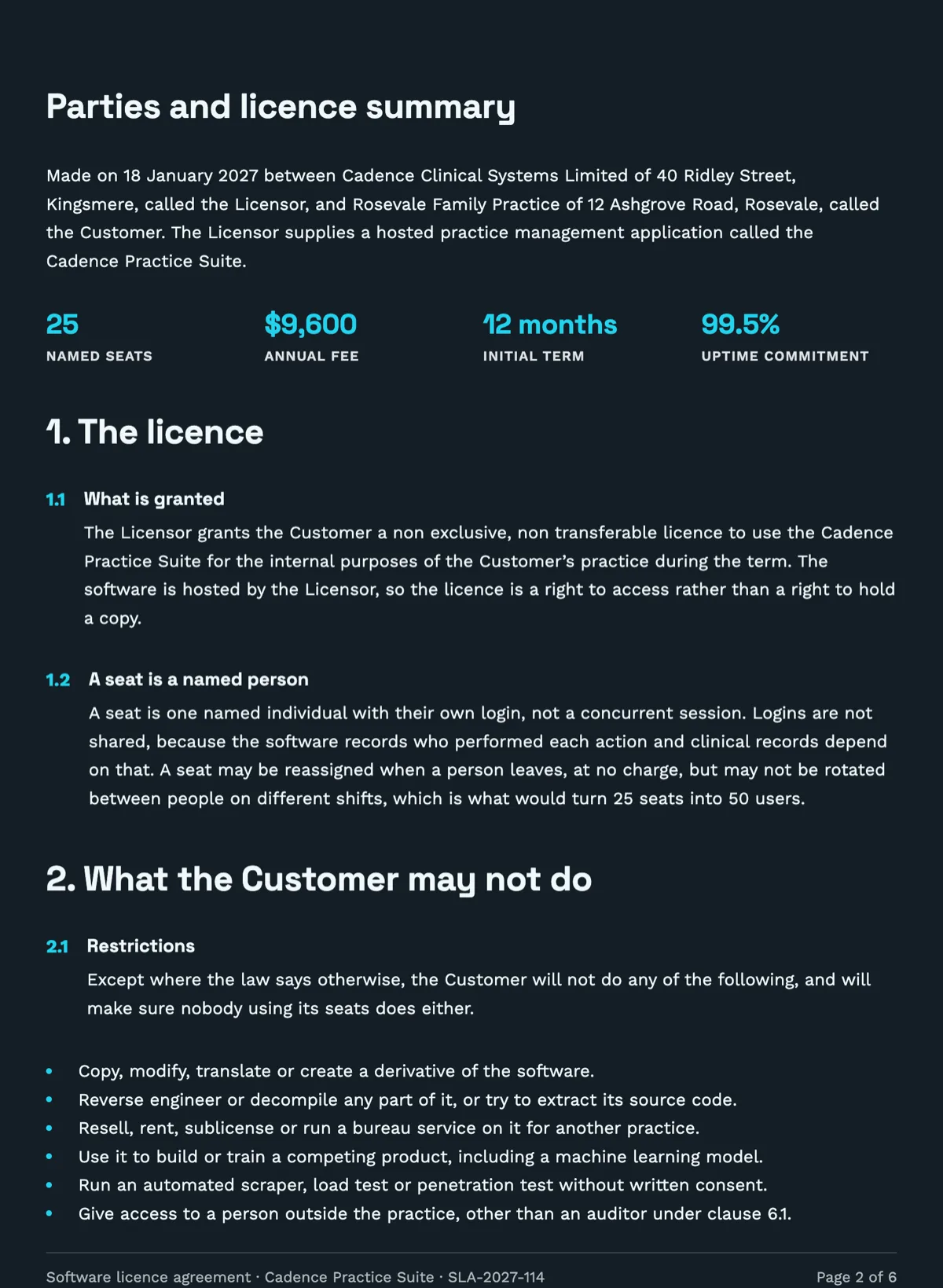 Software licence agreement template with seats, term and supportA software licence agreement has to answer three questions before anything else: what a seat is, what happens when the software is down, and who gets the data at the end. This one licenses a hosted practice management suite to a medical practice for 25 named users at $9,600 a year, with a support table, uptime credits and a 30 day export.
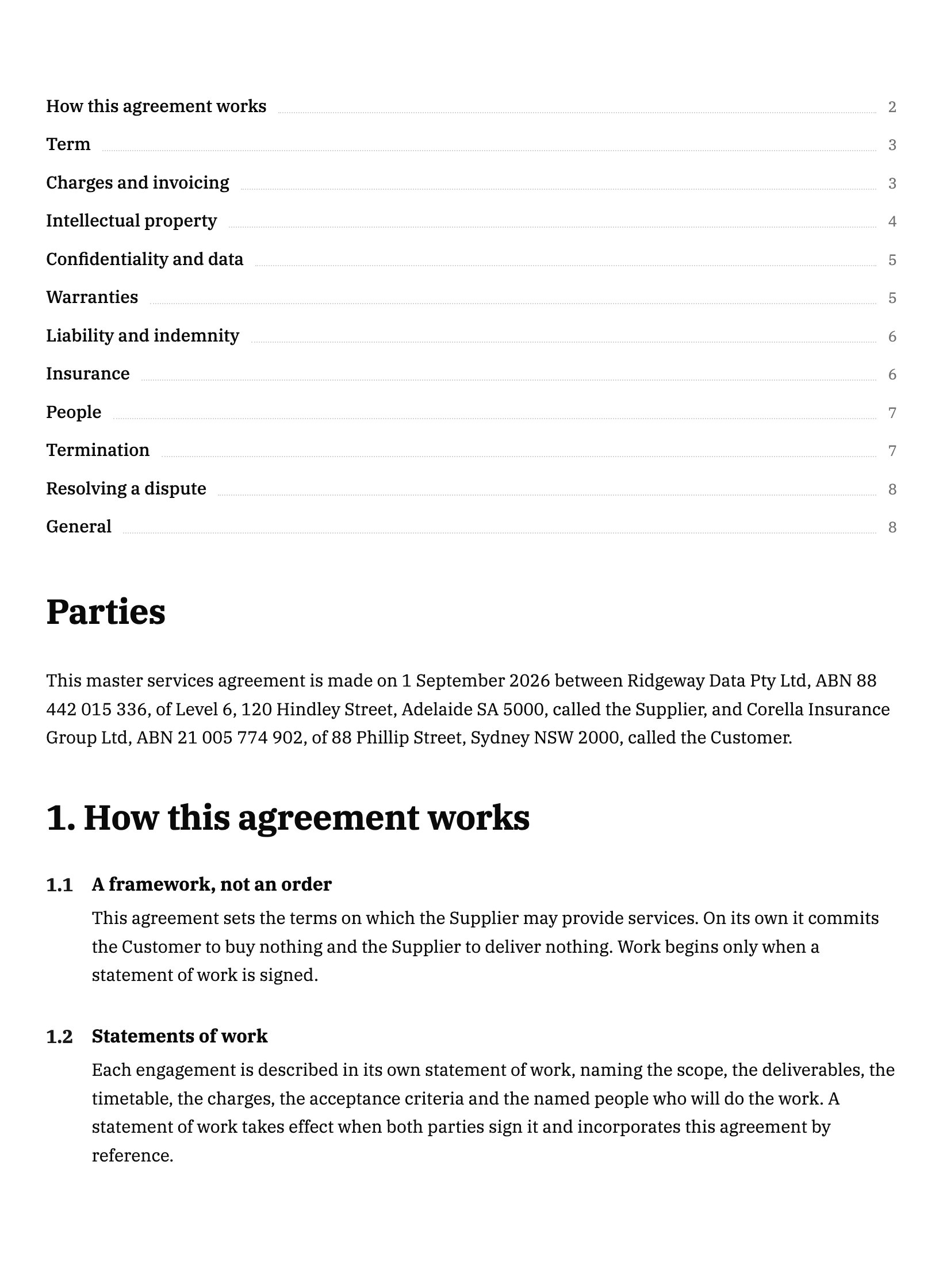 Master services agreementA data consultancy and an insurer sign this once and then buy work under it for three years. It is the rare contract whose whole purpose is to make the next twenty contracts short.
Questions people ask
Does a customer own an idea it suggests to a software company?
Usually not in any legal sense. An idea on its own is not protected by copyright in Australia, which covers the form of expression. What a customer can have rights in is a written specification, a design mock up, sample code, or information shared in confidence. The feedback clause settles the question for all of those at once.
Is a feedback clause unfair to the customer?
Not usually, provided it is limited to suggestions about the product and excludes confidential and personal information. Customers get improvements they asked for, and suppliers avoid a claim over each release. The version customers push back on is an assignment wide enough to capture the customer's own business processes or pre existing material.
Should feedback be credited to the customer?
Most clauses say no, because tracking who suggested what across thousands of tickets is impractical and a credit can be read as a claim. Some customers ask for the right to be named in release notes. A clause can permit that at the supplier's discretion without creating an obligation.
Does the clause cover bug reports?
It should. Bug reports often contain the most useful information a supplier receives, including steps that reveal how the product fails. Naming bug reports, enhancement requests and survey responses in the definition avoids an argument that only formal suggestions were caught.
Can a feedback clause override confidentiality?
Only if it is drafted badly. The usual structure excludes the customer's Confidential Information from the definition of Feedback and states that the confidentiality clause prevails. Without that, a broad licence to use anything the customer says could be argued to authorise use of information the customer never meant to share.
Do free trial and beta terms need a feedback clause?
They are where it matters most, because the whole point of a beta is to collect comments and act on them. Beta terms commonly pair a broad feedback licence with a disclaimer of warranties and a short term. The clause should still exclude confidential and personal information.
Put the clause in a finished document
The button opens the document generator with a starting description already filled in. Change it to match your own agreement before you run it.
Create a document with OneCraftRelated clauses
- Licence grant clauseA licence grant clause gives permission to use intellectual property without owning it. Sample photo licence wording and the six terms every grant settles.
- Confidentiality clauseA confidentiality clause inside a wider contract, not a standalone NDA. Sample consulting wording, mutual and one way variants, the tail period and exceptions.
- Open source software clause: what a developer promises about code it did not writeAn open source software clause sets what a developer may put in a deliverable and what it must disclose. Sample wording, licence families and three variants.
- Trademark licence clause: using a brand without owning itA trademark licence clause lets another business use a name or logo under the owner's quality control. Sample wording, co marketing and approval variants.
For everything the document generator can do, see the document maker.
Step by step in the builder: Create a document with AI, then Document builder components.
Written and checked by the OneCraft team. Last checked .