Classic form
Accountant new client form that never asks for a TFN
Half of what an accounting firm needs from a new client is structural, the entity, the ABN, the GST cycle and the software, and the one thing it must not collect in a web form is the tax file number. This sixteen field new client form gets the first list and refuses the second, asking instead how the number will be handed over.
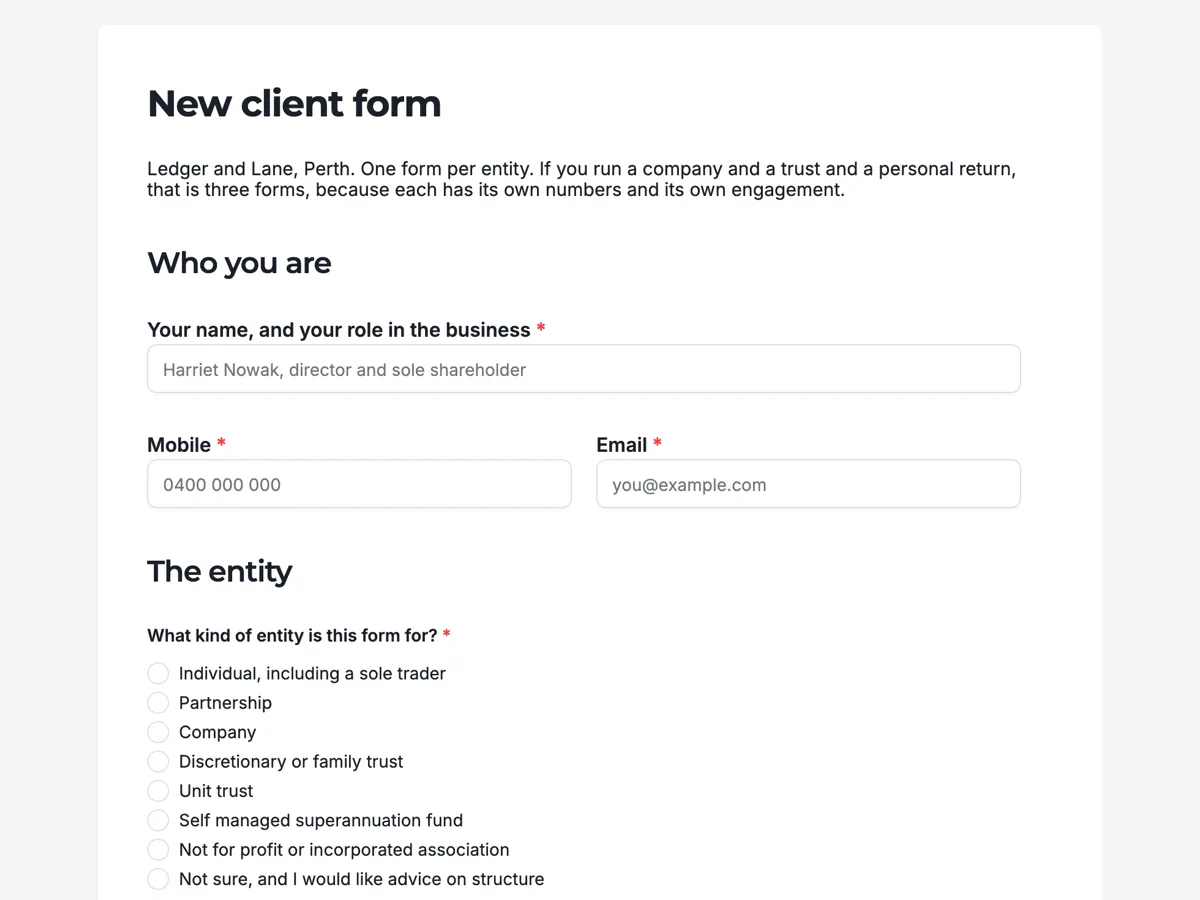
The form itself
A static copy of the finished form, exactly as it renders. Nothing here can be filled in or submitted, so read it as a reference and build your own from the button above.
Every field, and what it collects
The complete field list, in the order respondents meet it.
- Your name, and your role in the businessShort textRequired
- MobileShort textRequired
- EmailShort textRequired
- What kind of entity is this form for?Single choiceRequired
- Options: Individual, including a sole trader · Partnership · Company · Discretionary or family trust · Unit trust · Self managed superannuation fund · Not for profit or incorporated association · Not sure, and I would like advice on structure
- Entity name, exactly as it is registeredShort textRequired
- ABNShort text
- Is the entity registered for GST?Single choiceRequired
- Options: Yes, reporting quarterly · Yes, reporting monthly · Yes, reporting annually · No, under the threshold · No, and I think we may have passed the threshold · Not sure
- How would you like to provide the tax file number?Short textRequired
- What accounting software is in use?DropdownRequired
- Options: A cloud accounting subscription in the business name · A cloud subscription held by the previous accountant · Desktop accounting software · Spreadsheets · A shoebox, receipts and bank statements · A point of sale system that exports · Nothing yet, the business has just started
- Do you consent to bank feeds being connected?Single choiceRequired
- Options: Yes, feeds are already connected · Yes, please set them up · Yes, but read only access to the accounts · No, I will provide statements each quarter · I would like this explained first
- Previous accountant, firm and contactShort text
- Have they been told you are moving?Single choiceRequired
- Options: Yes, they know · No, and I would rather tell them myself first · No, please handle it as part of the transfer · Not applicable, no previous accountant · There is a fee dispute they may raise
- Which services are you asking for?Multiple choiceRequired
- Options: Annual financial statements · Company, trust or partnership tax return · Individual tax returns for the owners · Business activity statements · Bookkeeping · Payroll and single touch payroll · Superannuation guarantee lodgement · Fringe benefits tax return · Self managed super fund administration · Budgeting and cash flow reporting · Structure or restructure advice · An ATO debt or lodgement catch up
- Which financial year should the firm start with?Short textRequired
- Engagement acknowledgementMultiple choiceRequired
- Options: I understand an engagement letter will be provided before any work begins · I confirm nobody has typed a tax file number into this form
- SignatureSignatureRequired
Who you are
The entity
Tax file number
How the books are kept
What you want done
Engagement
What each block of this form collects
The contact block is three fields and asks for a role rather than a job title, because director, partner, trustee and bookkeeper each mean something different about who can sign what. The entity block is where the form earns its keep: the type, the registered name in full including any trustee capacity, the ABN with a length check, and the GST cycle. The tax file number block is a paragraph and a single question about method. The books block covers the software, bank feeds and the previous accountant, including the question nobody likes asking. Services and the starting financial year define the scope, and the engagement block makes it explicit that none of this is an engagement yet.
The Australian pieces on this form
Everything structural here is Australian. The entity list separates a discretionary trust from a unit trust and both from a company, because the return, the distributions and the advice differ at every point. The registered name placeholder shows a company acting as trustee for a family trust, which is the shape a great many small Australian businesses take and the one most often written down wrong. The ABN field is plain text that the firm checks against the register, and the GST question asks for the reporting cycle rather than a yes, since quarterly, monthly and annual activity statements are three different workloads. The engagement paragraph notes that identity verification is a separate step before the firm can be added as tax agent, which is the part new clients are most often surprised by.
How to adapt this form
A firm doing mostly individual returns drops the entity block to a single sole trader question and adds occupation, whether there is a rental property, whether there are shares or crypto sold during the year, and whether a spouse return is also needed. A self managed super fund specialist replaces the services list with a fund block: the trustee structure, the members, the auditor, the investment types held and whether a property inside the fund is geared. A bookkeeping practice drops the return services and adds the volume questions that set a monthly fee, transactions a month, employees on payroll and how many bank accounts and cards feed in.
What makes this form work
A paragraph and a field replace the TFN box
The form refuses to collect a tax file number and says why, then asks how it will be handed over instead. The second acknowledgement tick, confirming nobody typed one in, makes the rule visible to the person who was about to.
The entity name placeholder shows a trustee company
Nowak Joinery Pty Ltd as trustee for the Nowak Family Trust. That one example teaches the field what a correct answer looks like, which is the difference between a name the firm can act on and one it has to ring back about.
The GST question asks for the cycle, not a yes
Quarterly, monthly, annual, under the threshold, possibly over it, and not sure. Six answers that between them set the activity statement workload, and two of them are honest admissions rather than facts.
Questions people ask
Why will an accounting firm not take a tax file number on a form?
Because it is protected information with its own handling rules, and a web form and an email are the two worst places to put one. The paragraph says so plainly and the field beside it asks for a method instead: in person, read over the phone, or through a secure portal link sent with the engagement letter.
Why is it one form per entity?
Because each entity has its own ABN, its own GST cycle, its own return and its own engagement letter. A client who runs a company, a trust and a personal return is three engagements, and folding them into one form produces answers that cannot be attached to anything. The introduction says so in its first two lines.
What does the bank feeds question change?
How the bookkeeping is done and what the firm can see. Feeds already connected, feeds to be set up, read only access, or statements provided quarterly are four different workflows and four different fees. The last option, I would like this explained first, is there because plenty of clients have not been asked this before.
Why ask whether the previous accountant knows?
Because the transfer is handled differently depending on the answer. Clients who would rather tell their old accountant themselves should be allowed to, and a fee dispute is worth knowing about before an ethical letter goes out. Five options make an awkward question answerable in one click.
Does the ABN field check that the number is real?
No. The form takes whatever is typed and does not check the digits, so a missing or extra digit reaches the firm as written. Validating an ABN against the register is a lookup no form does, and the firm confirms it as part of the engagement anyway, at the same time it verifies the entity name, the trustee capacity and the GST registration shown on the public record.
What happens after this form is sent?
An engagement letter comes back, setting out the scope, the fee basis, what the firm needs from the client and by when. Nothing is lodged and nothing is charged until it is signed. Identity verification happens separately before the firm can be added as tax agent, which the engagement paragraph names.
Build your own in about a minute
The button below opens the generator with this use case already described. Change the wording to match your own, generate, then edit anything you like.
Make one like thisOther form examples
Financial planning fact find with five tables and a risk profile
An adviser cannot recommend anything until the whole balance sheet is on one page, which is why a fact find is long and why most of it is tables rather than questions. This twenty four field fact find carries goals with dollar figures, assets and liabilities, every super fund and every existing policy, then a seven statement risk profile.
Law firm client intake form with the conflict check on it
A firm cannot give a word of advice until it knows who else is involved, because acting against an existing client is the one mistake that ends a matter before it starts. This fifteen field intake form puts the conflict check on the form as a four row table of other parties, and says plainly that the enquiry engages nobody.
Dog grooming intake form with the matting consent already signed
A grooming appointment goes wrong in two ways: the coat is worse than the booking allowed for, or the dog will not tolerate the dryer and nobody warned the groomer. This intake form asks about both before the appointment, and it takes the matting consent in writing so the conversation at the table is about the coat rather than about permission.
Want the steps in the builder? Read Every form field and when to use it, then Control who can fill in your form. For everything this generator can do, see the form maker.
Written and checked by the OneCraft team. Last checked .