Classic form
Financial planning fact find with five tables and a risk profile
An adviser cannot recommend anything until the whole balance sheet is on one page, which is why a fact find is long and why most of it is tables rather than questions. This twenty four field fact find carries goals with dollar figures, assets and liabilities, every super fund and every existing policy, then a seven statement risk profile.
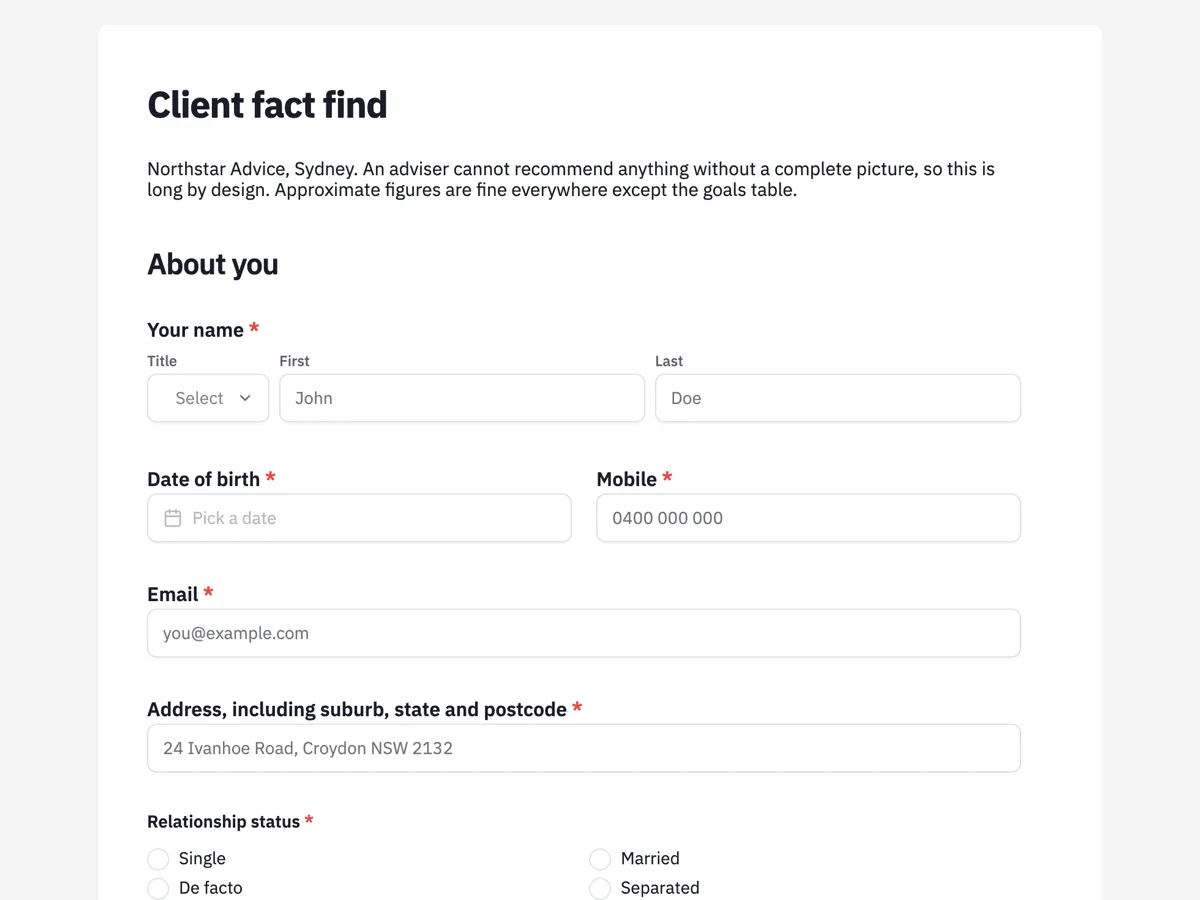
The form itself
A static copy of the finished form, exactly as it renders. Nothing here can be filled in or submitted, so read it as a reference and build your own from the button above.
Every field, and what it collects
The complete field list, in the order respondents meet it.
- Your nameNameRequired
- Date of birthDateRequired
- MobileShort textRequired
- EmailShort textRequired
- Address, including suburb, state and postcodeShort textRequired
- Relationship statusSingle choiceRequired
- Options: Single · Married · De facto · Separated · Divorced · Widowed
- Dependants, and their agesShort textRequired
- Employment statusSingle choiceRequired
- Options: Employed, full time · Employed, part time or casual · Self employed or a business owner · Contractor · Retired · Not working at the moment · On parental or extended leave
- Occupation and employerShort textRequired
- Gross salary a year, before taxNumberRequired
- Other income a year, before taxNumber
- Household spending a monthNumberRequired
- Age you would like to retireNumber
- Your goalsTable
- Columns: Goal · Timeframe · Amount in dollars
- Assets, excluding superannuationTable
- Columns: Asset · Owner · Approximate value
- LiabilitiesTable
- Columns: Debt · Lender · Balance owing · Interest rate · Repayment a month
- Superannuation fundsTable
- Columns: Fund name · Approximate balance · Insurance held inside it
- Existing insuranceTable
- Columns: Type of cover · Insurer · Sum insured · Inside super or held directly
- How much do you agree with each statement?Rating gridRequired
- Statements:
- I would accept a lower return for more certainty
- A drop of twenty percent in a year would make me sell
- I understand how shares and property differ as investments
- I have been through a market downturn while invested
- I check my balances more than once a month
- I would borrow to invest if the numbers made sense
- Protecting what I have matters more than growing it
- Wills and powers of attorneySingle choiceRequired
- Options: Both in place and reviewed in the last five years · A will, but no power of attorney · Both, but out of date · Neither · Not sure what I have
- What would you like advice on?Multiple choiceRequired
- Options: Retirement planning · Superannuation consolidation and contributions · Investment outside super · Personal insurance · Debt and mortgage strategy · Cash flow and budgeting · Estate planning · Redundancy or a lump sum · Aged care for a parent · Centrelink entitlements
- Anything else your adviser should knowLong text
- ConsentMultiple choiceRequired
- Options: I consent to my information being collected and used to prepare advice · I authorise the adviser to request details of my superannuation and insurance from the providers listed above
- SignatureSignatureRequired
About you
Work and income
Goals
Assets and liabilities
Superannuation
Insurance already held
How you feel about risk
Estate and what you want advice on
Privacy and consent
What each block of this form collects
Seven personal fields, then work and income as four numbers on two rows, which is the whole cash flow picture an adviser needs before the modelling starts. The goals table comes before the money tables on purpose, because a client who lists their goals first fills in the balance sheet thinking about what it has to achieve. Assets and liabilities are separate tables because they behave differently: an asset needs an owner, and a debt needs a rate and a repayment. Superannuation gets its own table since the fund name matters more than the balance, and insurance gets one because the crucial column is whether the cover sits inside super or is held directly. The risk grid is seven statements, and the last block is consent to go and verify all of it.
The Australian pieces on this form
Three things here are specifically Australian. Superannuation is asked for as a table of funds rather than a single balance, because multiple accounts from multiple jobs are the norm and consolidating them is one of the most common first recommendations. The insurance table asks whether cover is held inside super or directly, since premiums paid from a super balance erode retirement savings quietly and duplicated cover across two funds is the classic finding of a first fact find. The advice list names Centrelink entitlements and aged care for a parent, which are two of the most common reasons an Australian household first books an adviser. The consent paragraph names the Financial Services Guide and states that nothing is advice until a written statement of advice is given.
How to adapt this form
A couple is two fact finds plus one joint sheet: each partner completes the personal, income, super, insurance and risk sections separately, because risk tolerance differs inside almost every couple, and the assets, liabilities and goals tables are filled in once between them. A retirement specialist drops the debt strategy line from the advice list and adds a pension block, the account based pension already in place, the drawdown rate and any Centrelink age pension currently received. A risk advice practice keeps the insurance table and the dependants question and adds an occupation duties description, a smoking question and a medical history block, since those three set the premium and the underwriting path.
What makes this form work
Goals come before the balance sheet
Three rows with a goal, a timeframe and an amount, placed above the asset and liability tables. A client who writes their goals first fills in the money tables thinking about what the money is for, which is a different and better set of answers.
The liabilities table carries the rate and the repayment
Debt, lender, balance, interest rate and repayment a month. Five columns turn a list of debts into something that can be modelled, and the rate column is where an adviser spots the card sitting at twenty percent behind a mortgage at six.
Insurance is asked with one decisive column
Inside super or held directly. That single column separates premiums quietly eroding a retirement balance from ones a household knowingly pays, and it is where duplicated cover across two funds shows itself.
Questions people ask
Why does a fact find need a dollar figure against every goal?
Because a goal without a number cannot be modelled. Pay off the mortgage is a wish; pay off 280,000 dollars in eleven years is a calculation with a required return and a required contribution attached. The paragraph above the goals table says exactly that, and the table gives the amount its own column, so a goal written without a figure stands out when the adviser reads it.
What if I do not know my superannuation balances?
Write the fund name and an estimate. The paragraph above that table says balances can be checked through myGov, and the second consent tick authorises the adviser to request the details from the providers listed. A guess with a fund name attached is useful; a blank row is not, because the fund is the part that gets chased.
Why does the insurance table ask whether cover is inside super?
Because it changes who pays and what it costs. Premiums paid from a super balance reduce retirement savings without ever appearing in a household budget, and the same cover duplicated across two funds is one of the most common findings in a first fact find. The column makes it visible in one pass.
Is the risk profile a score?
No, and the paragraph above the grid says so. Seven statements rated from strongly disagree to strongly agree are a starting point for a conversation, and they are compared against what the client's own goals actually require. The gap between comfort and requirement is usually the most useful thing the grid produces.
Why is the owner column on the assets table?
Because whose name something is in decides how it is taxed and what can be restructured. An investment property held jointly, a share portfolio in one name and a term deposit inside a family trust lead to three different recommendations, and an adviser cannot tell which is which from a value alone.
Does signing this form mean I have received advice?
No. The privacy paragraph states that nothing is advice until a written statement of advice is given, and that a Financial Services Guide has been provided separately. What the signature records is consent to collect and use the information, plus authority to verify the superannuation and insurance details with the providers.
Build your own in about a minute
The button below opens the generator with this use case already described. Change the wording to match your own, generate, then edit anything you like.
Make one like thisOther form examples
Home care intake form that asks about the house too
A home care visit fails on practical things long before it fails on clinical ones: the step with no rail, the dog behind the gate, the key nobody mentioned. This twenty field intake form collects the package level and the services alongside the access notes that decide whether the first visit works.
Mortgage broker fact find a lender can read in one sitting
A fact find is the document a loan application is actually built from, and it falls apart when income, debts and living expenses arrive in three emails a week apart. This one takes all three as tables on a single form, with the loan purpose at the top and the credit consent signed at the bottom.
Accountant new client form that never asks for a TFN
Half of what an accounting firm needs from a new client is structural, the entity, the ABN, the GST cycle and the software, and the one thing it must not collect in a web form is the tax file number. This sixteen field new client form gets the first list and refuses the second, asking instead how the number will be handed over.
Want the steps in the builder? Read Every form field and when to use it, then Paginate a classic form into steps. For everything this generator can do, see the form maker.
Written and checked by the OneCraft team. Last checked .