Classic form
Mortgage broker fact find a lender can read in one sitting
A fact find is the document a loan application is actually built from, and it falls apart when income, debts and living expenses arrive in three emails a week apart. This one takes all three as tables on a single form, with the loan purpose at the top and the credit consent signed at the bottom.
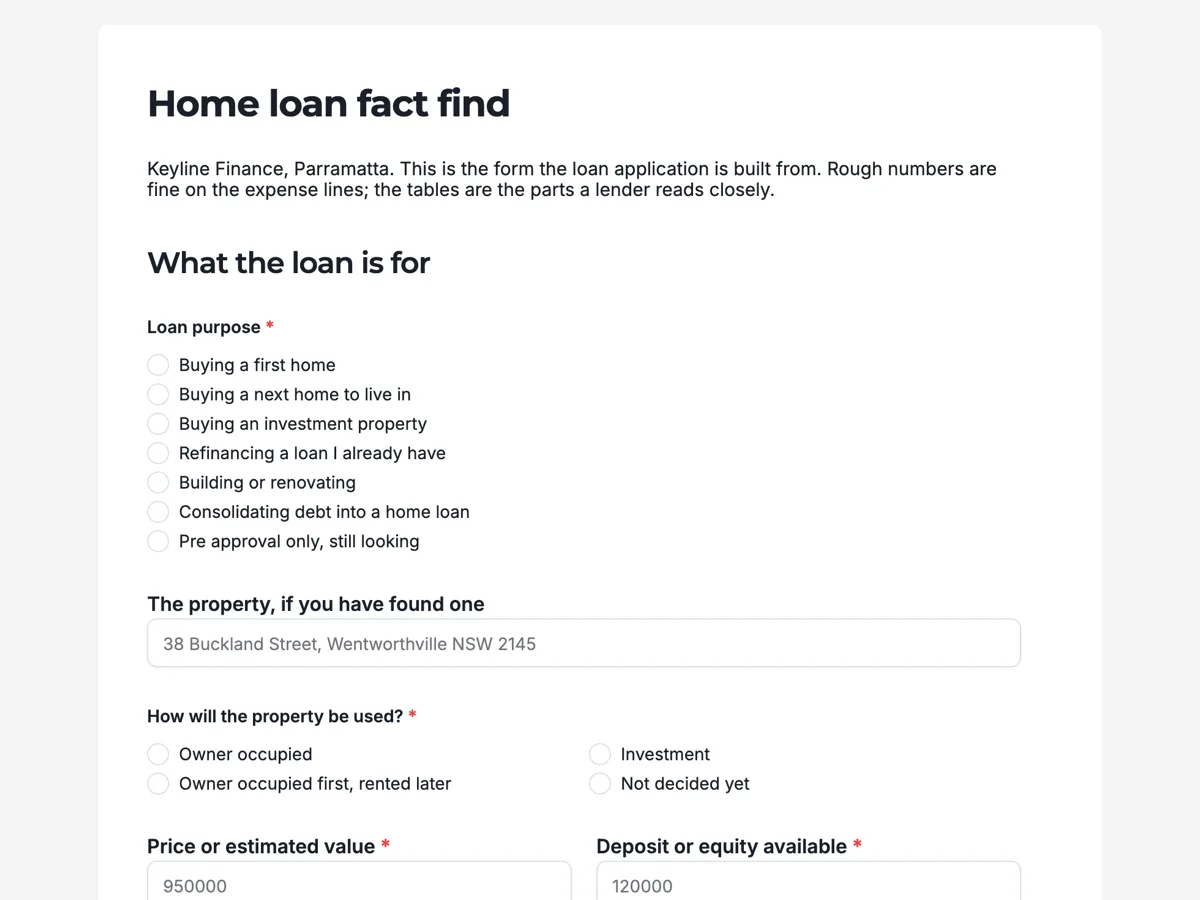
The form itself
A static copy of the finished form, exactly as it renders. Nothing here can be filled in or submitted, so read it as a reference and build your own from the button above.
Every field, and what it collects
The complete field list, in the order respondents meet it.
- Loan purposeSingle choiceRequired
- Options: Buying a first home · Buying a next home to live in · Buying an investment property · Refinancing a loan I already have · Building or renovating · Consolidating debt into a home loan · Pre approval only, still looking
- The property, if you have found oneShort text
- How will the property be used?Single choiceRequired
- Options: Owner occupied · Investment · Owner occupied first, rented later · Not decided yet
- Price or estimated valueNumberRequired
- Deposit or equity availableNumberRequired
- Loan amount you think you needNumberRequired
- ApplicantsTableRequired
- Columns: Full name · Date of birth · Citizenship or visa status · Dependants
- Current address and how long you have lived thereShort textRequired
- Income before taxTableRequired
- Columns: Applicant · Employer or source · Role · Gross a year
- Employment type of the main applicantSingle choiceRequired
- Options: Full time permanent · Part time permanent · Casual · Fixed term contract · Self employed sole trader · Company or trust director · Not currently working
- Time in the current roleDropdownRequired
- Options: Under 3 months · 3 to 6 months · 6 to 12 months · 1 to 2 years · 2 to 5 years · Over 5 years
- Other income, and where it comes fromLong text
- Loans, cards and buy now pay later accountsTableRequired
- Columns: Lender · Type · Limit or balance · Repayment a month
- HECS or HELP balance, if you have oneShort text
- Rent, board or current repaymentsNumberRequired
- Groceries and householdNumberRequired
- Transport, insurance and utilitiesNumberRequired
- Childcare, school fees and the restNumberRequired
- Which of these is closest to your credit history?Single choiceRequired
- Options: Never missed a payment I know of · One or two late payments in the last two years · A default listed against me · A debt agreement or bankruptcy, now finished · Currently in a hardship arrangement · I have no idea and would like it checked
- Payslips, statements and identificationFile upload
- Two recent payslips for each applicant, three months of the account your pay lands in, and one photo identification page. Images or PDF, up to 10 files, 10 MB each. Anything missing can follow by email.
- Privacy and credit consentMultiple choiceRequired
- Options: I consent to a credit report being obtained for this application · I consent to my information being given to the lenders I agree to
- Signature of the main applicantSignatureRequired
What the loan is for
Who is applying
What comes in
What you already owe
What you spend in a normal month
Credit history, documents and consent
Question banks built on this form
What each field on this form collects
The first block is the shape of the deal: the loan purpose as one of seven real reasons people call a broker, the property address where one has been found, how the property will be used, the price or estimated value, the deposit or equity available and the loan amount the borrower thinks they need. The second block is who is applying, as a two row table carrying name, date of birth, citizenship or visa status and dependants, followed by the current address and how long they have been there. The income block is a four row table of applicant, employer, role and gross annual figure, then the employment type of the main applicant, the time in the current role and a free text field for income that is not salary. The liabilities table takes lender, type, limit or balance and monthly repayment across four rows, with a separate field for a study loan balance. Four number fields take housing, groceries, transport and everything else in a normal month. The last block is the credit history radio, the document upload, two consent ticks and the signature.
The Australian pieces on this form
Two parts of this form are shaped by Australian lending rules rather than by curiosity. The four living expense numbers exist because a lender compares declared spending with a benchmark household expenditure measure and assesses on whichever figure is higher, so a borrower who guesses low simply gets assessed on the benchmark and loses a week to clarifications. The study loan field is there because a HECS or HELP balance is a compulsory repayment taken from pay once income passes a threshold, which reduces borrowing capacity even though most people do not think of it as a debt.
How to adapt this form
A broker who mostly writes investment lending replaces the deposit field with an equity release pair, existing property value and current loan balance, and adds a rental income column to the income table, because serviceability on an investment purchase turns on rent and negative gearing rather than on savings. A commercial or asset finance version drops the living expense block entirely, since the test is business cash flow, and swaps the applicants table for an entity block taking the trading name, the ABN, the entity type and the directors. A refinance only version can cut the form roughly in half: the purpose radio collapses to two options, the property is already known, and the questions that matter become the current lender, the rate, the fixed period end date and the break cost, which is worth adding as its own short text field above the liabilities table.
What makes this form work
Three tables carry the numbers a lender reads
Applicants, income and liabilities are tables rather than paragraphs, so each one arrives as columns a broker can transcribe straight into a servicing calculator.
The expense block is four numbers, not a total
Rent or repayments, groceries, transport and commitments are asked separately in one two by two block, each with a realistic placeholder. The paragraph above says why the honest answer is faster.
Consent is two ticks and a signature, not a footnote
Obtaining a credit report and sending an application to a lender are agreed as separate lines above the signature. A broker who is asked later when consent was given has a dated submission with two specific statements attached, rather than a general agreement buried in an email thread.
Questions people ask
Why are living expenses asked as four numbers instead of one total?
Because one total is always wrong and nobody can check it. Splitting rent or repayments, groceries, transport and commitments into four lines gives four smaller estimates that people can actually reconstruct from a card statement, and it shows a broker at a glance which category looks light before a lender does.
Does the form pull a credit report by itself?
No. A form collects answers and a consent record. The credit report is obtained separately by the broker once the signed consent exists, which is why the consent paragraph is split into two ticks: one for the report and one for sending the application to a shortlisted lender. Nothing happens automatically on submission.
Why is the applicants table limited to two rows?
Because a table on this form renders exactly the rows it is configured with and cannot grow, and two covers the overwhelming majority of applications. A guarantor or a third applicant is handled on a second form rather than by stretching this one, which keeps the income and liability tables readable.
What should a borrower do if they have no idea about their credit history?
Pick the last option, which says exactly that. It is the most honest answer on the form and it routes the conversation to checking the file rather than to a lender rejecting an application on a default the borrower had forgotten. Everyone in Australia can request a free copy of their own credit file.
Are the uploaded payslips and statements stored with the answers?
They are attached to the submission and read by the broker with the rest of it. The upload accepts images or PDF, up to ten files at ten megabytes each, which comfortably covers two payslips per applicant, three months of statements and an identification page. Anything missing can follow by email.
How is this different from a lender application form?
A lender form asks for one product on one lender template. A fact find is lender neutral: it captures purpose, capacity and existing debt so a broker can compare products before anything is submitted. The same answers can feed several applications, which is why the consent asks separately about sending them on.
Build your own in about a minute
The button below opens the generator with this use case already described. Change the wording to match your own, generate, then edit anything you like.
Make one like thisOther form examples
Financial planning fact find with five tables and a risk profile
An adviser cannot recommend anything until the whole balance sheet is on one page, which is why a fact find is long and why most of it is tables rather than questions. This twenty four field fact find carries goals with dollar figures, assets and liabilities, every super fund and every existing policy, then a seven statement risk profile.
Massage intake form that asks about pressure before the table
A client lying face down with their eyes closed will almost never ask for lighter pressure or say that they would rather their feet were left alone. This fourteen field intake form asks both in advance, alongside a contraindication screen that adapts the technique rather than cancelling the booking.
Child psychology intake form with two guardian signatures
A child psychologist needs three histories before the first session: the development, the school and the household, and the consent of everyone with parental responsibility. This twenty two field intake form collects all four, and ends with two signature boxes rather than one.
Want the steps in the builder? Read Every form field and when to use it, then View, export and manage your responses. For everything this generator can do, see the form maker.
Written and checked by the OneCraft team. Last checked .