Classic form
Massage intake form that asks about pressure before the table
A client lying face down with their eyes closed will almost never ask for lighter pressure or say that they would rather their feet were left alone. This fourteen field intake form asks both in advance, alongside a contraindication screen that adapts the technique rather than cancelling the booking.
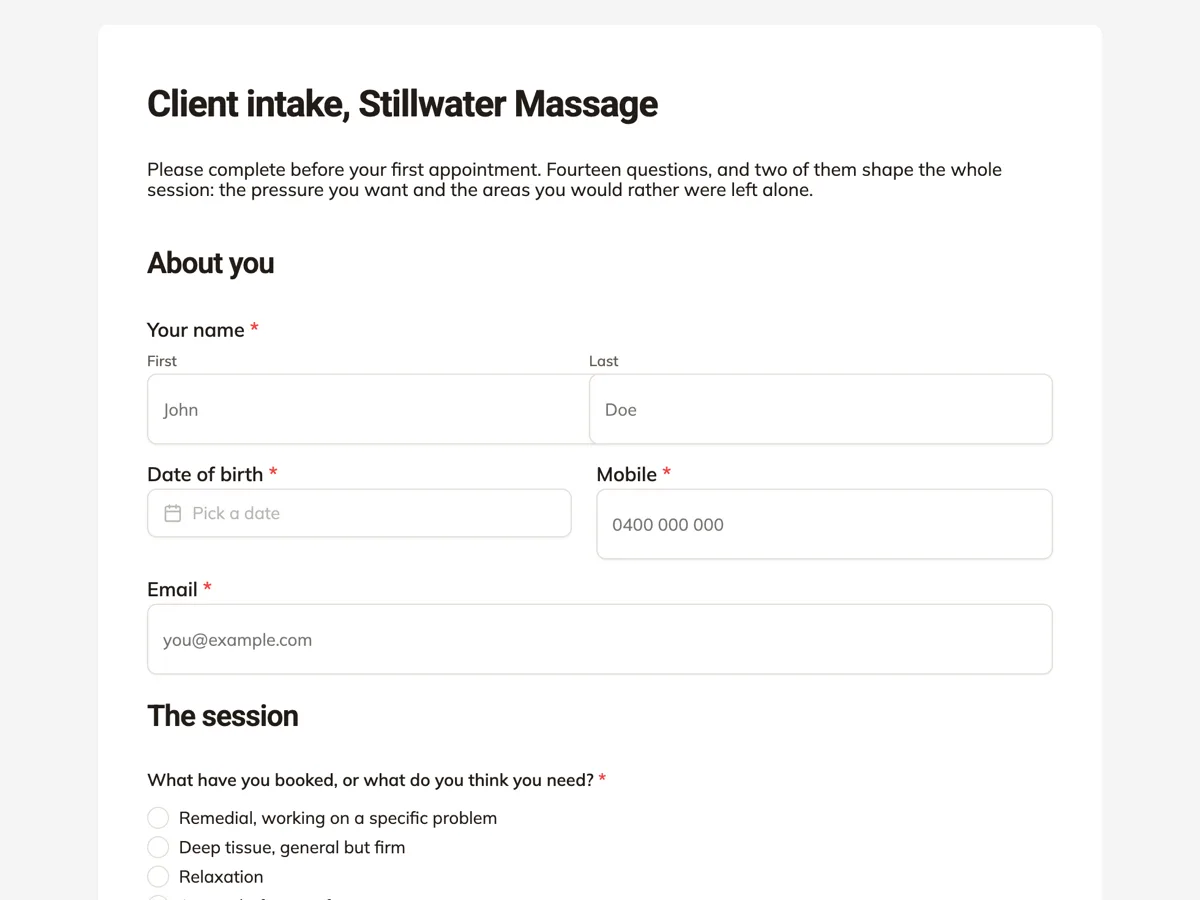
The form itself
A static copy of the finished form, exactly as it renders. Nothing here can be filled in or submitted, so read it as a reference and build your own from the button above.
Every field, and what it collects
The complete field list, in the order respondents meet it.
- Your nameNameRequired
- Date of birthDateRequired
- MobileShort textRequired
- EmailShort textRequired
- What have you booked, or what do you think you need?Single choiceRequired
- Options: Remedial, working on a specific problem · Deep tissue, general but firm · Relaxation · Sports, before or after an event · Pregnancy massage · Not sure, please advise on the day
- How much pressure do you want?Single choiceRequired
- Options: Light, nothing that makes me tense up · Medium · Firm, but stop short of pain · As deep as I can take, I will say when · Firm on the back, light everywhere else
- What would you like the session to focus on?Multiple choiceRequired
- Options: Neck and shoulders · Upper back · Lower back · Hips and glutes · Legs and calves · Feet · Arms, forearms and hands · Head and scalp · Whole body, no particular focus
- Areas you would rather were left aloneMultiple choiceRequired
- Options: Feet · Abdomen · Glutes · Face and head · Inner thighs · Chest and front of shoulders · Scars or a specific spot I will point out · Nowhere, anything is fine
- Do any of these apply to you right now?Multiple choiceRequired
- Options: Pregnant, at any stage · Taking a blood thinning medication · Surgery in the last three months · A fracture, sprain or acute injury in the last six weeks · Varicose veins, or a history of blood clots · Skin condition, rash, infection or open wound · Cancer, current or in treatment · Uncontrolled high or low blood pressure · Diabetes with reduced sensation in the feet or hands · None of these
- Injuries, surgery and anything that hurts todayLong textRequired
- Medications and allergies, including oils and nutsLong text
- Have you had a professional massage before?Single choiceRequired
- Options: Regularly · A few times · Once, a long time ago · Never
- Health fund, if you want to claim a rebateShort text
- SignatureSignatureRequired
About you
The session
Health
Rebate and consent
What each block of this form collects
The identity block is four fields and no address, because a massage clinic does not need one. The session block is where this form earns its place: what was booked, how much pressure the client wants, what they want worked on and what they would rather was left alone. The pressure options are written as behaviour rather than as numbers, so firm but stop short of pain and as deep as I can take, I will say when are both available and mean different things. The avoid list has eight options ending in nowhere, anything is fine, which lets the field be required. The health block opens with the privacy paragraph and a ten line contraindication screen, then two written answers about injuries and about medications and allergies, with the oil base named. The last block is a health fund name, a consent paragraph and the signature.
The Australian pieces on this form
Massage therapy is not a registered profession under the national registration scheme in Australia, unlike physiotherapy, chiropractic and psychology. Rebates for remedial massage run through private health funds and depend on the individual therapist holding membership of an approved professional association with a provider number, which is why the form asks for the fund name rather than a provider or member number and says the card is swiped at the desk. That keeps identifiers out of a web submission entirely while still flagging that a rebate is wanted, and it reflects how an Australian clinic actually processes a claim, on the terminal at reception at the end of the appointment.
How to adapt this form
A pregnancy specialist clinic moves the pregnancy line out of the contraindication list and into its own block with a trimester question and a positioning preference, because for that clinic it is the booking rather than a caution. A sports clinic replaces the focus list with a sport and event date pair and adds a question about the last hard session, since timing changes what should be done. A mobile therapist working in homes and offices adds an address and an access note, and moves the pressure question to the top of the form, because the conversation that would normally happen at a reception desk does not happen at all.
What makes this form work
Pressure is described as behaviour
Five options including firm, but stop short of pain and as deep as I can take, I will say when. Numbers out of ten mean something different to every client, while these describe what the therapist should actually do when the client tenses up.
Areas to avoid is required, with a way out
Eight options covering the areas people most often want skipped, ending in nowhere, anything is fine. Because there is an honest last option the field can be required, so every client answers a question that most would never raise out loud.
The health fund field asks for a name, not a number
One short text field with a placeholder saying the card is swiped at the desk. The client is reminded to bring it, the clinic knows a rebate is wanted, and no membership identifier passes through a web form at all.
Questions people ask
Why ask about pressure on a form instead of on the table?
Because almost nobody asks for lighter pressure once they are lying face down. Writing firm, but stop short of pain on a form takes a second and removes the social cost entirely. The therapist then starts at roughly the right depth and the check in during the session becomes a confirmation rather than an invitation to be polite.
What does the areas to avoid list actually do?
It replaces a conversation most clients will not start. Feet, abdomen, glutes and inner thighs are the areas people most often want skipped, for reasons ranging from ticklishness to history, and none of them needs explaining. The last option, nowhere and anything is fine, is what allows the question to be required so that everybody answers it.
Does a contraindication mean the appointment is cancelled?
Usually not, and the privacy paragraph says the screen exists so a technique can be adapted rather than so a booking can be refused. Blood thinners mean lighter work, recent surgery means avoiding a region, an acute sprain means treating around it. Only a small number of answers lead to a therapist suggesting a doctor first.
Why is the massage oil named in the allergies field?
Because a nut allergy and a grapeseed base are a specific pairing that a general allergies question misses. Telling the client what the oil is, in the placeholder, is what prompts the answer. A clinic using a different base or offering an unscented alternative should name that instead, since this is the field where the answer will actually be read.
Should a massage intake form collect a health fund membership number?
Not on this form. It asks for the fund name only and says the card is swiped at the desk, which is how a rebate is processed anyway. Membership numbers are identifiers worth keeping out of a web submission, and the client still gets the reminder to bring the card without the clinic storing the number.
Why does the form ask whether someone has had a massage before?
Because a first time client needs a different two minutes at the start: what to expect about draping, undressing to their own comfort, and permission to speak up. The answer does not change the treatment, it changes the conversation, and knowing it beforehand means the therapist does not have to guess from how nervous someone looks in reception.
Build your own in about a minute
The button below opens the generator with this use case already described. Change the wording to match your own, generate, then edit anything you like.
Make my massage intake form that asks about pressure before the tableOther form examples
Physiotherapy intake form built around one injury
A physiotherapist has about forty minutes and needs a third of it to examine, so the history has to arrive before the patient does. This eighteen field intake form maps the region and side, the onset, the pain score and what aggravates it, then records which funding pathway is paying.
Psychology intake form with the limits of confidentiality on it
A first psychology session has fifty minutes and a person who has usually waited weeks for it, so the history should not eat the first twenty. This twenty field intake form takes the referral pathway, a ten item distress baseline and the supports already in place, and states the limits of confidentiality above the signature.
Chiropractic intake form with a spine history grid
A chiropractor examining a lower back needs to know what the neck, the mid back and the jaw have been doing for the last three months, and asking that one region at a time takes the whole appointment. This seventeen field form puts eight regions in a single grid and screens for the conditions that change the plan.
Want the steps in the builder? Read Every form field and when to use it, then Design your welcome and thank you screens. For everything this generator can do, see the form maker.
Written and checked by the OneCraft team. Last checked .