Classic form
Midwifery intake form for a private booking visit
A booking visit with a private midwife is ninety minutes and should mostly be about what the woman wants, not about reconstructing her history out loud. This twenty field intake form takes the due date, the previous pregnancies, the blood group and the birth preferences beforehand, and asks who will be in the room.
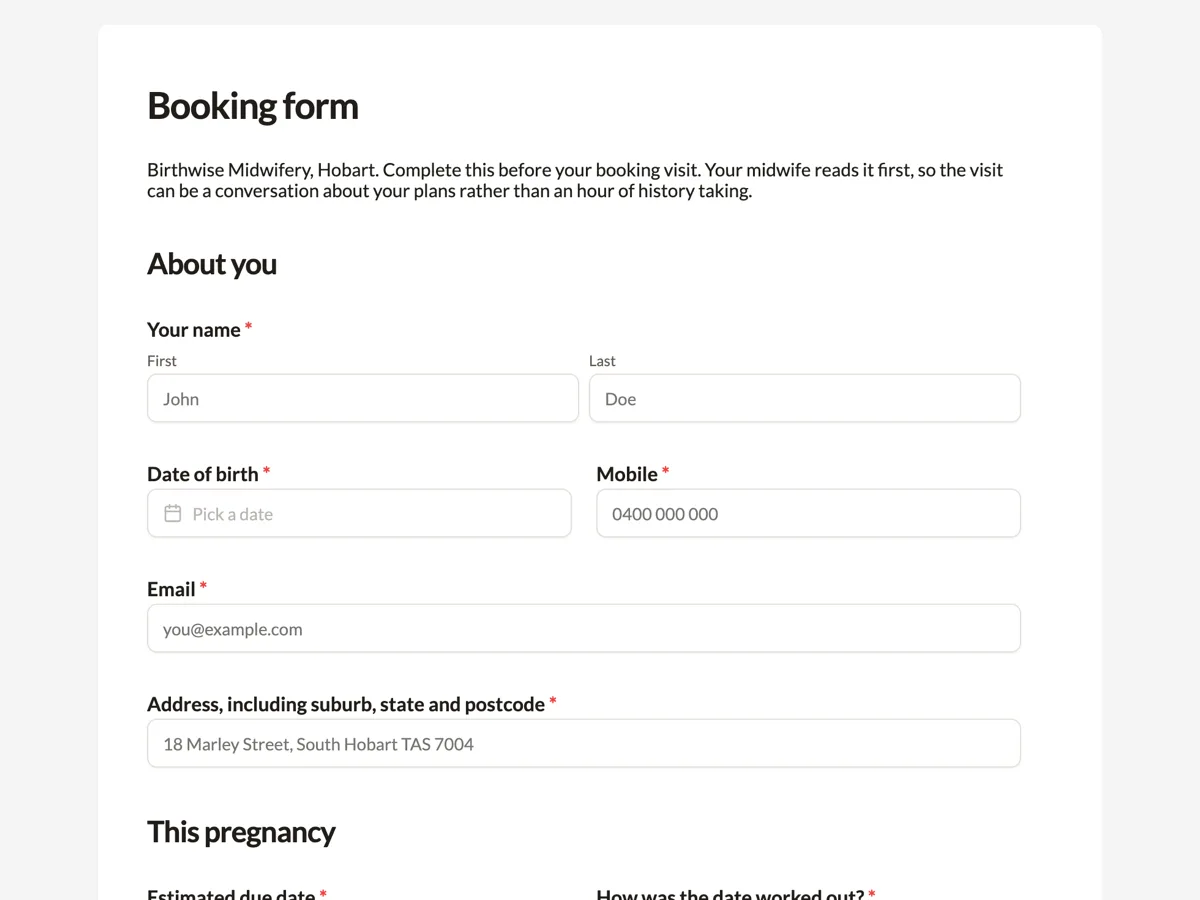
The form itself
A static copy of the finished form, exactly as it renders. Nothing here can be filled in or submitted, so read it as a reference and build your own from the button above.
Every field, and what it collects
The complete field list, in the order respondents meet it.
- Your nameNameRequired
- Date of birthDateRequired
- MobileShort textRequired
- EmailShort textRequired
- Address, including suburb, state and postcodeShort textRequired
- Estimated due dateDateRequired
- How was the date worked out?Short textRequired
- Where do you hope to give birth?Single choiceRequired
- Options: At home · In a birth centre · In hospital, with my midwife present · In hospital, undecided about the model of care · Still deciding
- Previous pregnanciesTable
- Columns: Year · How it ended · Where · Anything that mattered
- Your GP, name and practiceShort textRequired
- Obstetrician or hospital already booked, if anyShort text
- Blood group and antibody status, if you know themShort text
- Has any of these applied to you, now or in a previous pregnancy?Multiple choiceRequired
- Options: High blood pressure or pre eclampsia · Gestational or other diabetes · Thyroid condition · A clotting disorder, or a clot in a leg or lung · Heavy bleeding after a birth · A caesarean birth · A baby born before 37 weeks · A baby much smaller or larger than expected · Anxiety, depression or birth trauma · None of these
- Medications, supplements and anything you are allergic toLong text
- Smoking, alcohol or other substances in this pregnancySingle choiceRequired
- Options: None of these · Stopped when I found out I was pregnant · Still smoking, cutting down · Occasional alcohol · Would rather discuss this in person
- What matters to you about the birth?Multiple choiceRequired
- Options: Staying at home as long as possible · Water for labour, and possibly for birth · Movement and upright positions · As little vaginal examination as possible · Delayed cord clamping · Skin to skin straight away, before weighing · No students or extra observers in the room · Photographs or video during labour · A plan for pain relief if I ask for it · I have not thought about this yet
- How do you plan to feed your baby?Single choiceRequired
- Options: Breastfeeding · Breastfeeding, with help lined up if it is hard · Combination feeding · Formula feeding · Not sure yet
- Support peopleTable
- Columns: Name · Relationship to you · Phone
- Medicare cardShort textRequired
- SignatureSignatureRequired
About you
This pregnancy
Previous pregnancies
Your care team and health
Your plans
Who will be there
Medicare and consent
What each block of this form collects
Five identity fields, then the pregnancy itself: the due date, how it was worked out, and where the woman hopes to give birth. How the date was worked out matters because a dating scan and a last menstrual period give different confidence, and every decision about timing later in the pregnancy rests on it. The previous pregnancies table is the block that needed the most care, and the paragraph above it says outright that miscarriage, termination and stillbirth belong there and that nothing written will be raised again unless the woman raises it. The care team block holds the GP, any obstetrician, the blood group and the ten item history. The plans block is the birth preferences and feeding, and the support people table records who will actually be in the room.
The Australian pieces on this form
Private midwifery care here runs alongside the public system rather than outside it, so two Australian things are on the form. The first is the consent paragraph, which names the national guidelines on consultation and referral: those guidelines set out when a midwife must recommend an obstetric opinion, and saying so in the consent means a later recommendation is not a surprise. The second is the Medicare question, which asks for card status rather than a number. Eligibility changes what can be claimed for antenatal visits with an eligible midwife, so the practice has to know it, while the number itself is better read off the card at the booking visit than typed into a web form. Midwives here are registered with the national board, and the professional college publishes the guidelines the consent paragraph refers to.
How to adapt this form
A publicly funded midwifery group practice replaces the Medicare question with a hospital record number and adds a block for the referring hospital and the booking clinic date, since the woman is already in a system. A practice offering postnatal care only shortens the history block, drops the birth preferences entirely and adds the actual birth details, date, place, mode and any complication, plus a feeding status question. A practice that works with women planning a birth after caesarean promotes that single checklist line into its own block: the reason for the caesarean, the type of incision, and what the woman has been told so far, because that is the conversation the whole booking visit turns on.
What makes this form work
The previous pregnancies table has a fourth column for meaning
Year, how it ended, where, and anything that mattered. That last column is where a woman writes the sentence a clinical record would never hold, and it is the one the midwife reads first before the booking visit.
Birth preferences are ticks, with an honest opt out
Ten options from staying at home as long as possible to no students in the room, ending in I have not thought about this yet. A required question with that last line gets a truthful answer at twelve weeks instead of an invented plan.
The Medicare question asks for status, not a number
Own card, family card or not eligible is what changes the claiming, and it is the whole of what the practice needs before the booking visit. The card itself is read at the visit, so no government identifier is typed into the form at all.
Questions people ask
Why does the form ask about pregnancies that did not end in a baby?
Because they are part of the clinical picture and part of the person. A previous loss changes how a midwife handles scans, how early reassurance is offered and how the first trimester is talked about. The paragraph above the table says what can be written there and promises it will not be raised again unless the woman raises it first.
Why ask how the due date was worked out?
Because a date from a dating scan and a date from a last menstrual period are not equally reliable, and every later decision about timing rests on which one it is. It is one short field beside the date itself, and the answer changes how confidently anyone talks about being overdue.
Is the birth preferences list a birth plan?
No, it is a starting point for the conversation at the booking visit. Ten options cover what most women raise first, and the last one is that they have not thought about it yet, which is the honest answer at twelve weeks. The written plan comes later, once the pregnancy has a shape.
Why is there a support people table rather than one contact field?
Because labour support is usually more than one person and the order matters. Three rows with a name, a relationship and a phone number give the midwife a call list, and the paragraph above says plainly that the second midwife who attends every birth is not part of it and does not need to be listed.
Does the practice collect a Medicare number?
Not on this form. The field asks for card status: own card, family card, or not eligible, because eligibility is what changes the claiming. The placeholder asks the woman to bring the card to the booking visit instead, which keeps a government identifier out of a web submission without losing anything the practice needs.
What does the consent paragraph commit to?
Midwifery care for this pregnancy, given in line with the national guidelines on consultation and referral. It states that the midwife will recommend an obstetric opinion if something changes and that the woman decides what happens next. Fees and the payment schedule are deliberately kept out of it and set out in the written agreement at the booking visit.
Build your own in about a minute
The button below opens the generator with this use case already described. Change the wording to match your own, generate, then edit anything you like.
Make one like thisOther form examples
Massage intake form that asks about pressure before the table
A client lying face down with their eyes closed will almost never ask for lighter pressure or say that they would rather their feet were left alone. This fourteen field intake form asks both in advance, alongside a contraindication screen that adapts the technique rather than cancelling the booking.
Chiropractic intake form with a spine history grid
A chiropractor examining a lower back needs to know what the neck, the mid back and the jaw have been doing for the last three months, and asking that one region at a time takes the whole appointment. This seventeen field form puts eight regions in a single grid and screens for the conditions that change the plan.
NDIS intake form that starts from the plan itself
An NDIS provider cannot start a support without five things off the plan: the participant number, the two dates, the management type and the goals. This nineteen field intake form asks for all five, plus the participant name as the plan shows it, and tells them to have the plan open while they answer.
Want the steps in the builder? Read Every form field and when to use it, then Design your welcome and thank you screens. For everything this generator can do, see the form maker.
Written and checked by the OneCraft team. Last checked .