Classic form
Chiropractic intake form with a spine history grid
A chiropractor examining a lower back needs to know what the neck, the mid back and the jaw have been doing for the last three months, and asking that one region at a time takes the whole appointment. This seventeen field form puts eight regions in a single grid and screens for the conditions that change the plan.
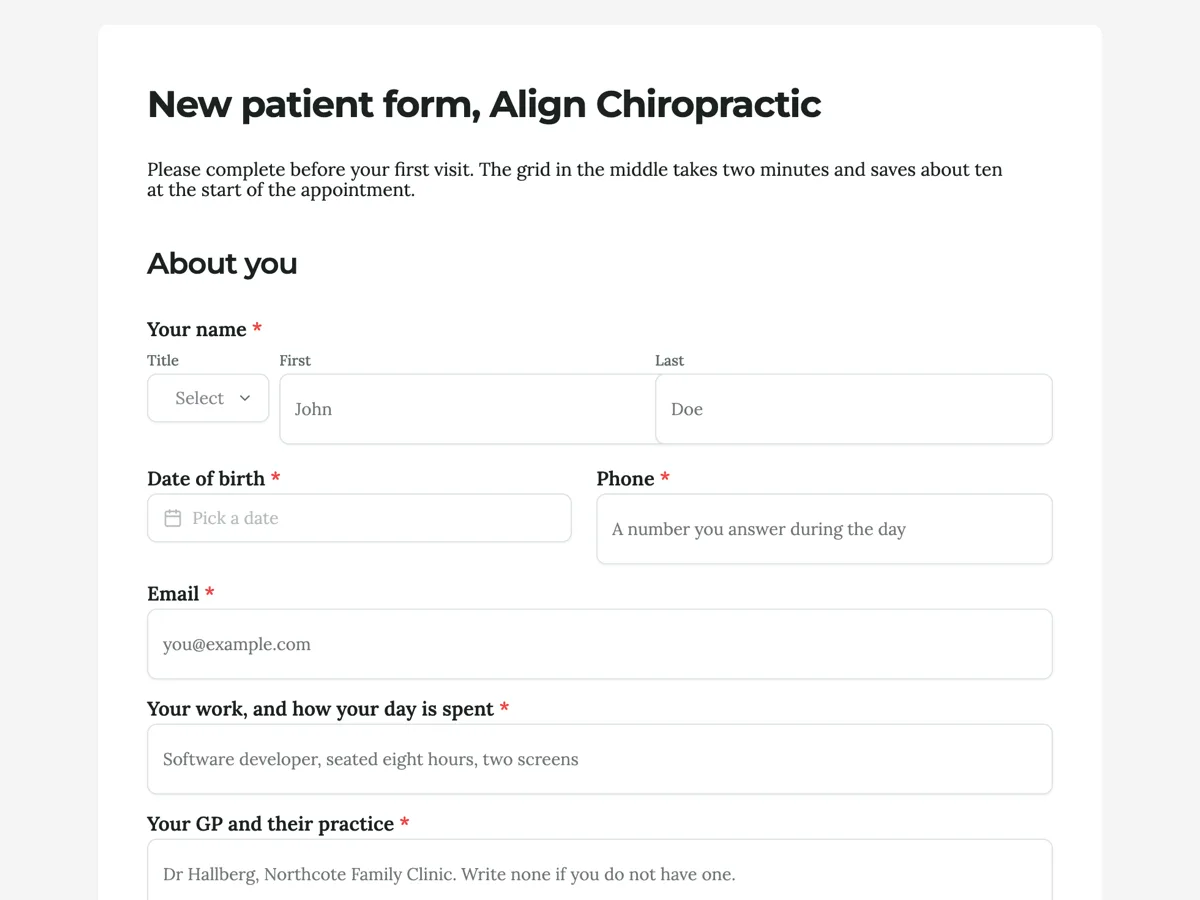
The form itself
A static copy of the finished form, exactly as it renders. Nothing here can be filled in or submitted, so read it as a reference and build your own from the button above.
Every field, and what it collects
The complete field list, in the order respondents meet it.
- Your nameNameRequired
- Date of birthDateRequired
- PhoneShort textRequired
- EmailShort textRequired
- Your work, and how your day is spentShort textRequired
- Your GP and their practiceShort textRequired
- What is the main problem, in your own words?Long textRequired
- How long has it been going on?Single choiceRequired
- Options: Under a week · 1 to 4 weeks · 1 to 6 months · 6 to 24 months · More than 2 years · It comes and goes over years
- How would you describe the pattern?Single choiceRequired
- Options: Constant, it never fully settles · Worse in the morning, easier as the day goes on · Fine in the morning, worse by the evening · Only with certain movements · Only after sitting or standing for a long time · Unpredictable
- Spine and related regions, over the last three monthsRating gridRequired
- Statements:
- Neck stiffness or pain
- Headaches starting at the base of the skull
- Between the shoulder blades
- Lower back
- Pain travelling down an arm
- Pain travelling down a leg
- Jaw clicking or pain
- Rib or chest wall tightness
- Have you been adjusted by a chiropractor before?Single choiceRequired
- Options: Never · Yes, and it helped · Yes, and it did not help · Yes, and I had a bad reaction · Yes, years ago and I do not remember much about it
- Have you had imaging of your spine?Single choiceRequired
- Options: No imaging · X ray, in the last two years · X ray, more than two years ago · CT or MRI, in the last two years · CT or MRI, more than two years ago · I have had imaging but I am not sure what kind
- Other treatment you have tried for thisLong text
- Do any of these apply, now or in the past?Multiple choiceRequired
- Options: Osteoporosis or low bone density · Inflammatory arthritis, including rheumatoid or ankylosing spondylitis · A blood thinning medication or a bleeding disorder · Cancer, current or previous · A stroke, a transient ischaemic attack or a known artery condition · Spinal surgery, fusion or hardware · Recent significant trauma, including a fall or a collision · Pregnancy · Numbness in the saddle area, or a change in bladder or bowel control · None of these
- Medications and supplements you takeLong text
- What would a good outcome look like for you?Single choiceRequired
- Options: Getting out of pain, nothing more · Getting out of pain and understanding why it happened · Returning to a specific activity · Managing something long term · A second opinion before I decide on surgery
- SignatureSignatureRequired
About you
Why you are here
What has been done already
Health screen
Consent
What each block of this form collects
The first block is four identity fields, a question about what the working day does to the body, which for a spinal complaint is often the history that matters most, and the patient GP, which is who a referral letter goes to if the health screen turns something up. The complaint block asks the problem in the patient own words first, then two structured questions that a free text answer rarely covers: how long it has been going on, and the pattern, with options that separate morning stiffness from evening fatigue because those point in different directions. The grid is the centre of the form. What has been done already covers previous adjustments and imaging, both as radios with honest options. The health screen is ten lines and the last of the nine conditions is the one that changes everything.
Why a whole spine grid instead of a body map
A patient books an appointment about one region and thinks about one region, but a chiropractor assesses the chain. Asking eight separate questions about places that do not currently hurt feels repetitive and gets skipped; a single grid with never, occasionally, weekly and daily takes two minutes and gets every row answered, which is why the paragraph above it asks specifically that no row be left blank. The rows are chosen for what they change: headaches starting at the base of the skull, pain travelling down an arm or a leg, and rib or chest wall tightness are each the kind of finding that alters an examination plan, and the jaw row catches the clenching that quietly drives a proportion of neck complaints.
How to adapt this form
A practice focused on paediatric care replaces the work question with a birth and developmental history block and cuts the grid to four rows, because a six year old does not have a three month pattern to report. A sports chiropractic clinic adds a training load question and a return to competition date, and expands the imaging radio to include scans ordered by a club physiotherapist. A multidisciplinary clinic sharing one intake across chiropractic, physiotherapy and podiatry keeps the grid and the health screen exactly as they are and adds a first question asking which practitioner the appointment is with, which routes the remaining sections.
What makes this form work
Eight regions in one grid, rated over three months
Never, occasionally, weekly and daily across neck, headaches, mid back, lower back, arm, leg, jaw and ribs. The paragraph above asks that no row be left blank, so a region that has never given trouble is recorded as an answer rather than as a gap.
The pattern question separates morning from evening
Six options including worse in the morning and easier as the day goes on, and fine in the morning and worse by the evening. Those two point at different mechanisms, and neither reliably appears in a free text description of the pain.
The health screen ends with the urgent line
Nine conditions from osteoporosis to recent trauma, then numbness in the saddle area or a change in bladder or bowel control, then none of these. That second last option is the one that means a phone call rather than an appointment, and every patient is asked it.
Questions people ask
Why does a chiropractic form ask about the jaw and the ribs?
Because both change what an examination looks for. Jaw clicking and clenching commonly travel with neck pain and headaches, and rib or chest wall tightness can mimic or accompany mid back complaints. Neither is something a patient thinks to mention when they booked about a sore lower back, so the grid asks directly rather than waiting for it to come up.
What is a red flag screen and why is it on an intake form?
It is a list of conditions and symptoms that mean the usual approach needs changing or a referral is appropriate. Osteoporosis, blood thinners, inflammatory arthritis, previous stroke and recent trauma all sit on that list. The last line, saddle numbness or a change in bladder or bowel control, is the one that needs same day medical attention rather than an adjustment.
Why offer I had a bad reaction as an option for previous adjustments?
Because it is a real answer and it changes the first appointment completely. A patient who had a bad experience will often say nothing if the choices are only yes and no, and then tense through an examination. Naming the option gives them a way to raise it before they are on the table, which is exactly where that conversation belongs.
Does the form need imaging uploaded?
This version asks what imaging exists rather than collecting it, including an option for a patient who knows they had a scan but not what kind. That answer is enough for the chiropractor to request the report from the referring practice or the imaging provider, and it keeps the form short.
Should consent be a checkbox as well as a signature?
Here the paragraph and the signature do the work together. The paragraph names manual adjustment, the common soreness afterwards, the rarity of serious complications and the right to stop at any time without explaining why. The signature records that it was read.
How long should a chiropractic intake form take?
About ten minutes, which is what seventeen fields with one grid comes to. The value is in the trade: two minutes on the grid and one on the health screen returns roughly ten minutes of the first appointment, which is the difference between a rushed examination and a conversation about what the findings mean.
Build your own in about a minute
The button below opens the generator with this use case already described. Change the wording to match your own, generate, then edit anything you like.
Make my chiropractic intake form with a spine history gridOther form examples
Physiotherapy intake form built around one injury
A physiotherapist has about forty minutes and needs a third of it to examine, so the history has to arrive before the patient does. This eighteen field intake form maps the region and side, the onset, the pain score and what aggravates it, then records which funding pathway is paying.
Massage intake form that asks about pressure before the table
A client lying face down with their eyes closed will almost never ask for lighter pressure or say that they would rather their feet were left alone. This fourteen field intake form asks both in advance, alongside a contraindication screen that adapts the technique rather than cancelling the booking.
Psychology intake form with the limits of confidentiality on it
A first psychology session has fifty minutes and a person who has usually waited weeks for it, so the history should not eat the first twenty. This twenty field intake form takes the referral pathway, a ten item distress baseline and the supports already in place, and states the limits of confidentiality above the signature.
Want the steps in the builder? Read Every form field and when to use it, then Control who can fill in your form. For everything this generator can do, see the form maker.
Sources
Written and checked by the OneCraft team. Last checked .