Classic form
Optometry intake form that asks about the family too
Half of what an optometrist looks for at a first examination is decided by two things the patient already knows: how their eyes are used, and what runs in their family. This fourteen field intake form collects both, along with the screen hours, the driving pattern and the general health that change what the examination tests.
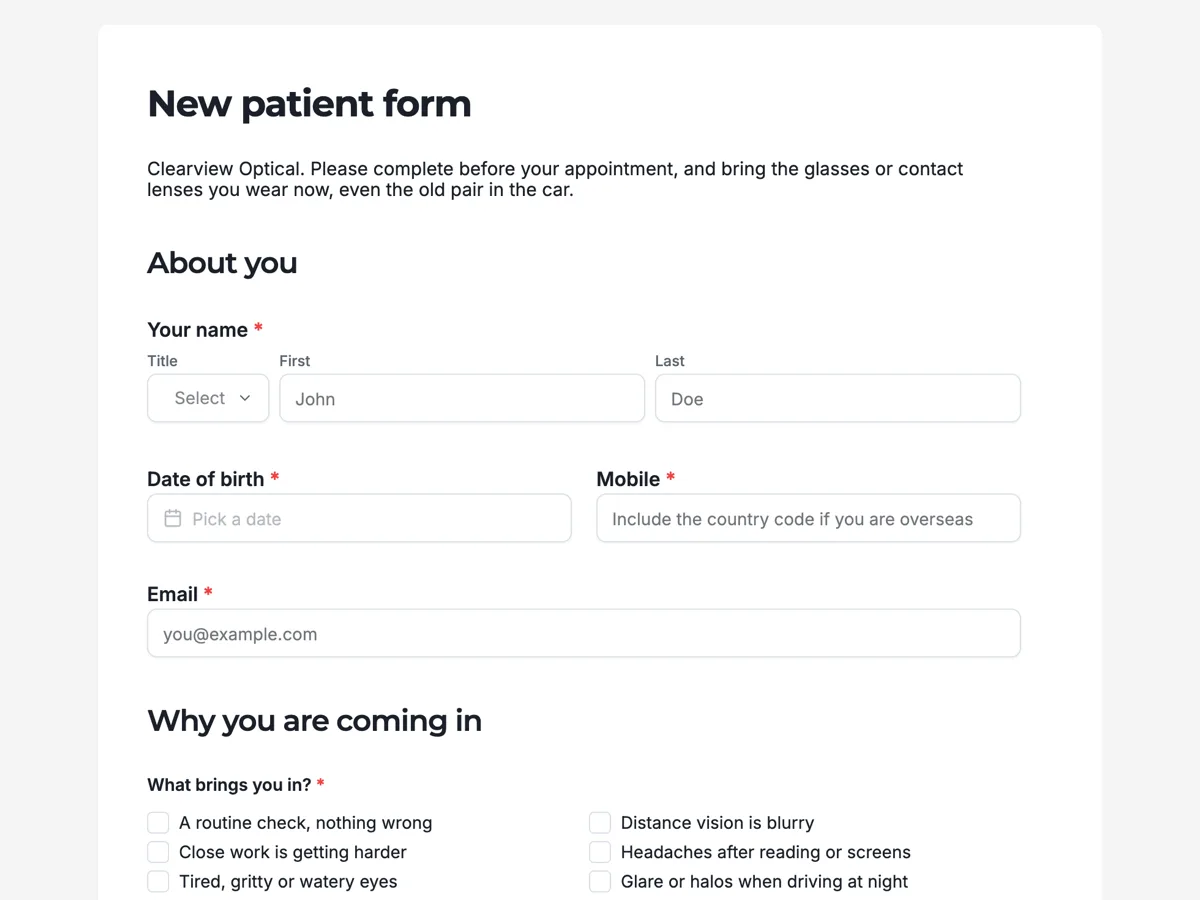
The form itself
A static copy of the finished form, exactly as it renders. Nothing here can be filled in or submitted, so read it as a reference and build your own from the button above.
Every field, and what it collects
The complete field list, in the order respondents meet it.
- Your nameNameRequired
- Date of birthDateRequired
- MobileShort textRequired
- EmailShort textRequired
- What brings you in?Multiple choiceRequired
- Options: A routine check, nothing wrong · Distance vision is blurry · Close work is getting harder · Headaches after reading or screens · Tired, gritty or watery eyes · Glare or halos when driving at night · New floaters or flashes · Double vision · An eye that turns or drifts · Wanting to try contact lenses · A referral from a doctor
- What do you wear now?Single choiceRequired
- Options: Nothing at all · Reading glasses only · Distance glasses only · Multifocal or bifocal glasses · Contact lenses, soft daily or monthly · Contact lenses, rigid or specialty · Both glasses and contact lenses
- When was your last eye test, and who with?Short textRequired
- Hours a day on screens, all devices added togetherNumberRequired
- DrivingSingle choiceRequired
- Options: Do not drive · Drive occasionally, daylight only · Drive daily, mostly local · Drive daily, including at night · Drive for work, including a heavy vehicle licence
- Do any of these apply to you?Multiple choiceRequired
- Options: Diabetes · High blood pressure · Thyroid condition · Migraine, with or without aura · An autoimmune condition such as rheumatoid arthritis · A head injury or stroke · Previous eye surgery, including laser correction · A lazy eye or patching as a child · None of these
- Medications you takeLong text
- Has anyone in your immediate family had any of these?Multiple choiceRequired
- Options: Glaucoma · Macular degeneration · Cataract before the age of sixty · Retinal detachment · Diabetic eye disease · Keratoconus · Colour blindness · Blindness or low vision from any cause · None that I know of
- Health fund or optical insurer, if you are claimingShort text
- SignatureSignatureRequired
About you
Why you are coming in
How your eyes are used
Health and family
Payment and consent
What each block of this form collects
Four identity fields, then the reason for the visit as eleven ticks rather than a text box, because patients under describe symptoms and over describe worry. The first option is a routine check with nothing wrong, which is the honest answer for most people and stops the rest of the list from reading as a menu of things to claim. What is worn now is asked as seven options because reading glasses only and multifocals are completely different starting points, and the last eye test question asks who it was with as well as when, since a previous record can often be requested. Screen hours and driving describe the visual demand the prescription has to meet. Health, medications and family history are the block that decides what is examined beyond refraction.
How to adapt this form
A practice fitting a lot of contact lenses adds a wearing pattern block after what is worn now: hours a day, sleeping in lenses, solution used and how often a case is replaced, because compliance predicts the complications more than the prescription does. A behavioural or paediatric practice replaces the screen hours number with a school block, reading age, whether letters are reversed, and whether the teacher has raised anything, and swaps the signature for a guardian one. A practice offering myopia control for children adds parental prescription, hours spent outdoors and the rate of change over the last two years, which are the three inputs that decide whether to intervene at all.
What makes this form work
The first option is nothing is wrong
A routine check heads the eleven reasons for the visit, which is the truthful answer for most patients. Without it the list reads as a menu of symptoms to claim, and an optometrist starts the appointment hunting for a problem the person does not have.
What is worn now is seven answers, not yes or no
Reading only, distance only, multifocals, soft lenses, rigid lenses, both, or nothing. Each is a different starting prescription and a different conversation, and the thank you screen asks the patient to bring the actual pair so the current power can be measured from the lenses.
Family history is a tick list with an honest last line
Glaucoma, macular degeneration, early cataract, retinal detachment, diabetic eye disease and keratoconus, ending in none that I know of. That last option lets an adoptee or someone out of contact with their family answer a required question truthfully.
Questions people ask
Why does an optometry form ask about family eye history?
Because glaucoma, macular degeneration and keratoconus run in families and are silent until they are found. A patient whose parent has glaucoma is checked differently from one whose family history is clear: pressures, nerve imaging and visual fields move from optional to routine. Nine options, including one that says none that I know of.
What do screen hours change in an eye test?
What is prescribed rather than what is diagnosed. Eight hours at a fixed working distance changes which intermediate correction is worth adding and how dry eye is managed, and it is the most common explanation for headaches after reading. It is asked as one number because the exact figure matters less than the order of magnitude.
Why is driving asked as five options instead of yes or no?
Because the vision standard and the practical advice differ. Driving occasionally in daylight, driving daily at night and driving for work on a heavy vehicle licence set different thresholds and different conversations about glare, and a yes or no answer would hide all three. The last option is also the one most likely to need a formal report.
Does the practice need a health fund membership number?
No, and the field says so in its placeholder: fund name only, because the card is swiped at the desk. Collecting a membership number in a web form adds an identifier the practice has to protect without saving anybody any time, so the form asks for the fund so reception can prepare the claim and nothing more.
Why does the consent paragraph mention drops?
Because dilating drops are the part of an eye examination that affects the rest of the patient's day. They blur near vision and increase glare for several hours, which matters if somebody drove themselves in. Saying it before the appointment rather than in the chair lets a patient arrange a lift or pick a different time.
Can this form be used for a follow up rather than a first visit?
It can, though most of it will already be on file. A shorter review version keeps the reason for the visit, what is worn now, the medications field and the health checklist, since those are the four that change between visits, and drops the family history and the driving questions, which usually do not.
Build your own in about a minute
The button below opens the generator with this use case already described. Change the wording to match your own, generate, then edit anything you like.
Make one like thisOther form examples
Cosmetic clinic consultation form with a treatment history table
The question that decides a cosmetic appointment is rarely what the client wants, it is what they have already had and when. This seventeen field consultation form takes a dated table of previous treatments alongside the skin type, the medications and the pregnancy question, and is explicit that it books nothing.
Chiropractic intake form with a spine history grid
A chiropractor examining a lower back needs to know what the neck, the mid back and the jaw have been doing for the last three months, and asking that one region at a time takes the whole appointment. This seventeen field form puts eight regions in a single grid and screens for the conditions that change the plan.
Podiatry intake form that asks about diabetes first
Two answers decide how a podiatry appointment is run before the podiatrist has seen a foot: whether the patient has diabetes, and whether the circulation and nerve supply are intact. This fifteen field intake form asks both in the first health block, then collects the footwear, the standing hours and the orthotics history that explain the rest.
Want the steps in the builder? Read Create a form with AI, then Every form field and when to use it. For everything this generator can do, see the form maker.
Written and checked by the OneCraft team. Last checked .