Classic form
Podiatry intake form that asks about diabetes first
Two answers decide how a podiatry appointment is run before the podiatrist has seen a foot: whether the patient has diabetes, and whether the circulation and nerve supply are intact. This fifteen field intake form asks both in the first health block, then collects the footwear, the standing hours and the orthotics history that explain the rest.
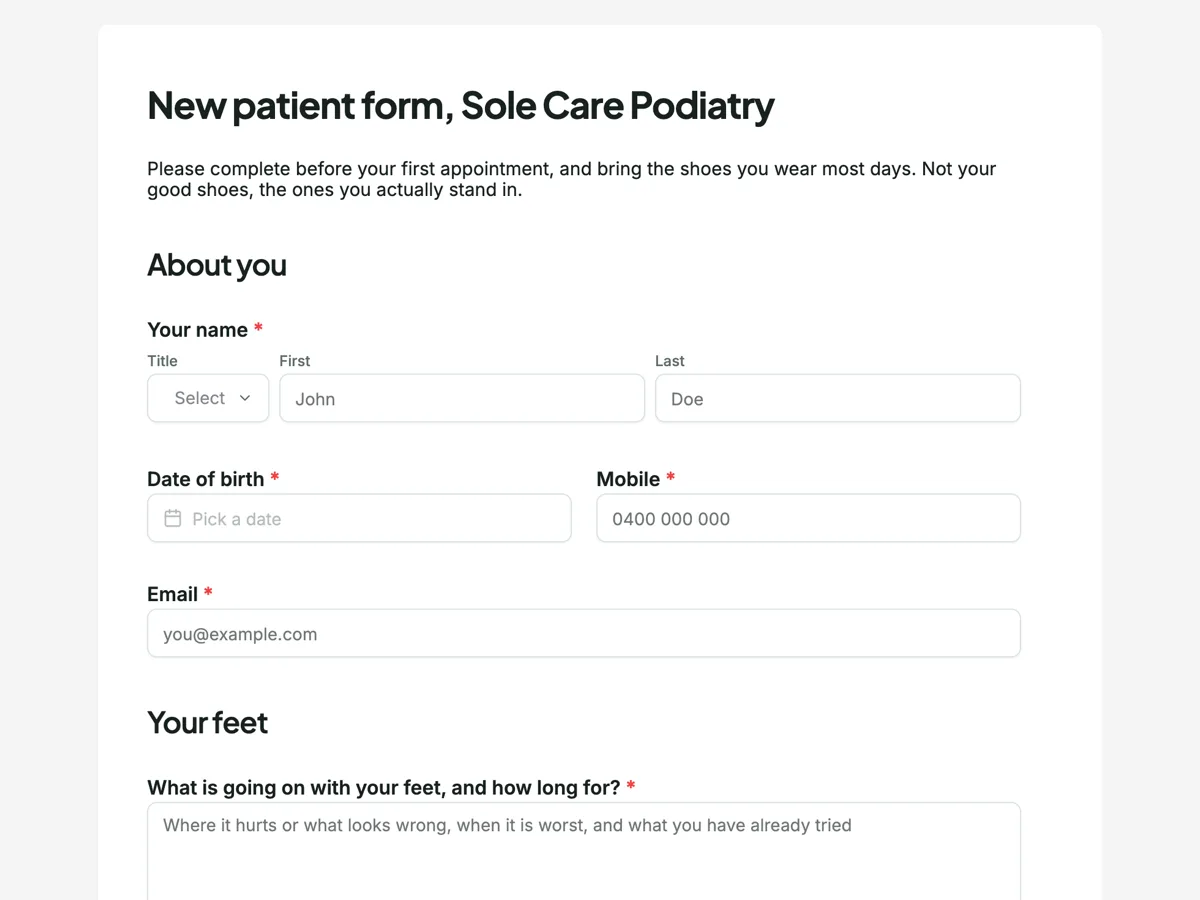
The form itself
A static copy of the finished form, exactly as it renders. Nothing here can be filled in or submitted, so read it as a reference and build your own from the button above.
Every field, and what it collects
The complete field list, in the order respondents meet it.
- Your nameNameRequired
- Date of birthDateRequired
- MobileShort textRequired
- EmailShort textRequired
- What is going on with your feet, and how long for?Long textRequired
- Do you have diabetes?Single choiceRequired
- Options: No · Type 1 · Type 2, managed with diet or tablets · Type 2, on insulin · Pre diabetes or impaired glucose · Not sure
- Do you notice any of these in your feet or legs?Multiple choiceRequired
- Options: Numbness, pins and needles or burning · Cramping in the calves when walking, easing with rest · Feet that are cold to touch or look pale · Swelling in the ankles by the end of the day · Cuts and grazes that take a long time to heal · Colour change in a toe · Varicose veins · Nothing like this
- Other conditions that matter for foot careMultiple choiceRequired
- Options: Rheumatoid or other inflammatory arthritis · Osteoarthritis · Peripheral neuropathy already diagnosed · Kidney disease or dialysis · Blood thinning medication · Immune system suppressed · Previous foot or ankle surgery · A foot ulcer, now or in the past · Chemotherapy in the last two years · None of these
- Medications you takeLong text
- What do you wear on your feet most days?DropdownRequired
- Options: Lace up runners · Slip on sneakers · Steel cap work boots · Leather work shoes or dress shoes · Heels above four centimetres · Ballet flats · Thongs or slides · Sandals with a strap · Boots, ankle or knee height · Bare feet most of the day
- How much are you on your feet?Single choiceRequired
- Options: Seated most of the day · Standing or walking a few hours a day · On my feet all day at work · On my feet all day, on hard floors or concrete · Running or sport three or more times a week
- Have you worn orthotics before?Single choiceRequired
- Options: Never · Off the shelf inserts from a pharmacy · Custom made, currently wearing them · Custom made, gave up on them · Made for me but never collected
- How is this appointment being paid for?Single choiceRequired
- Options: Private, claiming on a health fund · Private, no rebate · GP chronic disease management plan, referral in hand · Department of Veterans Affairs · NDIS plan · Workers compensation claim · Not sure, please check at the desk
- Referral, care plan or recent imaging reportFile upload
- A GP chronic disease management plan referral, a Veterans Affairs referral, or an x ray or ultrasound report. A phone photo of the printed page is fine. Images or PDF, up to 10 MB each.
- SignatureSignatureRequired
About you
Your feet
Health that changes foot care
Shoes, activity and orthotics
Funding and referral
Consent
What each block of this form collects
The identity block is four fields, then one open question about the feet, and then the block that changes the appointment. Diabetes is asked as six options rather than yes or no, because type 2 managed on tablets and type 2 on insulin are different risk pictures and not sure is an honest answer that gets checked at reception. The circulation and nerve list asks about the specific things a patient can notice without being told to look: numbness, calf cramping that eases with rest, feet cold to touch, swelling by evening, cuts that take too long. The third block is about load and habit rather than disease. What is on the feet most days, how many hours they carry weight, and what has been tried in the way of orthotics, including the two honest failure answers that most forms never offer.
The Australian pieces on this form
The funding radio names the real Australian pathways: private with a health fund rebate, private with none, a GP chronic disease management plan with the referral in hand, the Department of Veterans Affairs, an NDIS plan and a workers compensation claim. The chronic disease pathway is the one podiatry sees most, because a patient with a chronic condition such as diabetes can be referred by a GP for a limited number of allied health services in a calendar year, and the practice has to hold the referral before it can claim. That is why the upload sits directly under the funding question and why the thank you screen still asks for the original paperwork at the desk. Podiatrists here are registered with the national board, and no Medicare or health fund membership number is collected in the form at all.
How to adapt this form
A high risk foot clinic promotes the diabetes block into its own page and adds the date of the last foot check, the most recent glucose result and a question about whether the patient can see and reach their own feet, since that single question decides whether self care advice is realistic. A sports podiatry practice replaces the footwear dropdown with a training shoe and surface pair, weekly kilometres and a recent change question, because in that setting the cause is usually a change in load. A residential aged care service drops the funding radio for a facility and room block and adds a next of kin field, since consent and billing both run through somebody else.
What makes this form work
Diabetes is six options, not a yes or no
Type 1, type 2 on tablets, type 2 on insulin, pre diabetes and not sure sit beside no. Those are five different risk pictures for the same foot, and a yes or no question throws the difference away at the exact moment it matters most.
Circulation is asked in symptoms a patient can notice
Cramping in the calves when walking that eases with rest, feet cold to touch, cuts that heal slowly, colour change in a toe. Nobody knows whether their arterial supply is reduced, but everybody knows whether their calves cramp on the way to the shops.
The orthotics question offers two ways to have failed
Gave up on them, and made for me but never collected. Both answers are common, both are embarrassing to volunteer, and both change what the podiatrist recommends. Printing them as options is what makes them gettable.
Questions people ask
Why does a podiatrist ask about diabetes before anything else?
Because it changes the appointment. Reduced sensation means a patient cannot feel a cut being made, and reduced healing means a small nick matters more than it would otherwise. Knowing before the appointment lets the podiatrist plan a neurovascular assessment into the time rather than discovering the need for one halfway through.
What is calf cramping that eases with rest a sign of?
It is the classic description of reduced arterial supply to the legs, and it is the one circulation symptom patients reliably recognise in themselves. Putting it on the checklist in those words, rather than asking about peripheral arterial disease, is why the answer arrives on the form instead of in the room.
Why does the form ask which shoes are worn most days?
Because the everyday pair causes the problem and the good pair gets described. Ten options cover what people actually stand in, and the welcome screen asks the patient to bring the real pair, since wear on a worn sole shows the loading pattern faster than any question does.
What is the point of asking about orthotics that were never collected?
It is the most useful answer in that question. A patient who was cast, charged and never came back has a reason, and it is usually cost, comfort or scepticism. Knowing it before the appointment stops a podiatrist recommending the same thing again and opens the conversation that should have happened the first time.
What can be uploaded to the referral field?
A GP chronic disease management plan referral, a Veterans Affairs referral, or an x ray or ultrasound report. The upload accepts images or PDF, up to three files at 10 MB each, which covers a phone photo of a printed referral plus two reports. Those are the only two file kinds a form upload allows.
Does the practice collect a Medicare or health fund number?
Not on this form. The consent paragraph says the health fund card is processed at the desk, and any Medicare detail needed for a chronic disease claim is taken from the original referral at reception. Collecting identifiers in person rather than in a web form is both safer and shorter, and it removes two fields from the intake.
Build your own in about a minute
The button below opens the generator with this use case already described. Change the wording to match your own, generate, then edit anything you like.
Make one like thisOther form examples
Speech pathology intake form as a child case history
A paediatric speech pathologist starts from a case history that reaches back to birth, because prematurity, early feeding and the age of first words each change what a delay is likely to be. This twenty one field intake form collects that history, the hearing testing, the languages spoken at home and the funding, before the first forty five minute session begins.
Home care intake form that asks about the house too
A home care visit fails on practical things long before it fails on clinical ones: the step with no rail, the dog behind the gate, the key nobody mentioned. This twenty field intake form collects the package level and the services alongside the access notes that decide whether the first visit works.
Midwifery intake form for a private booking visit
A booking visit with a private midwife is ninety minutes and should mostly be about what the woman wants, not about reconstructing her history out loud. This twenty field intake form takes the due date, the previous pregnancies, the blood group and the birth preferences beforehand, and asks who will be in the room.
Want the steps in the builder? Read Every form field and when to use it, then View, export and manage your responses. For everything this generator can do, see the form maker.
Written and checked by the OneCraft team. Last checked .