Classic form
Speech pathology intake form as a child case history
A paediatric speech pathologist starts from a case history that reaches back to birth, because prematurity, early feeding and the age of first words each change what a delay is likely to be. This twenty one field intake form collects that history, the hearing testing, the languages spoken at home and the funding, before the first forty five minute session begins.
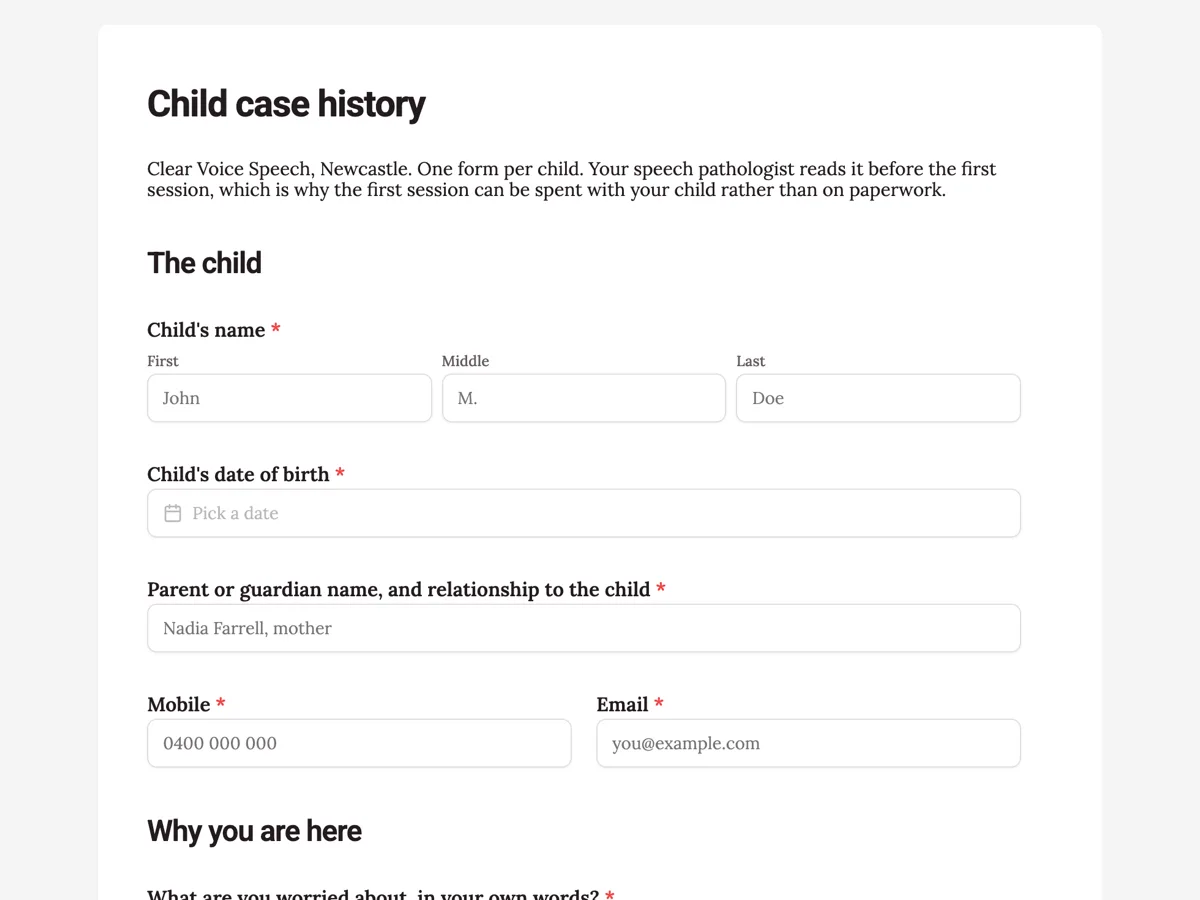
The form itself
A static copy of the finished form, exactly as it renders. Nothing here can be filled in or submitted, so read it as a reference and build your own from the button above.
Every field, and what it collects
The complete field list, in the order respondents meet it.
- Child's nameNameRequired
- Child's date of birthDateRequired
- Parent or guardian name, and relationship to the childShort textRequired
- MobileShort textRequired
- EmailShort textRequired
- What are you worried about, in your own words?Long textRequired
- Who suggested this appointment?Single choiceRequired
- Options: Nobody, this was our own decision · Child and family health nurse · GP or paediatrician · Preschool or school teacher · Another therapist already seeing the child · NDIS early childhood partner
- Weeks of pregnancy at birthShort textRequired
- Birth weightShort textRequired
- Time in special care or a neonatal unit, if anyShort text
- Feeding in the first yearShort text
- Milestones and the age they happenedTable
- Columns: Milestone · Age it happened · Anything you noticed at the time
- Has your child had a hearing test?Single choiceRequired
- Options: Yes, in the last twelve months, result was normal · Yes, in the last twelve months, something was found · Yes, but more than a year ago · Only the newborn screen at the hospital · The newborn screen was not passed · Never tested · Not sure
- Date of the most recent hearing test, if you know itDate
- Which languages are spoken at home?Multiple choiceRequired
- Options: English · Mandarin · Arabic · Vietnamese · Cantonese · Punjabi · Greek · Italian · Auslan · An Aboriginal or Torres Strait Islander language · Another language, named at the first visit
- Which language is your child strongest in?Single choiceRequired
- Options: English · Another language spoken at home · About equal in two languages · Too early to tell
- Preschool or school, and the class or roomShort textRequired
- Teacher or educator, and anything they have raisedShort text
- Is there an NDIS plan?Single choiceRequired
- Options: Yes, plan managed · Yes, self managed · Yes, agency managed · Access request submitted, waiting on a decision · No, paying privately · No, using a Medicare chronic disease referral
- Who else is already involved?Multiple choiceRequired
- Options: Paediatrician · Occupational therapist · Physiotherapist · Psychologist · Audiologist · Early childhood educator with a support plan · Another speech pathologist, now or previously · Nobody else yet
- Parent or guardian signatureSignatureRequired
The child
Why you are here
Birth and early history
Milestones
Hearing
Language at home
School and supports
Consent
What each block of this form collects
The child and the guardian are separated at the top, with the relationship asked in words rather than a dropdown, because the person filling it in is as often a grandparent or a foster carer as a parent. The concern question comes before any structured field so the parent writes what they actually notice, which is usually more specific than any checklist. Birth history is four short fields instead of a paragraph, since gestation, weight, special care and early feeding are each a separate risk marker and a parent answers them faster as four boxes. Milestones are a table rather than six questions, and the paragraph above names the six so nothing is guessed. Hearing, home language, school and funding follow, each of which decides something about how therapy is delivered rather than what is wrong.
The Australian pieces on this form
Funding is asked as an NDIS plan question with three management types, because plan managed, self managed and agency managed change who the practice invoices and how quickly it is paid. An access request submitted and waiting on a decision is its own option, since a family in that position often starts privately and switches later. The last option names a Medicare chronic disease referral, which is the other common route for a child seeing an allied health professional here. The hearing question separates the newborn screen every Australian baby is offered in hospital from a later diagnostic test, and it offers an option for a screen that was not passed, which is the single answer most likely to change the first session. Speech pathologists here work to the professional association standards, and NDIS registered providers to the commission practice standards.
How to adapt this form
A practice that works with adults after stroke replaces the entire birth and milestone section with a date of the event, the hospital, the side affected and a swallowing screen, and swaps the guardian signature for the client's own with a space for a substitute decision maker. A stuttering clinic adds an onset date, a family history question and a recording of ninety seconds of connected speech. A classic file upload takes only images and PDF, so that version is built as a conversational form with a recording field, or asks the parent for a link to the audio.
What makes this form work
Six milestones, named in the paragraph above the table
First words, two words together, short sentences, sitting, walking and being understood outside the family. The table has three columns and six rows, and the paragraph tells the parent exactly which six to write, so nobody has to invent a list.
The hearing question can stop therapy starting
Seven options, one of which is that the newborn screen was not passed. Untreated hearing loss explains a speech delay better than anything a speech pathologist can test for, and the form asks about it before the first session rather than after four of them.
Home language and strongest language are two questions
A child can hear four languages and be strongest in one, or be genuinely balanced across two, or be too young to tell. Assessment is done in the strongest language, so asking only which languages are spoken would leave the practice measuring the wrong one.
Questions people ask
Why does a speech pathology form ask about birth weight and prematurity?
Because both change the likelihood and the shape of a delay. A child born at thirty four weeks is developmentally younger than the birth date suggests for the first couple of years, and time in special care often comes with early feeding difficulty. Four short fields collect it in under a minute and save a set of questions in the room.
What if a parent cannot remember the milestone ages?
Approximate ages are useful and the welcome screen says so. What matters clinically is the order and the rough spacing, not whether first words were at thirteen months or fourteen. A blank row is better than a guess that is years out, and the third column lets a parent write what they noticed instead of an age.
Why does the hearing question have seven options?
Because the answers behave differently. A normal test last year, a test that found something, an old test, the newborn screen only, a screen that was not passed, never tested and not sure lead to five different next steps. A yes or no would collapse the one answer that stops therapy starting, which is a screen that was not passed.
Does speaking two languages at home cause a speech delay?
No, and the form asks about home languages for a different reason. A bilingual child is assessed against their strongest language, not against English, so the practice needs to know which that is before it measures anything. The strongest language question includes too early to tell, because for many toddlers that is the accurate answer.
What do the three NDIS management types change?
Who pays the invoice. Plan managed means a third party pays the practice on the participant's behalf, self managed means the family pays and claims back, and agency managed means the practice claims through the portal. None of them changes the therapy, which is why the question sits with school and supports rather than with the clinical history.
Who is allowed to sign this form?
Somebody with parental responsibility for the child, which the consent paragraph states in those words above the signature field. That covers a parent, a legal guardian or a carer with a court order. Where two guardians must both agree, the practice sends a second copy of the form rather than relying on one signature to speak for both.
Build your own in about a minute
The button below opens the generator with this use case already described. Change the wording to match your own, generate, then edit anything you like.
Make one like thisOther form examples
Child psychology intake form with two guardian signatures
A child psychologist needs three histories before the first session: the development, the school and the household, and the consent of everyone with parental responsibility. This twenty two field intake form collects all four, and ends with two signature boxes rather than one.
Physiotherapy intake form built around one injury
A physiotherapist has about forty minutes and needs a third of it to examine, so the history has to arrive before the patient does. This eighteen field intake form maps the region and side, the onset, the pain score and what aggravates it, then records which funding pathway is paying.
Occupational therapy intake form built on a daily living grid
An occupational therapist is asked to change how a day works, so the intake has to describe the day rather than the diagnosis. This eighteen field intake form takes an eight task support grid, the equipment already in the house, and the funding with its plan dates, before the first home visit is booked.
Want the steps in the builder? Read Every form field and when to use it, then Design your welcome and thank you screens. For everything this generator can do, see the form maker.
Written and checked by the OneCraft team. Last checked .