Classic form
Occupational therapy intake form built on a daily living grid
An occupational therapist is asked to change how a day works, so the intake has to describe the day rather than the diagnosis. This eighteen field intake form takes an eight task support grid, the equipment already in the house, and the funding with its plan dates, before the first home visit is booked.
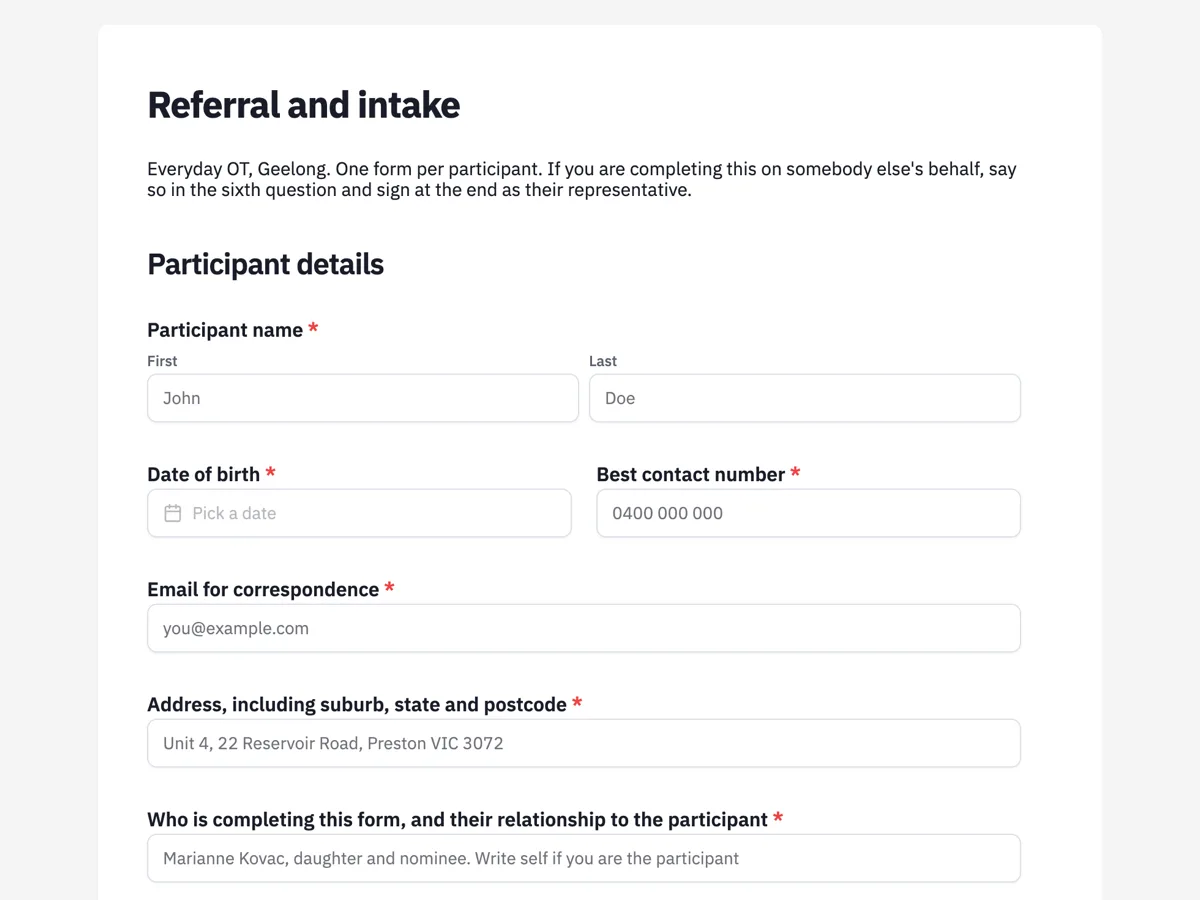
The form itself
A static copy of the finished form, exactly as it renders. Nothing here can be filled in or submitted, so read it as a reference and build your own from the button above.
Every field, and what it collects
The complete field list, in the order respondents meet it.
- Participant nameNameRequired
- Date of birthDateRequired
- Best contact numberShort textRequired
- Email for correspondenceShort textRequired
- Address, including suburb, state and postcodeShort textRequired
- Who is completing this form, and their relationship to the participantShort textRequired
- How is occupational therapy being funded?Single choiceRequired
- Options: NDIS, plan managed · NDIS, self managed · NDIS, agency managed · Home Care Package · Medicare chronic disease referral from a GP · Department of Veterans Affairs · Private, paying myself · Insurer or workers compensation
- Plan or funding start dateDateRequired
- Plan or funding end dateDateRequired
- Plan manager or support coordinator, name and contactShort text
- Diagnoses or conditions relevant to this referralLong textRequired
- Goals, in the participant's own wordsLong textRequired
- How much help does each task take?Rating gridRequired
- Statements:
- Showering and drying
- Dressing, including shoes and fastenings
- Preparing a hot meal
- Moving around inside the home
- Getting in and out of the house
- Getting to the shops or an appointment
- Managing money, mail and appointments
- Work, study or volunteering
- Equipment already in useMultiple choiceRequired
- Options: Walking stick · Four wheel walker · Manual wheelchair · Powered wheelchair or scooter · Shower stool or bench · Grab rails · Toilet frame or raised seat · Hospital bed or pressure mattress · Hoist or transfer board · Communication device or app · Nothing yet
- What is the home like?Multiple choiceRequired
- Options: Steps at the front or back entrance · Stairs inside the home · Narrow doorways or hallways · A step into the shower, or a bath only · Rented, so changes need the owner's permission · Shared with family who provide support · Lives alone · None of these apply
- Where should the first appointment happen?Single choiceRequired
- Options: At home, which is usually the most useful · At the clinic in Geelong · At school or an early learning centre · At the workplace · By video call to start with
- Who else is already involved?Multiple choiceRequired
- Options: GP · Specialist or rehabilitation consultant · Physiotherapist · Speech pathologist · Psychologist or counsellor · Support workers · Another occupational therapist, now or recently · Nobody else yet
- Signature of the participant or their representativeSignatureRequired
Participant details
Funding
Why you are asking for OT
A normal day
Appointments and the team
Consent
What each block of this form collects
Five identity fields and then a sixth that most intake forms leave out: who is filling this in, and what they are to the participant. It is answered self about half the time and the other half it is a daughter, a nominee or a support coordinator, which changes who the therapist rings back. Funding comes next, and the plan start and end dates sit on one row because the gap between them is the whole runway for the work. The clinical block is two open questions, diagnoses and goals, with goals asked in the participant own words and shown as four example sentences rather than a category list. The grid, the equipment list and the home questions are the assessment prompt.
The Australian pieces on this form
The funding radio names eight real pathways and three of them are NDIS management types, because plan managed, self managed and agency managed decide who the practice invoices and how long it waits to be paid. A Home Care Package sits beside them for older participants, a Medicare chronic disease referral for the ones reaching an occupational therapist through a GP, and Veterans Affairs for the entitlements that run separately again. The plan end date is asked as a required field because funding here does not roll over: an assessment booked three weeks before a plan ends is a different job from one booked in the first month, and the thank you screen tells the participant to say so on the phone. Occupational therapists in Australia are registered with the national board, and NDIS registered providers work to the commission practice standards.
How to adapt this form
A paediatric service replaces the daily living grid with a school day version, covering dressing, lunch box, handwriting, sitting in a group and playground, and adds the teacher as a named contact with a consent tick for talking to them. A hand therapy clinic drops the home access block entirely and adds a dominance question, a splint history and a return to work date, since the assessment is about one limb rather than one house. An aged care assessment service keeps the grid and adds a falls question, how many in twelve months and whether any needed an ambulance, because that single number decides how urgent the home visit is.
What makes this form work
Eight tasks, five levels of support
Showering through to work or study, each rated independent, with equipment, with prompting, hands on help or not able. That grid is the assessment prompt and the funding evidence at once, and it takes a participant two minutes rather than the twenty a conversation would.
Goals are shown as sentences, not categories
Shower without help. Get back to the shops on my own. Cook dinner twice a week. The placeholder prints four real goals in a participant voice, which is what the field is asking for, and it produces answers a therapist can actually work towards.
Equipment already in the house is a tick list
Ten items from a walking stick to a hoist, plus a nothing yet option. Knowing what is already there stops the first visit recommending a shower stool that has sat in the bathroom for a year, and it tells the therapist what the house has been through.
Questions people ask
Why does an occupational therapy form ask about tasks rather than symptoms?
Because the goal of the work is a task, not a symptom. Whether someone can shower, dress, cook and leave the house is what the therapy changes and what a funding body reads, and a diagnosis on its own predicts none of it. Two people with the same condition can sit at opposite ends of the same grid row.
What does with equipment mean on the support grid?
That the task is managed alone once a rail, a stool, a board or a stick is in place. It is a distinct answer from hands on help, because the person is independent, and from prompting, where the body can do it but the sequence does not start on its own. Separating those three is what the grid is for.
Why ask for the plan start and end dates?
Because they set the runway. Funding here is granted for a period and does not carry over, so an assessment three weeks before an end date is a different piece of work from one at the start of a new plan. Both dates are required fields and the follow up call confirms them before anything is booked.
Who signs when the participant cannot?
A representative, and the signature field says so in its label. The sixth question records who they are and what their relationship is, so the file shows on its face whether a nominee, a guardian or a family member signed. Where a formal appointment exists, the practice asks for that paperwork at the first visit.
Does the participant see a report written for the funding body?
Yes, and the consent paragraph commits to it in those words: reports are shown to the participant before they are sent. That matters because a funding report describes somebody at their least capable, which is the version that gets funded and is not the version anyone wants to read about themselves unannounced.
Why is the first appointment usually at home?
Because the house is the thing being assessed. Step heights, doorway widths, where the bathroom is and how far the letterbox sits from the door cannot be measured in a clinic. The form offers clinic, school, workplace and video as alternatives, and marks the home option as the one that is usually most useful.
Build your own in about a minute
The button below opens the generator with this use case already described. Change the wording to match your own, generate, then edit anything you like.
Make one like thisOther form examples
Physiotherapy intake form built around one injury
A physiotherapist has about forty minutes and needs a third of it to examine, so the history has to arrive before the patient does. This eighteen field intake form maps the region and side, the onset, the pain score and what aggravates it, then records which funding pathway is paying.
Home care intake form that asks about the house too
A home care visit fails on practical things long before it fails on clinical ones: the step with no rail, the dog behind the gate, the key nobody mentioned. This twenty field intake form collects the package level and the services alongside the access notes that decide whether the first visit works.
Optometry intake form that asks about the family too
Half of what an optometrist looks for at a first examination is decided by two things the patient already knows: how their eyes are used, and what runs in their family. This fourteen field intake form collects both, along with the screen hours, the driving pattern and the general health that change what the examination tests.
Want the steps in the builder? Read Every form field and when to use it, then Control who can fill in your form. For everything this generator can do, see the form maker.
Written and checked by the OneCraft team. Last checked .