Classic form
Home care intake form that asks about the house too
A home care visit fails on practical things long before it fails on clinical ones: the step with no rail, the dog behind the gate, the key nobody mentioned. This twenty field intake form collects the package level and the services alongside the access notes that decide whether the first visit works.
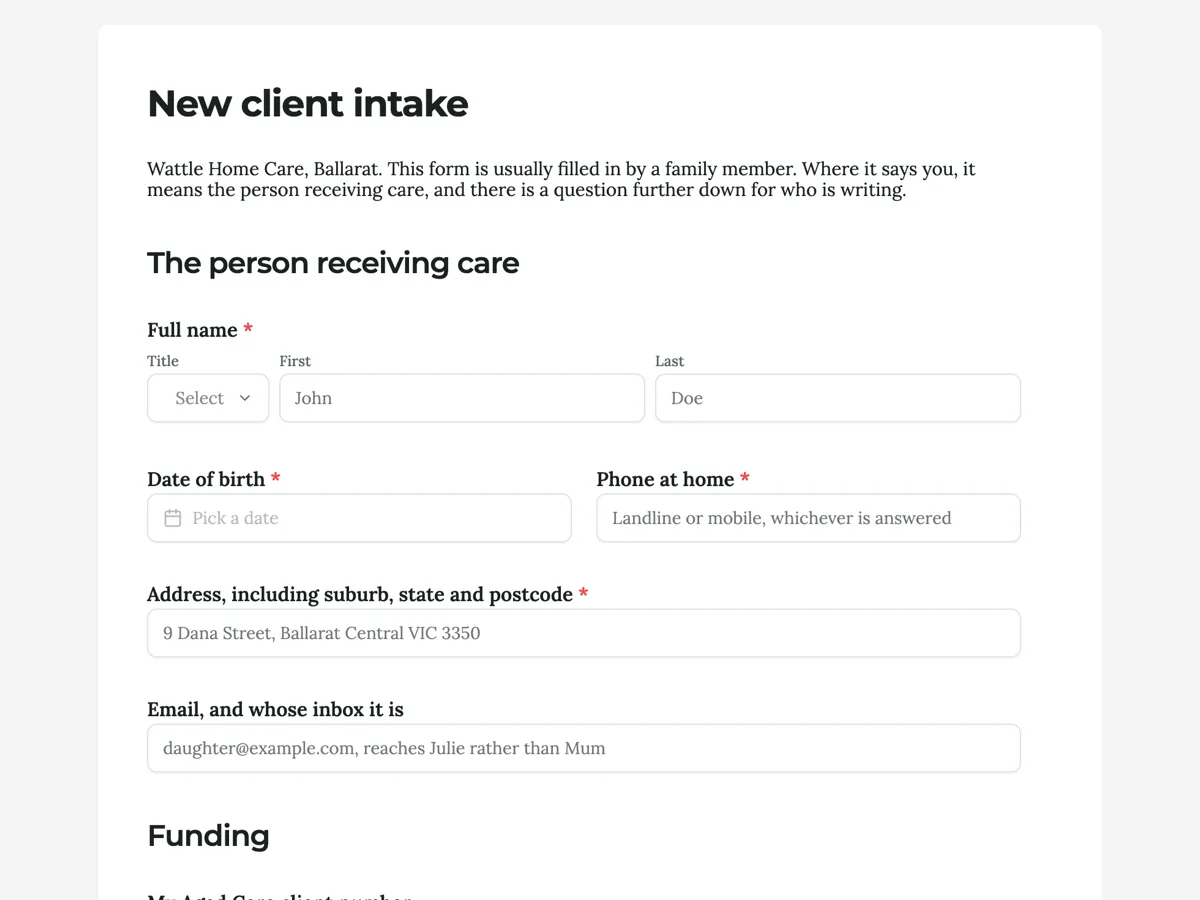
The form itself
A static copy of the finished form, exactly as it renders. Nothing here can be filled in or submitted, so read it as a reference and build your own from the button above.
Every field, and what it collects
The complete field list, in the order respondents meet it.
- Full nameNameRequired
- Date of birthDateRequired
- Phone at homeShort textRequired
- Address, including suburb, state and postcodeShort textRequired
- Email, and whose inbox it isShort text
- My Aged Care client numberShort text
- What funding is approved?Single choiceRequired
- Options: Home Care Package, level 1 · Home Care Package, level 2 · Home Care Package, level 3 · Home Care Package, level 4 · Approved for a package, waiting for one to be assigned · Commonwealth Home Support Programme services · Assessment booked, nothing approved yet · Privately paying, no assessment
- Who is completing this form, and their relationshipShort textRequired
- Next of kin, name and phoneShort textRequired
- GP, name and practiceShort textRequired
- Which services are you asking for?Multiple choiceRequired
- Options: Domestic help and cleaning · Personal care, showering and dressing · Meal preparation · Shopping, with or without the client · Transport to appointments · Social support and companionship · Nursing care · Allied health, such as physiotherapy · Garden and lawn maintenance · Home maintenance and small repairs · Respite so a carer can have a break · Not sure, please advise
- What mobility aids are in use?Multiple choiceRequired
- Options: Walking stick · Four wheel walker · Wheelchair, self propelled · Wheelchair, pushed by someone else · Mobility scooter · Shower chair or bench · Grab rails already installed · Bed rails or an adjustable bed · Hoist or transfer board · None of these
- How much help is needed with personal care?Single choiceRequired
- Options: None, this is about the house and the garden · Prompting and supervision only · Help with some steps, such as washing hair or feet · Help throughout, one worker · Two workers are needed for transfers
- Health conditions, medications and allergiesLong textRequired
- Home access notesLong textRequired
- How does a worker get in?Single choiceRequired
- Options: The client answers the door · A key safe, code given to the office · A key held by a neighbour or family member · The door is left unlocked at agreed times · A carer is always home · This needs to be worked out at the home visit
- What should a worker know before arriving?Multiple choiceRequired
- Options: There is a dog · There are other animals · Somebody smokes inside · Hearing loss, so knock loudly and wait · Memory loss or confusion, especially later in the day · Oxygen is in use · Stairs inside the home · A language other than English is spoken at home · None of these
- What matters to the person receiving care?Long textRequired
- ConsentMultiple choiceRequired
- Options: I consent to a care manager contacting the GP and My Aged Care about this referral · I understand a home care agreement will be provided to read before services start
- Signature of the client or their representativeSignatureRequired
The person receiving care
Funding
Who to contact
What is needed
Getting into the house
Consent
What each block of this form collects
The identity block belongs to the person receiving care, and the intro says so in its first line, because roughly two thirds of these forms are filled in by an adult child. The email field asks whose inbox it is for the same reason. Funding is a client number and a level. The contacts block is three fields: who is writing, the next of kin who gets the first call, and the GP. What is needed is the care assessment in four questions. The access block is the part most intake forms skip and the part that decides whether a first visit works: written notes about the house, how a worker gets in, and eight things a worker should know before they knock. The last field asks what matters to the person.
The Australian pieces on this form
Home care here runs through a single front door, so the form asks for the My Aged Care client number and the assessment outcome rather than for a diagnosis. The funding radio names the four Home Care Package levels separately because the level sets the annual budget and therefore how many hours of what can be scheduled, and it also names the two positions people are most often actually in: approved and waiting for a package to be assigned, and receiving Commonwealth Home Support Programme services instead. The consent paragraph names the Aged Care Quality Standards and says a complaint can go straight to the Aged Care Quality and Safety Commission without affecting the care received.
How to adapt this form
A disability support provider swaps the funding block for a plan number, plan dates and management type, and replaces the aged care standards reference with the disability equivalent. A respite service drops most of the services list and adds the carer as the primary client: how many hours they need, what the person being cared for needs while they are gone, and when the last break was. A nursing only service keeps the access block unchanged, since it is the most portable part of this form, and replaces the services list with wound care, medication management, catheter and stoma care, each with a frequency, because those are scheduled per visit rather than per week.
What makes this form work
Eight things a worker should know before knocking
A dog, somebody smoking inside, hearing loss so knock loudly and wait, memory loss later in the day, oxygen in use. Each one changes who is rostered or how they arrive, and none of them appears in a clinical history.
The funding radio names waiting as a real answer
Approved for a package and waiting for one to be assigned sits beside the four levels, because that is where many families are when they first call. A radio that offers only levels one to four forces a wrong answer from the people who need the call most.
The last question is what matters to the person
How they like to be addressed, the routine that should not change, what they still do for themselves, the garden bed nobody touches. It is a required field, and it is the one a support worker reads before their first shift.
Questions people ask
Why does a home care form ask about the front door?
Because that is where a first visit fails. Two steps with no rail decide whether a worker can bring a walker through, a sticking side gate decides whether they get in at all, and street parking after nine changes the roster. The notes field prints four real examples so the answer arrives in that shape.
What does the package level actually change?
The annual budget, and therefore how many hours of which services can be scheduled. Levels one to four are listed separately rather than collapsed into a yes, and the list also names approved and waiting, which is the position many families are in when they call. The care manager confirms the level before a schedule is written.
Why ask whose inbox the email belongs to?
Because the person receiving care and the person organising it are often different, and sending a schedule to an address nobody reads is the most common early failure. One short placeholder, daughter@example.com reaches Julie rather than Mum, makes the answer useful without adding a field.
Is the key safe question really necessary at intake?
Yes, because entry has to be solved before the first shift, not during it. Six options cover it: the client answers, a key safe, a neighbour or family member holds a key, the door is unlocked at agreed times, a carer is always home, or it needs working out at the home visit. That last option is an honest answer.
Who signs when the client cannot?
A representative, and the signature label says so. The form separately records who completed it and their relationship, so the file shows on its face whether a daughter, a partner or an appointed decision maker signed. Where a formal appointment exists, the care manager asks for the paperwork at the home visit.
Does this form commit anybody to a service?
No. The paragraph above the signature says nothing is charged and no worker is sent from the form. A care manager visits first, agrees the services and the schedule, and provides a home care agreement and a budget to read before anything starts. The two ticks record that this was understood.
Build your own in about a minute
The button below opens the generator with this use case already described. Change the wording to match your own, generate, then edit anything you like.
Make one like thisOther form examples
Accountant new client form that never asks for a TFN
Half of what an accounting firm needs from a new client is structural, the entity, the ABN, the GST cycle and the software, and the one thing it must not collect in a web form is the tax file number. This sixteen field new client form gets the first list and refuses the second, asking instead how the number will be handed over.
Law firm client intake form with the conflict check on it
A firm cannot give a word of advice until it knows who else is involved, because acting against an existing client is the one mistake that ends a matter before it starts. This fifteen field intake form puts the conflict check on the form as a four row table of other parties, and says plainly that the enquiry engages nobody.
NDIS intake form that starts from the plan itself
An NDIS provider cannot start a support without five things off the plan: the participant number, the two dates, the management type and the goals. This nineteen field intake form asks for all five, plus the participant name as the plan shows it, and tells them to have the plan open while they answer.
Want the steps in the builder? Read Every form field and when to use it, then View, export and manage your responses. For everything this generator can do, see the form maker.
Written and checked by the OneCraft team. Last checked .