Classic form
NDIS intake form that starts from the plan itself
An NDIS provider cannot start a support without five things off the plan: the participant number, the two dates, the management type and the goals. This nineteen field intake form asks for all five, plus the participant name as the plan shows it, and tells them to have the plan open while they answer.
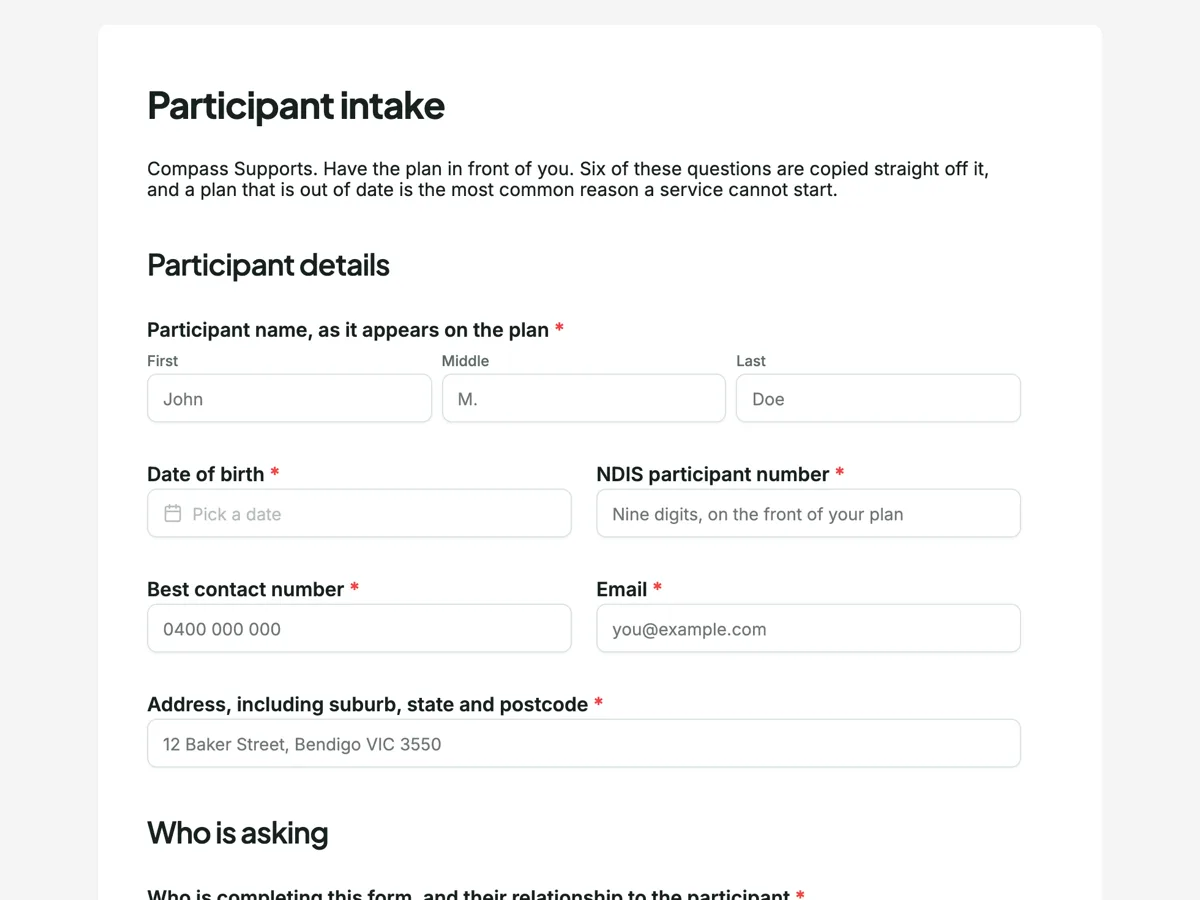
The form itself
A static copy of the finished form, exactly as it renders. Nothing here can be filled in or submitted, so read it as a reference and build your own from the button above.
Every field, and what it collects
The complete field list, in the order respondents meet it.
- Participant name, as it appears on the planNameRequired
- Date of birthDateRequired
- NDIS participant numberShort textRequired
- Best contact numberShort textRequired
- EmailShort textRequired
- Address, including suburb, state and postcodeShort textRequired
- Who is completing this form, and their relationship to the participantShort textRequired
- Nominee or representative contact, if there is oneShort text
- How is the plan managed?Single choiceRequired
- Options: Plan managed, by a registered plan manager · Self managed · Agency managed, through the portal · A combination of two of the above · Not sure, it is written on the plan somewhere
- Plan start dateDateRequired
- Plan end dateDateRequired
- Plan manager or support coordinator, name and contactShort text
- Which supports are you asking about?Multiple choiceRequired
- Options: Assistance with daily life at home · Assistance with social and community participation · Support coordination · Improved daily living, including therapy · Assistive technology · Home or vehicle modifications · Transport · Finding and keeping a job · Improved relationships, including behaviour support · Not sure, I would like it explained
- Goals, copied from your planLong textRequired
- How do you prefer to communicate?Multiple choiceRequired
- Options: Speaking, in English · Speaking, with an interpreter · Auslan · A communication device or app · Written notes or email rather than phone · Easy read documents · Through my nominee or family · Extra time, and one thing at a time
- Where should supports usually happen?Single choiceRequired
- Options: At home · In the community · At a centre or clinic · At work or study · A mix, depending on the support · By video or phone where possible
- What should a worker know before the first visit?Multiple choiceRequired
- Options: Manual handling or transfers are needed · A hoist or specific equipment is used · There are behaviours that can be distressing for others · A behaviour support plan is in place · Seizures are possible · Allergies, including to food or latex · Dogs or other animals in the home · Someone smokes in the home · Access is difficult, stairs or a narrow entry · None of these
- ConsentMultiple choiceRequired
- Options: I understand a service agreement will be sent for me to read before anything starts · I consent to Compass Supports contacting my plan manager or support coordinator about funding
- Signature of the participant or their nomineeSignatureRequired
Participant details
Who is asking
The plan
How supports should work
Service agreement and consent
What each block of this form collects
The participant block asks for the name as it appears on the plan, which sounds pedantic until an invoice is rejected because a preferred name was used. The nine digit participant number is checked against the plan on the follow up call, so a transposed digit is caught before the first claim rather than at it. Who is asking is a separate block because the person filling this in is often not the participant, and the nominee contact decides who the coordinator calls. The plan block is the four fields the provider genuinely cannot start without. The how supports should work block is the part that makes the first visit go well: communication preferences, location, and a checklist of what a worker needs to know before they walk in. The last block is consent, and it commits to sending a service agreement rather than assuming one.
The Australian pieces on this form
Everything structural here is NDIS specific. The three management types decide who the provider invoices: a registered plan manager pays on the participant's behalf, a self managing participant pays and claims back, and an agency managed participant is claimed for through the portal. The plan start and end dates are required because funding does not roll over, and a service starting six weeks before a plan ends is a different conversation from one starting in month two. The support categories are written in the plain words a plan uses rather than in line item codes, since a participant reads the former and a provider translates to the latter. The consent paragraph names the NDIS Code of Conduct and says plainly that a complaint can go straight to the Quality and Safeguards Commission without affecting the supports received.
How to adapt this form
A support coordination service drops the worker briefing checklist, since it does not send workers into homes, and adds the other providers already engaged with their contacts, which is the map coordination actually starts from. A therapy provider replaces the support category list with a therapy type and frequency block and adds a question about previous reports and assessments as an upload. A supported independent living provider keeps everything and adds a housing block: current living arrangement, who else lives there, the roster of care being sought and whether the participant has been through a home and living assessment, because those decide whether the enquiry can be answered at all.
What makes this form work
Six fields come straight off the plan
The participant name as it appears on the plan, the participant number, how the plan is managed, the start date, the end date and the goals. The intro says six questions are copied from the plan, and the welcome screen tells the participant to stop and come back if the plan is not in front of them, because guessed dates are the most common reason a service cannot start.
Support categories are written the way a plan reads
Assistance with daily life, social and community participation, improved daily living, assistive technology. Ten plain descriptions instead of line item codes, ending in not sure I would like it explained, which is the honest answer for a first plan.
The consent paragraph names the complaints route
Supports run under the NDIS Code of Conduct, and a complaint can go to the provider or straight to the Quality and Safeguards Commission without affecting the supports received. Saying that at intake rather than in a policy nobody reads is the point.
Questions people ask
Why does an NDIS intake form need the plan start and end dates?
Because funding is granted for a period and does not carry over. A support starting in the last six weeks of a plan is a different piece of work from one starting in month two, and a provider that does not check the end date can deliver supports that cannot be claimed. Both dates are required fields.
What do the three plan management types change?
Who pays the provider. A registered plan manager pays invoices on the participant's behalf, a self managing participant pays the provider and claims it back, and an agency managed participant is claimed for through the portal. None of them changes the supports themselves, which is why the question sits with the plan rather than with the clinical detail.
Why ask the participant to copy the goals word for word?
Because the wording in the plan is what the funding is tied to, and paraphrasing it loses the link. What the participant would say instead is often more useful to the coordinator, so the first conversation asks for that version out loud rather than making the form longer. The copied goals stay the reference the service agreement is written against.
Is the participant number checked by the form?
No. It is a short text field that accepts whatever is typed, so a transposed or missing digit reaches the response as entered. It is not checked against any register either, which no form can do. The coordinator confirms the number against the plan on the follow up call before any service agreement is drafted, which is where a typo is caught.
Why is there a checklist of what a worker should know?
Because a first visit goes wrong for practical reasons rather than clinical ones. Manual handling, a hoist, possible seizures, a behaviour support plan, a dog at the door, somebody smoking inside or a narrow entry each change who is rostered and what they bring. Ten ticks collect it faster than a phone call.
Does signing this form commit the participant to anything?
No, and the paragraph above the signature says nothing is booked from it. What the two ticks record is that the participant understands a service agreement will be sent to read first, and that the provider may contact their plan manager or support coordinator about funding. The agreement itself is signed later.
Build your own in about a minute
The button below opens the generator with this use case already described. Change the wording to match your own, generate, then edit anything you like.
Make one like thisOther form examples
Home care intake form that asks about the house too
A home care visit fails on practical things long before it fails on clinical ones: the step with no rail, the dog behind the gate, the key nobody mentioned. This twenty field intake form collects the package level and the services alongside the access notes that decide whether the first visit works.
Occupational therapy intake form built on a daily living grid
An occupational therapist is asked to change how a day works, so the intake has to describe the day rather than the diagnosis. This eighteen field intake form takes an eight task support grid, the equipment already in the house, and the funding with its plan dates, before the first home visit is booked.
Physiotherapy intake form built around one injury
A physiotherapist has about forty minutes and needs a third of it to examine, so the history has to arrive before the patient does. This eighteen field intake form maps the region and side, the onset, the pain score and what aggravates it, then records which funding pathway is paying.
Want the steps in the builder? Read Every form field and when to use it, then Control who can fill in your form. For everything this generator can do, see the form maker.
Written and checked by the OneCraft team. Last checked .