Classic form
Physiotherapy intake form built around one injury
A physiotherapist has about forty minutes and needs a third of it to examine, so the history has to arrive before the patient does. This eighteen field intake form maps the region and side, the onset, the pain score and what aggravates it, then records which funding pathway is paying.
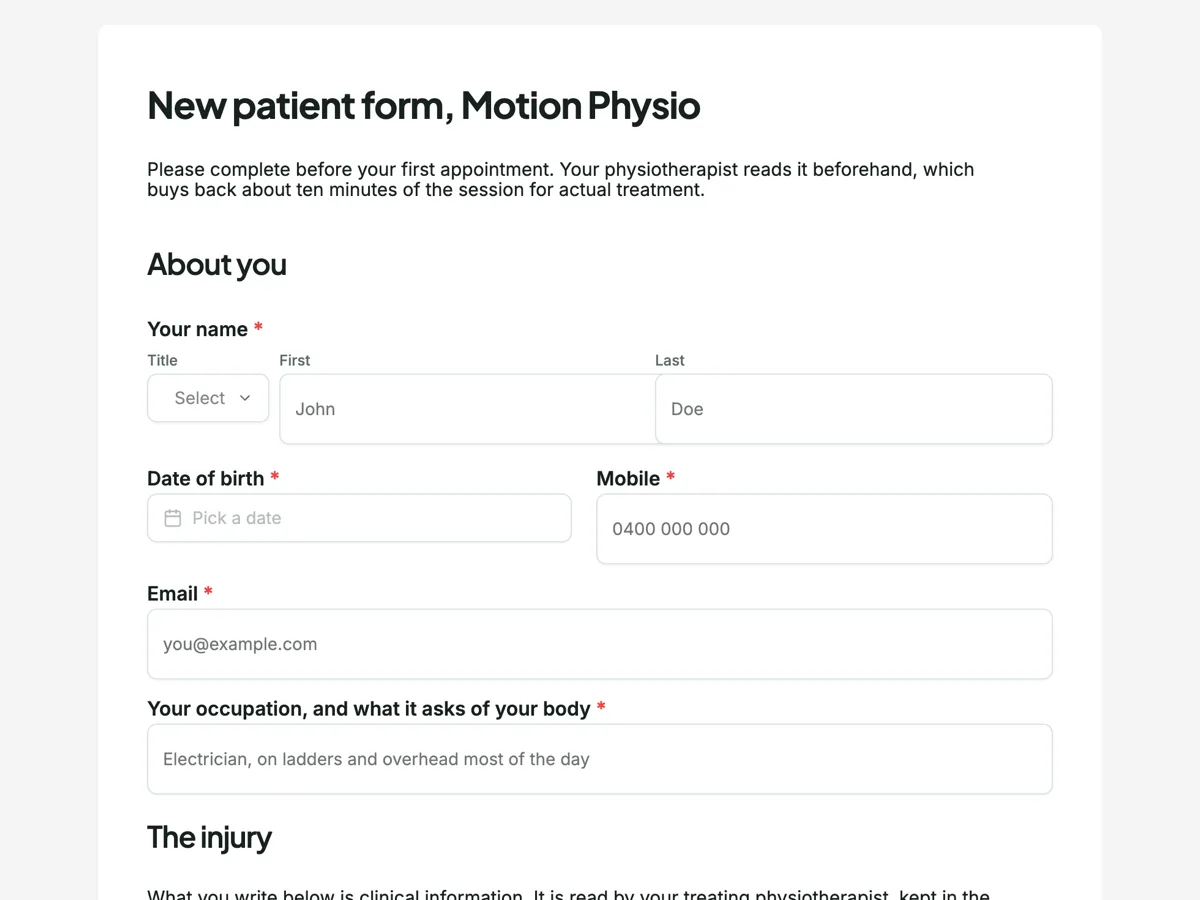
The form itself
A static copy of the finished form, exactly as it renders. Nothing here can be filled in or submitted, so read it as a reference and build your own from the button above.
Every field, and what it collects
The complete field list, in the order respondents meet it.
- Your nameNameRequired
- Date of birthDateRequired
- MobileShort textRequired
- EmailShort textRequired
- Your occupation, and what it asks of your bodyShort textRequired
- Where is the problem?Multiple choiceRequired
- Options: Neck · Upper back or between the shoulder blades · Lower back · Shoulder · Elbow, wrist or hand · Hip or groin · Knee · Ankle or foot · Head or jaw · More than one area, related
- Which side?Single choiceRequired
- Options: Left · Right · Both · Centre or not sided
- When did it start?DateRequired
- Pain right now, 0 is none and 10 is the worst you can imagineSingle choiceRequired
- Options: 0 · 1 · 2 · 3 · 4 · 5 · 6 · 7 · 8 · 9 · 10
- How did it start?Single choiceRequired
- Options: A single incident, I know the moment · Gradually, over weeks · Gradually, over months or years · After surgery · At work, and I have reported it · At work, and I have not reported it · In sport or training · I have no idea
- What makes it worse?Multiple choiceRequired
- Options: Sitting · Standing still · Walking · Bending forward · Lifting · Overhead work · Running or jumping · Lying down or sleeping · First thing in the morning · Nothing in particular
- What have you already tried?Long text
- What do you want to get back to?Short textRequired
- How is this appointment being funded?Single choiceRequired
- Options: Private, paying myself with a health fund rebate · Private, paying myself with no rebate · GP chronic disease management plan, referral in hand · WorkCover claim · Compulsory third party motor accident claim · Department of Veterans Affairs · Not sure, please explain at the desk
- Claim or referral number, if you have oneShort text
- Imaging reports and referral lettersFile upload
- Reports rather than the images themselves: an x ray, ultrasound, CT or MRI report, a GP referral or a surgeon letter. Photos of a printed page are fine. Images or PDF, up to 10 MB each.
- Do any of these apply to you?Multiple choiceRequired
- Options: Heart condition, high blood pressure or a pacemaker · Diabetes · Osteoporosis · Cancer, current or in the last five years · A bleeding disorder or blood thinning medication · Epilepsy · Pregnant, or in the twelve weeks after birth · A joint replacement or spinal surgery · Unexplained weight loss, night pain or fever in the last month · None of these
- SignatureSignatureRequired
About you
The injury
Referral and funding
Health and consent
What each block of this form collects
The first block is four fields plus an occupation question that asks what the job asks of the body, because a diesel mechanic and a bookkeeper with the same shoulder present differently and recover on different timelines. The injury block opens with the privacy paragraph and then maps the problem in the order a physiotherapist takes a history: region, side, date of onset, current pain out of ten, mechanism, and what aggravates it. The two free text questions are deliberately last in that block, one asking what has already been tried and one asking what the patient wants to get back to, which is the field that sets the goal for the whole episode of care. The funding block decides billing and reporting before the patient reaches the desk.
The Australian pieces on this form
Funding is the part that is unmistakably Australian. The radio names the real pathways side by side: private with a health fund rebate, private with none, a GP chronic disease management plan with the referral in hand, a WorkCover claim, a compulsory third party motor accident claim, and the Department of Veterans Affairs. Each one changes what the practice can bill, what it must report and how many sessions are available, so it is asked once and asked early. No Medicare or health fund numbers are collected in the form at all: the consent paragraph says the card is swiped at the desk, which keeps identifiers out of a web submission while still telling the patient to bring it. Physiotherapists are registered with the national board, and a patient can look up any practitioner registration.
How to adapt this form
A hand therapy clinic narrows the region list to six hand and wrist zones and adds a dominance question plus a splinting history, because those change the plan more than the mechanism does. A sports practice replaces what do you want to get back to with a season and competition date pair and adds a training load question, since return to play is scheduled rather than open ended. A practice doing a lot of workers compensation work adds an employer and case manager block after the funding radio and a separate consent tick for reporting to the insurer, which is the one disclosure the general privacy paragraph should not be asked to carry.
What makes this form work
The pain scale sits beside the onset date
Eleven options across three columns take one tap and one line, paired with the date it started on the same row. Together they give the physiotherapist a duration and a baseline in the two fields that every later progress note is measured against.
Funding names seven real pathways
Private with and without a rebate, a chronic disease management plan, WorkCover, a motor accident claim, Veterans Affairs and not sure. Billing, session limits and reporting obligations all branch from this single answer, so it is asked once, in words the patient recognises from their own paperwork.
The health screen ends with a red flag line
Nine conditions, then unexplained weight loss, night pain or fever in the last month, then none of these. That second last option is the one that makes a physiotherapist pick up the phone to a GP, and it is asked of every patient rather than only the ones who look unwell.
Questions people ask
Why does a physiotherapy form ask for the side as a separate question?
Because left and right get lost in free text and the mistake is expensive. A separate radio with left, right, both and centre or not sided means the answer is structured, searchable in the records and impossible to skim past. Centre matters too, since a mid back or a jaw problem does not have a side at all.
Is a zero to ten pain scale useful on an intake form?
It is useful as a baseline rather than as a diagnosis. The number at intake is what every later score is compared against, which is how a patient and a physiotherapist agree that something is working. On a classic form the eleven options fit on one line in three columns, so it costs the patient a single tap.
Why ask whether a work injury has been reported?
Because it changes what happens next. A reported injury has a claim, a case manager and a set of forms; an unreported one needs a conversation about whether to report it before treatment starts, since claiming later without a report is much harder.
What imaging should a patient send?
The report rather than the images. A radiologist report on an x ray, ultrasound, CT or MRI is what a physiotherapist reads, and it is a page of text that photographs well on a phone. The upload takes images or PDF, up to four files, which comfortably covers a referral letter and two reports.
Does the practice collect a Medicare number?
Not on this form. The consent paragraph says the health fund card is swiped at the desk, and any Medicare details for a chronic disease management plan are taken from the referral at reception. Identifiers like these are safer collected in person than in a web form, and leaving them out shortens the intake at the same time.
Why is dry needling named in the consent paragraph?
Because consent has to cover what will actually happen. Hands on techniques, exercise and dry needling are the three things a physiotherapist is most likely to do at a first appointment, and naming the third one lets a patient who does not want needles say so before they are on the table.
Build your own in about a minute
The button below opens the generator with this use case already described. Change the wording to match your own, generate, then edit anything you like.
Make my physiotherapy intake form built around one injuryOther form examples
Psychology intake form with the limits of confidentiality on it
A first psychology session has fifty minutes and a person who has usually waited weeks for it, so the history should not eat the first twenty. This twenty field intake form takes the referral pathway, a ten item distress baseline and the supports already in place, and states the limits of confidentiality above the signature.
Chiropractic intake form with a spine history grid
A chiropractor examining a lower back needs to know what the neck, the mid back and the jaw have been doing for the last three months, and asking that one region at a time takes the whole appointment. This seventeen field form puts eight regions in a single grid and screens for the conditions that change the plan.
Massage intake form that asks about pressure before the table
A client lying face down with their eyes closed will almost never ask for lighter pressure or say that they would rather their feet were left alone. This fourteen field intake form asks both in advance, alongside a contraindication screen that adapts the technique rather than cancelling the booking.
Want the steps in the builder? Read Every form field and when to use it, then Control who can fill in your form. For everything this generator can do, see the form maker.
Written and checked by the OneCraft team. Last checked .