Conversational form
Pilates intake form that asks the postnatal question properly
A reformer is set up per person, so a pilates studio needs the injuries and the pregnancy stage before the class rather than in the doorway of it. This eleven screen intake form asks those one at a time, with a womens health clearance question that leads to a referral rather than a refusal.
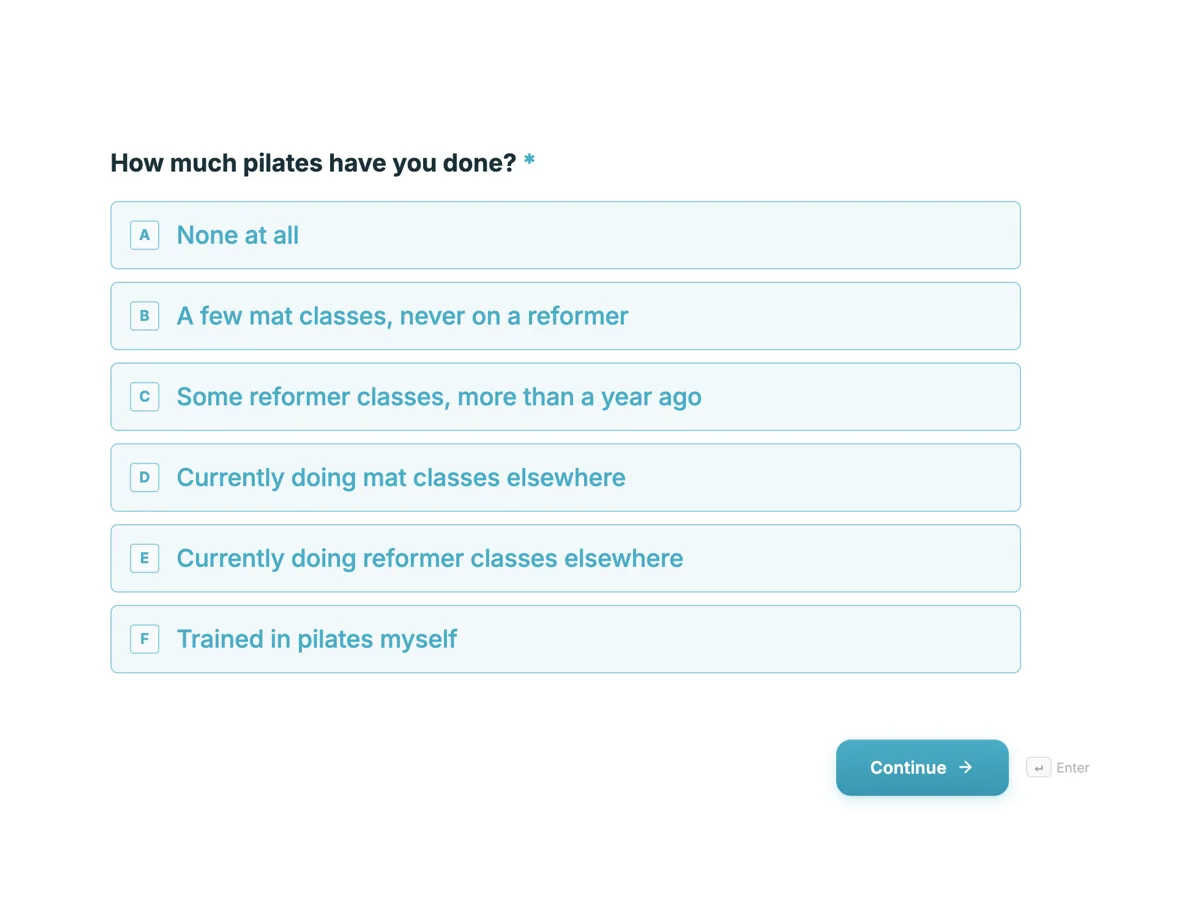
The form itself
The first screen of the form. A conversational form shows one question per screen, so the remaining screens are listed in the field table below. Nothing here can be filled in or submitted, so read it as a reference and build your own from the button above.
Every field, and what it collects
The complete field list, in the order respondents meet it.
- How much pilates have you done?Single choiceRequired
- Options: None at all · A few mat classes, never on a reformer · Some reformer classes, more than a year ago · Currently doing mat classes elsewhere · Currently doing reformer classes elsewhere · Trained in pilates myself
- Which classes are you interested in?Multiple choiceRequired
- Tick anything that appeals. The timetable is built around what people actually ask for, and beginners are welcome in every class marked all levels.
- Options: Reformer, all levels · Reformer, beginners only · Reformer, advanced and jumpboard · Mat class · Clinical pilates, one to one · Pregnancy class · Postnatal class with babies welcome · Over sixties and bone health class
- How often would you like to come?Single choiceRequired
- Options: Once a week · Twice a week · Three or more times a week · Casually, whenever a class suits
- Injuries, surgeries and anything that still gives you troubleLong textRequired
- This is health information and is read only by the instructors teaching you. Old injuries matter even when they no longer hurt, because they change which springs and which range a movement is started at. Write none if there is nothing.
- Do any of these apply to you?Multiple choiceRequired
- Each of these changes what an instructor will and will not cue. None of them stops you from taking a class.
- Options: Osteoporosis or osteopenia · A disc injury or ongoing back pain · Hypermobility, or joints that dislocate · High blood pressure · A recent surgery, in the last six months · A shoulder that comes out or catches · Vertigo or dizziness when lying back · None of these
- Are you pregnant, or in the first year after birth?Single choiceRequired
- Pregnancy and the postnatal period both change the programming, and the answer decides which classes are suitable before you book one.
- Options: No, neither · Pregnant, first trimester · Pregnant, second trimester · Pregnant, third trimester · Under six weeks after birth · Six weeks to six months after birth · Six to twelve months after birth
- Have you been checked by a womens health physiotherapist?Single choiceRequired
- Only relevant if you answered pregnant or postnatal above. A clearance check covers the pelvic floor and abdominal separation, and it decides which loaded movements are appropriate. Answer does not apply if it does not.
- Options: Does not apply to me · Yes, and I was cleared for exercise · Yes, and there were things to avoid · Booked, but not seen yet · No, and I would like a referral · No, and I am not planning to
- Will you be claiming on a health fund?Single choiceRequired
- Group reformer classes are fitness rather than treatment, so they are not claimable. One to one clinical sessions delivered by a physiotherapist can be, if your level of cover includes it. The desk explains which of your options is which.
- Options: No, paying myself · Yes, on extras cover for clinical sessions · Not sure, please explain at the desk · Using an NDIS plan · Coming on a workplace wellbeing program
- How did you hear about the studio?Single choiceRequired
- Options: A friend or family member · Walked or drove past · Searched online · Instagram · A physiotherapist or GP suggested it · A workplace program
- What would make this worth it for you?Long text
- One sentence is plenty. It is read before your first class and it is what the instructor checks in on at six weeks.
- How does the studio reach you?ProfileRequired
What each screen of this form collects
Experience opens the form because it decides which class a new client is steered into, and it separates mat from reformer rather than asking for a level, since somebody with two years of mat classes is still new to a reformer. The class tick list doubles as a timetable signal. The injuries screen carries the privacy note and asks for the side and roughly when, which is what an instructor needs to set a spring rather than to diagnose anything. The conditions checklist is seven items that change cueing rather than eligibility, and its description says so. Pregnancy and the clearance question sit together. Health fund claiming is asked early enough to prevent a misunderstanding at the desk, and the last three screens are soft: how they heard, what would make it worth it, and the contact block.
The Australian pieces on this form
The health fund question is where this form is unmistakably Australian, and it is written to prevent the most common argument a studio has at its front desk. Group reformer classes are exercise rather than treatment, so extras cover does not pay for them, while a one to one clinical session delivered by a physiotherapist may be claimable depending on the level of cover. The description states that distinction in two sentences before the client picks an option, and not sure please explain at the desk is a real answer rather than a fallback. An NDIS plan and a workplace wellbeing program are listed separately because both are paid a different way. The clearance question names a womens health physiotherapist, which is the Australian title for the practitioner who does that check.
How to adapt this form
A clinical pilates practice run by physiotherapists swaps the class tick list for a referral block, the referring practitioner, the diagnosis and the number of sessions recommended, and moves the health fund question to the top since almost every client is claiming. A yoga studio keeps the structure and replaces the conditions checklist with wrists, neck and inversions, which are the three things that change a cue there. A gym adding reformer classes to a membership drops the contact block, because the member record already exists, and adds a question about which other classes they attend so the load across the week can be balanced.
What makes this form work
The clearance question ends in a referral
No, and I would like a referral is an option on the womens health physiotherapist screen. That turns the one answer a studio might otherwise treat as a problem into a next step, which is the difference between screening people out and looking after them.
Seven conditions, described as cueing changes
Osteoporosis, a disc injury, hypermobility, high blood pressure, recent surgery, an unstable shoulder and vertigo when lying back. The description says outright that none of them stops a client taking a class, which is why the honest answers arrive.
The claiming question explains itself before it asks
Two sentences separate group classes from one to one clinical sessions, so the client picks an option knowing what each means. It is the single most common misunderstanding at an Australian studio desk and it is settled before the first booking.
Questions people ask
Why does a pilates studio need an intake form at all?
Because a reformer is adjusted per person and per body. Spring tension, footbar height, strap length and the range a movement starts from all depend on what the instructor knows, and finding out mid class means either guessing or stopping. Five minutes beforehand buys a set up that is ready when the client walks in.
What does the womens health clearance question do?
It routes rather than refuses. Cleared, cleared with things to avoid, booked but not seen, and no and I would like a referral are four different next steps, and the last one turns a gap into a referral instead of a knock back. Does not apply sits first so everybody else passes it in one tap.
Why separate the postnatal period into three stages?
Because the first six weeks, six weeks to six months and six to twelve months are three different programs. Loading, abdominal work and impact all change across that year, and a single postnatal answer would tell the instructor almost nothing. The three pregnancy trimesters are separated for the same reason.
Can group reformer classes be claimed on private health insurance?
Not as a rule, because a group exercise class is fitness rather than treatment. One to one clinical sessions delivered by a physiotherapist can be claimable where the level of cover includes it. The form explains that before the client answers, which is far better than explaining it after they have paid.
Does ticking osteoporosis or hypermobility stop somebody joining a class?
No, and the description above the checklist says that in one line. What changes is the cueing: forward flexion and rotation are handled differently with osteoporosis, and end range positions are avoided with hypermobility. The instructor needs to know which of those applies before the client is on the machine, not after.
Why is the contact block the last screen?
Because a form that opens by asking for a name and a phone number reads as a sales capture, while one that opens by asking how much pilates you have done reads as a studio getting ready for you. Ten screens in, nobody abandons at the name field.
Build your own in about a minute
The button below opens the generator with this use case already described. Change the wording to match your own, generate, then edit anything you like.
Make one like thisOther form examples
Physiotherapy intake form built around one injury
A physiotherapist has about forty minutes and needs a third of it to examine, so the history has to arrive before the patient does. This eighteen field intake form maps the region and side, the onset, the pain score and what aggravates it, then records which funding pathway is paying.
Midwifery intake form for a private booking visit
A booking visit with a private midwife is ninety minutes and should mostly be about what the woman wants, not about reconstructing her history out loud. This twenty field intake form takes the due date, the previous pregnancies, the blood group and the birth preferences beforehand, and asks who will be in the room.
Massage intake form that asks about pressure before the table
A client lying face down with their eyes closed will almost never ask for lighter pressure or say that they would rather their feet were left alone. This fourteen field intake form asks both in advance, alongside a contraindication screen that adapts the technique rather than cancelling the booking.
Want the steps in the builder? Read Create a conversational form with AI, then Design your welcome and thank you screens. For everything this generator can do, see the form maker.
Written and checked by the OneCraft team. Last checked .